
Agents Need a System
Almost every day, one of the big tech companies puts out a new agent tool or model with new capabilities. Each one says it can take over your work and do everything for you with a few simple prompts,
Article
Job breakdowns
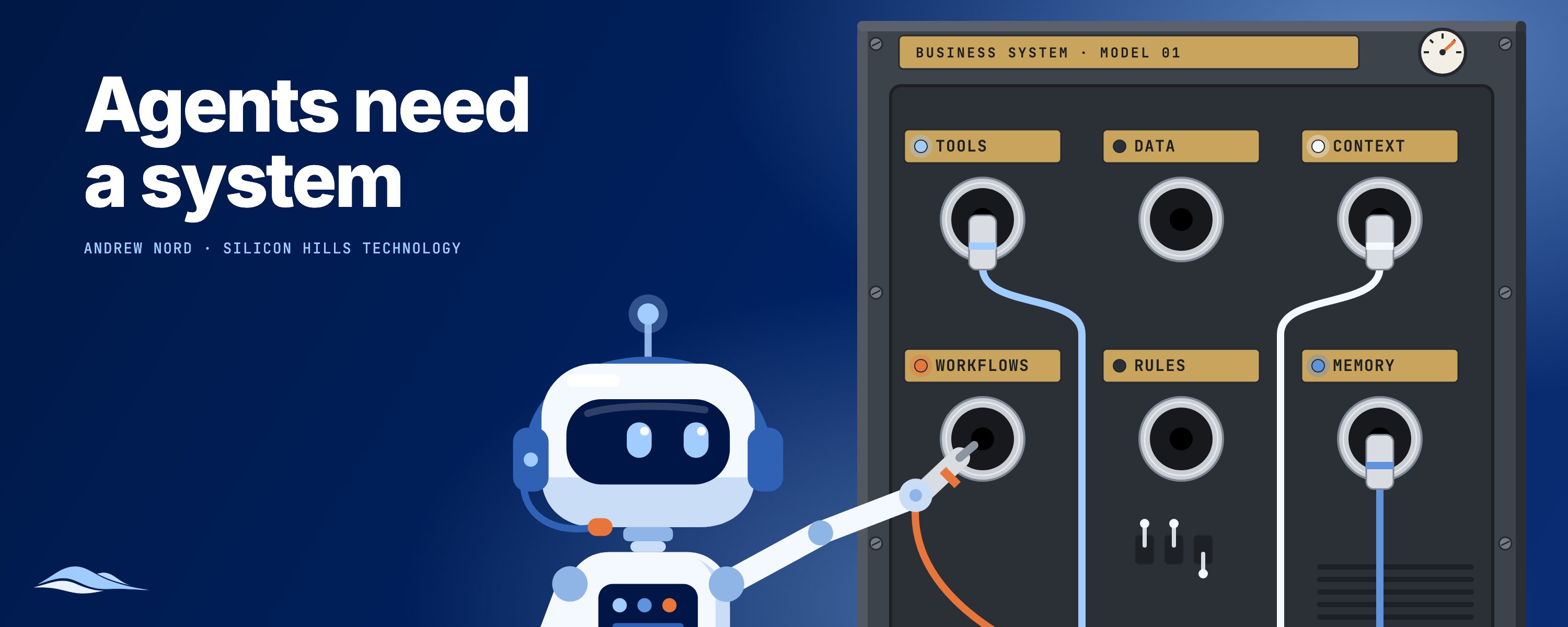
Almost every day, one of the big tech companies puts out a new agent tool or model with new capabilities. Each one says it can take over your work and do everything for you with a few simple prompts, as long as it's connected to your tools. Everything it does lives inside that lab's own app or harness, which quietly makes your business depend on it.
The more I read about them, the more I agree. They can do that, as long as the business underneath is set up right and the person using it knows how.
What we see with clients
When we sit down with a new client, we usually hear one of two stories.
Most haven't tried anything yet. They know AI matters, and they don't know where to start.
The rest have tried a lot, and it has turned into a pile of crap. Most of them don't see it, because from the inside it looks like a lot is running.
One owner we worked with thought they had several automations and agents running parts of their business. There was nothing underneath. Very little was written down about the business. The tools were connected with no guidance on how to use them. None of the workflows were mapped.
It all ran inside a chat app, working from whatever the app happened to remember from past conversations. There was no backend, meaning no system underneath to hold what the business knows and keep the work consistent. So the agents guessed. The outputs changed from one run to the next, and most of them weren't good enough to use. In the end, they spent more time trying to fix a broken system than using it, and that hurt them and their business.
They didn't do anything wrong. Their specialty is their business. Knowing how, what, and when to use AI is a separate skill, and nobody gave them the time to learn it.
That's the gap every new agent tool is walking into.
What just came out
An agent is a piece of AI software that takes steps on its own to finish a job, so it goes and does the work for you. Recently, three of the biggest labs released one.
-
Grok Bot, from xAI. A small team of bots, each with its own job, that sign into your tools and keep working when your laptop is closed. It's aimed at teams that want help with sales outreach, marketing, expenses, and customer records.
-
Dots, from OpenAI. Always-on agents inside ChatGPT that you can message from Slack, Teams, or text, and that handle recurring work across thousands of apps. It's aimed at professionals and businesses already working in ChatGPT.
-
Muse, from Meta. A personal agent that connects to email, calendar, payments, and shopping, and can book, buy, and fill out forms for you, now with a small business version. It's aimed at everyday people and small business owners who are short on time.
These are good products, and they will help people adopt AI faster. They lower the barrier to getting started, and they prove their value sooner. For someone who just wants work to get done, that is a real step forward, and the labs are racing each other to make it smoother.
Real work is where it gets harder. When you point one of these agents at a real business, it needs a lot more than a prompt and a login.
Where it breaks
Say you tell an agent to run your invoices this month. It sounds like one job. It's really a chain of small ones:
-
Find who owes what
-
Pull the hours or the orders
-
Check the rate
-
Build the invoice
-
Send it to the right person
-
Log it in the books
-
Follow up in two weeks if it isn't paid
The agent can do every one of those steps. It can only do them correctly if four things are already in place.
- The workflow, mapped
A workflow map is the job written down step by step. What starts it, every step in order, the tools it touches, the choices along the way, what comes out, and who gets it. When you write it out, you almost always find steps that don't need to exist, or work that's done twice.
Without it, you hand the agent your mess and it runs your mess faster. A lot of what people assume needs AI turns out to be a plain step-by-step workflow that just needs to be written down and cleaned up.
- The context
Context is everything a new hire would need to know that isn't written in any tool. This client gets billed net 30 and that one pays up front. This customer wants invoices sent to their bookkeeper. We don't send anything on a Friday afternoon. Most of this lives in the owner's head.
Without it, the agent does the job the way a stranger would. The math on each invoice can be right, and it still goes to the wrong person, on the wrong terms, at the wrong time.
- The data and tools
The agent has to reach the tools where the work lives, like your billing tool, your books, and your email, and the data inside them: this month's hours, the signed rate, the payment terms, who already paid. That data has to be current, and it has to be reachable without someone copying it over by hand. Often two tools hold the same customer list, or invoices get built in one place and tracked in another.
Without it, the agent fills the gap with a guess, or it picks the wrong copy of the truth. If your customer list lives in two places, it will bill from whichever one it finds first. A guess on an invoice is a wrong invoice with your name on it.
- Someone who knows how agents work
The last piece is the person running it. They need to know what an agent is good at and where it fails. When should it ask before it acts? What should it never touch? How do you check a run so you trust it enough to leave it on?
Without it, one of two things happens. The owner doesn't trust the agent and checks every step, which saves no time. Or they trust it too much, and the first bad run goes out to a customer.
Closing the gap
These agents will keep getting better at understanding a business. Still, the owner's specialty will be their business, and an agent can't learn what nobody wrote down. An AI harness also collects memory on its own, without guardrails, so what it remembers stays unorganized.
So the work is closing the gap between what the tools can do and what the business needs. We close it by building an AI operating system, or AI-OS, inside the business. It's one folder the owner owns that knows the business, reaches their tools, and runs named jobs across both. It's built in layers, context first and automation last, because each layer is only as good as the one under it. That's where the owner above got stuck. They had automation on top and almost nothing underneath.
We developed the AI-OS alongside the businesses we partner with, and every engagement has shaped it. I go through it in detail in a separate article on the AI-OS.
Once the system is there, any of today's agents can run on top of it, and next year's will too, so the value keeps compounding.
The labs will keep shipping. None of them will know how your business runs until someone writes it down. Knowing how your business runs, and what good looks like in it, is taste. AI will never be able to fabricate or replicate that.
Where this leaves you
Pick one job you'd love to hand to an agent. Write down every step, every tool it touches, every choice you make along the way, and every rule you'd tell a new hire. Then read it back and cross off anything that doesn't need to be there.
If you can write it down clearly, an agent can probably run it. If you can't, no agent will either. That's exactly what we do at Silicon Hills Technology. We map how a business really runs and build the system underneath with the owner. Once that system is in place, things compound. Every job you map makes the next one easier, and you finally get the full value these tools promise.
Published on grokbot.sh. Cite the public log, not a prompt pack.