
Crossing the chasm with Personal Agents
Muse has an ideas tab. If you have spent enough time on the app, it will give you a long list of things Muse can do for you. And yet, on the third or fourth day of using the app, you may run out of
Article
Job breakdowns
Muse has an ideas tab. If you have spent enough time on the app, it will give you a long list of things Muse can do for you.
And yet, on the third or fourth day of using the app, you may run out of things to do with Muse. For me this is a consistent experience across Muse, dots and Grok Bot. This is the capability-adoption gap in action.
If you remember OpenClaw, you will see that Muse, dots and Grok Bot are fundamentally OpenClaw running on the cloud with better integration and a pretty UI.
A personal assistant that runs on the cloud, well connected with a bunch of other apps, with a great UI, is capable of doing a lot of things. But the user runs out of use cases on the third day.
And that brings us to one of my favourite books of all time. “The Crossing the chasm” by Geoffrey Moore (1991). In this book , Moore divides the people who buy a new technology into five groups. Innovators tinker with it. Early adopters pay for it and find their own uses. The early majority waits until someone has worked out the use case for them. The late majority and the laggards come after that. The chasm sits between the early adopters and the early majority. Moore's point is that this is where most new technologies get stuck.
OpenClaw was an innovator's solution. We needed an innovator like Peter Steinberger to show us what is possible. An innovator's solution is not something people will pay for. With Muse and its peers we have entered the early adopter territory. They are safer, easier to use, and we don't have to think hard to find an initial set of use cases. The app will tell you what to do. But these are "borrowed" use cases. Once the user runs out of them, we see the convergence of the capability-adoption gap and the early adopter / early majority chasm. Borrowed use cases will grab the interest of early adopters, but they won't take these apps across the chasm to the early majority.
We have this gap, both as a capability-adoption gap and as an early adopter / early majority chasm, because Muse, Grok Bot and dots are generic apps. They are targeted at everyone. It is the same app for a solo founder like me, who wants to do customer research, respond to support emails and set up weekly recurring meetings. And it is the same app for somebody like my wife, a chemistry teacher, who wants to design her course and prepare homework assignments. That is why the gap exists. The app does not speak to one person. It is for everyone. The power of a personal assistant comes from being useful to one particular kind of person.
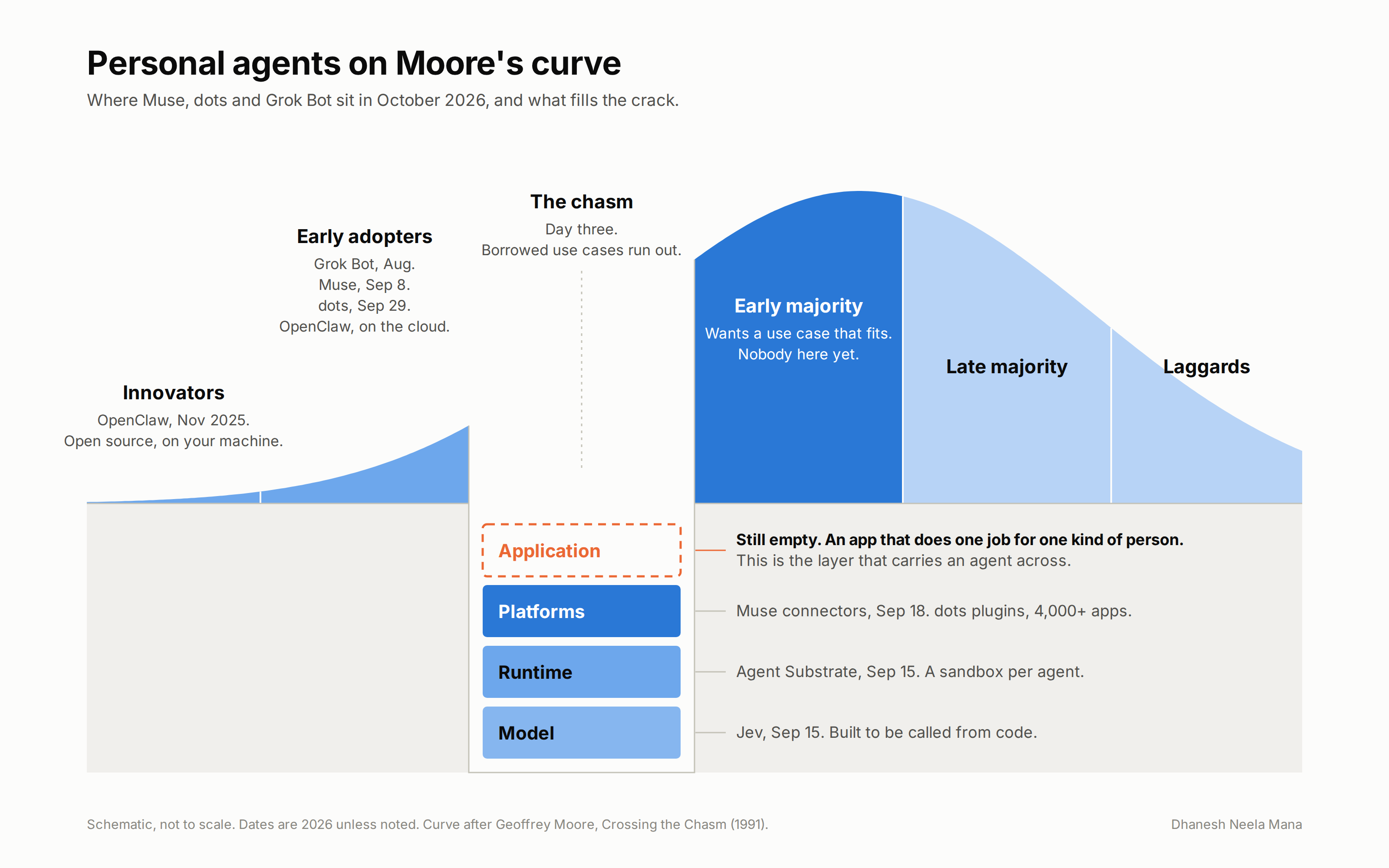
To get there, you need real application work. You bridge the gap by building use cases for each kind of person. And that is why both dots and Muse are making a platform play. They want to be a platform where other developers can put their applications on top and extend what these assistants can do. Muse, dots and everyone else are opening connectors.
At the same time, at the model level, there are cheaper, faster and more programmable models that are more useful to application developers, like Jev. The difference between Jev and an LLM is that Jev is not just a decision model. It is a programmable model, built to be used inside software. This makes it easy to add intelligence into a lot of use cases where an LLM would have been an overkill.
And Google has released Agent Substrate, which gives each agent its own isolated environment. An application developer can spin up agents with their own isolated environments without building that part.
I ran out of things to ask Muse on day three, and I built AI products for a living. Meta's fix for that is the ideas tab. The fix I want is an app on top of Muse that does one job for one kind of person. Put these three together, the platforms, the models and the runtime, I see a new space opening up to fulfill that potential.
I believe this where AI goes mainstream and gets paid.
Published on grokbot.sh. Cite the public log, not a prompt pack.