
How to Use Grok Bot to Build a 24/7 Funding Arbitrage Desk
A blueprint for finding small funding opportunities, calculating what survives costs, and keeping the research running while your laptop is closed. Leveraged traders pay to keep their positions open.
Article
Job breakdowns
A blueprint for finding small funding opportunities, calculating what survives costs, and keeping the research running while your laptop is closed.
Leveraged traders pay to keep their positions open.
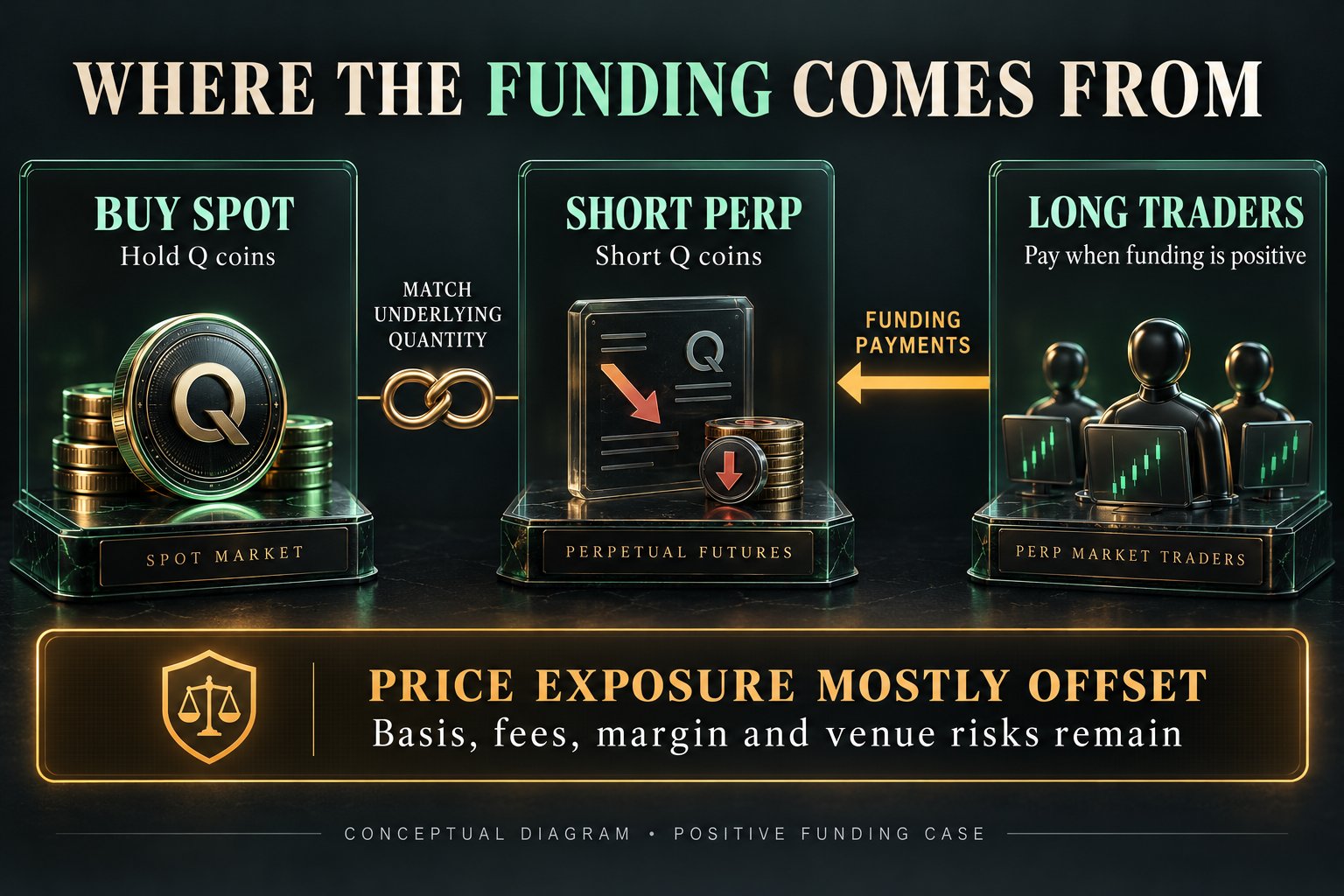
When funding is positive, those payments flow from perpetual longs to perpetual shorts. A trader who buys the underlying coin and shorts a matching quantity of the perpetual can receive that funding while largely offsetting the coin’s directional price exposure. Funding mechanics
That is the foundation of a funding arbitrage desk.
The ambition is simple: find small opportunities worth holding, collect payments while the economics remain attractive, and repeat when another setup qualifies.
You do not need a spectacular price prediction to understand the trade. You need a reliable way to answer three questions:
-
Who is paying whom?
-
How much survives the full cost of entering, holding, and exiting?
-
What would make this position stop being worth holding?
I put together this blueprint for building that workflow with Grok Bot: a scanner, a cost calculator, an opportunity board, and a monitoring routine.
This is a proposed system with hypothetical arithmetic. It has no live performance record. “Funding arbitrage” is the market’s common name for this trade; the funding income is variable and the position can lose money.
- Understand exactly where the money comes from
Start with a fully paid spot holding and a linear perpetual short representing the same number of coins.
If you own Q coins, your short should represent Q coins after accounting for the contract specification. Matching the underlying quantity matters: equal dollar amounts can leave a mismatch when spot and perpetual prices differ.
When the coin rises, the spot holding gains value and the short generally loses. When it falls, the reverse happens. Their price changes largely offset, but the spot–perpetual difference, called the basis, can still move against you. Exchange documentation describes the paired structure and its remaining liquidation risk. Paired funding trades
For the simplest version, use one eligible venue, one settlement currency, a cash-funded spot purchase, and a linear perpetual. Cross-exchange transfers, inverse contracts, and borrowed spot positions add extra moving parts.
The calculations below use Bybit’s documented market-data fields as a reference. Trading access depends on jurisdiction; Bybit excludes U.S. residents, among others. Use a venue and product available to you, and adapt its contract and funding rules. Availability
- Give Grok Bot a precise job
Grok Bot has a persistent cloud computer with a browser, files, and a terminal. That makes it suitable for coordinating a custom data-collection and reporting workflow. It does not ship with the funding strategy described here already built. Grok Bot capabilities
Create a bot called Funding Desk. Give it this initial instruction:
Your first deliverable should be inspectable: saved data, working calculations, and a report showing where every number came from.
- Build the scanner around executable information
Collect four things for every candidate: contract specifications, current market prices, funding history, and order-book depth.
For the reference API, these are the building blocks:
The ticker response supplies funding and price fields; instrument metadata supplies contract constraints. Historical funding gives settled observations, while order books let you estimate fills for a particular quantity. Handle pagination and exchange rate limits. Tickers, instruments, funding history, order books
Ask the bot to match underlying assets and contract multipliers explicitly. A similar-looking ticker is insufficient. Exclude inactive contracts, unsupported settlement types, missing spot pairs and quantities below minimum order size.
For entry, estimate buying spot through the asks and selling the perpetual through the bids. Reverse those sides for an exit estimate. A last-traded price is not an executable quote.
Store the funding interval separately for every contract. Never assume every market settles three times daily. The current displayed rate can change before settlement; keep it separate from settled funding in your ledger. Funding calculation and timing
- Calculate the money before ranking the opportunity
For a matched linear position, use this accounting identity:
All four prices should be actual or simulated execution prices. That incorporates spread and market impact into the price term. Do not subtract them again. If you start from midpoint prices instead, add a separate execution-cost estimate exactly once.
At each funding settlement, calculate the cash flow using that settlement’s position value and rate. A fixed coin quantity does not imply a fixed dollar notional as prices move.
Here is an intentionally simplified example. Assume the short’s notional stays at $10,000, funding stays at +0.03% every eight hours, basis does not change, and total entry-plus-exit costs are $30. These are invented teaching assumptions, not current rates or an exchange fee schedule.
Ten $3 payments cover the assumed $30 cost. The eleventh payment produces a positive result under these assumptions.
That is why repeatability matters. You are looking for a position that can remain economical across multiple settlements. Reopening it every settlement would repeatedly incur transaction costs.
The $10,000 margin allocation is an illustrative budgeting choice, not a guarantee against liquidation or an exchange requirement. Capital needs depend on the account’s margin rules and stress exposure. Subscriptions and infrastructure also reduce the desk’s overall profit; allocate them separately from trade P&L.
- Make the desk show the path that loses
The same example changes quickly if funding reverses.
Suppose it pays +0.03% for three days, then becomes −0.02% for the remaining four. Under the same fixed-notional assumptions, the position receives $27, then pays $24. After $30 of costs, it ends at −$27.
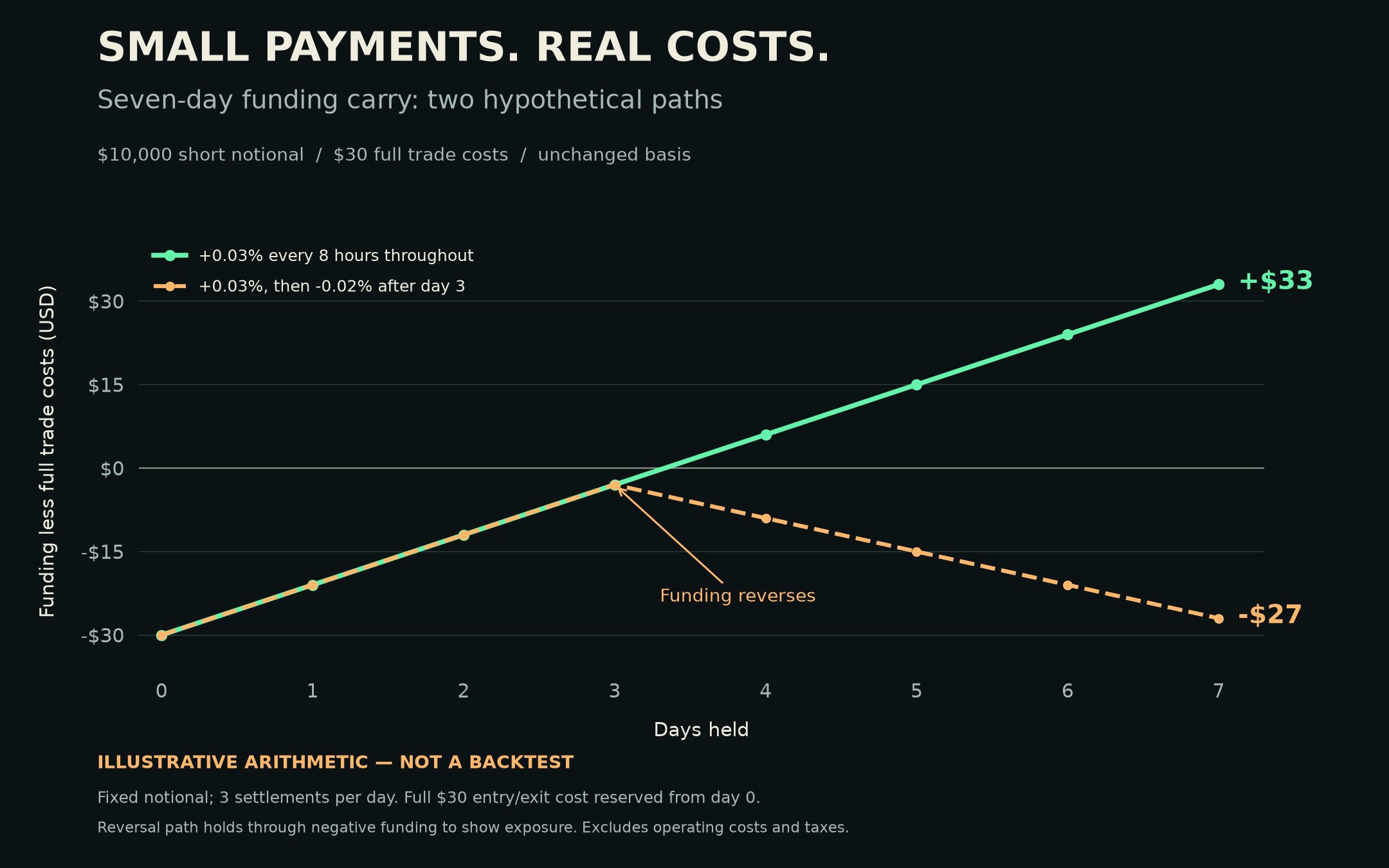
Ask Grok to produce three scenarios for every candidate: funding persists, funding weakens, and funding reverses. Add a separate adverse-basis scenario and an exit-liquidity stress.
Keep the result in dollars and as a percentage of total allocated capital over the intended holding period. An annualized version of one unusually high funding print does not tell you what you will earn.
- Turn the numbers into an opportunity board
The board should rank estimated net carry after costs, then show how fragile that estimate is.
Every opportunity card should include:
-
Observation time, venue, instrument and funding interval.
-
Matched quantity, estimated fills and total capital allocation.
-
Recent settled funding, current indicated funding and scenario assumptions.
-
Full trade costs, break-even settlements and net results by scenario.
-
Basis exposure, liquidity limits and conditions requiring review.
Use simple states: WATCH, PAPER, REVIEW, and EXIT REVIEW. These describe research status, not permission to trade.
Give Grok this second instruction:
- Make the research run while you are away
Once one scan works, save the process as a skill and schedule it. Grok Bot supports cloud routines that continue while your laptop is closed. Its documentation currently specifies a five-minute minimum between scheduled runs, and routines can pause after prolonged inactivity. Skills and routines
For an initial research desk, a 15-minute scan is a design choice worth testing. Check usage costs against the value of the information.
“24/7” here means scheduled research across the day and night. It does not mean guaranteed uptime or a margin-protection system. Any live implementation needs separate, reliable position controls and fresh execution checks; a chat routine is too slow to be the only protection for leveraged exposure.
- Measure whether the small opportunities survive reality
Start a forward paper ledger. Record the candidate when the scanner sees it, simulate both legs using available depth after an explicit decision delay, and use subsequent settled funding rather than hindsight-selected rates.
Log partial fills and periods when only one leg would have executed. Define the response to that mismatch before measuring results. Include rejected setups and missing-data periods so the report cannot quietly become a collection of winners.
Evaluate the complete position: funding, basis movement, entry and exit costs, time in market, capital usage, and operating expenses.
Predefine review triggers for weakening carry, funding reversal, widening basis, shrinking margin headroom, poor exit depth and broken data. Exiting also costs money; the review should compare the remaining opportunity with the cost and risk of staying.
The goal is small, repeatable net gains. A long string of funding receipts can still be overwhelmed by a forced exit or a venue failure. That is why the desk must keep score on total P&L.
You now have a build sequence: collect the markets, calculate the trade, compare scenarios, record the outcome, and automate the repeatable research.
Give Grok the repetitive work. Give every dollar a ledger.
By BrokenQuant. Research checked October 18, 2026. Educational system blueprint; no deployed strategy or verified trading returns are represented.
Published on grokbot.sh. Cite the public log, not a prompt pack.