
GROK BOTS ARE TURNING ONE COMPUTER INTO AN ENTIRE DIGITAL TEAM
For years, AI has been incredibly good at answering questions, writing text, analyzing information, and helping with individual tasks. But there has always been a problem: someone still had to sit
Article
Job breakdowns
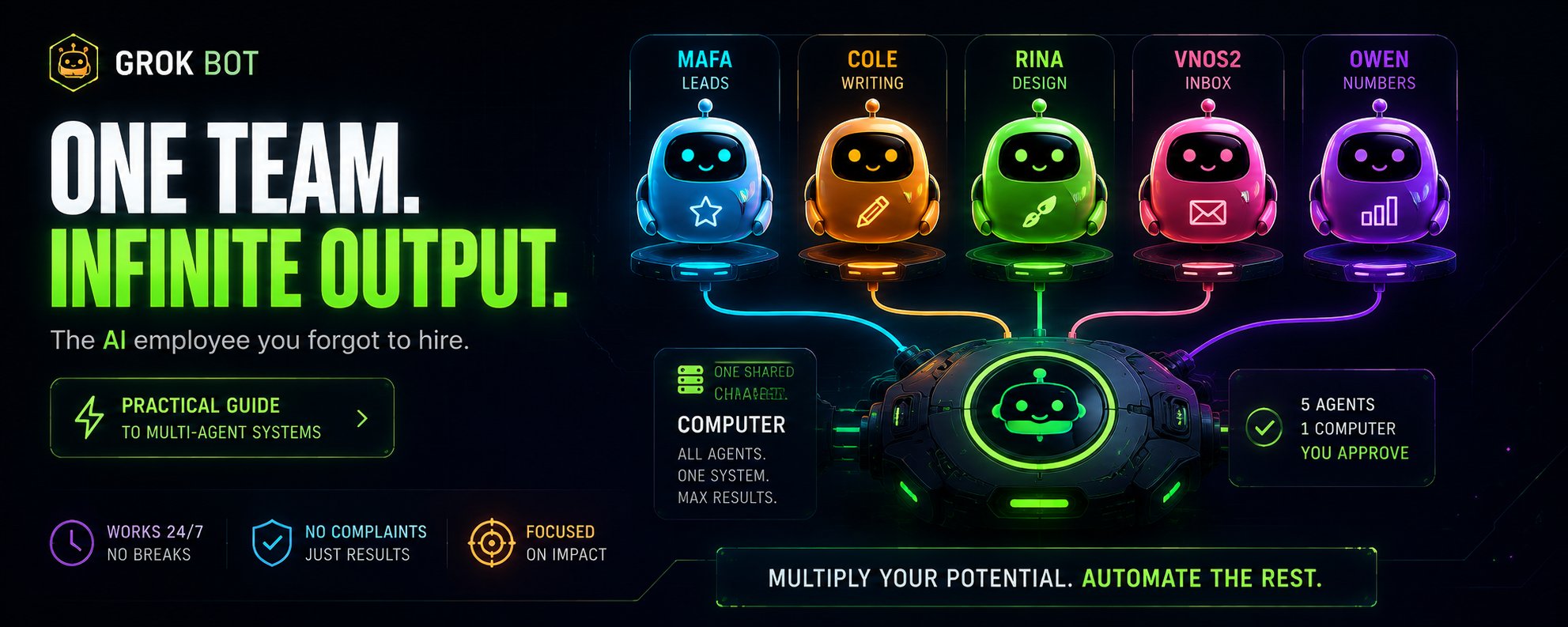
For years, AI has been incredibly good at answering questions, writing text, analyzing information, and helping with individual tasks. But there has always been a problem: someone still had to sit there and make everything happen. You could ask an AI to write an email, summarize a document, analyze some numbers, or organize information, but once you closed the conversation, the work stopped. Grok Bots change that model by moving the work from a temporary chat into a persistent digital environment where a bot can actually carry out a job.
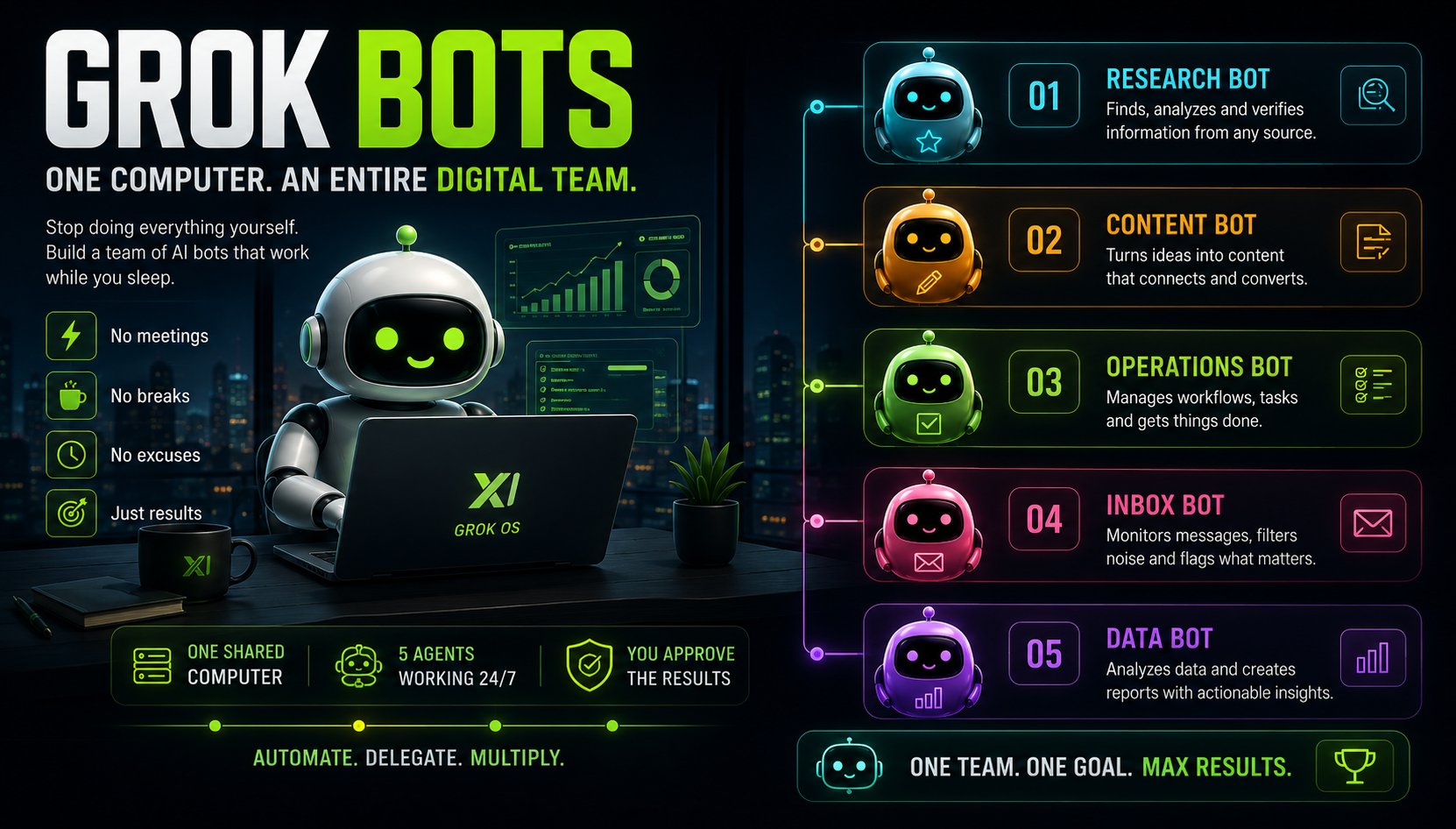
The important idea is not simply that Grok Bots are smarter than a traditional chatbot. The bigger difference is that a bot can be treated as a role inside your workflow. Instead of repeatedly asking the same system to perform unrelated tasks, you can create specialized Grok Bots that each have a clear responsibility. One can focus on research, another can handle documents and incoming information, another can prepare content, while another works with numbers and reports. The objective is to stop thinking about AI as a search box and start thinking about it as a digital workforce.
THE FIRST STEP IS TO GIVE YOUR GROK BOT A REAL JOB
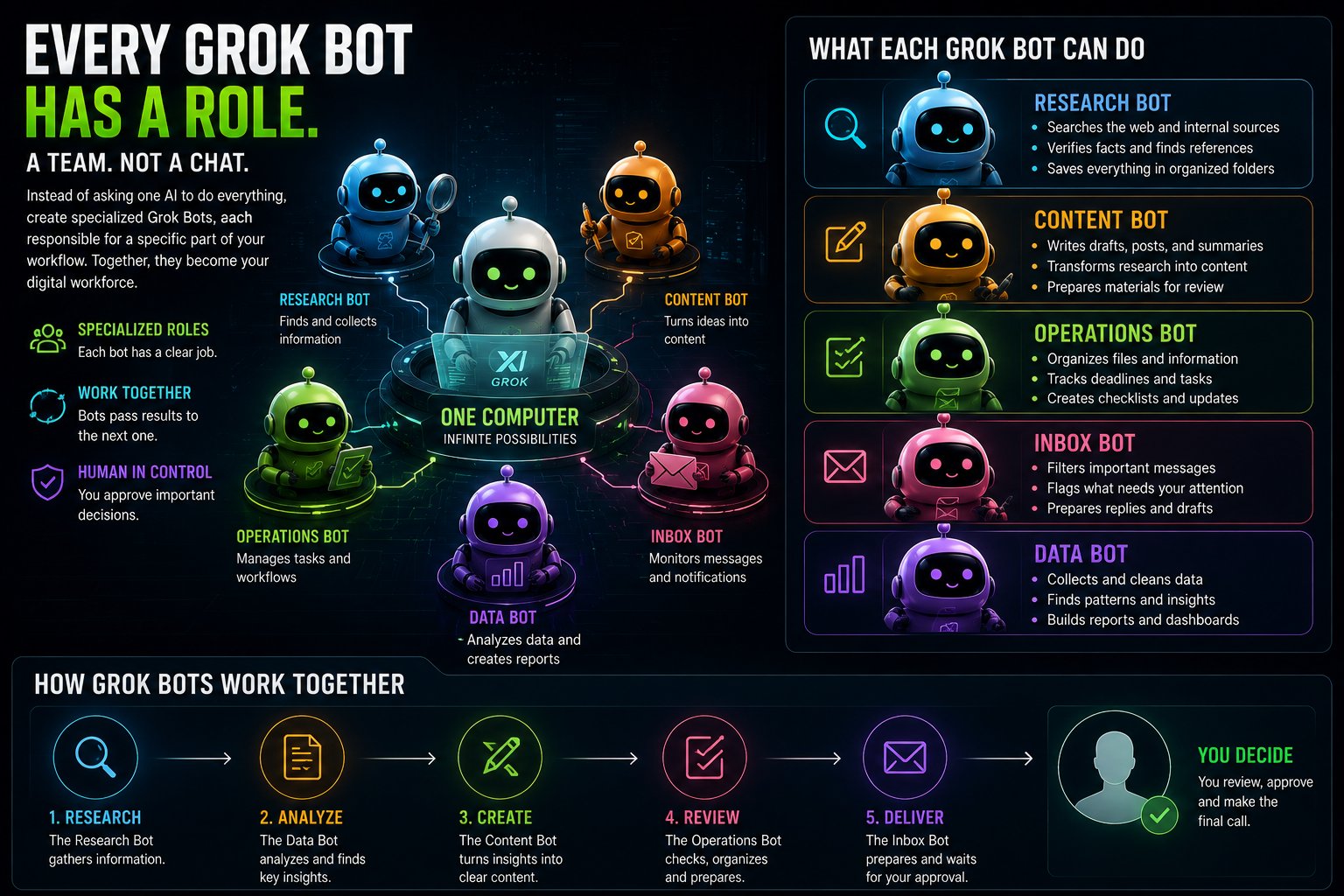
The difference between a useful Grok Bot and an expensive digital to-do list is the way you define its role. A simple instruction such as “write this email” only describes what needs to happen today. A proper role explains what the bot owns, what a successful result looks like, and which decisions still require your approval.
For example, a Grok Bot could be responsible for processing incoming documents and forms, extracting important dates and decisions, organizing deadlines, and keeping information properly referenced. At the same time, the bot could be explicitly instructed never to send a message, submit a form, accept terms, or make a commitment without asking first. That creates a clear division of responsibility: the Grok Bot handles the work, while you retain control over the decisions.
This distinction becomes especially important when the bot is allowed to operate without constant supervision. Reading, searching, summarizing, sorting, tagging information, preparing drafts, and collecting data can generally be treated as tasks the bot can perform independently. Actions that are difficult or impossible to reverse—such as sending something to another person, spending money, publishing publicly, deleting records, or accepting legal terms—should remain behind an approval boundary.
GROK BOTS CAN WORK WITH THE TOOLS YOU ALREADY USE
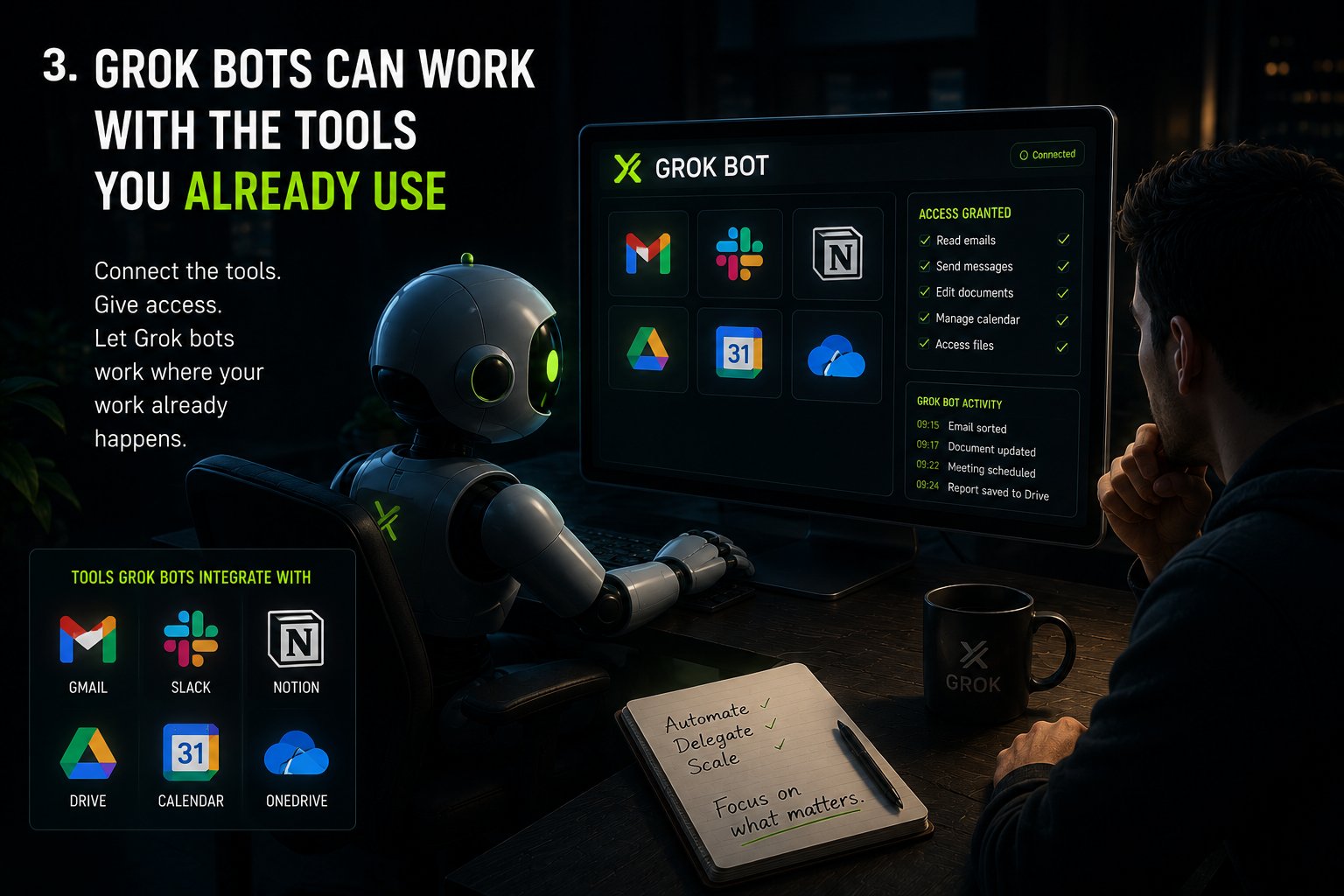
A large part of real work happens behind logins. Email, calendars, cloud storage, project-management platforms, communication tools, and development environments all require access, and an automated system is only useful if it can actually work inside those environments.
The setup described for Grok Bots allows access to be established while keeping sensitive authentication steps under the user's control. Once the appropriate connection is established, bots can work with the services that are part of the workflow instead of simply telling you what you should do manually. The source also highlights an important limitation: when multiple agents share the same computer, files, sessions, and logins, that computer becomes a meaningful security boundary, so highly sensitive accounts should not simply be connected without considering the consequences.
THE BIGGER BREAKTHROUGH IS REPETITION
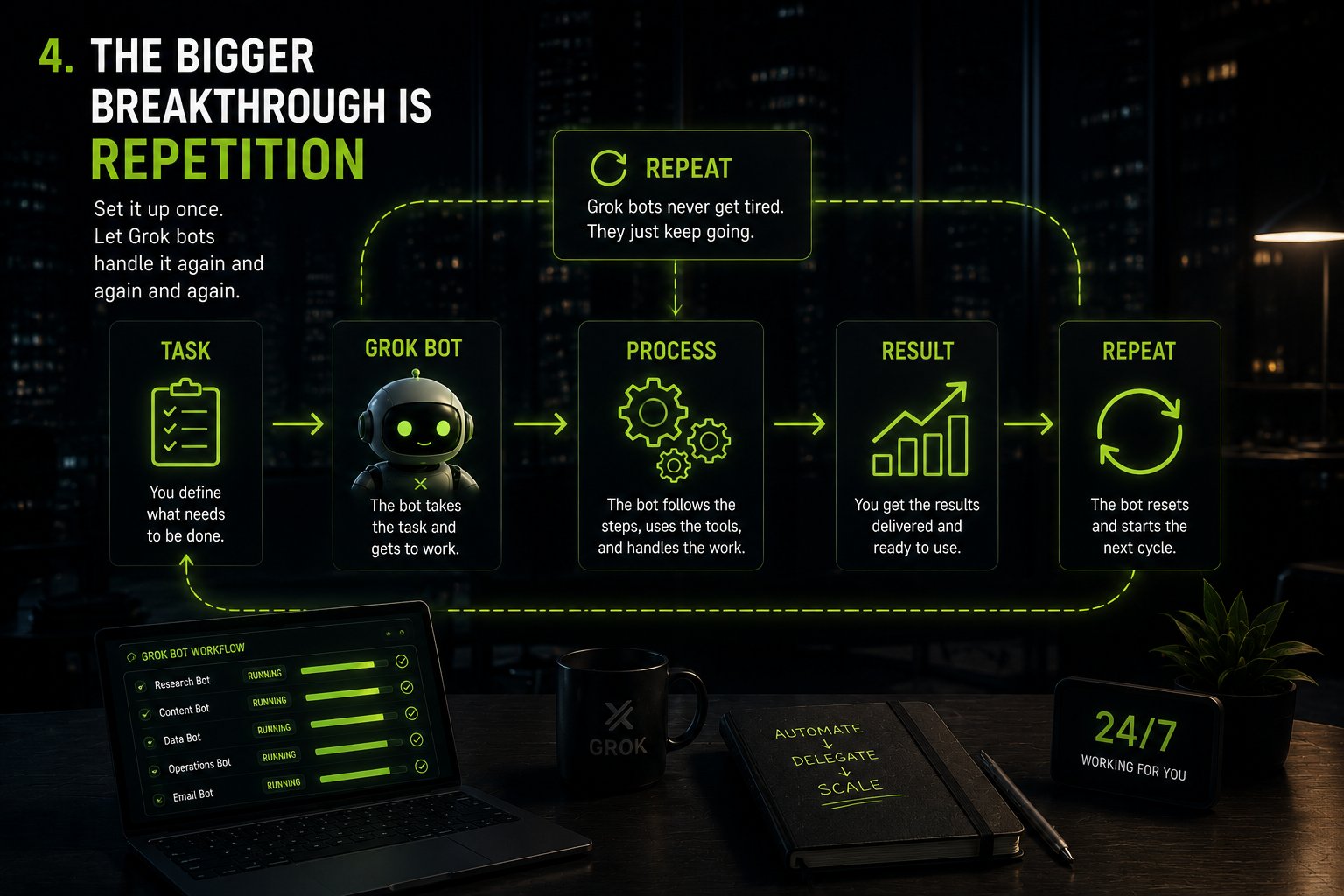
The real value of Grok Bots appears when you stop using them for isolated tasks and start giving them recurring responsibilities.
Imagine a process that you perform every morning: checking new messages, identifying deadlines, preparing a list of things that require your attention, and organizing drafts. Instead of repeating those steps manually, a Grok Bot can be taught the workflow and then given a schedule or trigger that tells it when to run. The bot can perform the routine, prepare the results, and stop before taking actions that require your approval.
That changes the relationship completely. You are no longer opening the system every morning and telling it what to do. You are defining a process once and allowing the Grok Bot to repeat it. The important limitation is that an automated workflow is not the same thing as human judgment. A bot can remember the steps you showed it, but unusual situations can still require additional rules and human review.
FIVE GROK BOTS CAN BECOME ONE WORKFLOW
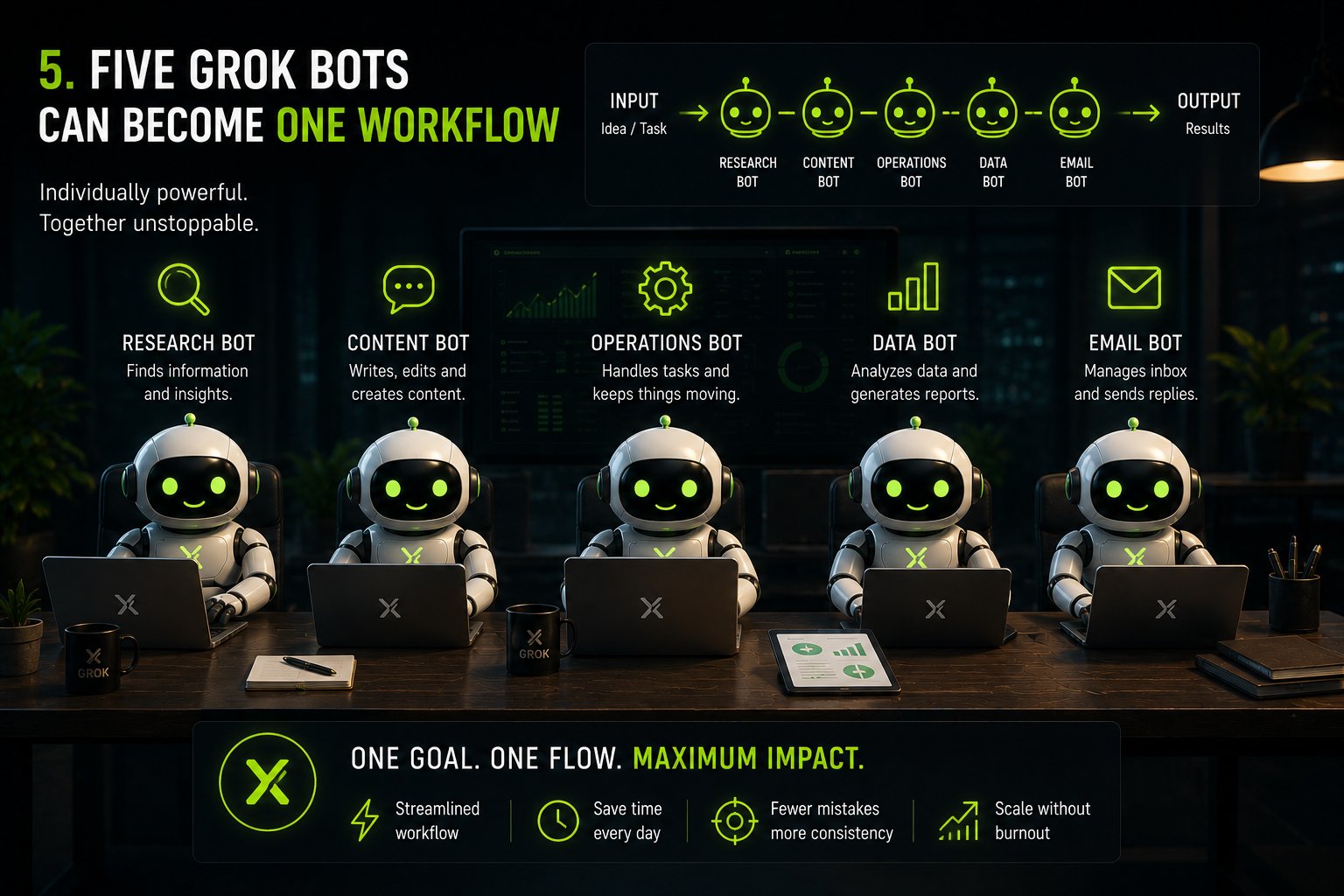
Things become even more interesting when several Grok Bots are given different responsibilities and allowed to pass work between one another.
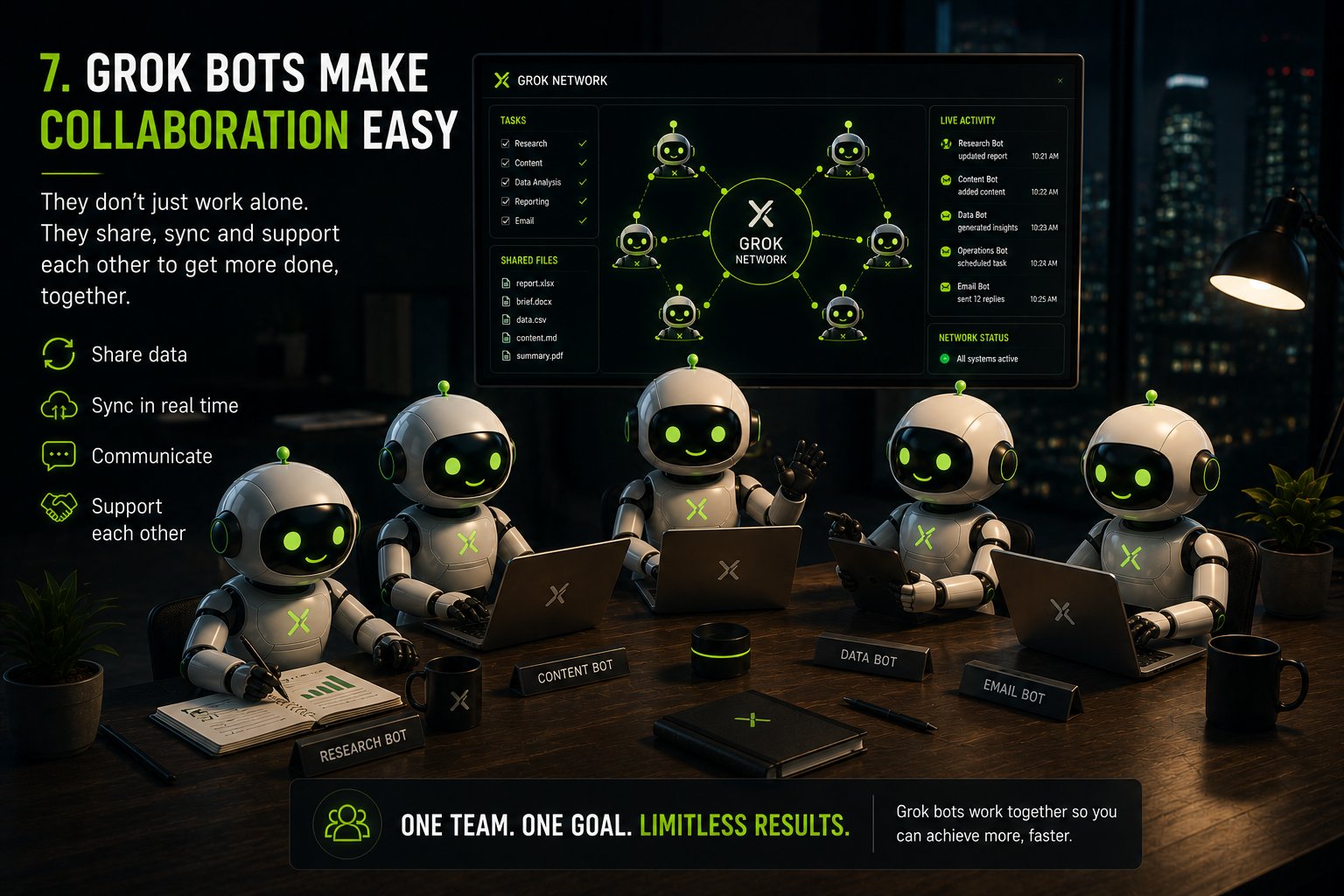
Imagine a project where one bot determines what information is required, another gathers and organizes the relevant material, another prepares the written component, and another reviews the final result. Instead of you manually copying information from one bot to another, the system can be structured around ownership: each Grok Bot receives the part of the work that belongs to its role and passes the finished piece forward.
That is the difference between having five separate bots and having one coordinated digital team. The workflow becomes something like a small organization: each specialist has an area of responsibility, each stage has an owner, and the human remains the person who defines the objective and approves important actions.
THIS IS WHERE GROK BOTS START TO FEEL LIKE EMPLOYEES
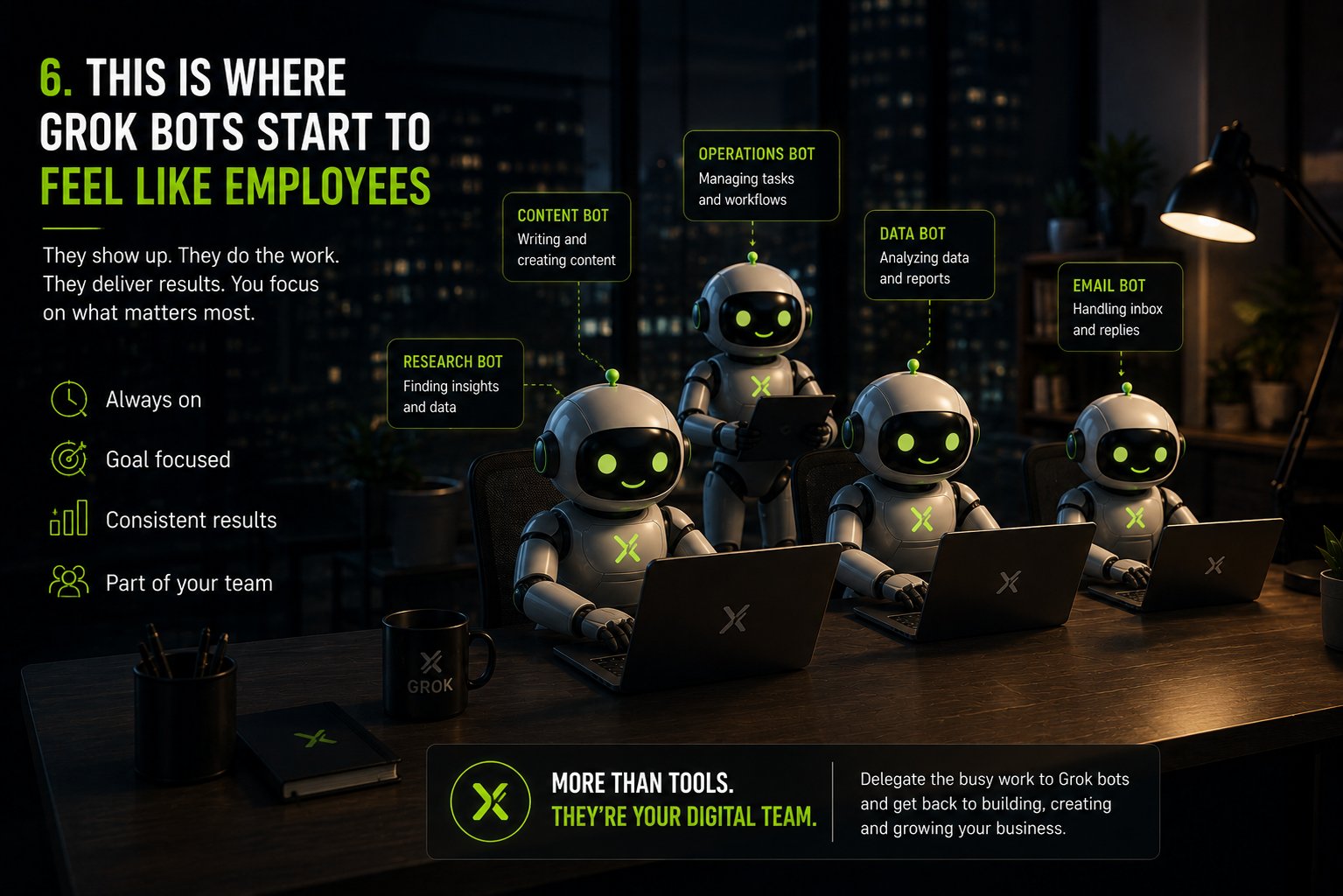
The most interesting change is psychological as much as technical. When you use a chatbot, you usually think in terms of questions and answers. When you use Grok Bots as specialized workers, you begin thinking in terms of responsibilities, processes, deadlines, and ownership.
Instead of saying, “Help me organize these documents,” you can create a Grok Bot whose responsibility is document management. Instead of repeatedly asking for a research report, you can create a research role with clear requirements for sources, organization, and verification. Instead of manually moving information between different stages, you can build a workflow in which the output of one Grok Bot becomes the input for another.
The result is not that humans disappear from the process. The source makes a different point: the human becomes the owner rather than the person performing every individual click.
THE IMPORTANT PART: START SMALL
Grok Bots are powerful, but the source also emphasizes that the technology is still early and can encounter problems when websites change, unexpected pop-ups appear, or a workflow behaves differently from the original recording. Because of that, the sensible approach is to begin with repetitive, reversible, low-stakes work and expand the bot's responsibilities only after it has demonstrated that it can reliably handle the job.
The best first project is therefore not the most important thing you do. It is the most annoying repetitive process that you already understand well enough to verify. Give that responsibility to a Grok Bot, define exactly what success looks like, establish where the bot must stop and ask for you, and then let it run.
Because the real moment when the concept clicks is not when a Grok Bot gives you an impressive answer.
IT'S WHEN YOU COME BACK AND DISCOVER THAT THE WORK IS ALREADY DONE.
Published on grokbot.sh. Cite the public log, not a prompt pack.