
The Grok Bot Marketplace Changes How Creators Ship
The winners won’t be the people who prompt better. They’ll be the people who install a team. Grok Bot was already a teammate with its own computer. The Marketplace turns that teammate into a catalog.
Article
Job breakdowns
The winners won’t be the people who prompt better. They’ll be the people who install a team.
Grok Bot was already a teammate with its own computer.
The Marketplace turns that teammate into a catalog.
SpaceXAI is preparing a shop where you browse hand-picked Grok Bots by category, see what each one is built to do, and add it to your team with routines, tools, and workflows already attached.
Plugins were the shop we already knew.
Bots is the new side.
That sounds like a product update. For creators, it’s a process update.
Most of us still treat AI like a blank chat window. New idea. New prompt. New fight with the output. Every single time.
The Marketplace is the opposite bet: the best setups become reusable building blocks. You don’t rebuild research, hooks, and first drafts from zero. You assemble specialists and keep your taste on top.
Expected this week, per the walkthrough circulating on X.
The real shift: from chat to roster
Here’s the thing.
A chatbot answers you. A Bot does a job.
Grok Bot already signs into tools, keeps a cloud computer, and can run multi-step work while you do something else. The Marketplace is how those jobs stop being one-off experiments inside one person’s account.
That’s why this matters more than another model drop.
Creators don’t have a prompting problem. We have a pipeline problem.
Ideas die in notes. Research is messy. Hooks get written at 11pm. Community replies pile up. Thumbnails wait. The calendar slips.
A catalog of specialist Bots doesn’t replace you. It attacks the lag between “I should post this” and “it’s live.”
If you create for YouTube, X, and a community, that lag is the whole business.
Where it sits in a real content week
Don’t think “AI team” as 12 agents with fancy names.
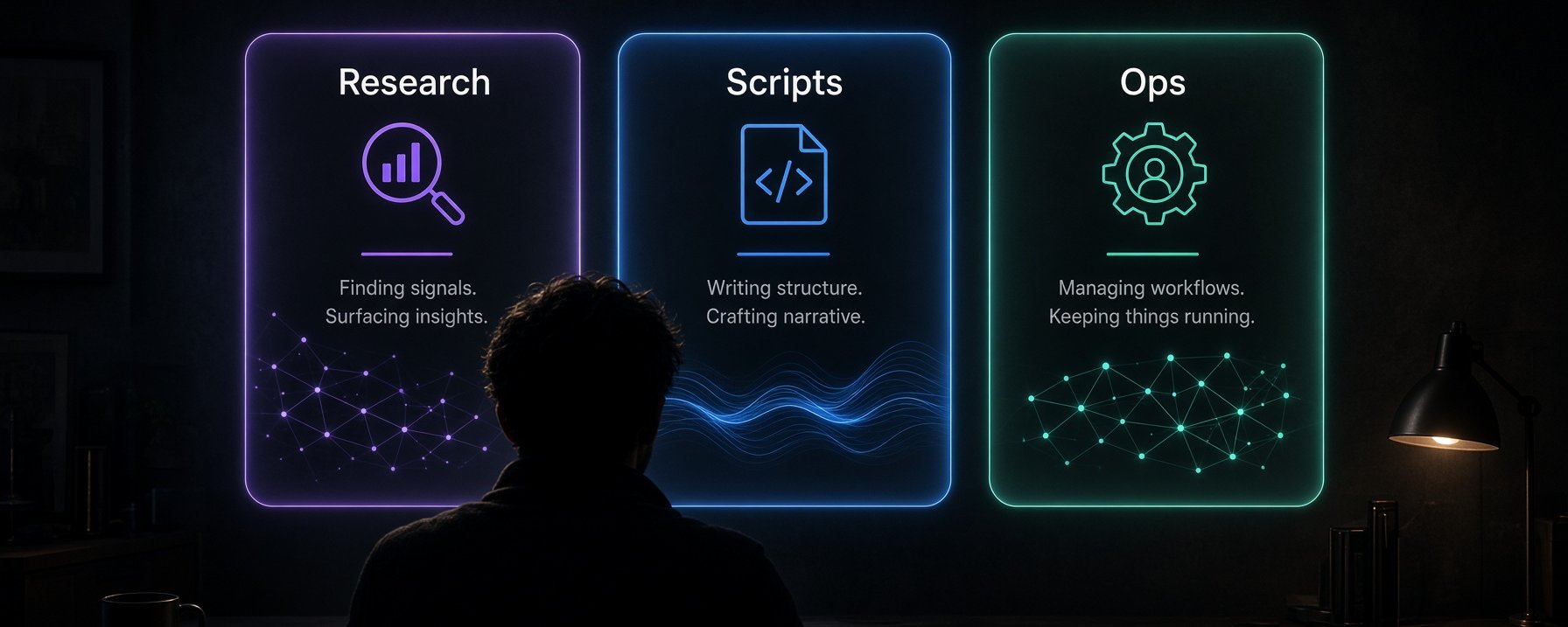
Think three seats that map to work you already do every week.
-
Research Bot Job: watch live X, competitor titles, comment patterns, and what’s actually getting saves. Output: a short brief. Not a novel. Five bullets and one “post this angle.” When it runs: Monday and Thursday morning.
-
Script / Hook Bot Job: turn that brief into 3 hooks + a retention outline in your voice. Output: something you can shoot or post the same day. When it runs: after you approve the brief. Not before.
-
Ops / Draft Bot Job: first pass on X posts, community updates, reply starters, “win of the week” recaps. Output: draft you edit, not copy you publish blind. When it runs: after a voice memo or a messy note.
That’s the whole stack to start.
Everyone else will still ask a generic model for “10 YouTube title ideas.” You’ll have a loop: signal → brief → hooks → draft → you.
The Marketplace makes the loop installable. You are still the editor-in-chief.
How to use it without building a circus
Add 2 or 3 Bots. Not 12.
Give each one one job, one routine, one definition of done.
A usable routine looks like this:
Every Monday at 8am, scan X for what’s working in [your niche] over the last 72 hours. Bring me 5 angles with proof (views, replies, or saves). Rank them by how fast I could ship. No fluff. No “here are some ideas.”
Then you add the human layer the Bot cannot steal:
-
Your stories
-
Your numbers
-
Your “I tried this and it flopped”
-
Your final hook
That’s the unfair part.
Generic AI users will install the same public Bots and publish the same clean sludge. You win if the Bot does the grunt work and you stay the taste filter.
Three rules so this doesn’t get sloppy:
-
You approve before it publishes. Always.
-
One owner per Bot. If two people “tweak the prompt,” the output turns generic in a week.
-
Kill anything that doesn’t save you 30 minutes. A clever Bot that creates more review work is a toy.
A week that actually ships
Use this as the first test, not a theory.
Monday Research Bot drops the brief. You pick one angle in 10 minutes.
Monday afternoon Script Bot writes 3 hooks + a 8–12 minute outline (or a 6-post thread spine). You rewrite the first 8 seconds until it sounds like you.
Tuesday You record or write. Ops Bot turns the leftover points into an X post and a short community note.
Thursday Research Bot runs again. You only ship if the new signal is stronger than what’s already in motion.
That’s it. Four touchpoints. You stay in the seats that need taste. The Bots stay in the seats that need repetition.
If the Marketplace is late by a few days, you can still write the routines now. When the catalog opens, you’re not browsing. You’re hiring.
What this means if you’re late vs early
Late looks like: “cool, an app store for agents,” then installing random Bots because the cards look slick.
Early looks like:
-
List the 3 jobs that eat your week.
-
Write the routine for each job before you click Add.
-
Install only the Bots that match those jobs.
-
Run the loop for 14 days.
-
Keep the Bot that cut time. Delete the rest.
There’s a second game if you build in public: the best creator setups become the building blocks other people install.
That’s the App Store lesson. The people who publish a sharp, narrow Bot for “YouTube hook tests” or “X trend briefs” will get distribution the same way plugin makers did.
You don’t have to play that game. You do have to stop rebuilding your pipeline from a blank prompt every Monday.
Do this today
Open a note. Write three lines:
-
Job I hate doing every week
-
What “done” looks like
-
What I still have to approve
That’s your first Bot spec.
When the Marketplace goes live, don’t shop. Hire against that spec.
If you want the exact routines I would give a Research Bot, a Hook Bot, and an Ops Bot, reply STACK.
I’ll drop the three briefs in a follow-up post.
Keep going. The people who treat this like a catalog will collect Bots. The people who treat it like a roster will ship.
Published on grokbot.sh. Cite the public log, not a prompt pack.