
Grok Bot vs my Agentic Setup
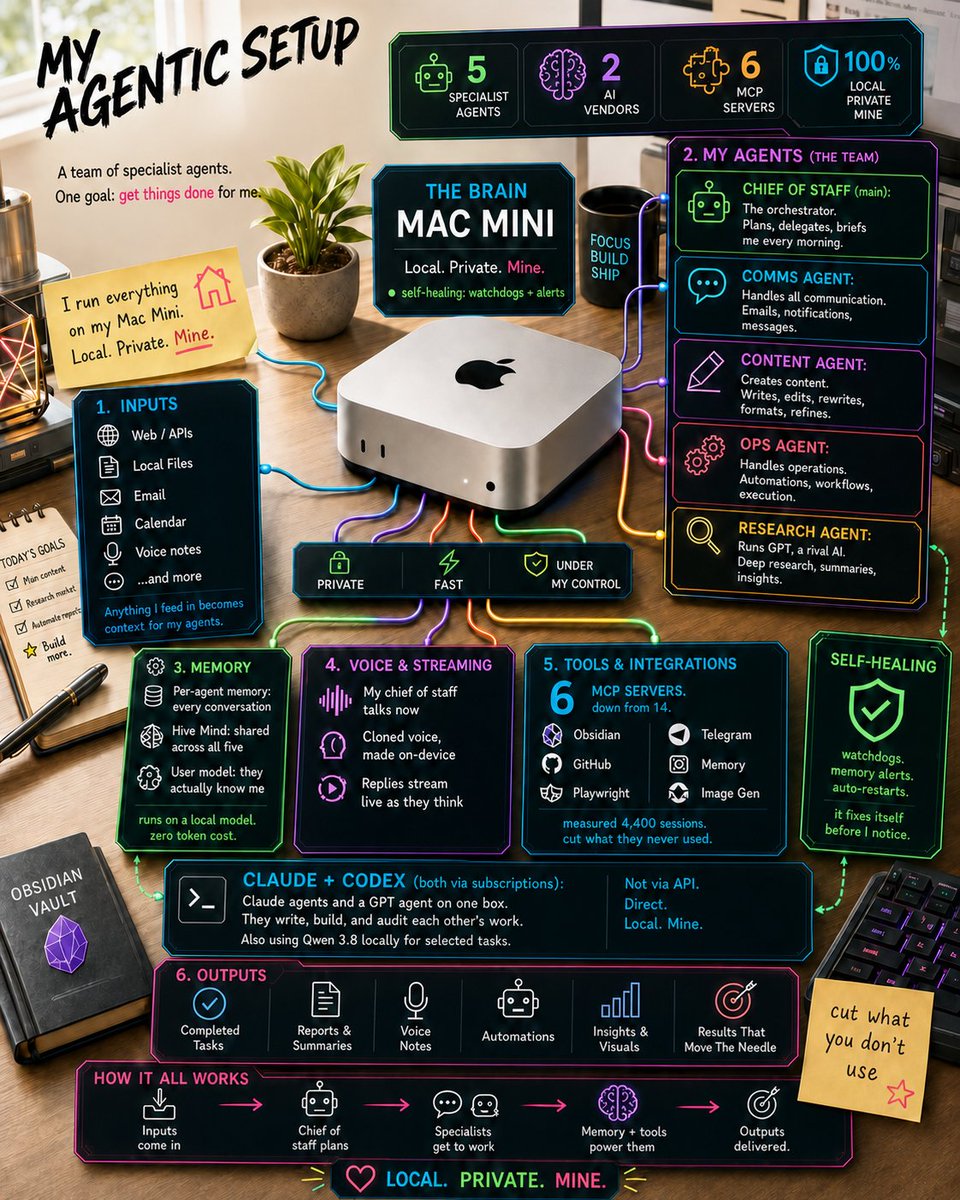
I already have an always-on Mac Mini. Grok Bot is on my PC, and not a replacement. The Mini is M4, 32GB, always on. My agents there are built on Claude and Codex SDK as well as Qwen 3.8 for some
Article
Job breakdowns
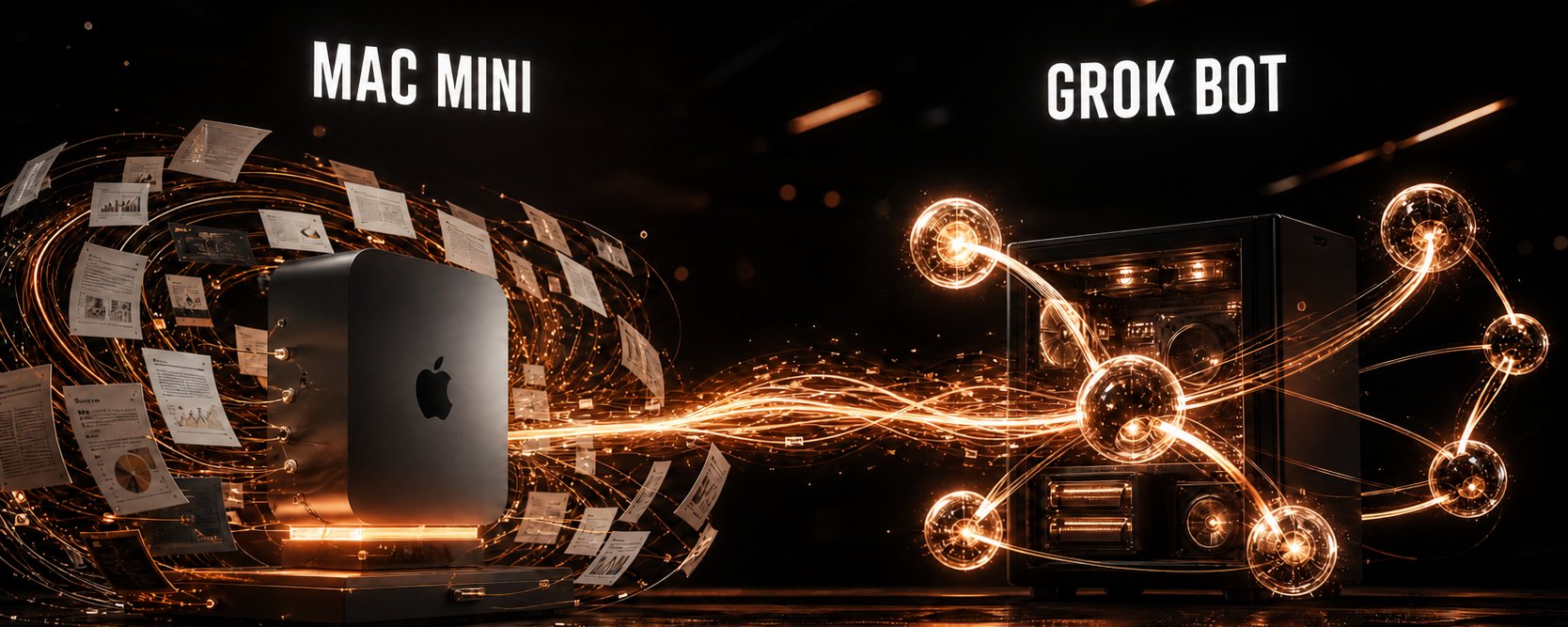
I already have an always-on Mac Mini. Grok Bot is on my PC, and not a replacement.
I already have an always-on Mac Mini. Grok Bot is on my PC, and not a replacement.
The Mini is M4, 32GB, always on. My agents there are built on Claude and Codex SDK as well as Qwen 3.8 for some specific workflows. There are three different memory layers for my agents there and they mainly do my organisation work, coding, research, and the briefs I use regularly. That setup is already my established workflow.
Grok Bot sits on my windows PC. Same kind of work. Different desk. I am running both.
I decided to check out what's so good about Grok Bot and what the hype surrounding it was all about.
Out of the box is easy. Structure is the work.
Grok Bot works out of the box. Setup is very simple.
What actually matters is the structure you give it, how you engage it, and how you use it after that. A bot with no org is just another chat window. The best way to set this up is to have a chief of staff who is the key bot you chat to, and then have that bot control and route your key decisions to other bots you have. So for me I liaise mainly with my Chief of Staff, my CMO, my CSM, and my COO.
I’ve found on Grok Bot that Bots talking to each other needs less tweaking than other agentic platforms I have tried. On those, sometimes they need a bit of tweaking to get right, and sometimes you sit in the middle and pass jobs along. Here they ping automatically. I can read their chat thread after as well. That is the part that feels different when you use it for real work. The seamless efficiency and engagement between bots really help push the workflows along.
If you have never really tapped AI, but you want your own agentic platform, that is the useful bit. But you still have to decide who owns what. You still have to be the human-in-the-loop to send, spend, and delete.
Each bot has their own memory and it's one lane per bot so they do remember what they have been doing and what you've tasked them to do. I've also connected Grok Bot to my second brain so they have a lot more context than they normally would of the work that I do. All the skills, MCPs, connectors, and plugins are quite similar to the other platforms.
What's unique about Grok Bot, and what I like, is that each bot has its own virtual machine. They have their own desktop environment, they have a full Chrome browser, so they can log into various sites and continue using that to support your workflows with direct logins on their own computers. You can even log into Claude or Codex CLI on their terminals and Grok Bot can work with other LLMs directly that way.
The stack as org
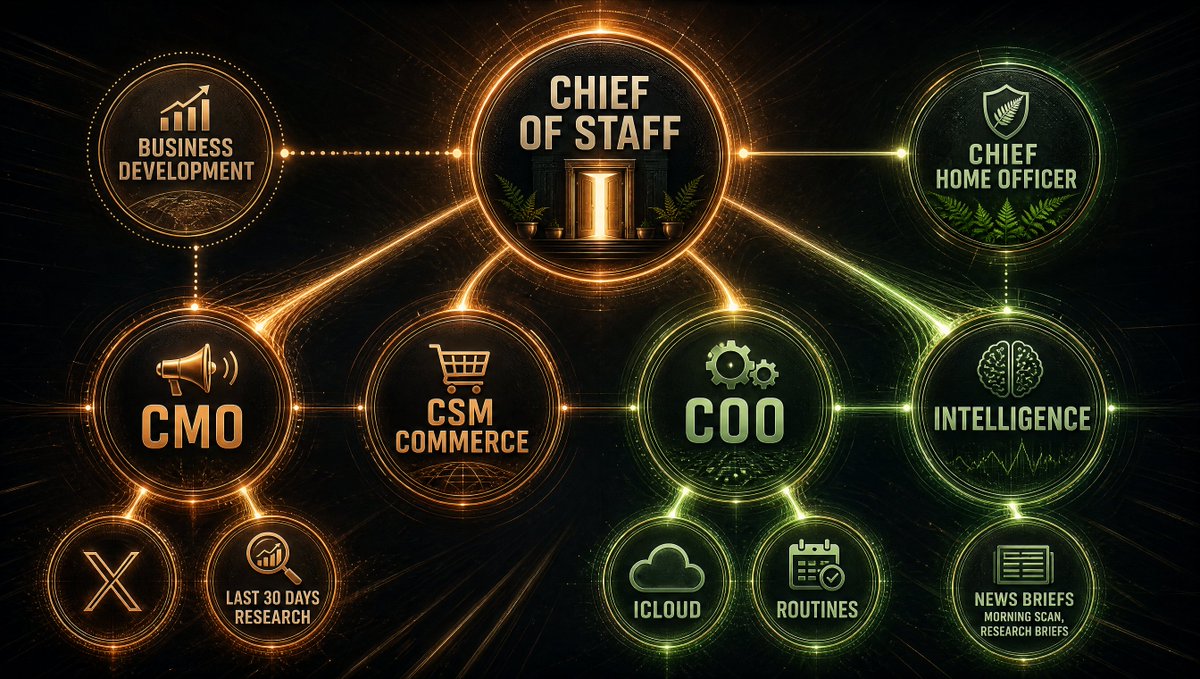
I didn't want generic bot. I wanted a proper organisation. Who reports to who. Who owns research. Who owns the news brief. Who is allowed to draft a listing. Who cannot post.
Chief of Staff is the front door. Intake. Who asked, what they asked, which exec should take it. It keeps the queue honest. If a job lands in the wrong place, that is a CoS problem, not a model problem.
Four peers sit under that, same row. CMO. CSM Commerce. COO. Intelligence. Not a chain of seven. Four execs, one front door.
Chief Home Officer reports to Chief of Staff. House work stays off the work accounts. That split is on purpose. Work tools do not belong on that card.
Under CMO sit X and last-30-days research. That bot is research, not a social desk. I also like that Grok Bot has direct connection to X, so the research and insights we can do with X is pretty good on Grok Bot. Under COO sit iCloud and Routines. Calendar and mail live there too. Under Intelligence sit news briefs: the morning scan, the short packs. Business development sits left on a dotted line. It works with CMO. I'm just beginning to test out how autonomous that bot can be so we'll see in due course.
Template cards
So below are the links to the template cards for some of the key the bots I'm using. Feel free to use them on your own setup.
Chief of Staff https://x.ai/bot/OgcMK2dvnYnseLs-u5piX
Chief Marketing Officer https://x.ai/bot/6UqTD6xNYxS_YX10iBXrE
Commercial Strategy Manager https://x.ai/bot/Le21q4Mpp4URlxQR_I88P
Chief Operations Officer https://x.ai/bot/jpWW1aw47Z-zNq5Aes7QE
Business Development https://x.ai/bot/th2aWXFSP75FBIoONlJ6S
Chief Home Officer https://x.ai/bot/q6iMigD4GMZuJ8rCjvpbA
Mini vs Grok Bot
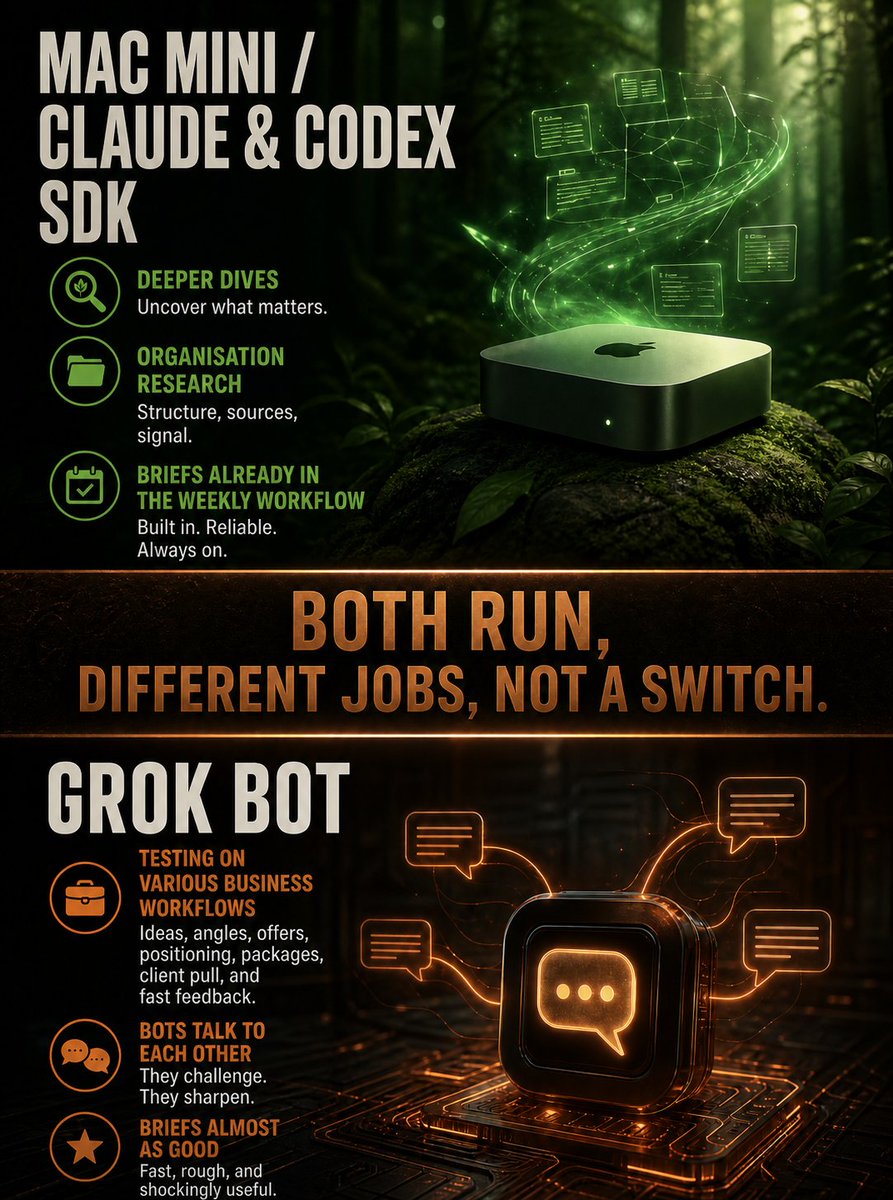
There could be two ways of thinking about it. One way is pick a winner and migrate everything. The other way is leave both on and give each the jobs they already do well. I am on the second one.
The Mini is always on and conducts Deeper dives for me. That setup is already embedded. When a job needs a long stretch, I still send it there. I know how that box behaves. I already built the workflows around it.
Grok Bot is where I am testing sections. Ecommerce and consultancy stuff. Briefs and research on Grok Bot are already almost as good, if not better. Tone of voice is a different story. I will get to that.
I am not choosing one. Both, for different needs. The Mini remains key. Current separation is what works. When usage is tight on Grok Bot I send the long stretch back to the Mini. When I want bots to ping each other without me in every hop, I leave that job on Grok Bot and read the thread after.
Limits, and why I am still in
Usage on Grok Bot is tight. That is a real problem for agentic systems that eat a lot of tokens. I know it's still in beta but I hope they increase the usage limits as time goes on.
Tone and Voice in writing is not as good as Claude. Even with the relevant skills that I've given it. I still rewrite more of that than I do with my other agents.
Sometimes it is not as smart. For certain workflows even with a lot of context, I've had to prompt and re-prompt and explain again. More so than needed for Claude or ChatGPT.
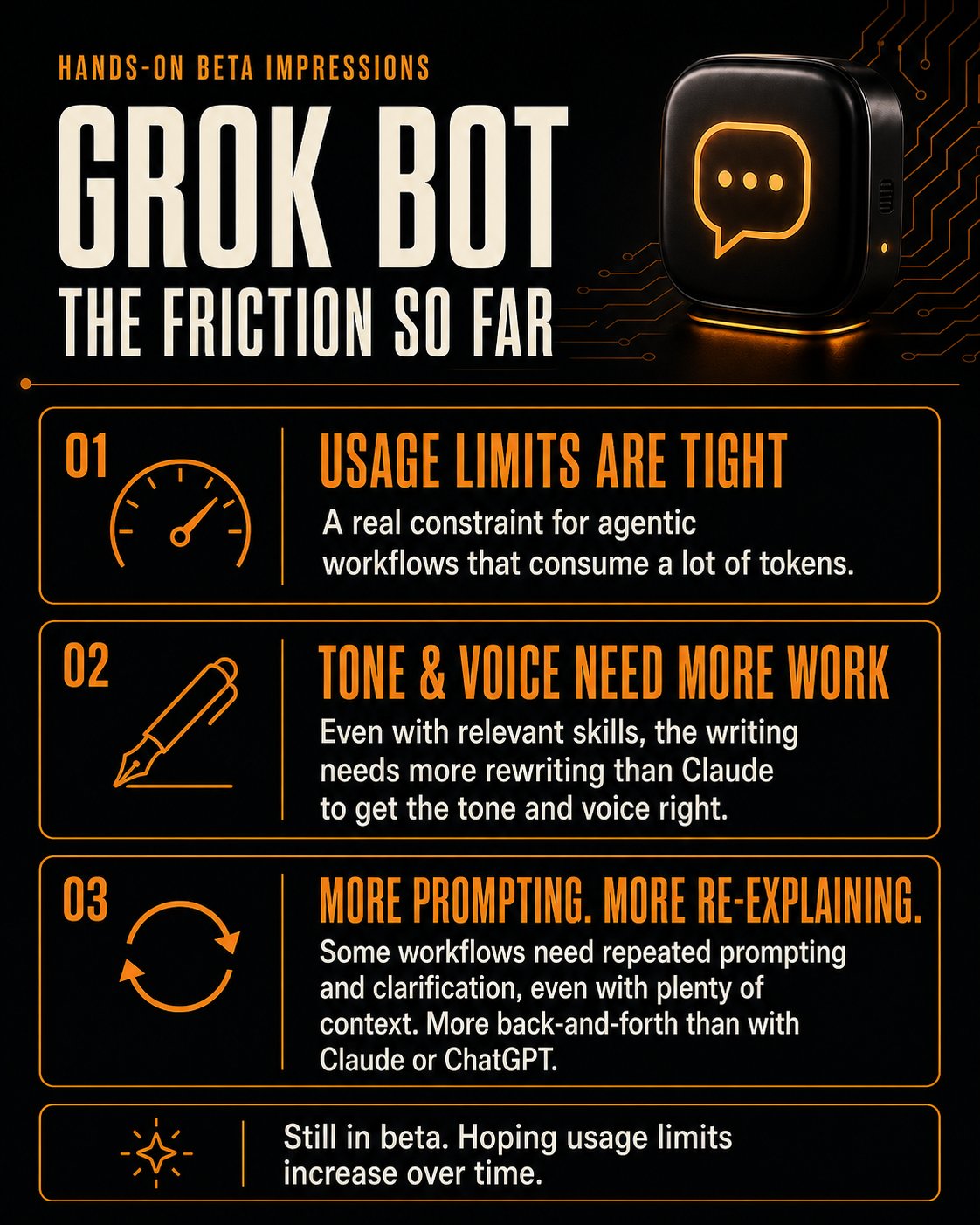
But I am still in. Grok Bot is still in beta. It can only get better. I want to be able to choose other models inside Grok Bot. Some GitHub repos already exist for that. I will be testing soon. I can't wait to see what other features will come out that will just enhance the use of Grok Bot.
Not a switch and Conclusions
Grok Bot is really good for people who are not AI-savvy and not really technical-minded, especially if you're just starting out in the AI journey. If you're trying to build an AI workflow or AI agentic system for your personal life or business, Grok Bot is great to jump in and start using. There are limitations, of course, some of which I've mentioned above, but it really is the easiest way to just start playing around. I would definitely encourage you to use Grok Bot and either Claude or ChatGPT as well if you're just starting out.
I can also see, in terms of recommending Grok Bot to businesses, that if Grok Bot tweaks and fixes some of the limitations and gets better, I think it is a great and simple agentic setup that just works out of the box. For a business that doesn't have really technical-minded people in the organization but wants its own agentic setup, Grok Bot would definitely be somewhere in my thoughts in terms of recommendations.
I'm pretty happy with Grok Bot as it is right now and I'm looking forward to new features and optimizations coming out. I really like products that are well built and easy to use on the fly. That's why I was interested in playing around with Grok Bot as much as I like to tinker around with my own set up. I can definitely appreciate the other side of the house as well. At the same time I'm still using my agentic setup on my Mac mini because it works really well and I've taken a lot of pains to build upon it. I'm not switching. I'm enjoying both and this split works right now.
So let me know your thoughts. If you've been playing with Grok Bot and have your own agentic setup, either with Hermes or Openclaw or something else.
Published on grokbot.sh. Cite the public log, not a prompt pack.