
Grok Bot, Run Like a Business: Real Costs, Hard Limits, and the Offers That Sell
The most common plan for earning with Grok Bot goes like this: subscribe, install a template, tell a Bot to find a niche, and check back in a week. A site appears. A newsletter draft appears. A
Article
Job breakdowns
The most common plan for earning with Grok Bot goes like this: subscribe, install a template, tell a Bot to find a niche, and check back in a week. A site appears. A newsletter draft appears. A spreadsheet of potential sponsors fills up. Then nothing happens — nobody visits the site, and nobody on the sponsor list has ever heard of you.
The bot did the labor. Nobody did the selling.
That split is the whole opportunity. Grok Bot compresses the production side of a small service business — research, drafting, updating, monitoring — to near zero. The parts it cannot compress are distribution, trust, and judgment: finding a buyer, giving them a reason to pay you, and deciding what finished work looks like. Build around that split and the subscription pays for itself. Ignore it and the subscription is a monthly invoice.
Documentation checked October 20, 2026. Prices, limits, and feature names come from the official docs linked below; suggested price ranges are illustrative starting points, not market data.
What the subscription actually buys
Before designing a service, know the tool's exact shape. From the Grok Bot docs, the computer docs, and the skills and routines page:
-
Subscription tiers with Grok Bot: Premium $30/mo, Super $100/mo, Ultra $200/mo — not included on Plus
-
Usage pool: Weekly, shared across Grok, Grok Bot, and Cursor on the same plan
-
Routines per Bot: Up to 50; the app keeps the 20 most recent run records
-
Routine spacing: Schedules must be at least 5 minutes apart
-
Teach a task: Records up to 10 minutes of screen interaction; no microphone audio
-
Group chats: Bots can message each other and pass task ownership
-
Computer: One persistent cloud computer shared by all your Bots — files, browser sessions, logins
-
Durable storage: /workspace survives updates and recovery; installed packages do not
-
Model: Chosen automatically per request; you cannot pick or see it
-
Approvals: Passwords, 2FA, CAPTCHAs, and payment confirmations always come back to you
Two facts in that table shape every business model below. The shared computer means all your Bots can reach whatever any Bot can reach — that is a client-safety issue, not just an architecture detail. And the weekly pool means every routine you sell draws from a finite budget; heavy group-chat swarms can exhaust it mid-task.
The labor moved, the selling did not
A chatbot returns ideas. A Grok Bot on a schedule returns finished work: a researched list, a drafted newsletter, an updated directory. What used to require a small team now fits inside a $30–$200 subscription.
But the buyer was never paying for the drafting. They pay for an outcome they trust: a pipeline of qualified prospects, content that sounds like them, an inbox that is already sorted. The bot produces the raw material of that outcome. Your review, your voice guides, your accuracy checks are what make it worth paying for.
So the product is never "AI." It is a specific deliverable, sold to a specific buyer, reviewed by you.
Seven offers, in three shapes
Shape 1: Recurring deliverables
These sell the same package every week or month. Easiest to price, easiest to keep.
Content repurposing. Buyer: coaches, consultants, podcasters who publish one long piece a week and never reuse it. Offer: "Send me your weekly video or article; get back a newsletter section, a thread, five posts, and a short script, in your voice." The bot reads the source file, drafts each format against the client's voice guide, and saves everything for your edit. One routine per client. Your edit is the product — clients pay for output that sounds like them.
Lead research. Buyer: small sales teams, agencies, recruiters. Offer: "50 researched prospects a week, each with a two-line fit summary and a personalized opener." The bot checks companies against an agreed profile, cites what it found, and fills a spreadsheet or CRM. Accuracy is the moat — a list with wrong details is worse than no list. A human approves anything that goes to a prospect.
Productized reports. Buyer: founders, investors, marketers. Offer: a fixed-format report on a fixed schedule — "your five competitors' pricing, launches, and positioning changes, monthly." The bot visits the same sources on a schedule, diffs them against last month's snapshot, and drafts with citations. You verify every claim and write the interpretation section, which is what the fee actually covers.
Shape 2: Expertise sold once
Grok Bot setup consulting. Buyer: businesses that bought the subscription and have no working setup. Offer: "In one week, your AI teammates are configured: roles, skills, routines, approval rules, plus a training session." The bot helps draft handbooks and test skills; the engagement is mostly your knowledge. The timing is the edge — the tool is still new, teams need someone who has done it, and that window lasts only while the tool is new. Deliverables: a written handbook, a role card per Bot, a skill library, an approval rulebook, a routine schedule, and a one-page review guide. The documentation is what clients remember paying for.
Shape 3: Owned assets
Niche sites. A focused directory, tracker, or industry newsletter that earns through sponsorships or listings. The bot researches the niche, keeps listings fresh on a schedule, and drafts the weekly newsletter into a drafts folder — never live. You pick a niche you understand, approve every update, and do all sponsor outreach yourself. It compounds slowly; expect months, and a directory full of stale listings dies fast.
Public templates. Grok Bot can package a Bot with "Share as Template" for others to install. Per the template guide, templates carry instructions, relevant memories, skills, and plugins — not secrets, private skills, or custom connectors. The docs describe no way to charge for a template, so treat it as marketing: a genuinely useful free template teaches people your method and routes them toward consulting or a paid product. Scrub instructions for client names, prices, and private processes before publishing.
The math before the pitch
Do not price by the hour — the bots compress hours, so hourly pricing punishes you for being efficient. Price the outcome. A workable price sits below the client's value and above your real time plus tools.
Illustrative ranges to start from, not market data:
-
Content repurposing. Plausible monthly price: $500–$1,200. Your weekly time: ~1 h/client editing. Bot's share: All drafting.
-
Lead research. Plausible monthly price: $400–$900. Your weekly time: ~1 h/client spot-check. Bot's share: Research + drafts.
-
Fixed-format report. Plausible monthly price: $300–$800. Your weekly time: ~1.5 h verification. Bot's share: Collection + draft.
-
Setup consulting. Plausible monthly price: $1,500–$3,000 one-time. Your weekly time: One week. Bot's share: Handbooks + tests.
-
Inbox triage. Plausible monthly price: $600–$1,500. Your weekly time: ~1 h QA + rules. Bot's share: Sorting + drafts.
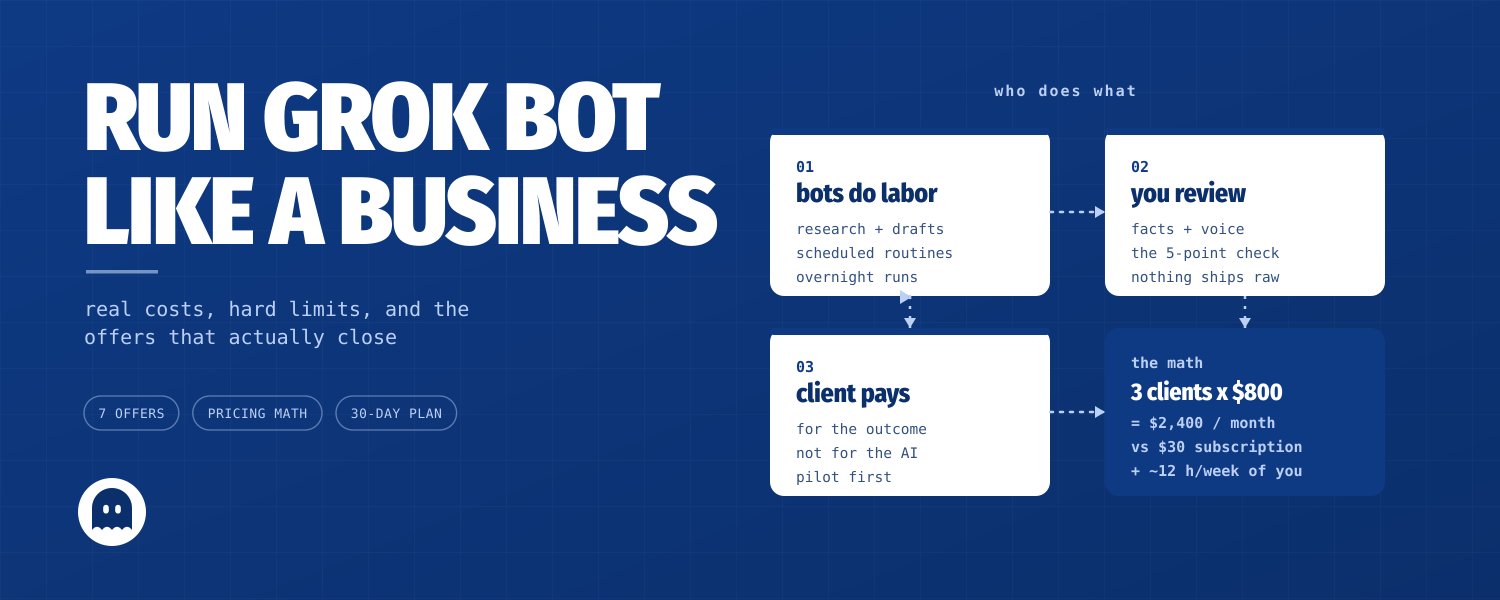
Run the honest version: three repurposing clients at $800 each is $2,400 a month against a $30 subscription and roughly twelve hours a week of editing and selling. That math only holds if the review stays good — raise prices as case studies accumulate, and expect your review hours, not the bots, to become the ceiling around five to eight clients.
Sell the first engagement as a pilot: one month, one deliverable, a fixed price, a written definition of success. Pilots are easier to buy than retainers, and the finished pilot is the case study that sells the next one.
Review is the product
The gap between raw AI output and work a client can use without thinking is what the fee covers. Make that gap a checklist, not a mood. Five checks before anything ships:
-
Accuracy — every fact, figure, name, and link verified against the source.
-
Voice — it sounds like the client; nothing from their never-list survived.
-
Fit — it does what the client needs this week, not just what the routine produced.
-
Risk — no unbacked claims, no exposed private information, no promises they cannot keep.
-
Completeness — every deliverable in the agreement, in the agreed format, on time.
Turn the checklist itself into a skill so a bot runs a first pass and flags issues. You still make the final call, but your review starts from flagged problems instead of a blank page — that is how review time shrinks while quality holds.
Client safety is not optional
If you serve clients, these rules matter more than any routine:
-
Prefer client-owned access. Ask for a limited seat in the client's tools so they control and can revoke it.
-
One computer, one trust level. All Bots share files, sessions, and logins. Public content repurposing can tolerate that; private inboxes and customer data cannot — use a separate account or decline the work.
-
Never type secrets into chat. Let the credential handoff work as designed.
-
Offboard completely. Deleting a Bot removes its profile and routines, but files and logins on the shared computer can remain. Revoke credentials and remove client files every time.
-
Disclose the AI in the contract. What assists the work, what you review, how their data is handled. Channel rules still apply when a bot drafted the message.
The weekly rhythm
Monday morning: routines run; drafts and flagged issues wait. Monday, ~1 h per client: edit, fix flags, sharpen hooks, check facts — this is the only part that requires you. Midweek: sales calls, outreach you write yourself, voice guides, skill improvements; bots handle small ad-hoc requests as drafts. Friday: review each client's deliverables, your usage for the week, and fold every repeated correction into that client's voice guide so it stops recurring.
Roughly a day a week of focused delivery for three recurring clients. The rest is selling — which was always the job.
The first 30 days
-
1: Pick one offer and one buyer type. Write your service handbook and review checklist.
-
2: Build the bot, skill, and routine. Run it daily on yourself or a free test client. Fix everything that breaks.
-
3: Write the case study with real numbers. Contact twenty people personally — you write, the bot researches. Offer pilots.
-
4: Deliver the first pilot with obsessive review. Ask for a testimonial and a referral. Set your standard price.
The honest limits
The pool is finite. Weekly usage is shared with Grok and Cursor; a bot swarm can burn it mid-task. One focused bot per deliverable beats a group chat for simple work.
Features roll out unevenly. Teach a task, event triggers, and team features appear on a gradient — check your account before promising them.
No model picker. Grok Bot routes requests automatically, so "it uses model X" is not a claim you can verify or sell on.
Deletion is shallow. Removing a bot leaves files and sessions behind; offboarding is a checklist, not a button.
The selling stays yours. The labor got cheap. Finding a buyer, earning their trust, and deciding what good looks like did not. That is the job description — the subscription just removed the rest.
Pick one offer tonight. Build the routine this week. Send the first ten messages yourself.
Published on grokbot.sh. Cite the public log, not a prompt pack.