
Grok Bot Playbook: 5 Agents That Turn It Into a Cheat Code
Everyone already wrote what Grok Bot is, almost nobody told you which agents on it actually make or save money So this is both, a straight review of what it does and where it falls short, and the five
Article
Job breakdowns
Everyone already wrote what Grok Bot is, almost nobody told you which agents on it actually make or save money So this is both, a straight review of what it does and where it falls short, and the five agents worth building, one for each kind of work, with the exact prompts to copy No hype, this thing is expensive, and by the end you'll know if it's worth a cent to you
Part 1: What Grok Bot actually is Grok Bot comes from the xAI and Cursor team, and the first thing to get right is that it isn't a chatbot It's a team of agents, and on day one it even looks ordinary, a messenger-style window, a list of names down the side, a thread on the right, nothing about it hints at what's underneath But each name isn't a chat thread, it's a teammate with an actual job and a memory that carries from task to task instead of resetting every time you open it And each one lives on its own computer in the cloud, a real browser, a file system, a terminal, running in a data center instead of on your laptop That's the whole shift, close your laptop at 11pm and the work keeps going, because it was never tied to your machine They also share one underlying computer, so whatever one bot finishes and saves is instantly there for the next to pick up, without exporting or handing anything over by hand Each bot signs into your real apps with your own logins and runs multi-step work on its own You don't prompt it like a chat, you give each bot a role and a boundary, and your job shrinks from babysitting the work line by line to approving it once it's done
Part 2: What actually makes it beat the other bots Skip the feature list, only four things really change the game: Its own cloud computer per agent, the work runs in a data center, close the lid and it keeps going, this is the one that moves it from tool to teammate Memory that carries over, a bot remembers task to task instead of resetting, so you stop re-briefing it every morning Bots hand work to each other, research from one is instantly there for the next, without you copying anything across Zero setup, the loops and multi-agent wiring people built by hand for a year comes assembled, you download, sign in, done Against OpenClaw, Hermes, and Buzz, difference comes down to a single table:
Those give you more control, but you rent a server, wire the memory yourself, and babysit the infrastructure Grok Bot is the "it just works" option, and you pay for that with the tradeoffs below
Part 3: Where it falls short, honest Convenience like this always has a cost, and here it lands in four places: You don't choose the model, it's Grok, full stop, if your work depends on a specific model's behavior that's a hard limit You don't own the harness, it's bundled into a subscription and it's early beta, what comes next month isn't your call Your data lives on their cloud, not yours, fine for most work, a dealbreaker for some It's expensive, there's a 7 day free trial, a card is required and nothing charges unless you convert, then it's bundled from $120 a seat on
Cursor Teams Premium, $200 on Cursor Ultra, $300 on SuperGrok Heavy, cheaper access has started appearing through SuperGrok Plus at $100 and Cursor Pro+ at $60, but you can't get it standalone at $20 None of that is a reason to walk away, it's the trade you're making, speed and zero setup in exchange for control
Part 4: How to set it up Getting in is the easy part, here's the whole path: Download the desktop app from the official site at x.ai/bot and sign in Pick the 7 day free trial, a card is required and nothing charges unless you convert, so run it on something real Create your first bot, give it a name and a short description of its job, then let it interview you and build a context file about your work before it does anything Connect your tools, where a proper connector exists the bot uses it the fast way, where one doesn't it opens the app in a browser and clicks like you would, slower and more fragile, so connect what you can Set a trigger, a schedule like every morning at 7am, or an event like a new email, and it runs on its own from then on For anything repetitive, teach it by recording yourself doing the task once, and it turns that into something it repeats Two things worth doing early, load your context before you hand out tasks or the output comes back generic, and keep the approve step on for anything that leaves your accounts until it's proven
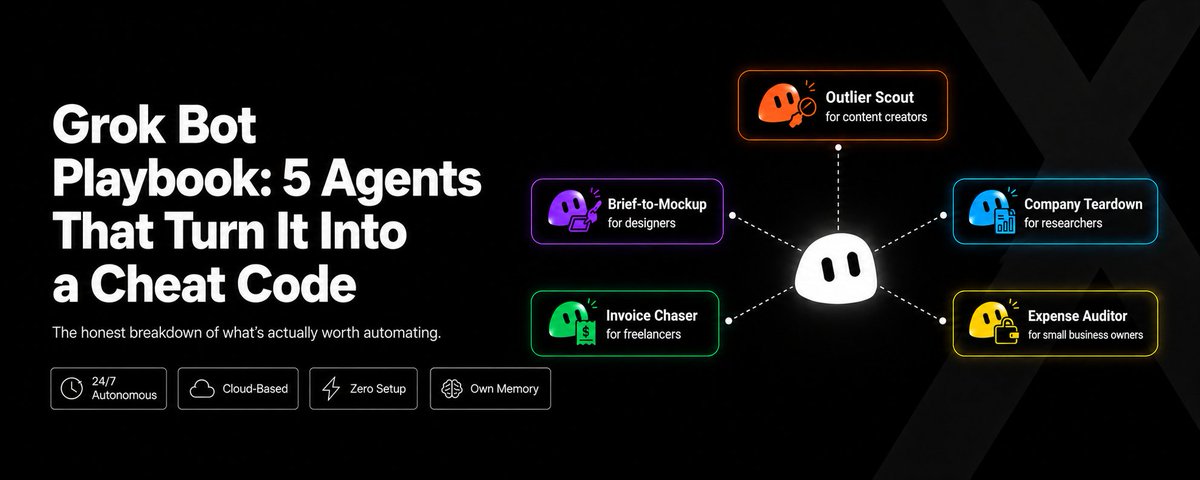
Part 5: The 5 agents worth building Anyone can list twenty bots, here's one for each kind of person, picked because it earns or saves real money, with the prompt ready to copy For the content creator, an outlier scout What it does: every morning it finds the posts and videos outperforming their own channels in your niche, and hands you the hook plus angles to write today The payoff: it replaces the hour of scrolling that used to start your day, and it runs whether or not you're at your desk
For the designer, a brief-to-mockup agent What it does: you drop a brief and it returns real mockups you can send, two directions, exported and ready The payoff: it turns a 3 hour session into a 15 minute review, so you take more work without more hours
For the freelancer, an invoice chaser What it does: it watches your unpaid invoices and drafts the reminders on a schedule, warmer at first, firmer later, so you stop leaving money on the table Result: one recovered invoice most freelancers would've written off can cover the whole subscription for the month
For the researcher, a company teardown agent What it does: you give it a company or project and it returns the same structured breakdown every time, model, revenue signals, weak points, the opening Result: half a day of scattered research per target collapses into one guided pass, and it runs overnight
For the small business owner, an expense auditor What it does: once a month it finds every recurring charge, flags what you don't use, duplicates, and price creep, and hands you a cancel list Result: it's pure saved money, most people find enough dead subscriptions in one run to pay for this several times over
Part 6: Does it actually pay off Here's the honest math, this costs about six times a normal chat plan, so it only makes sense if you have recurring work with a stable shape If you do, it pays for itself fast, one recovered invoice, one round of cancelled dead subscriptions, one prospect closed off a teardown you ran overnight, any one of those can cover a month If your AI use is asking questions and reading answers, don't buy this, a $20 Claude plan does that better for a tenth of the price, and you'll learn more The move is simple, run the 7 day free trial on one real task you already do every week, not on a demo, and let it prove the number before you pay a cent
Conclusion The models were already smart, they were smart last year, what changed is that the layer around them, the one people spent a year wiring by hand, now comes prebuilt for anyone with a card That's a real change, and it's worth the noise it's getting, but it isn't for everyone and it isn't cheap For someone drowning in recurring work, it earns its price the moment one agent finishes one paid job, for everyone else it's an expensive way to do what a $20 plan already does Start the free week on the one task you already do every week, and let it either pay for itself or talk you out of it
Published on grokbot.sh. Cite the public log, not a prompt pack.