
Grok Bot Is Quietly Turning AI From Something You Use Into Someone You Hire
For the last 3 years, using AI has mostly meant sitting in front of a chat box. You type, it answers, you copy something, and then you give it the next instruction. Grok Bot is trying to kill that
Article
Job breakdowns
For the last 3 years, using AI has mostly meant sitting in front of a chat box. You type, it answers, you copy something, and then you give it the next instruction.
Grok Bot is trying to kill that loop.
On August 11, xAI launched Grok Bot: persistent AI teammates with their own computer that can sign into the tools you already use, move between apps and inboxes, keep working 24/7, remember how you like things done, and come back only when they actually need your approval.
That sounds like a small product update. I think it is a much bigger change.
Because the important part is not that Grok became smarter.
The important part is that Grok got a workplace.
The chatbot is slowly disappearing
Think about how most people use AI today.
You ask ChatGPT to research 10 companies. Then you paste the results into a spreadsheet. Then you ask it to draft emails, copy those into Gmail, check the replies yourself and return to ChatGPT with more context.
AI may do 70% of the thinking, but you still do 100% of the orchestration.
Grok Bot changes the abstraction.
Instead of saying “Help me do this,” you can increasingly say “Do this.”
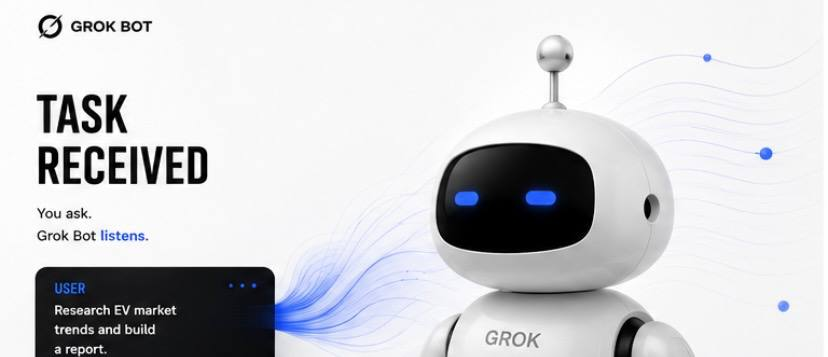
A Bot has its own persistent computer. It can work across multiple applications, retain context from previous conversations and keep executing when you are no longer sitting there supervising every step. xAI says its internal teams already created Bots for sales outbound, marketing campaigns, office operations and bug fixing before releasing the product publicly.
That distinction matters more than another benchmark win.
A model gives you intelligence. An agent gives that intelligence tools. A Bot gives the agent somewhere to live.
xAI spent months quietly assembling the pieces
Grok Bot makes more sense when you look at everything xAI shipped before it.
On July 16, Grok received Automations. You can describe a job once and have Grok execute it on a schedule or when an email arrives. Those jobs can use files, connectors and skills while running against current information each time.
Then came more infrastructure around applications and creation.
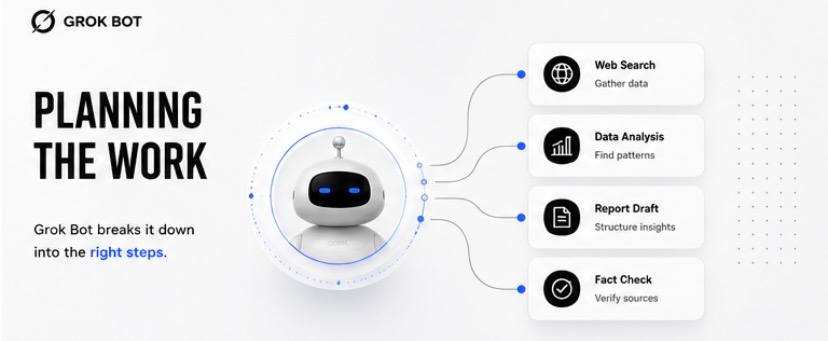
Grok can connect to email, files and calendars. Build Mode can create and publish functioning websites, apps, games and dashboards directly from a conversation. Grok Build operates as a coding agent with terminal execution, Git integration, memory, MCP servers, hooks, skills, subagents, background tasks and sandboxed execution.
xAI even open-sourced the Grok Build harness in July, exposing the agent loop, context assembly, tool-call dispatch system and extension architecture behind it.
Then, one day after Grok Bot launched, xAI released Grok 4.6 with an explicit focus on long-running agents and tasks that span many steps across research, coding and knowledge work.
Look at those pieces together:
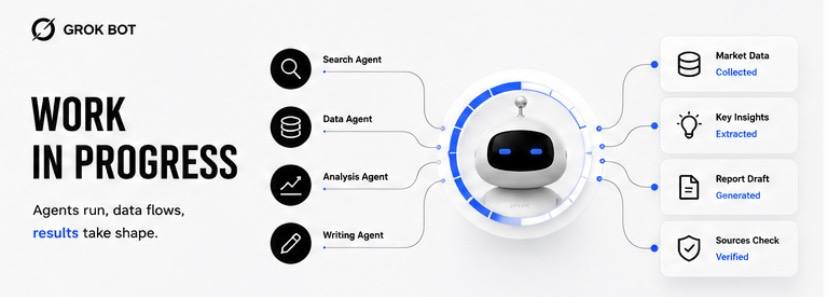
Memory → Skills → Connectors → Tools → Automations → Background execution → Persistent computer.
Grok Bot is not really one new feature. It is the layer that connects everything underneath it.
Imagine hiring the workflow instead of using the software
Take one boring example: outbound sales.
A normal AI workflow might look like this: you export 100 leads, ask an AI model to research them, move the useful information into your CRM, ask for personalized messages, review those messages, send them, check replies the next day and repeat the process.
Now imagine giving one Bot a persistent instruction instead.
Research every new qualified lead. Check their website and company information. Determine which product angle is relevant. Prepare personalized outreach. Update the CRM. Watch the inbox. When a prospect replies positively, prepare the response and ask me before sending anything important.
That is a completely different product.
The output is no longer text. The output is completed work.
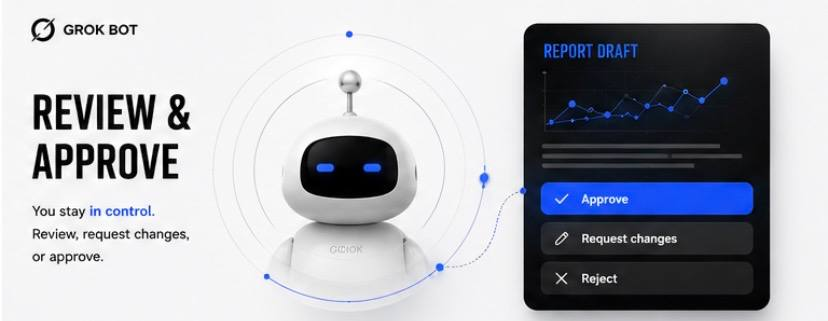
And the human moves from operator to approver.
Approval may become the most valuable interface
People usually imagine autonomous agents as systems that never need humans.
I suspect the more useful model is the opposite.
Humans remain in the loop, but the number of places where they need to intervene collapses.
Instead of making 40 tiny decisions during a workflow, you might make three important ones: approve this campaign, approve this purchase, approve this code change.
Everything between those checkpoints becomes machine work.
Grok Build already demonstrates this philosophy with its Plan Mode: complex changes can be proposed first, with edits blocked until the user approves the plan.
That could become the interface for a huge amount of knowledge work.
Not click → type → copy → paste → click → repeat, but assign → inspect → approve.
24/7 matters more than it sounds
A human employee has working hours. Traditional software waits until someone opens it. A persistent agent has neither limitation.
That doesn’t mean one Grok Bot suddenly replaces an employee.
It means a completely new category of task becomes economically interesting: work that is individually too small, repetitive or fragmented to justify constant human attention.
Checking an inbox every 15 minutes, re-running research when data changes, watching bugs, preparing daily reports, updating internal records, researching every incoming lead, running recurring operational checks.
None of these tasks is impressive.
Together, they consume enormous amounts of time.
And that is exactly why boring agents may ultimately be much more valuable than spectacular demos.
The next AI benchmark may be hours returned
For years, the AI industry has competed on model intelligence: context windows, tokens per second, coding benchmarks, math benchmarks and reasoning scores.
Those still matter.
But persistent agents introduce another metric:
How many human actions disappeared?
If a workflow previously required 46 manual actions and now requires 4 approvals, that may matter more to a company than a few additional benchmark points.
If an operation previously required someone to check five applications every morning and an agent can continuously monitor all five, the product has created value before generating a single beautiful paragraph.
The interesting unit becomes less about tokens produced.
It becomes hours returned.
And this changes what software itself looks like
Software used to expose features.
Photoshop gives you tools for editing an image. Salesforce gives you interfaces for managing customers. Excel gives you cells, formulas and functions.
The user learns the interface and operates the machine.
Agents invert that relationship.
The interface increasingly becomes the outcome.
You don’t necessarily need to know where every button is if an agent can operate the application for you. You don’t need to understand every CRM field if your Bot understands the process that those fields represent.
And eventually, software companies may have to ask an uncomfortable question:
If an agent operates the interface better than the user, how much of the interface does the user still need?
We may be moving from software subscriptions to digital labor
SaaS taught companies to pay monthly for access to tools.
The agent era could teach them to pay for completed operations.
That is a subtle but enormous difference.
A company buying software asks: “What can this product help my employees do?”
A company buying an agent asks: “What work can I stop assigning to employees altogether?”
That does not mean entire jobs disappear overnight. Most jobs are collections of dozens of different tasks, relationships and decisions.
But software does not need to replace a job to have enormous economic value. It only needs to remove enough repetitive pieces of it.
10 minutes here. 25 minutes there. One report every morning. One spreadsheet nobody wants to update. 300 leads nobody has time to research.
That is how automation usually enters businesses.
Not dramatically.
One boring workflow at a time.
Grok Bot is still early
There are obvious caveats.
Grok Bot launched in beta, and xAI initially limited access to a smaller group of higher-tier users.
Persistent agents also create new problems around permissions, reliability, security, cost and deciding which actions should ever happen without explicit approval.
Giving AI a computer is far more powerful than giving it a chat box. It is also far more consequential when the AI gets something wrong.
Those problems are not details. They may determine which agent platforms actually survive.
But the direction is becoming difficult to ignore.
The last generation of AI waited for you to open a tab. The next generation gets an account, a computer, a memory, a set of tools and a job.
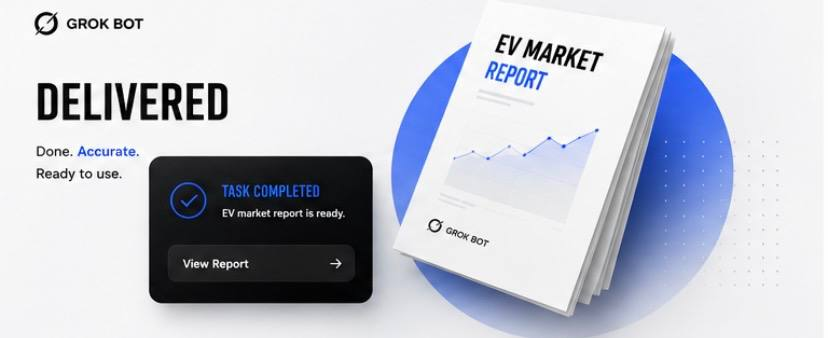
Grok Bot is still early, but the shift is already visible: AI is moving from something you actively use into something you can assign work to.
And once that transition becomes reliable enough, the biggest advantage may no longer come from knowing how to prompt AI better.
It may come from knowing what work to hand over first.
Thanks for reading.
Follow @Lummox_eth for more deep dives into AI, GitHub, agents and unusual ways to use new technology.
Bookmark this article.
I’ll be breaking down real Grok Bot workflows, experiments and use cases next. Stay tuned.
Published on grokbot.sh. Cite the public log, not a prompt pack.