
Broadcom Names the Custom Buyer. Google Posts the Cheap Price.
AI chip sales hit $16.7 billion. Anthropic becomes the 2027 account. Gemini 3.8 Flash ships the same afternoon. September 3, 2026 Broadcom printed the custom book on Wednesday. Fiscal third-quarter
Article
Job breakdowns
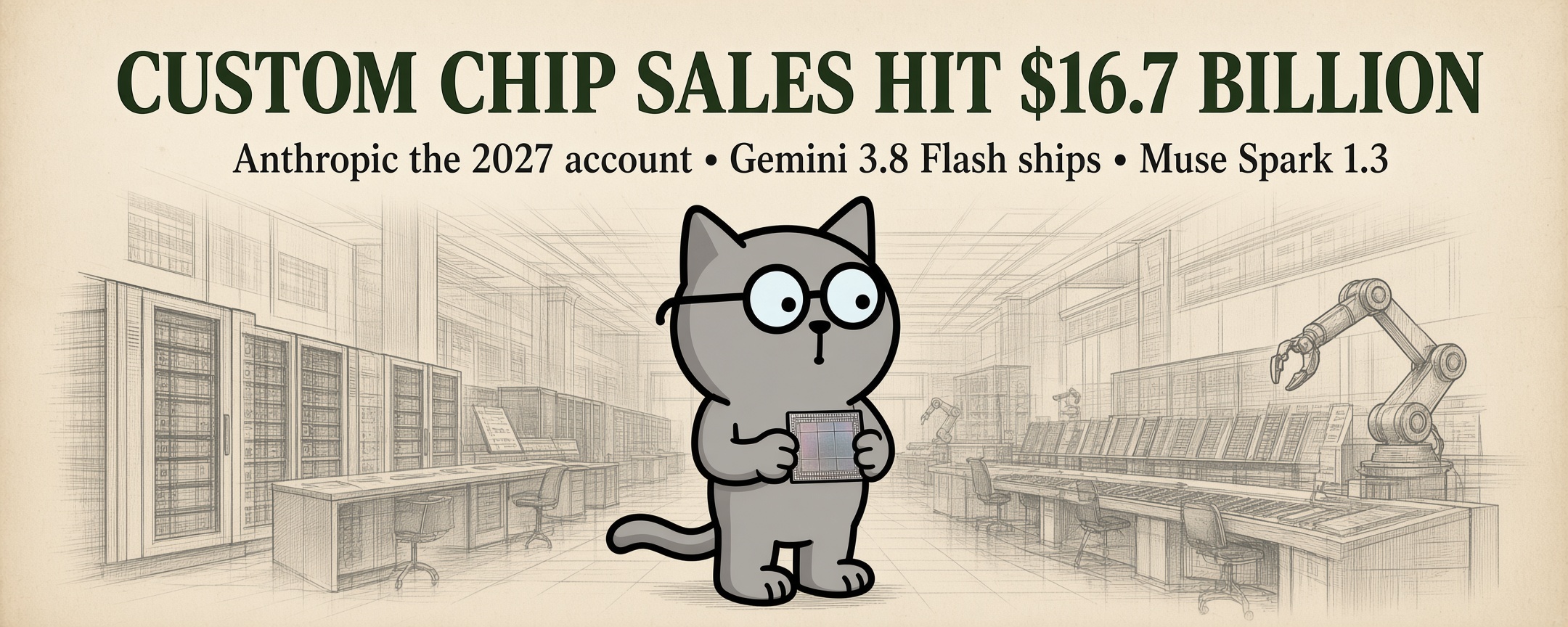
AI chip sales hit $16.7 billion. Anthropic becomes the 2027 account. Gemini 3.8 Flash ships the same afternoon.
September 3, 2026
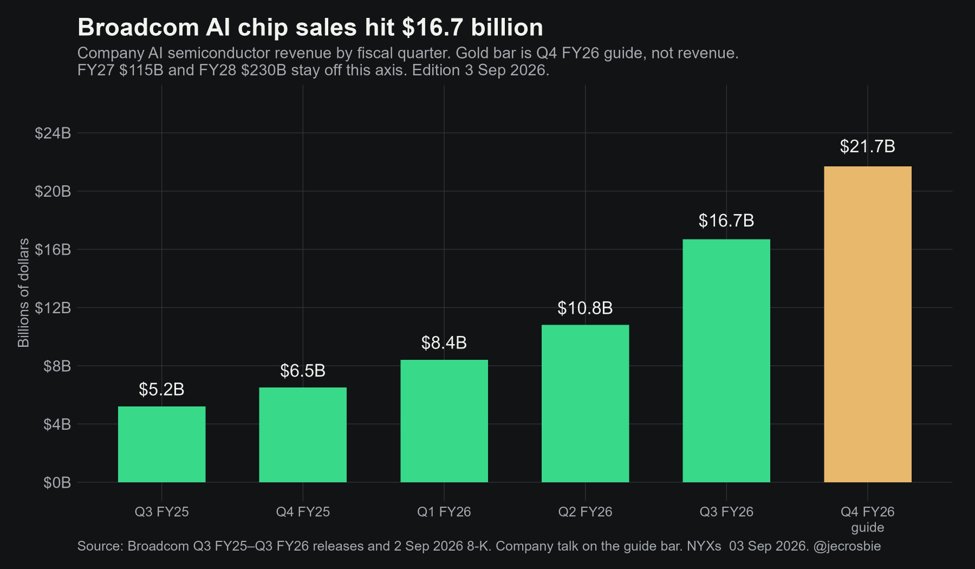
Broadcom printed the custom book on Wednesday. Fiscal third-quarter revenue was $29.59 billion against about $29.36 billion expected, up 86 percent from a year earlier. AI semiconductor revenue reached $16.7 billion, up 221 percent year over year and 54 percent from the prior quarter. That print is the fifth green bar in the figure. Non-GAAP earnings were $3.32 a share against $3.24. Free cash flow was $13.66 billion. Semiconductor solutions now make 70 percent of the firm.
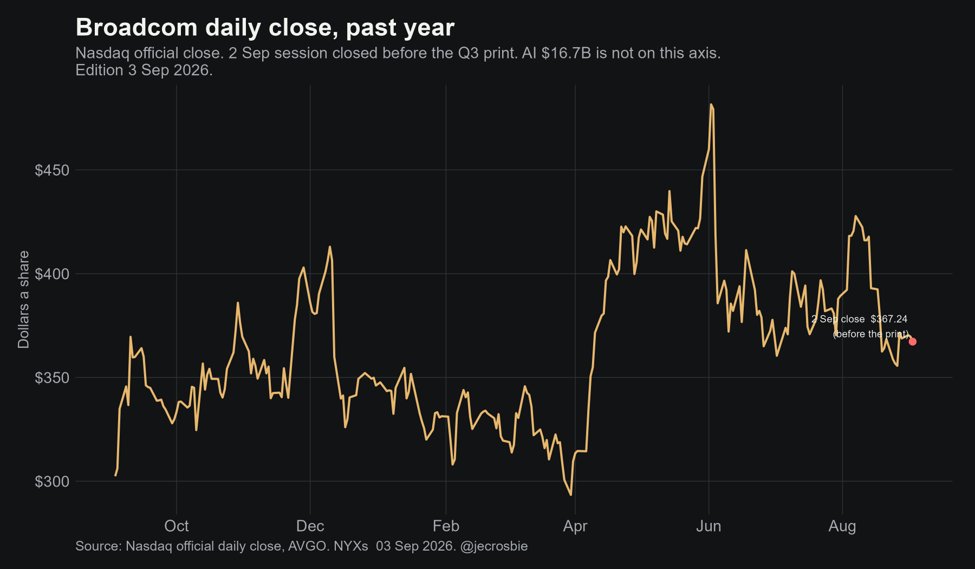
The tape sold the miss first. Fourth-quarter total revenue was guided at about $34.8 billion against a Street number near $35.03 billion. Shares slipped a few points after the bell. The official close on 2 September, $367.24, is the last session before that print. It is marked on the price figure. Then the call circulated. Hock Tan raised the fiscal 2026 AI chip outlook to $58 billion from $56 billion. He said the company has secured supply to double that book again, to about $115 billion in fiscal 2027, and has line of sight to about $230 billion in fiscal 2028. Demand, he said, exceeds the outlook. Supply is the bind. Those two years stay off the revenue figure.
The buyer list is the new chapter. Tan said Anthropic is on track to become Broadcom’s largest custom-chip customer in 2027 and to hold that rank in 2028, taking it from Google. He sketched 5 gigawatts of Broadcom silicon to Anthropic next year and 10 gigawatts the year after. Jalapeño, OpenAI’s first custom accelerator, shipped in the quarter. The company says it beats Nvidia’s Grace Blackwell on inference. OpenAI is down for about 1.3 gigawatts of Jalapeño in 2027 and more than 5 gigawatts of the next part in 2028. Meta is down for about 3 gigawatts of its own MTIA chips. “We have six customers,” Tan said. “Four of them are just simply going to be huge.” Those allocations are his.
Tuesday’s page carried an unconfirmed $35 billion cloud lease for Anthropic at Hut 8’s Beacon Point campus in Nueces County, Texas, about 350 megawatts, with Nvidia on the paper. Nobody filed it. Wednesday’s transcript does not name that slab. It names the die and the gigawatts. Do not staple the two. Lasers are the constraint Tan will talk about. Demand for EML and CW parts, he said, is far past industry supply even after Broadcom tripled its own capacity. A Singapore plant is slated to start substrates in fiscal 2027.
The workhorse and the locked twin
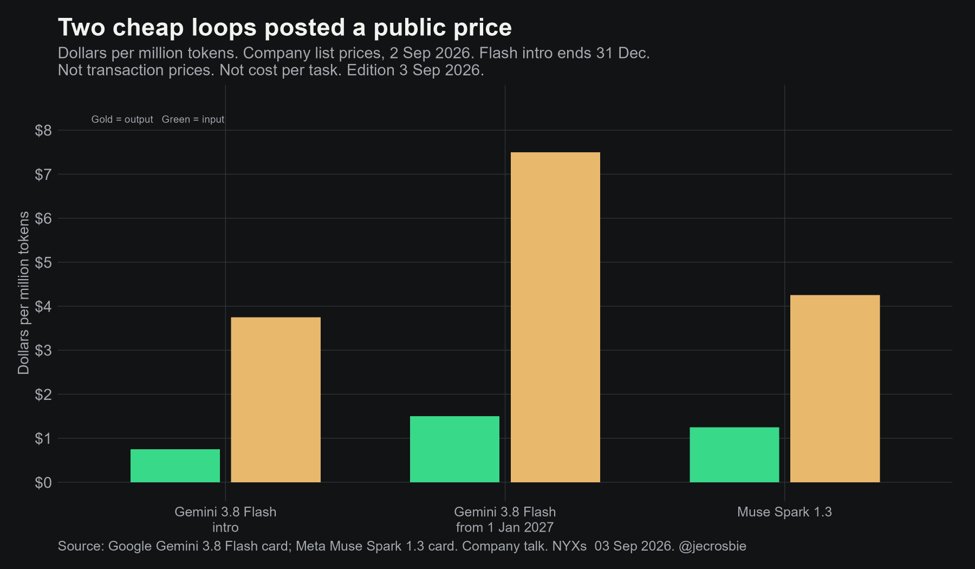
Google stopped being a rumor. Gemini 3.8 Flashis on the public API. It is the third Flash drop in six weeks, three weeks after 3.7. Introductory price is $0.75 a million input tokens and $3.75 a million output tokens through December 31. On January 1 the list becomes $1.50 and $7.50. Context is 1,048,576 tokens in and 65,536 out. The company says the model approaches larger frontier nets on long software jobs at Flash cost. It also warns the net may burn more tokens at higher effort. A cheap sticker is not a cheap job.
A second card, 3.8 Flash Cyber, is not on that API. It goes through a new program called Fairwind, for trusted defenders. Google puts the list near 650 names. CrowdStrike and the Center for Internet Security sit on it. Company framing: Chrome security produced 2.6 times more correct patches than larger commercial models. Cloud researchers found one critical hole in under two hours. On one public board the gated model’s pass rate, 47.2 percent, sat a hair under a larger frontier net at 47.8 percent and cost less. Those marks are Google’s and its partners’. The public Flash carries tighter cyber and biological locks. The sharp tool stays on a list. That is the same split OpenAI drew around Astra on Tuesday. Do not reprint the Critical tag. Reprint the cousin.
The other cheap loop
Meta put Muse Spark 1.3 into Muse Code and its model API the same afternoon. List price did not move. It is still $1.25 a million input tokens and $4.25 a million output tokens. Cached input is 15 cents. Alexandr Wang, who runs the lab, called it frontier performance almost too cheap to meter. That is his line. A contributor tier that lets Meta train on the work sells for pennies and already takes a meaningful double-digit share of Muse Code seats, he told Axios. The three posted stickers , Flash now, Flash from 1 January, and Spark , are in the price figure. They are list prices, not trades.
Artificial Analysis scored the shipping variant at 61 on its Intelligence Index, up from 57 in August. A max-reasoning preview still in partner hands scored 62, behind only Fable 5.1 and Opus 5 on that board. Cost per Index task ran about 55 cents, against 94 and 95 cents for two larger peers. Meta’s own coding comparison said the new net used about 20 percent fewer tool calls and 25 percent fewer tokens than the last Spark. Mark Zuckerberg said a larger model named Watermelon and open Spark weights are coming soon. A post is not a weight file.
Elon Musk put a date on the next Grok. On 1 September he wrote that Grok 4.7 comes out in 10 days. That is about 11 or 12 September. A promise is not a card. It sits on the same board as Fable 5.1 and the two cheap loops that posted Wednesday.
A Shanghai book and a Valencia switch
Tencent-backed Enflame, the last of China’s four little AI-chip houses to list, priced 43 million STAR Market shares at 142.18 yuan (about $20). The raise is about 6.1 billion yuan (about $908 million to $911 million). The online book was 6,109 times subscribed. The winning rate for those accounts was 0.025 percent. Bloomberg, reading the retail slice, put that book at 4,073 times. Print both. The company is eight years old and still unprofitable. Proceeds are marked for fifth- and sixth-generation chips. A stampede is not a margin.
In Valencia, iPronics closed a $125 million growth round. Maverick Silicon and Light Street led. Nvidia joined the cap table. Total raised is $177 million. The product is an optical circuit switch, a box that rewires a data-center network with light instead of copper. Google has used that idea inside its own clusters for years. iPronics says it can shrink the merchant version about twentyfold and flip the map in less than a millisecond. It has been shipping for about a year. Tan’s laser comment and this check are the same sentence.
Seats, agents, and a fifth hall
Snowflake beat the quarter. Revenue was $1.55 billion, up 35 percent. Its CoCo coding agent now sits in 9,100 accounts. Full-year product sales were lifted to $6.07 billion. Shares jumped about 20 percent after the bell. Wonderful, an agent-deployment shop founded last year, took $550 million at a $5 billion valuation. Insight led. Salesforce wrote the first outside check. Headcount is about 650, aimed at 1,000. That is forward-deployed labor priced like a lab. Hewlett Packard Enterprise printed $12.2 billion of quarterly sales and a $3.5 billion server order with an unnamed cloud firm.
Ramp, reading its own expense tape, said 80 percent of OpenAI and Anthropic enterprise revenue still comes from 1 percent of customers, heavy in tech and in other AI shops. That is Ramp’s book, not the labs’ 10-K. A CloudBees survey of more than 200 technology leaders found 92 percent called AI-written code production-ready before it shipped. After it shipped, 81 percent of that group reported more production issues. OpenAI told two House Democrats it is building automated shutdown tools. The administration filed a brief in the New York Times case arguing that training on copyrighted work is generally fair use.
Southaven, Mississippi, approved a 600,000-square-foot SpaceXAI hall on a 51-acre swap next to the plant rising on Stanton Road. It is the fifth site in that Memphis belt. A municipal yes is not a megawatt filing. Texas motor-vehicle records added 106 Model Y cars to Tesla’s robotaxi register. The live book is 420: 375 Model Ys and the same 45 Cybercabs from Monday’s file. A midday tracker print of 314 was the book before that add. Waymo is 988 on the same register. Zoox is 44. A Cybercab event is set for downtown Austin at 4:45 p.m. Central on Thursday. France put two Full Self-Driving cars on the road after a meeting between Elon Musk and the transport minister. The possible EU-wide vote is still dated October 6. Grok Bot is now on Android. The same night Musk said the voice model can share a screen so it can read and control the car display.
What still counts
Tuesday’s page was a cheaper Anthropic loop, a gated exploit, and a Texas lease nobody filed. Wednesday’s page is who sold the custom die into that lease, and two cheap workhorse models that now sit next to Fable on the public boards.
A few hundred million missed on a quarterly guide is not the rank. Anthropic as Broadcom’s largest custom account in 2027 is the rank. Five plus ten gigawatts is a second receipt on a campus that still has no 10-K. The revenue figure stops at the printed $16.7 billion quarter and the $21.7 billion guide. Gemini 3.8 Flash is no longer a source. It is a list price and a January step-up. Flash Cyber is the locked twin. Muse Spark 1.3 is the other cheap loop. Those three stickers are the price figure. Grok 4.7 is a date, about 11 September, not a card. Enflame’s book is a bid, not a profit. iPronics is the networking half of a laser shortage. A 420-car register is 375 Model Ys and 45 Cybercabs, not a mile. A 600,000-square-foot vote is not a watt. The Fusion paper from Monday and the Nueces lease from Tuesday still sit under the new chapter. The new chapter is the die, the price, and the lock.
Published on grokbot.sh. Cite the public log, not a prompt pack.