
Grok Bot: The $30,000/Month Creative Engine, Run By One Person
You are running a one-person creative shop. You do the market research. You write the hooks. You track what's burning out. You handle the client emails. You chase the invoices. You reconcile the
Article
Job breakdowns
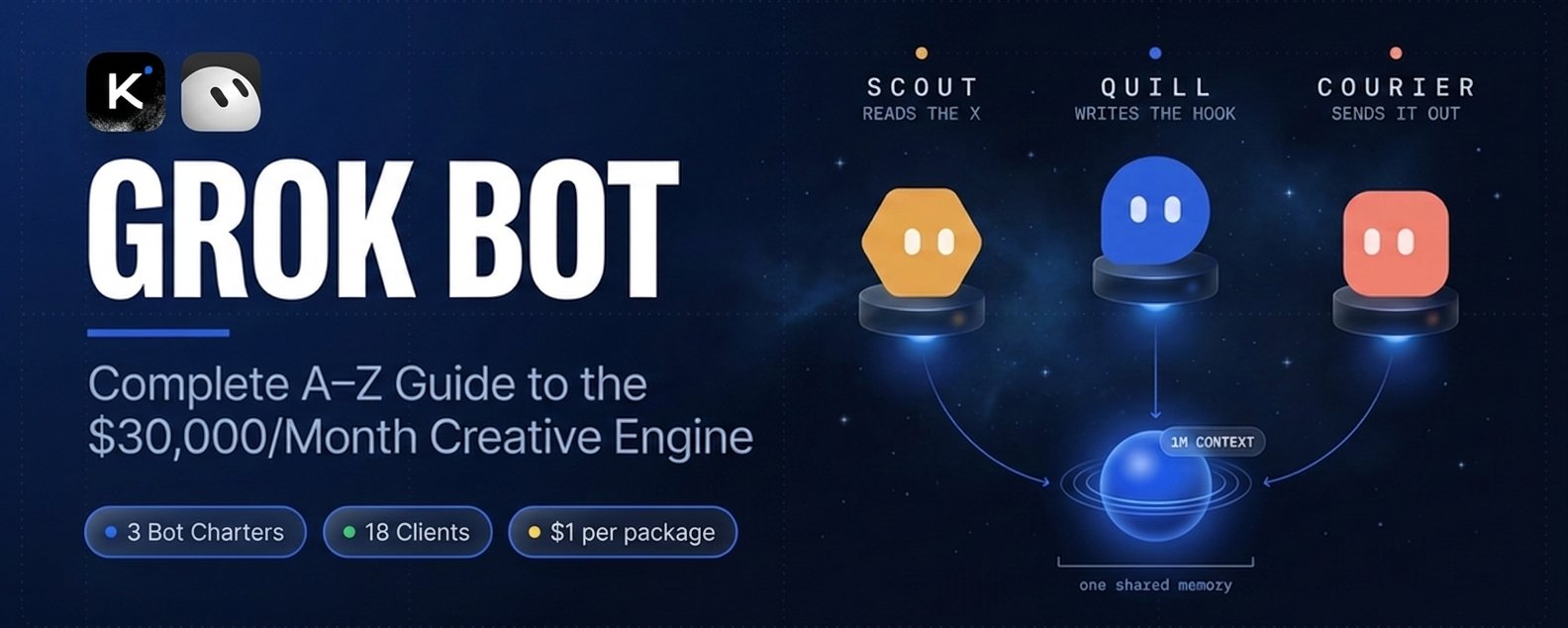
You are running a one-person creative shop.
You do the market research. You write the hooks. You track what's burning out. You handle the client emails. You chase the invoices. You reconcile the revenue.
By the time the week ends, half the list is still sitting there.
Bookmark this article before you forget.
The Split That Makes This Work
Most people pick one model and route everything through it. That's the mistake.
Grok Bot is the hands. Each bot gets its own cloud computer. It signs into your real tools, clicks through interfaces, searches X in real time, sends emails, fills forms. It keeps working after you close your laptop. What it cannot do is hold enormous amounts of context cheaply.
Kimi K3 is the head. It doesn't click anything. It thinks over volume — the full client brief, every creative you've ever made for them, all the performance data, this week's research — all at once in a 1M context window, at $3/M input and $15/M output.
The division is clean: anything requiring a browser or live X goes to Grok Bot. Anything requiring volume and judgment goes to K3.
Run creative production through Grok alone and you'll pay premium rates to reason over context it can barely hold. Run research through K3 alone and you'll find it has no access to what people said on X twenty minutes ago.
Together they cover the whole job.
Grok Bot and Kimi K3 don't make you faster at these tasks. They remove you from them.
Why Creative Is the Right Business for This
Ad creative has a shelf life. Meta and TikTok both punish repetition — the same hook stops converting somewhere between the tenth and twentieth impression on the same audience.
Every agency knows this. None of them have enough volume.
The usual fixes all fail. More copywriters kills your margin. Recycled creatives kill performance. Generic AI output sounds like generic AI output, which converts worse than the burned-out creative it replaced.
What makes AI creative actually work isn't the model — it's whether the model knows what's happening in the market this week. That's the gap this system fills, and it's why the research layer isn't optional.
The Business, Before the Build
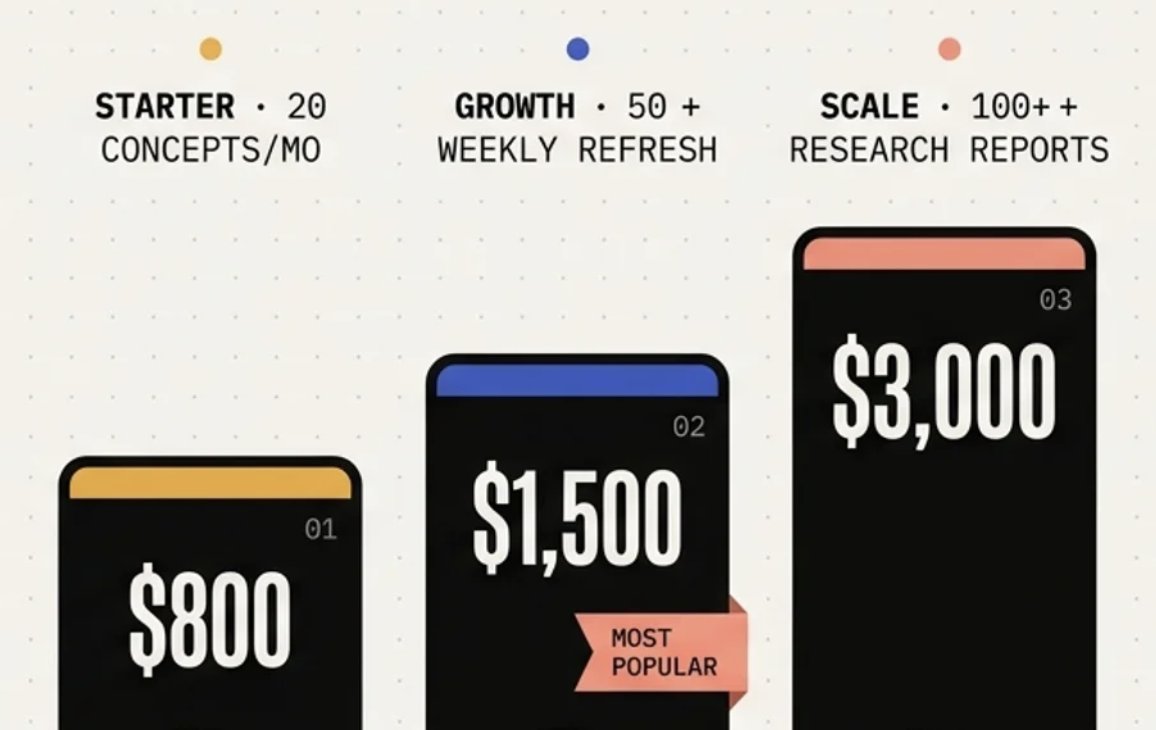
-
15 clients on Growth = $22,500
-
3 clients on Scale = $9,000
-
Total: $31,500
Eighteen clients. That's the target — not a revenue number, a headcount. Aim at that instead.
Running costs per client package: roughly $0.40 for Grok research with X Search, $0.60 for K3 production. About $1.
Eighteen clients with weekly refreshes lands under $100/month in API spend, plus whatever tier gets you Grok Bot access.
The interesting part isn't the margin. It's that production capacity stops being your constraint and client acquisition becomes it — a completely different problem.
Step 1 — Get Access
Grok Bot: SuperGrok Heavy at $300/month, Cursor Ultra at $200/month, or Cursor Teams Premium at $120/month per seat — all three open the same app.
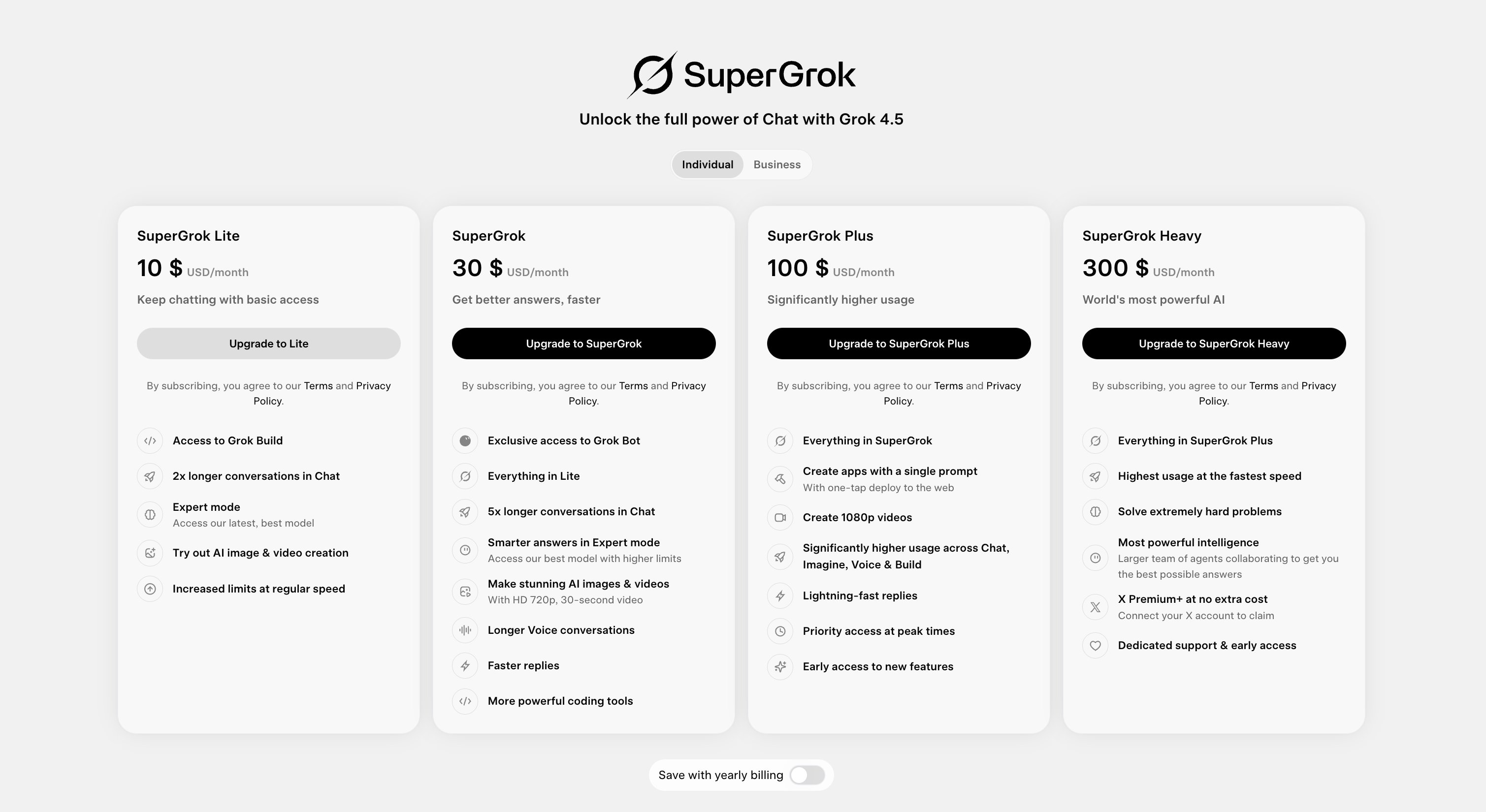
Download at x.ai/bot
Sign in, about four minutes to your first bot running.
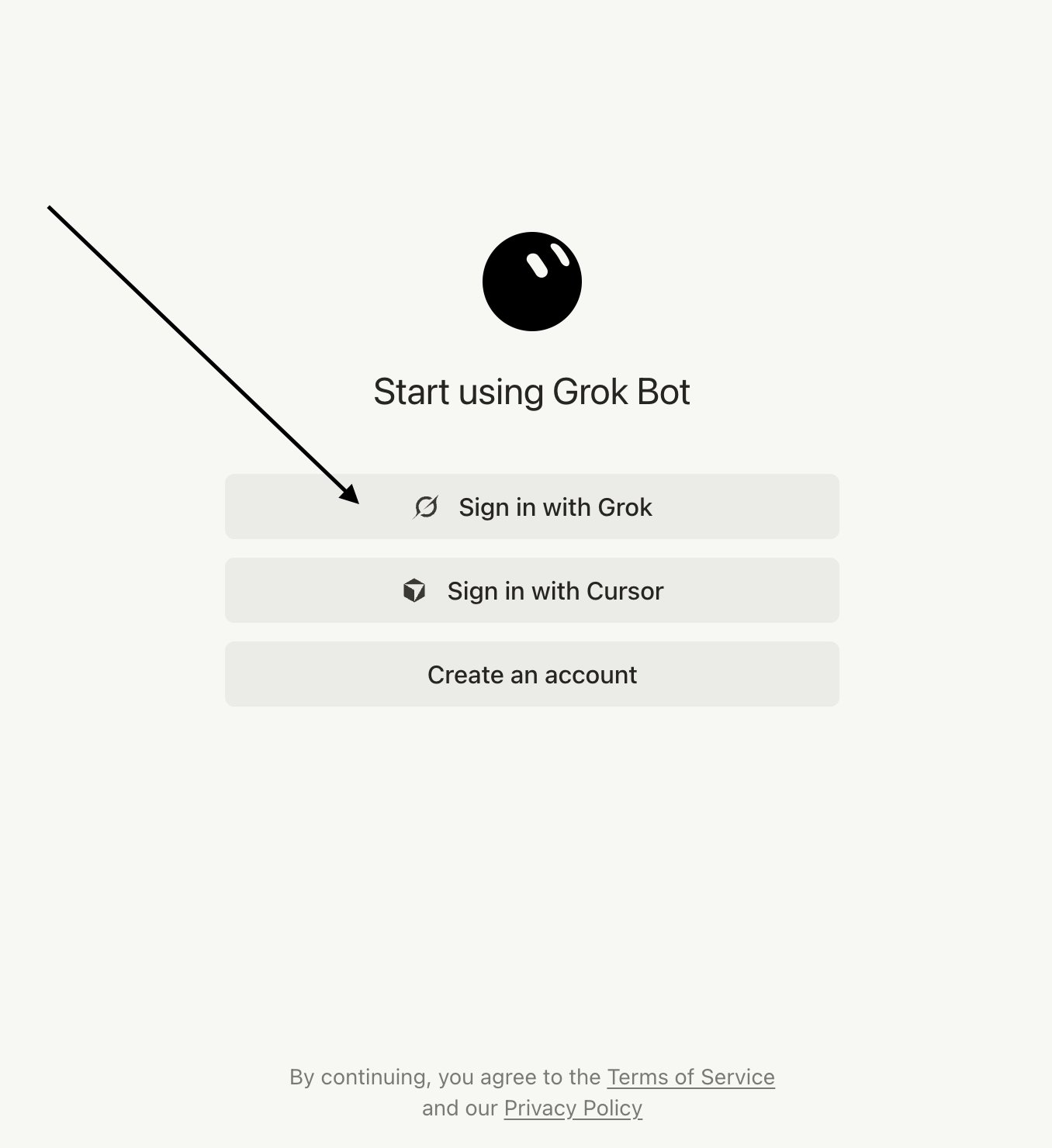
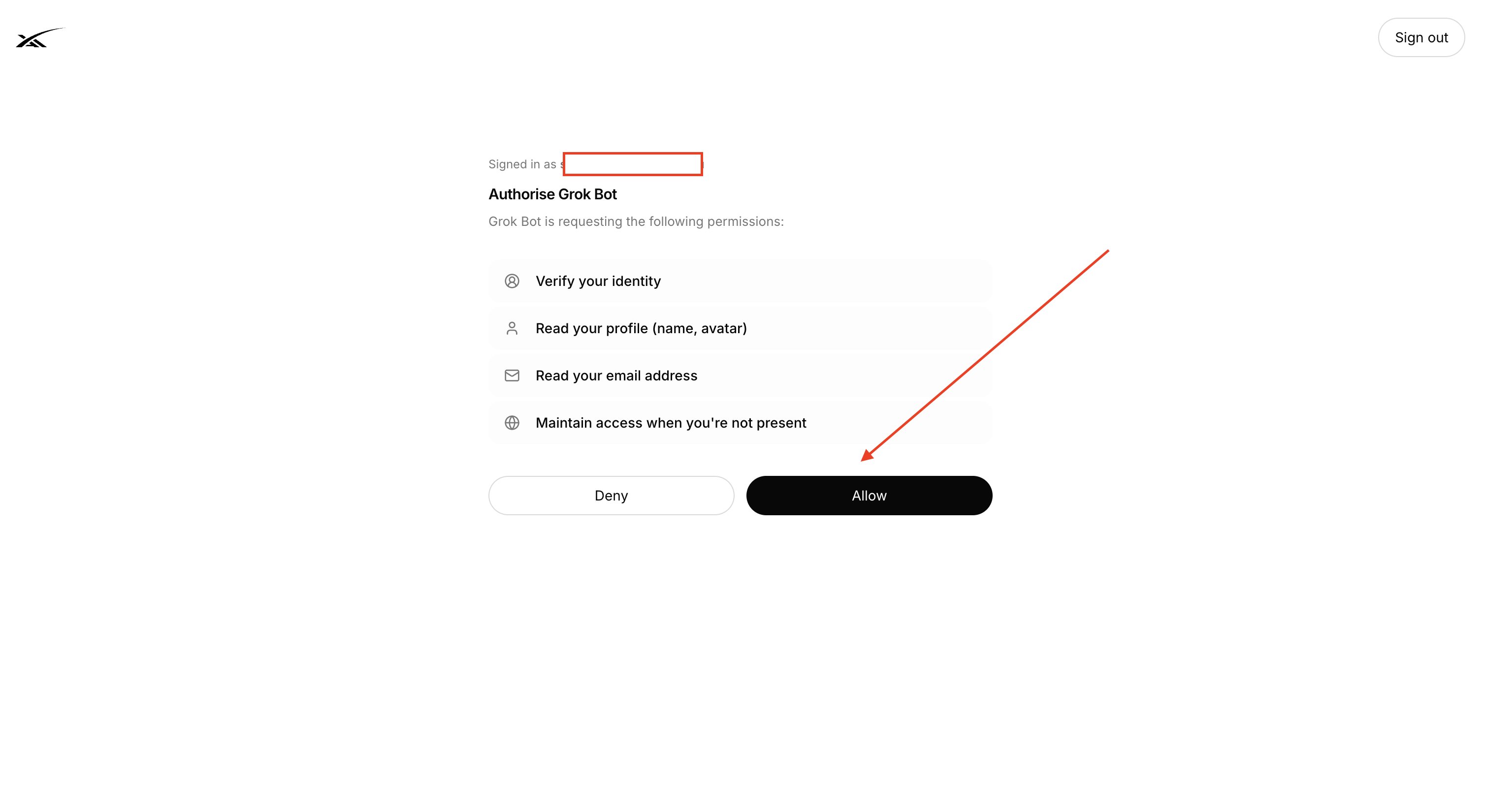
Once you've logged in, you can use the product
During onboarding it asks what tools you use daily. Pick your stack — Gmail, Slack, Notion, whatever your CRM is. The bots know where to operate before you ask them anything.
Kimi K3: How to Install Kimi Code (The Terminal Agent)
If you want K3 running inside your actual codebase instead of a chat window, this is the setup.
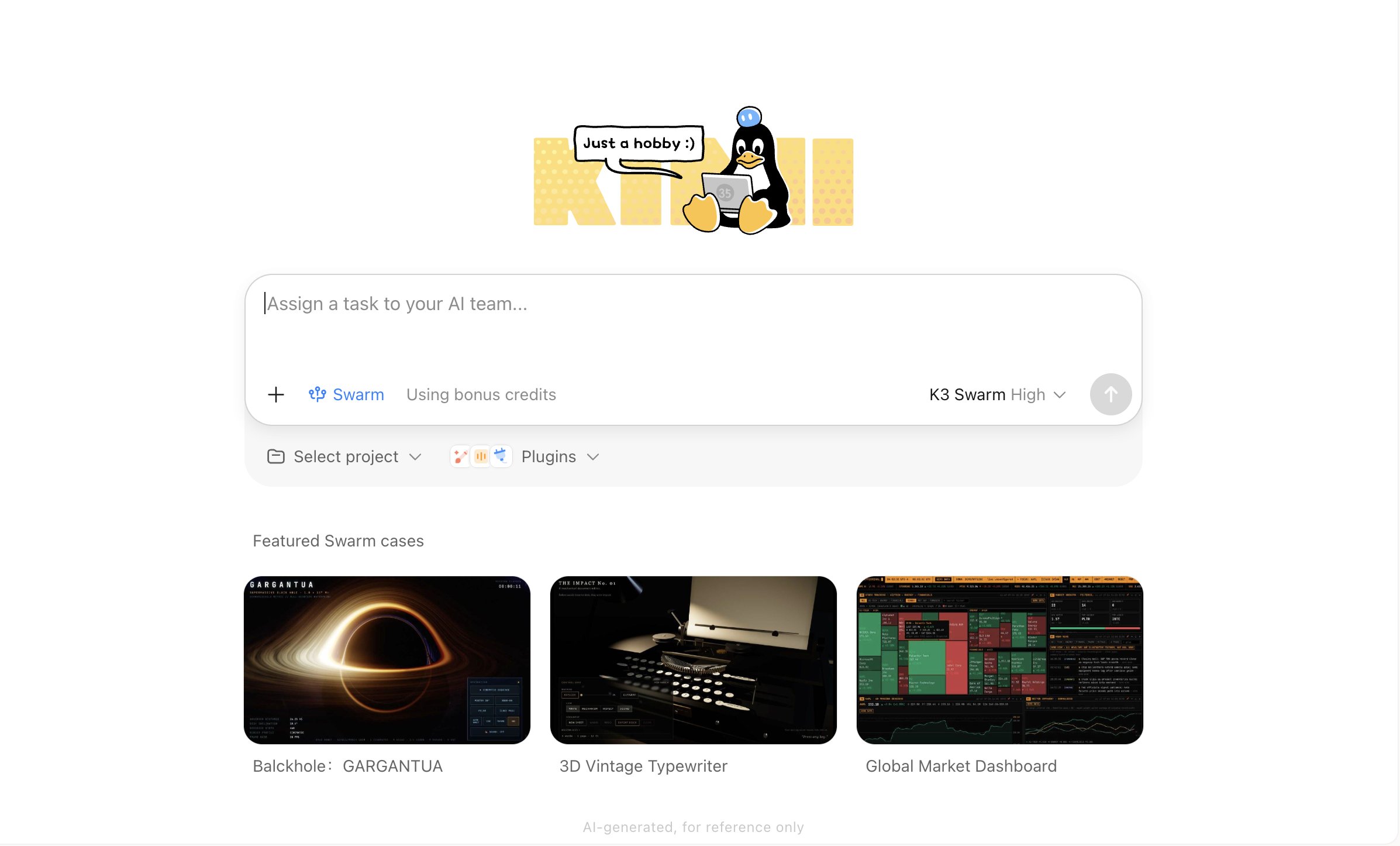
Requirements:
-
A computer (Mac, Windows, or Linux)
-
Terminal access
- Kimi account —kimi.com
Step 1.1 — Install Kimi Code
Mac/Linux:
Windows (PowerShell):
On Windows, install Git for Windows first — Kimi Code CLI uses its bundled Git Bash as the shell environment.
Verify the install:
Due to macOS Gatekeeper, the first run may take noticeably longer. Add your terminal app in System Settings → Privacy & Security → Developer Tools to speed up later launches.
If you already have uv installed, you can install directly:
Kimi Code CLI supports Python 3.12–3.14, with 3.13 recommended for best compatibility.
Step 1.2 — Navigate to your project and launch
On first launch, run /login inside the session to configure your API source — it opens a browser window for OAuth.
Check - https://www.kimi.com/en/help/kimi-code/cli-getting-started
Step 1.3 — Give it a task
Kimi Code is now running inside your project, with direct read/write access to every file. Describe a task in plain English — it plans the steps, edits the code, runs tests, and reports what it did.
One account, one shared cloud computer, up to 50 bots. Files, browser sessions, and logins are shared across all of them. Connect Gmail once and every bot you ever create can use it.
Step 2 — Hire Bots, Don't Prompt Them
A prompt is a request. A bot is a role.
Name it after a job a person could hold. Then write its charter the way you'd brief a hire on day one: what it owns, what good output looks like, and what it must never do without asking.
That last part isn't paperwork. It's the thing that lets you leave a bot running unattended — you define where its authority stops, once, instead of worrying about it daily.
Bots that ask about everything are useless. Bots that never ask are dangerous. The charter is where you draw that line.
The Three Bots You Need
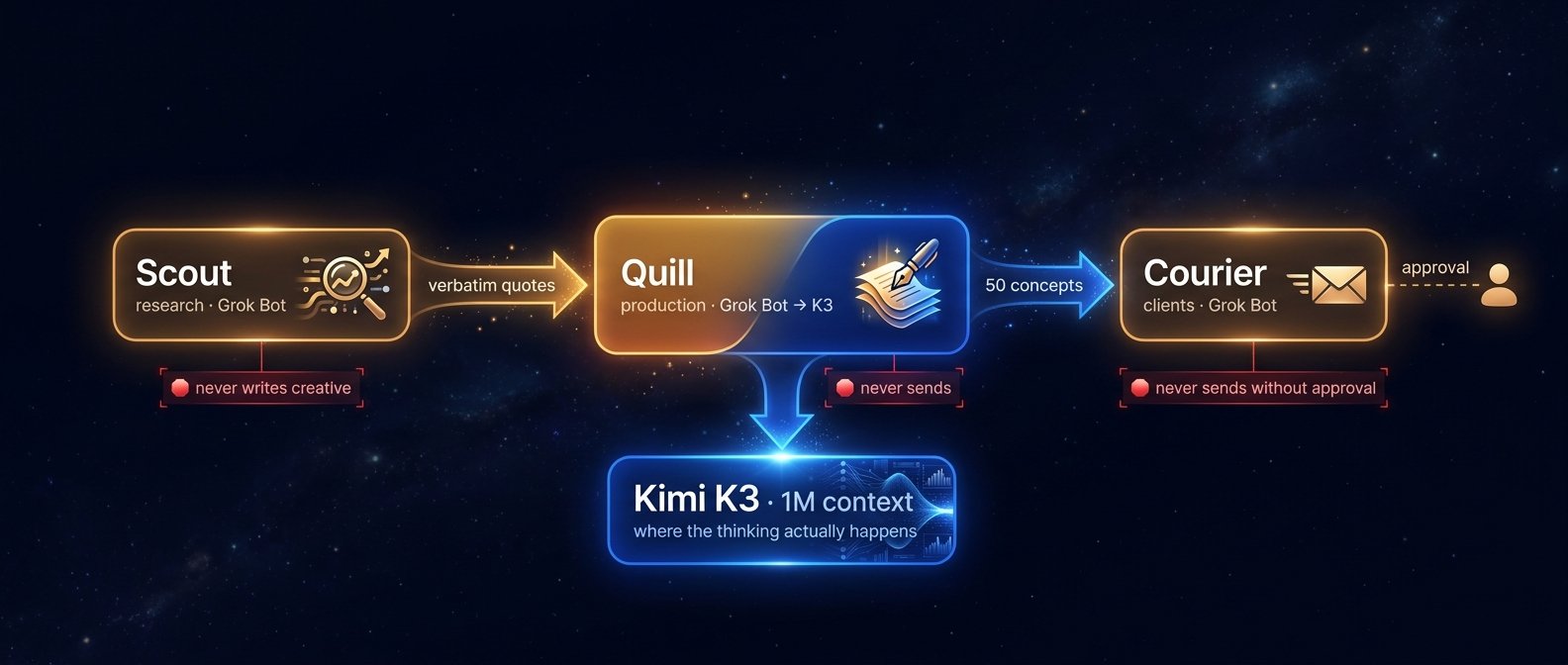
Bot 1 — Scout (Research)
Lives in Grok Bot. This is the one nothing else can replace.
The verbatim requirement is the whole competitive advantage. A copywriter guesses how people talk. Scout brings back the actual sentences.
The "don't clean up how someone wrote" line is load-bearing — models normalize language by default, and normalized language is precisely what makes ad copy sound like ad copy.
Bot 2 — Quill (Production)
Lives in Grok Bot, but calls K3 to do the actual thinking.
The prompt Quill sends to K3:
Requiring each concept to cite its research finding is what keeps this grounded. Without it, the model produces plausible ad copy from training data. With it, everything traces to something a real person said this month.
The 1M context is what makes "different from every previous creative" enforceable — you're not asking for creativity in a vacuum, you're handing over the full history and demanding no repeats.
Bot 3 — Courier (Clients and Money)
Lives in Grok Bot. Touches clients, so its boundaries are the strictest.
One client relationship mistake costs more than any efficiency gain. That's why Courier drafts and never sends.
Step 3 — The Group Chat
Put all three in one chat and give them an objective, not a task list. A task list means you already did the decomposition — which is the part you're trying to hand off.
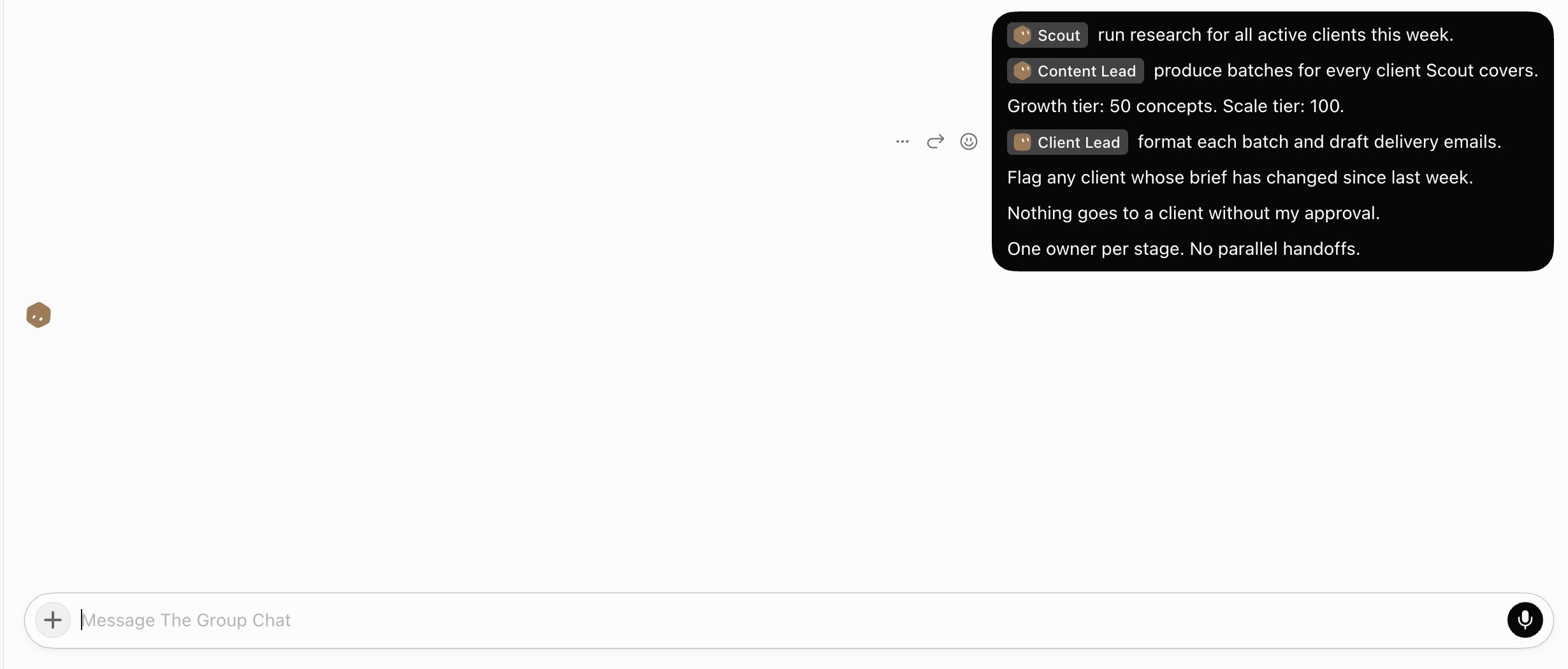
@Scout run research for all active clients this week.
@ContentLead produce batches for every client Scout covers. Growth tier: 50 concepts. Scale tier: 100.
@ClientLead format each batch and draft delivery emails. Flag any client whose brief has changed since last week.
Nothing goes to a client without my approval. One owner per stage. No parallel handoffs.
Optional fourth bot, once you're past eight clients — a coordinator whose only job is running the other three:
Step 4 — Schedules That Run the Week
The whole operation on four triggers:
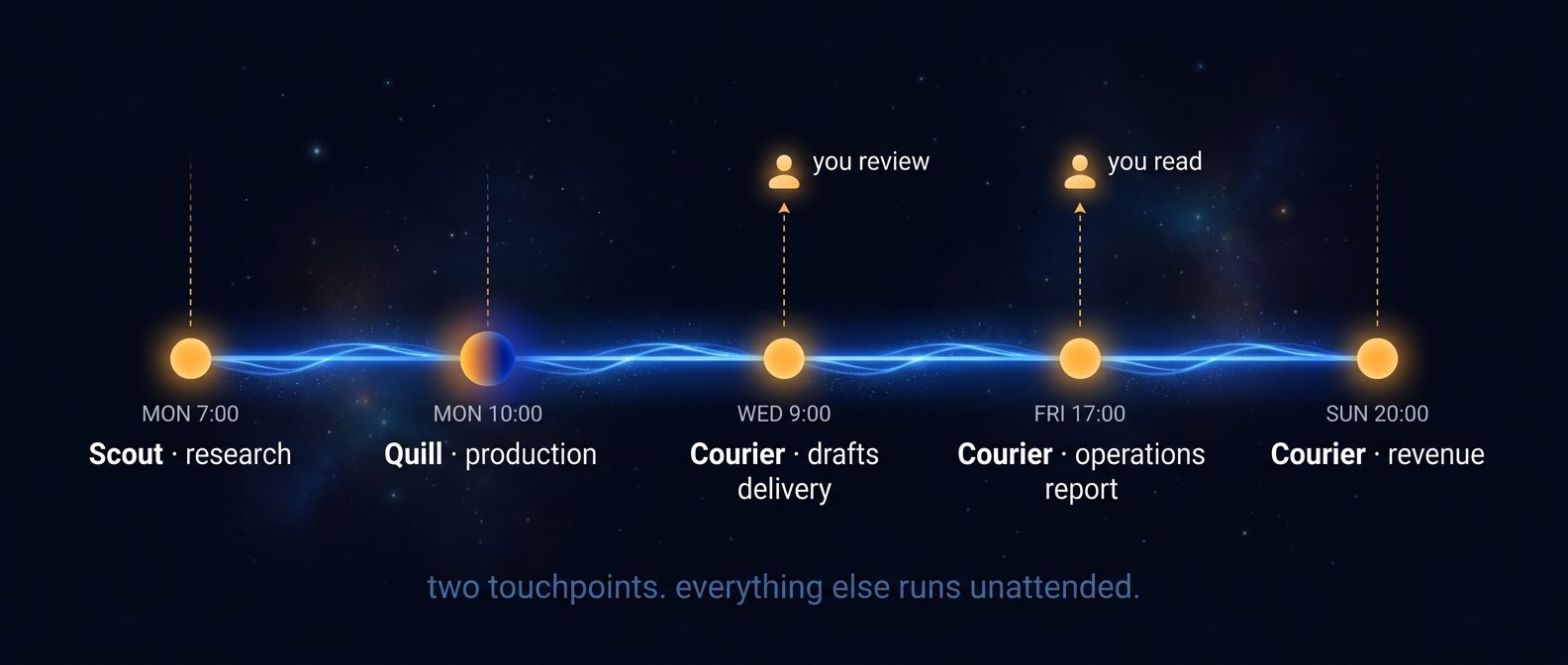
You review drafts Wednesday morning and read a summary Friday. That's the week.
Step 5 — The Weekly Refresh Loop
This is where recurring revenue actually comes from, and where most people building this stop.
That constraint separates this from a content mill. Winners get extended structurally, not recycled. The client sees compounding improvement instead of diminishing returns — which is the actual reason they don't churn.
What You Deliver
Concepts, not finished assets. This matters for margins.
Your deliverable is a document: hooks, scripts, angles, and the research behind them. The client's team or their editor turns those into finished creatives.
You could add production. Video generators exist. But it changes the business — production is where time goes, where revisions live, and where your margin dies. The reason this reaches $30K solo is that you never open a timeline.
Position it honestly: you are the creative strategy layer, not the production house. Agencies understand that distinction and pay for it.
Getting the First Five Clients
The bottleneck no stack solves.
Lead with a free audit, not a pitch. Have Scout run research on a prospect's category. Send the audience language findings and three concepts built from them. Costs about $1, takes fifteen minutes, and beats any deck.
Where they are: agencies posting copywriter job ads — they have the need and the budget right now. Brands whose Meta Ads Library shows the same three creatives running two months — they're stuck. Media buyers complaining about creative bottlenecks on X, which Scout can find for you.
Price the first three low. $500 for what you'll later charge $1,500. You're buying case studies, and those are worth more than the difference.
Raise prices on new clients only. Never the first three. They're your proof.
Realistic timeline to eighteen clients: three to six months of serious outreach. Anyone promising faster is selling something.
When It Goes Wrong
Creatives sound generic. Almost always weak research — the production layer can only be as specific as its input. Check whether Scout is returning verbatim quotes or summaries. Summaries produce abstractions.
Concepts repeat across weeks. Context isn't being maintained. Every previous creative goes into every K3 call. That's what the 1M window is for.
Client says "this isn't our voice." Brand voice was too vague. "Professional but friendly" means nothing to a model. Get five approved examples and five rejected ones. Examples beat adjectives.
Research returns nothing useful. Some categories genuinely have no X discussion — B2B industrial, local services, anything unsexy. Know this before you sell. Without public conversation, the research layer has nothing to give you.
Costs climb. X Search is $5 per 1,000 calls — trivial per call, noticeable if you run research per variation instead of once per client per week. Cache it.
Bots step on each other. Usually parallel handoffs. One owner per stage, sequential. Quill doesn't start until Scout posts. Courier doesn't start until Quill finishes.
You can't scale past eight clients. You're customizing the process per client instead of running one process with different briefs. If you're writing bespoke charters per client, you built a job instead of a business.
Conclusion
A copywriter charging $6,000 a month delivers twelve concepts, because twelve concepts is what twelve concepts of human labour costs.
You deliver fifty for a dollar of API spend.
That gap is the entire business. Not the models — the gap.
But the gap only exists because of the split. Grok Bot brings back the sentences people actually wrote this week. K3 holds every creative you've ever made and refuses to repeat one. Neither half works alone: research with nothing to produce from is a report, and production with nothing to research from is generic AI copy that converts worse than what it replaced.
Production capacity was never why agencies run out of creative. Attention and specificity were. Now you have both, cheaply, and the constraint moves to the one place no stack reaches — finding eighteen people who'll pay for it.
That part is still yours.
Links
- Grok Bot: https://x.ai/bot
- Kimi K3: https://www.kimi.com
Meta Ads Library: https://www.facebook.com/ads/library
- Meta Ads Library: https://www.facebook.com/ads/library
Hosting: https://ishosting.com/affiliate/NzE0MiM2
My Telegram: https://t.me/kirillk_web3
- My Telegram: https://t.me/kirillk_web3
My Twitter/X: https://x.com/kirillk_web3
- My Twitter/X: https://x.com/kirillk_web3
Published on grokbot.sh. Cite the public log, not a prompt pack.