
5 Random People Accidentally Discovered the Same Grok Bot Loophole
One person ran a job search like a staffing agency. Another put eight named specialists on a crypto desk. A third turned a memecoin habit into a research operation. A fourth automated an entire Whop
Article
Job breakdowns

One person ran a job search like a staffing agency. Another put eight named specialists on a crypto desk. A third turned a memecoin habit into a research operation. A fourth automated an entire Whop storefront from a terminal. A fifth just wrote the general playbook. None of them talked to each other, and every single build converged on the same five structural choices.
That convergence is the actual story. Grok Bot is not powerful because of the model sitting underneath it. It is useful because it forces you into a shape, and once you see the shape, you can point it at anything.
Here are the five decisions that show up in every serious build, with the real examples that prove each one.
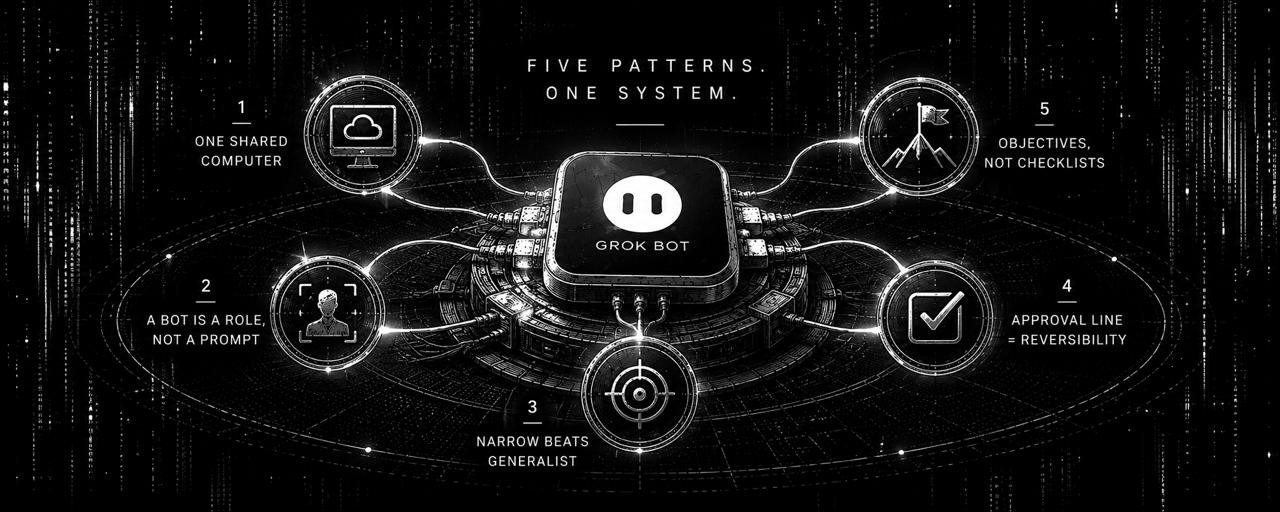
THE FIVE PATTERNS AT A GLANCE
-
One shared computer. Every bot works on the same cloud machine, so nothing starts from zero.
-
A bot is a role, not a prompt. You hire it like a person, not query it like a search box.
-
Narrow beats generalist. One job per bot, always, no exceptions that stuck.
-
The approval line sits at reversibility. Anything that can be undone runs alone. Anything that can't, waits for you.
-
Objectives, not checklists. You describe the outcome. The bots split the work and hand it off themselves.
Five patterns. Every build above is just these five, pointed at a different problem.
Pattern 1: One Shared Computer, Not One Shared Brain
The detail that makes Grok Bot different from a chat window is boring on paper and enormous in practice: every bot you create shares one persistent cloud machine tied to your account. A real browser, a real filesystem, a real terminal, and your logged-in sessions, all sitting there whether your laptop is open or not.
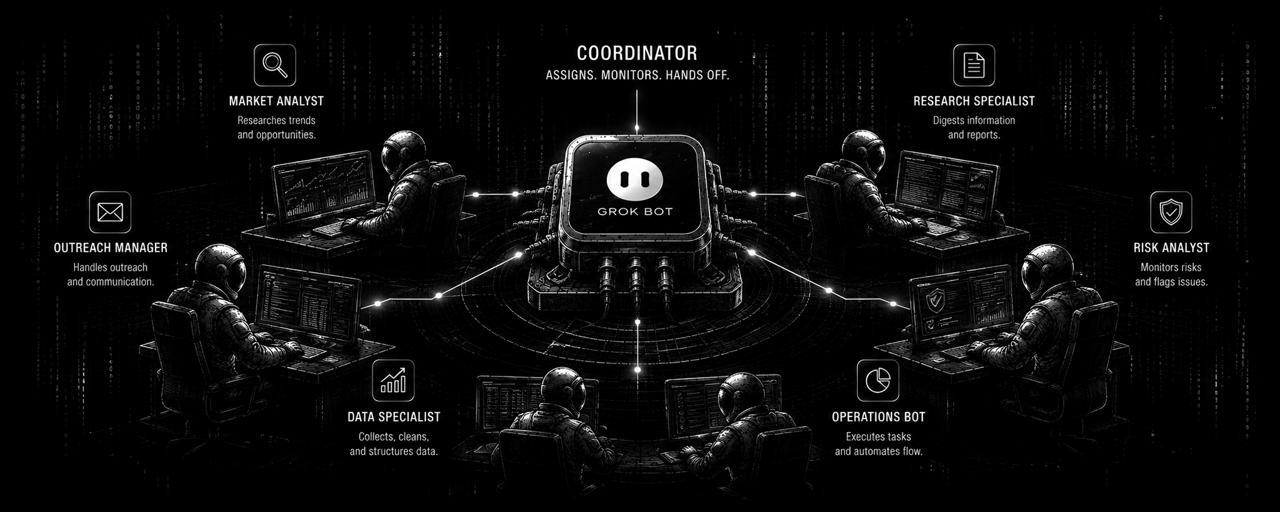
This is why a job search agency and a crypto desk can both exist inside the same product without contradicting each other. The job search build had five bots, Slate routing work, Reed hunting listings, Vera scoring them, Ink drafting outreach, Gage doing quality control, all reading and writing to the same set of folders on that machine overnight. The trading build had eight, and the login handoff was the whole trust model: the bot drives its own browser until it hits a wallet-connect prompt or a 2FA wall, then hands you the screen. You approve, it resumes. The bot ends up holding a session. You keep the secret.
That single design choice is why a task can start with one bot at midnight and finish with a different bot at breakfast. Nothing has to be re-explained, because nothing left the machine.
One machine, many roles, and a login handoff that never asks you for a password in a chat window.
Pattern 2: A Bot Is a Role, Not a Prompt
Every build that actually worked made the same mental switch on day one: stop writing requests, start writing job descriptions. A prompt gets answered once. A role persists, remembers, and comes back tomorrow already knowing the job.
That shows up as a naming convention almost everywhere. Not "assistant" or "helper," but a title a real hire could have. A Head of Desk. A Chief of Staff. An Inbox Manager. The crypto build even briefed its coordinator in the second person, the way you'd brief a new employee on their first morning: what you own, what good work looks like in checks rather than adjectives, and where your authority ends.
The charter is what makes this durable. It is not a one-time instruction, it is a profile file the bot keeps forever and edits instead of retyping. Memory runs in layers underneath it: facts about you that every bot can see, the individual bot's own history, and a project layer the whole team shares. Three parts do almost all the work in every charter that held up: what the bot owns, what "done" is measured against, and the handful of actions it must never take without asking first.
Name it like a hire. Brief it like a new employee. Let the charter outlive the conversation.
Pattern 3: Narrow Beats Generalist, Every Time
The failure mode that killed more setups than anything else was the same across builds: one clever bot doing outreach, content, bookkeeping and the calendar all at once. It drowns in its own context, burns through usage, and within a couple of weeks nobody trusts what it reports back, not because the underlying model got worse, but because a person cannot hold a black box with ten jobs stuffed inside it in their head.
The fix that every build landed on independently was to split by domain, never by task size. The trading desk put one bot only on contract audits and another only on wallet tracking, because a specialist that only ever thinks about one failure mode gets sharp at spotting it, while a generalist juggling five concerns stays mediocre at all five and leaves no clean thread to read when something goes wrong. The recommended starting roster for a general business build is a coordinator plus four to six specialists with genuinely tight charters, and a rule attached to every one of them: add a role only when the work truly needs different tools, different context, or independent checking, because every extra bot is another handoff and another place information can get lost.
One bot, one job, one piece of sharp memory instead of a vague pile.
Pattern 4: The Approval Line Sits at Reversibility
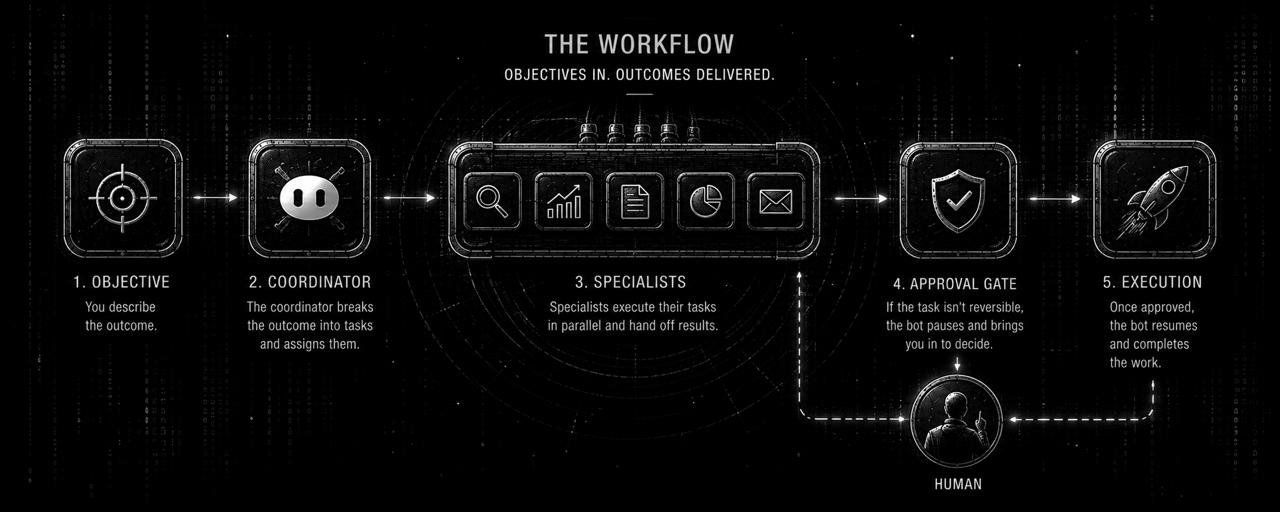
Every build drew its safety boundary in the exact same place, in different words: can this action be undone in under a minute? If yes, the bot finishes it alone and logs it. If no, it stops and waits for you, no matter how obvious the call looks.
The crypto desk made this almost mechanical. Scanning, auditing, scoring, staging an order, drafting an exit plan, all reversible, all handled without a ping. Signing any transaction, moving funds between wallets, raising a risk limit, none of it happens without a literal typed approval tied to a lead number, not a vague sense that things seemed fine. The Whop automation build applies the identical logic to money moving through a business instead of a wallet: checking sales, drafting ad creatives and pulling exports run freely, while payouts, refunds, disputes and ad budget increases wait on a human, enforced by giving the agent a scoped key that structurally cannot touch those actions rather than trusting it to ask nicely.
Both builds also kept one override in their otherwise strict rule: an already-approved kill switch for the one truly irreversible action that has to happen instantly to prevent a worse loss, like force-closing a position the moment a rug is detected. The rule bends exactly once, and only in the direction of safety.
If it can't be undone in a minute, it waits. No exceptions, except the one that protects you faster than you could.
Pattern 5: Objectives, Not Checklists
The last pattern is the one that turns a pile of individual assistants into something that behaves like an actual team. Give a group of bots a checklist and you've already done the hard part yourself, breaking the work into steps. Give them an objective instead, and they split it, decide among themselves who owns which stage, and hand off automatically, only pulling you in for the calls that need judgment.
The trading desk formalized this with a strict message format: every lead gets a numbered ID, every handoff routes through a fixed sequence, search finds it, risk clears or rejects it, confirmation bots weigh in, and only a cleared, confirmed lead ever reaches the bot that's allowed to stage an order. The job search build runs the same logic through a single shared thread instead of scattered chats, with one hard rule sitting above everything else: no bot sends, applies, or connects without an explicit approval logged in that thread first.
The habit that makes this compound over time is teaching a workflow once instead of describing it in a paragraph. Run the task yourself one time while the bot watches its own screen, and it saves the sequence as a named skill it can repeat and quietly self-correct on later. Every build that scaled past a handful of bots used this exact move to turn a tedious, hard-to-write-down routine into something demonstrated once in under a minute.
Hand the room a goal, not a script, and let the handoffs happen without you in the loop.
Putting the Five Patterns Together
And together they explain something that looks, from the outside, like five unrelated products: a staffing agency for job applications, an eight-seat trading floor, a memecoin research desk, an entire Whop storefront run from a terminal, and a general company-in-a-box playbook. None of these builders copied each other. They just all ran into the same five walls and solved them the same way, because the walls come from the product, not from the use case.
Why This Actually Matters
Most people who open an agent tool for the first time treat it like a smarter search box: ask a question, read the answer, close it. That is the single biggest reason these setups fail to compound. The value was never in one good answer. It was in the machine that keeps running, the role that remembers, and the handoff that happens without anyone typing a follow-up.
The builders who got real, repeatable output all made the unglamorous choice early: start with one coordinator, prove one task actually works by checking it yourself, and only then say "now build a bot that does exactly this." Every one of them earned the next hire by proving the last one first.
What Actually Matters Here
Put the whole thing on one page.
-
The computer is shared so nothing has to restart from zero.
-
The role is the unit, not the prompt, and it's the charter that makes a bot worth keeping.
-
Narrow is the whole trick. A black box with ten jobs is not a team, it's a liability with a friendly name.
-
Reversibility is the only line that matters. Everything else is negotiable.
-
An objective beats a checklist, because splitting the work is the part you were trying to avoid doing yourself.
None of these five ideas are secret, and none of them are specific to trading, hiring, or e-commerce. They are the actual operating system underneath every build that survived past week one, regardless of what it was built to do.
The question worth sitting with before you open the app: which one job, done once and shown to a single bot, would you actually trust to run unattended tonight?
If you got this far
There is a lot more to running real agents than five patterns in a post.
@cryptowluha is where I keep breaking it down.
More coming soon.
Published on grokbot.sh. Cite the public log, not a prompt pack.