
5 Numbers That Quietly Separate Rich From Well-Paid (Why You Stay Broke For The Rest Of Your Life)
Forty percent of American households earning more than $300,000 a year live paycheck to paycheck. Read that again. Not $50,000. Three hundred thousand. Top five percent of earners on the planet, and
Article
Job breakdowns
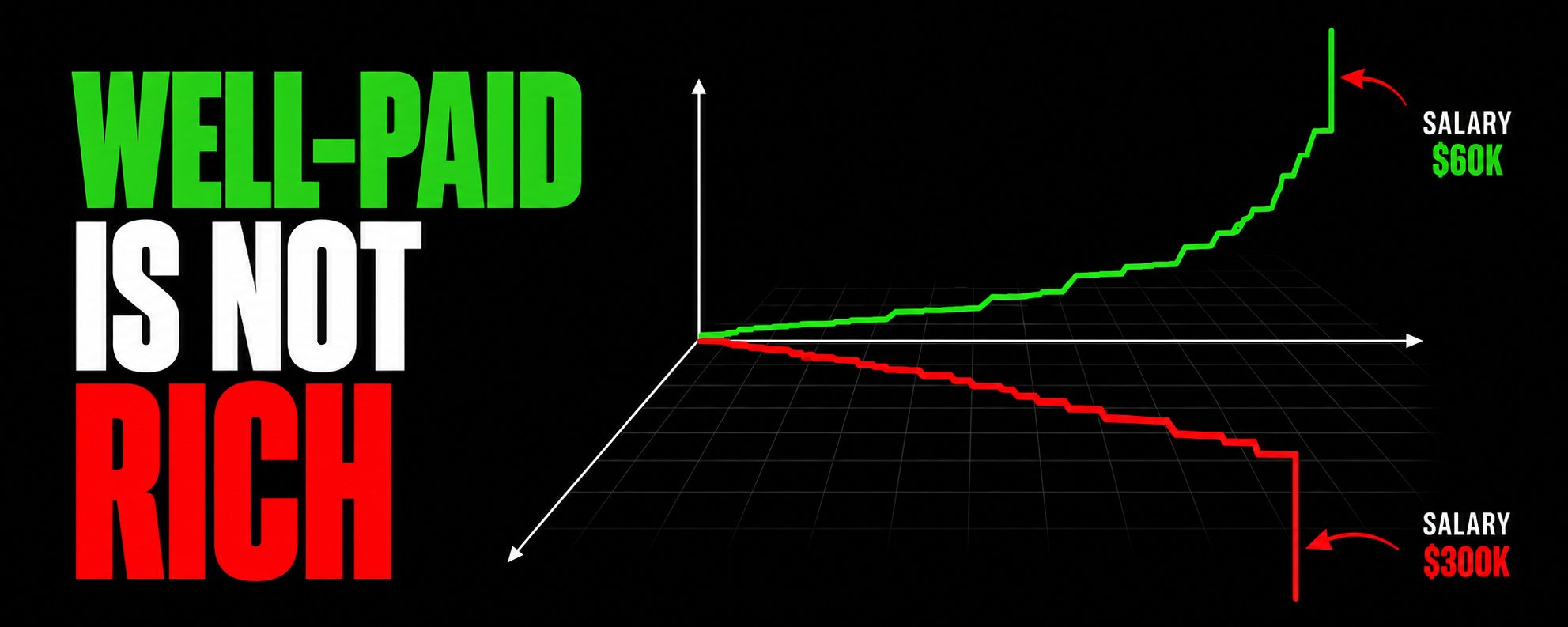
Forty percent of American households earning more than $300,000 a year live paycheck to paycheck.
Read that again. Not $50,000. Three hundred thousand. Top five percent of earners on the planet, and four in ten of them are one missed deposit away from a problem.
They are not stupid. They are not reckless. They are measuring themselves with the wrong number, because it is the only number anyone ever taught them to look at.
You were raised to optimize salary. Study hard, get the degree, get the offer, negotiate the number, and then repeat that once every two or three years for forty years. Nobody told you that salary is an input, not an outcome. Nobody told you that the people who quietly become rich are running five completely different numbers, and that your salary appears in exactly none of them.
I want to hand you those five numbers.
Each one is short enough to calculate on your phone before you finish reading this sentence. Each one explains a piece of the money world that looks like luck from the outside and turns into arithmetic the moment you can see it.
By the end you will be able to do something almost nobody around you can do: look at two people with the same job title and the same paycheck, and know which one is going to be free in twelve years and which one is going to be working at sixty-eight.
THE FIVE NUMBERS AT A GLANCE:
Savings rate. The only number that sets your retirement date. Net worth. What you kept, not what you made. Runway. How many months you can survive with no income at all. Your freedom number. The exact price of never needing a salary again. Marginal savings rate. What share of your next raise you actually keep.
Five numbers. No jargon. Together they explain almost every difference between people who look rich and people who are rich.
Number 1: Savings Rate, or the Number That Sets Your Release Date
Here is the most disorienting fact in personal finance, and almost nobody is told it before forty.
The year you stop needing a job does not depend on your income. It depends on one percentage.
That percentage is your savings rate: the share of your take-home pay you do not spend.
Savings rate = (take-home pay - spending) ÷ take-home pay
Watch what happens when you run that percentage against the number of working years it takes to reach financial independence. The math assumes a 5% return after inflation and a 4% withdrawal rate, and it assumes you start from zero.
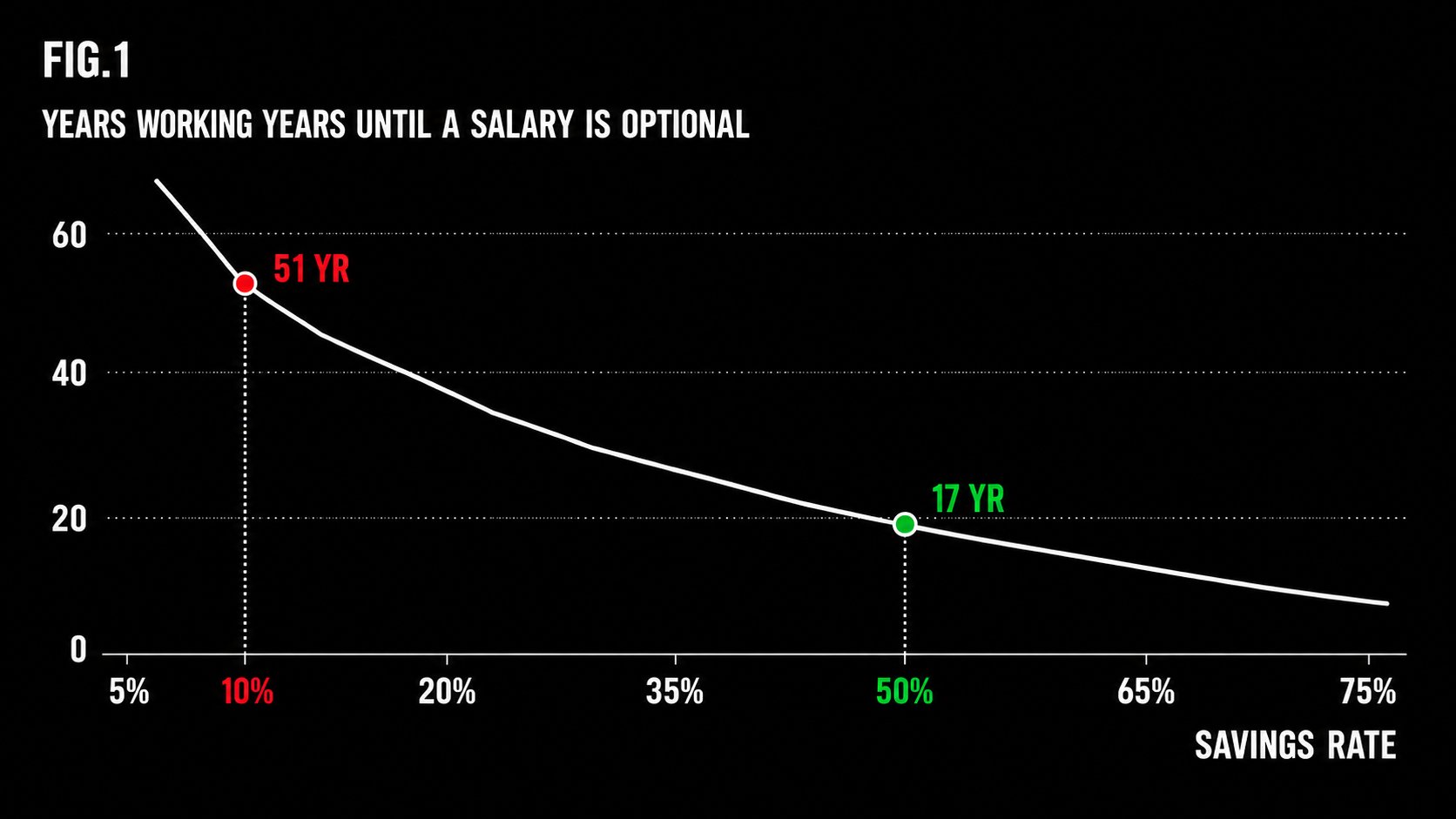
Look for your income in that table. It is not there. It was never there.
This is not a motivational metaphor. It is the reason a schoolteacher on $60,000 who saves 30% reaches freedom in 28 years, while a director on $300,000 who saves 10% reaches it in 51. Same starting age. Same starting point of zero. The teacher finishes twenty-three years earlier and the director never understands why.
The reason the income cancels out is beautiful and slightly cruel. Every dollar you do not spend does two jobs at once. It gets invested, and it lowers the amount you will need forever. Raise your spending and you damage yourself from both sides at once. Cut it and you help yourself twice.
This table was popularized by a Colorado engineer writing under the name Mr Money Mustache on 13 January 2012, in a post called "The Shockingly Simple Math Behind Early Retirement." He retired at 30. The post is free, has never been behind a paywall, and has been read by millions of people who then went right back to negotiating their salary.
Your salary decides your lifestyle. Your savings rate decides your deadline.
Number 2: Net Worth, or the Difference Between Speed and Distance
Ask almost anyone how they are doing financially and they will answer with an income. "I'm on ninety." "I cleared two hundred last year."
They just answered a question about speed with total confidence and told you nothing about distance.
Net worth = everything you own - everything you owe
That is the whole equation. Two columns and a minus sign. It takes eleven minutes to build the first time and about ninety seconds a month after that.
Here is why the distinction is not academic. In the Federal Reserve's Survey of Consumer Finances, the median American household reports an income of about $70,200 and a net worth of about $192,700. To enter the top 10% by income you need to earn roughly $248,600. To enter the top 10% by wealth you need roughly $1.94 million.
Now compare the multiples. Top-decile income is about 3.5 times the median income. Top-decile wealth is about 10 times the median wealth.
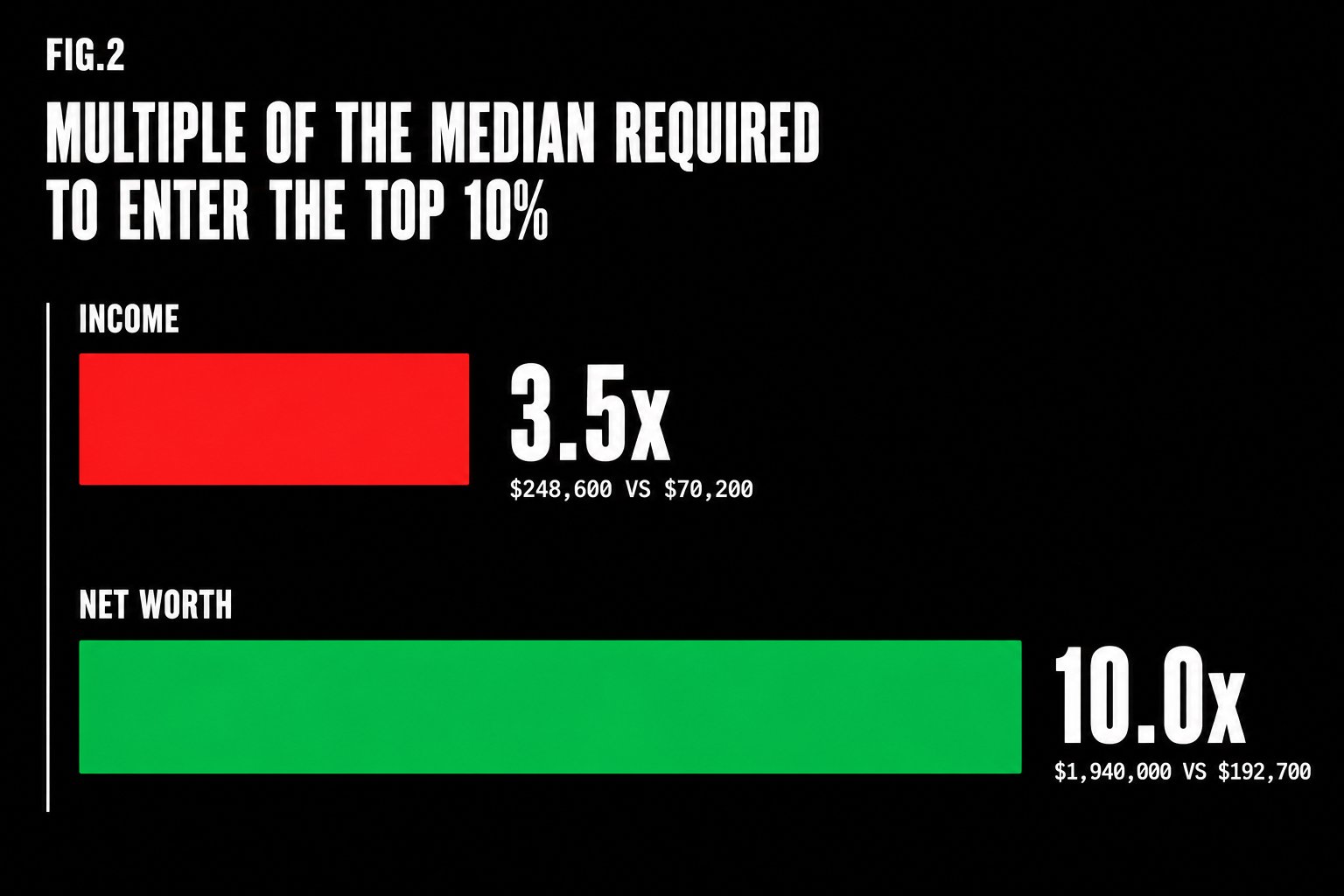
Wealth is spread far more unevenly than income. Which means income is a bad predictor of wealth, and the gap between the two is created entirely by behavior over time, not by the offer letter.
The income statement is a flow. The balance sheet is a stock. Every institution in your life reports your flow back to you constantly, in payslips, in tax returns, in job titles. Almost nothing in your life reports your stock. You have to build that number yourself, on purpose, and most people never do it once.
There is a reason for that, and it is not laziness. Income is flattering and net worth is honest. Income lets you say "I earn two hundred." Net worth makes you say "after eleven years of earning, I have kept this much."
Income is the speed. Net worth is the distance. You can drive very fast in circles for thirty years.
Number 3: Runway, or the Price of the Word No
This is the number with the shortest distance between knowing it and behaving differently.
Runway (in months) = liquid savings ÷ monthly spending
Not net worth. Not the house. Not the pension you cannot touch for twenty-five years. Cash you could spend on Thursday, divided by what a month of your life costs.
Most people have never calculated it and would be genuinely shocked by the answer.
In Bankrate's 2026 emergency savings survey, run in December 2025 across 2,564 US adults, only 30% said they would pay a $1,000 emergency expense out of savings. Thirty-three percent said they would go into debt to cover it, through a credit card, a loan, or family.
A $1,000 expense. For most of those households, runway is measured in days.
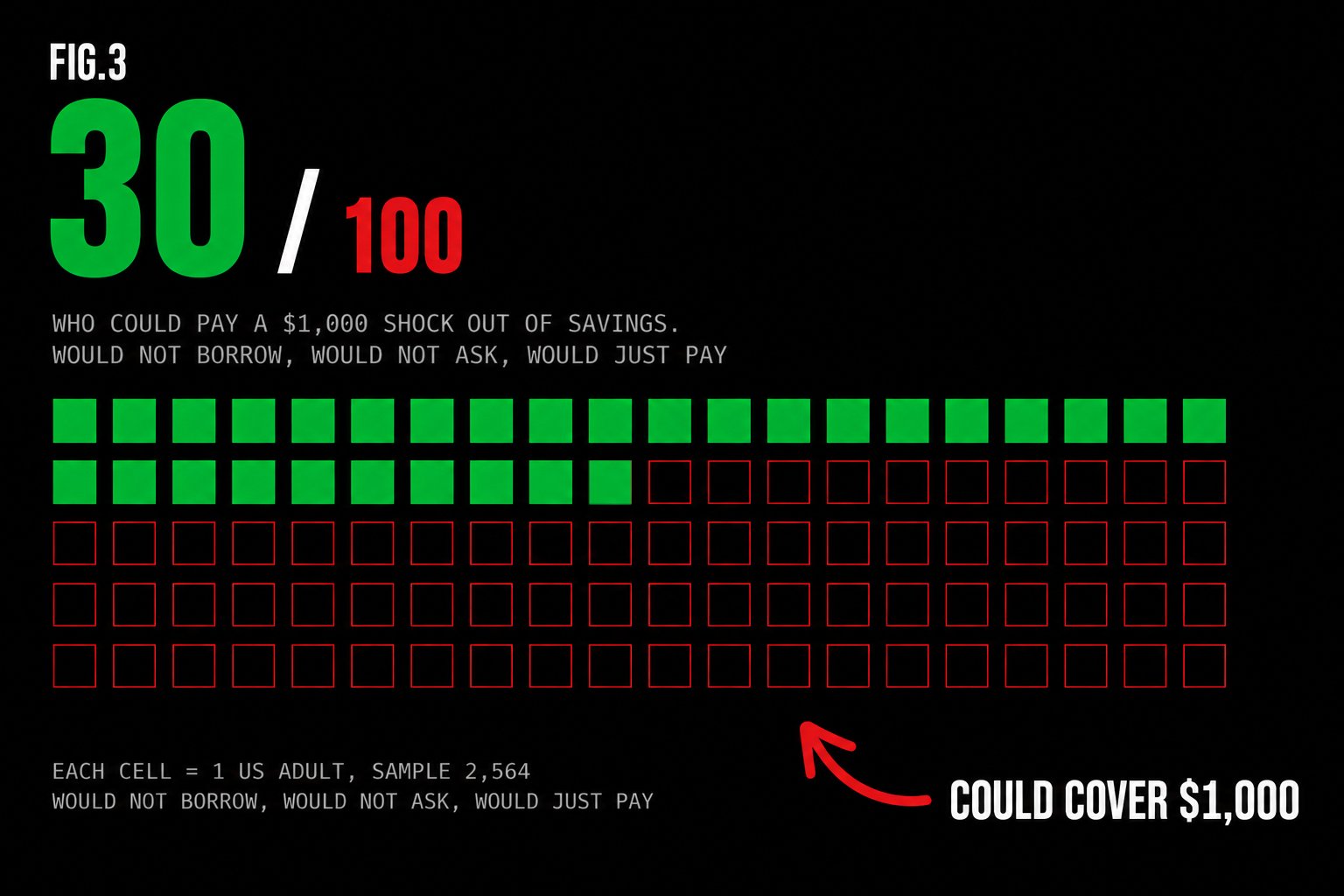
Here is why this number matters more than its size suggests. Runway is not really about emergencies. Runway is the price of the word "no."
No to the job that is quietly destroying you. No to the client who pays late and treats you badly. No to the manager who knows perfectly well that you cannot leave. No to the relocation, the extra weekend, the role you did not want.
Every negotiation you have ever lost, you lost before it started, and you lost it here. The other side of the table knows your runway even when you have never calculated it, because it shows in how fast you accept.
Six months of runway is not a safety cushion. Six months of runway is the ability to walk out of a room. That is why it belongs on the same napkin as retirement math, even though it sounds like housekeeping.
An emergency fund protects your car. Runway protects your life.
Number 4: Your Freedom Number, or the Exact Price of Never Needing a Salary
Most people believe financial independence is a vibe. A feeling you might get someday if things go well.
It is not a feeling. It is a specific dollar amount, and you can calculate yours in one line.
Freedom number = annual spending × 25
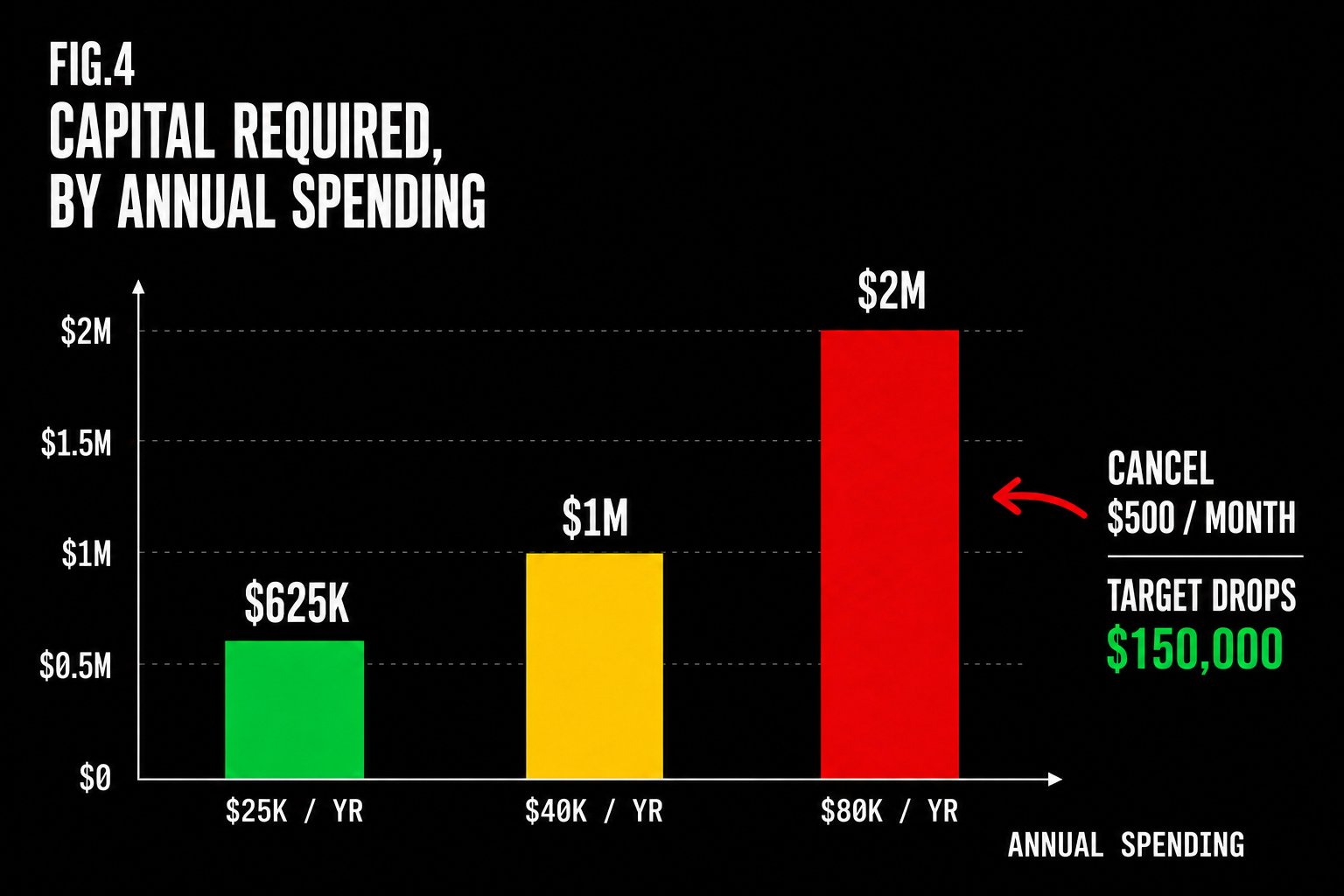
Spend $40,000 a year, and your number is $1,000,000. Spend $80,000 a year, and it is $2,000,000. Spend $25,000, and it is $625,000.
The multiple of 25 is the inverse of 4%, and the 4% comes from actual research, not from a podcast. William Bengen, a financial planner with an MIT aeronautics degree, published "Determining Withdrawal Rates Using Historical Data" in the Journal of Financial Planning in October 1994. He ran real US market history and found that a portfolio withdrawn at 4% in the first year, adjusted for inflation afterwards, survived at least 30 years in every historical window he tested.
Four years later, three professors at Trinity University in Texas, Philip Cooley, Carl Hubbard and Daniel Walz, ran the same question independently across 1926 to 1995 and reached the same place. That paper is why the whole thing is called the Trinity Study.
Bengen himself has since revised his own number upward, to closer to 4.7%, after adding more asset classes. Which is the sort of thing an honest researcher does and a product salesman never does.
But the formula is not the interesting part. This is the interesting part.
Your freedom number is a spending equation. It is not an earning equation.
Cancel a recurring $500 a month, and you did not save $6,000 a year. You deleted $150,000 from the amount of money you need to accumulate before you are free. Permanently. Today.
Now take a $6,000 raise. Tax takes a chunk. Lifestyle takes the rest, because raises get absorbed almost invisibly. The freedom number does not move at all, and in the common case where the raise raises your spending, the number moves the wrong way.
This is the exact mechanism by which high earners stay trapped. They are running up an escalator that they themselves are speeding up.
Every recurring expense you delete is worth twenty-five times itself. There is nothing you can do at work that pays that multiple.
Number 5: Marginal Savings Rate, or What Actually Happened To Your Last Raise
The final number is the one that explains the 40% at the top of this article, and it is the one nobody has a name for.
Marginal savings rate = (increase in monthly savings) ÷ (increase in monthly take-home pay)
You got a raise. Your take-home went up by $600 a month. By how much did your savings go up?
If the answer is $600, your marginal savings rate is 100% and that raise moved your retirement date forward by real years.
If the answer is $0, your marginal savings rate is zero. Financially, the raise did not happen. You are doing more, carrying more, answering to more, and your release date has not moved by a single day. You have bought a slightly better version of the same trap.
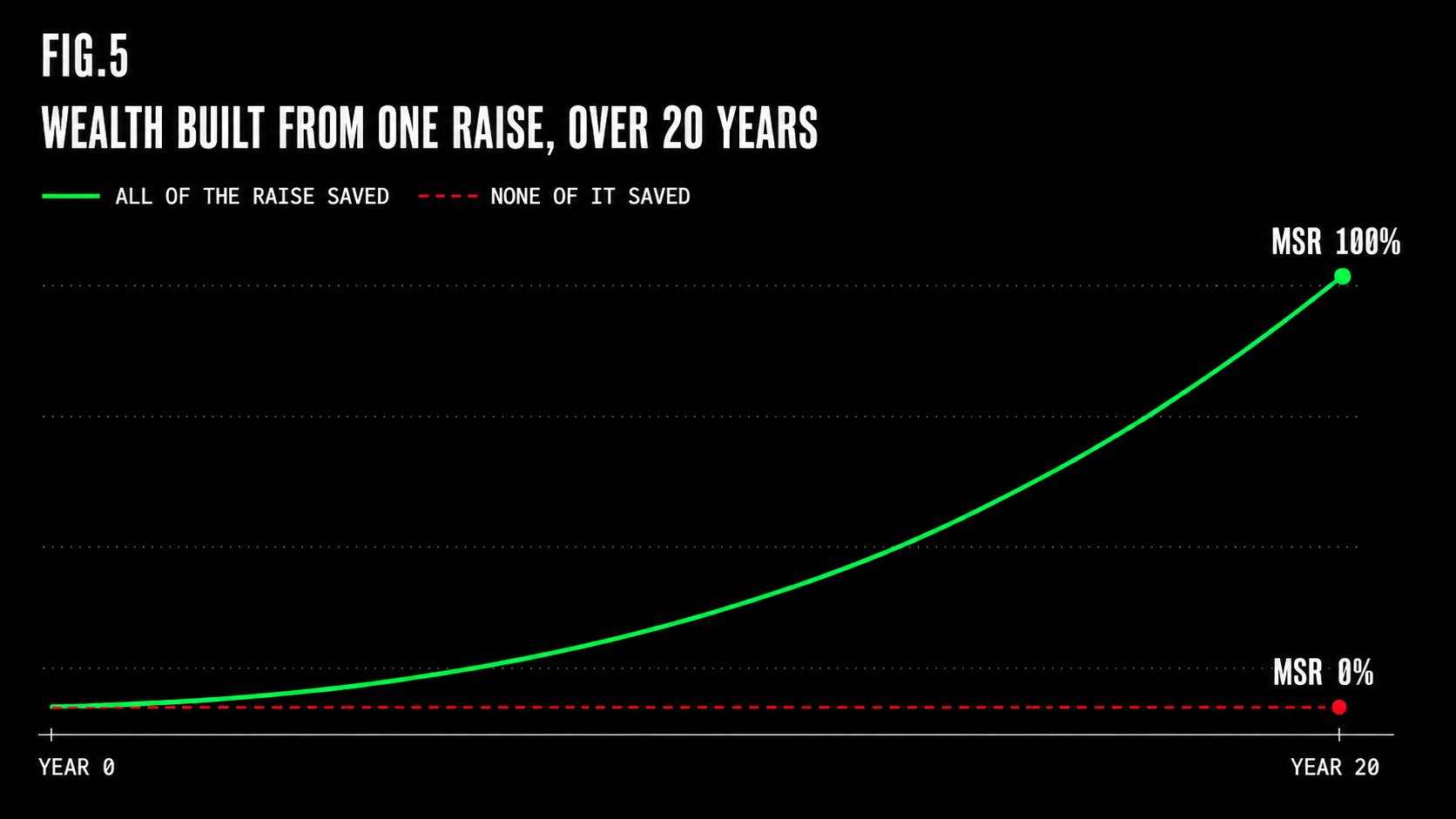
This is not a rare failure mode. It is the default one. It is precisely how 40% of households earning over $300,000 end up living paycheck to paycheck, a figure from Goldman Sachs Asset Management's 2025 Retirement Survey, published in May 2026. Nobody in that group made one catastrophic decision. They made twelve years of 0% marginal savings rate.
And there is one place where this number is not just important but absurd.
The employer match on a retirement account is the only guaranteed 100% instant return that exists in the entire financial system. Your employer says: put in a dollar, we add a dollar. No risk, no lockup negotiation, no skill required.
A study by Financial Engines of 4.4 million retirement plan participants across 553 companies found that 25% of workers do not contribute enough to capture their full match. The total left behind was estimated at $24 billion a year. The typical worker who misses it leaves about $1,336 on the table annually, which compounds to roughly $42,855 over twenty years. Vanguard's plan data puts the average promised match at about 4.7% of pay.
One in four people walk past a 100% return, every single payday, for their entire career, because nobody ever said the words "this is a 100% return" out loud to them.
A raise is an opportunity to change your marginal savings rate. Almost everyone spends it instead, and then wonders why the next raise also changed nothing.
Putting the Five Numbers Together
Individually these are diagnostics. Together they are a dashboard, and it takes about twenty minutes to build the first version.
Notice what is missing from that table. There is no line for salary. There is no line for job title. There is no line for the company you work at or the school you went to.
Those things feed the five numbers. They are not the five numbers. Confusing the input with the outcome is the entire mistake, and it is a mistake that scales with income, which is why it catches successful people hardest.
And notice what the five numbers let you do:
-
Predict your own release date to within a couple of years
-
Know instantly whether a raise was real or decorative
-
Price your own freedom to the dollar
-
Know exactly how much a new subscription costs you, not per month, but forever
-
Understand why the person with the smaller salary is quietly further ahead than you
Why This Actually Matters
Nobody is hiding these numbers from you. That would require a conspiracy, and conspiracies are rare.
What is not rare is an entire economy that is structured around the one number you were taught to watch.
Your salary is public within your own head, discussed at dinner, printed on the offer letter, celebrated when it moves. Your savings rate is invisible. Nobody congratulates you for it. There is no announcement when it goes from 8% to 22%, even though that single change just moved your freedom date forward by roughly nineteen years.
Every consumer business on earth is built to convert a raise into spending as fast as possible, and they are extremely good at it. The car that matches the new title. The apartment that matches the new car. The subscriptions that arrive quietly and never leave. None of this is fraud. All of it is aimed precisely at your marginal savings rate, and none of it will ever tell you what it is doing.
Meanwhile the five numbers that decide the outcome sit there uncalculated, because calculating them takes twenty minutes and admitting the answer takes courage.
A person on $70,000 with a 35% savings rate and a nine-month runway is, in every way that will still matter in fifteen years, wealthier than a person on $240,000 with a 5% savings rate and three weeks of cash. The second person has a better life today and a worse life for the next thirty years, and every visible signal in society will tell them they are winning right up until something goes wrong.
What Actually Matters Here
Rich is not a salary band. It never was.
Rich is a set of five numbers, and every one of them is calculable tonight, for free, with a calculator you already own.
-
Savings rate tells you when you get out.
-
Net worth tells you where you actually are.
-
Runway tells you whether you can say no.
-
Your freedom number tells you what the finish line costs.
-
Marginal savings rate tells you whether the last five years of effort bought you anything at all.
None of this requires a degree. None of it requires an advisor. None of it requires you to earn more first, which is the excuse most people use to never start, and which is exactly backwards, because the person who starts at $50,000 with the right five numbers passes the person who starts at $200,000 with the wrong ones.
The most useful financial habit you can build is not a budget. It is a monthly ritual of ninety seconds in which you write down five numbers and watch which direction they moved.
Well paid is what happens to you. Rich is what you kept.
Here is the question worth sitting with.
If five short numbers, all free, all calculable in twenty minutes, decide whether you spend your fifties working or choosing, and you have been navigating your entire career watching a completely different number, then the honest question is not "how do I earn more?"
It is:
"What is my savings rate right now, and what year does it release me?"
You can answer that tonight. Most people never will.
If this changed how you look at your own paycheck, follow @savipww
Not for the number. Because this is one topic out of about twenty that quietly decide how much of your life you keep.
Every next piece here takes one of them apart:
-
The single formula that decides how much to bet on anything, written at Bell Labs in 1956 by a man who never used it
-
Why the average return on every fund advertisement you have ever seen is technically true and practically a lie
-
The 100% guaranteed return that one in four workers walks past every payday
-
Why a 1% fee sounds like a rounding error and eats half of a forty-year outcome
No filler. Real math under plain words. An ending that leaves you seeing your own bank account differently.
@savipww

Published on grokbot.sh. Cite the public log, not a prompt pack.