
Your First AI Employee Needs a Probation Period
The Practical Guide to Hiring, Training, and Managing a Grok Bot You would interview a human before giving them access to your customers, inbox, and company card. Give your AI employee the same
Article
Job breakdowns
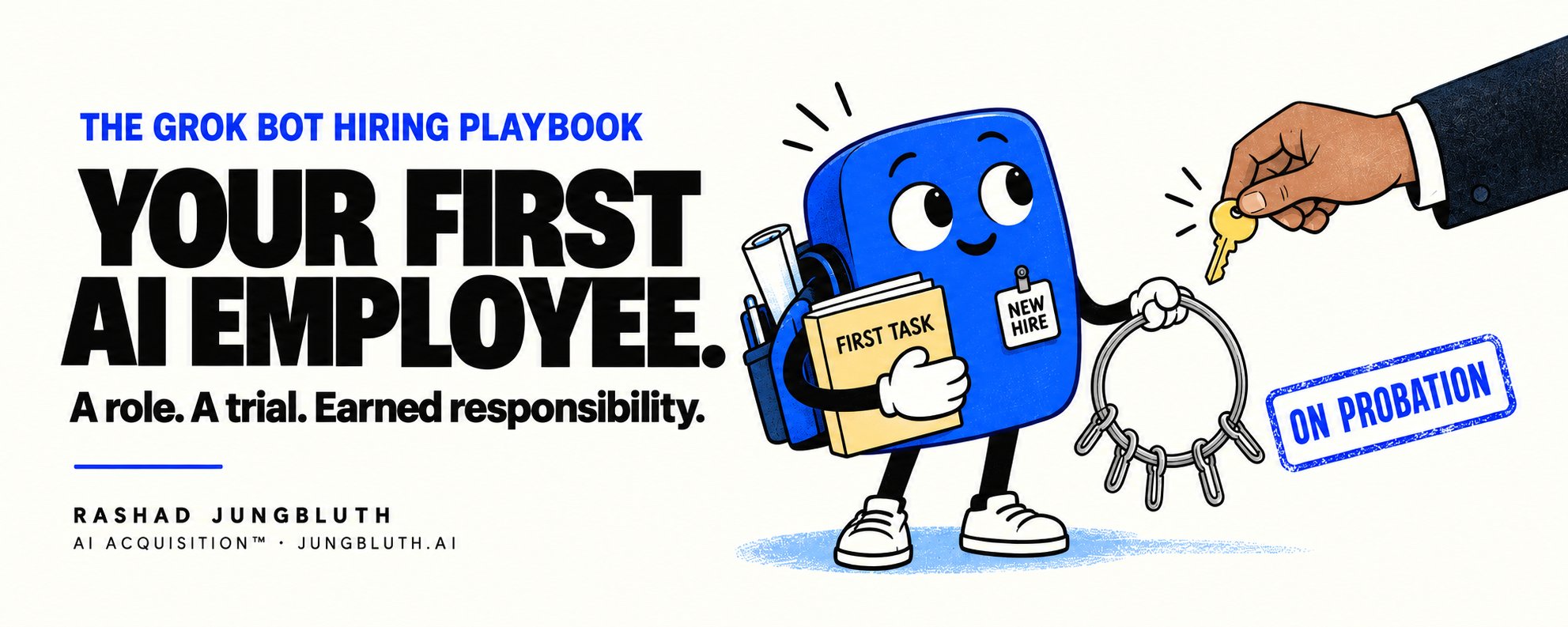
The Practical Guide to Hiring, Training, and Managing a Grok Bot
You would interview a human before giving them access to your customers, inbox, and company card.
Give your AI employee the same courtesy.
Create a Bot. Connect everything. Type “handle my marketing.”
That is a remarkably short onboarding process for something that can act inside your business.
The first impressive result tells you it can do the job once.
What you need to know is whether it can keep doing the job without creating another job for you.
That is where the money is.
Research ready before a sales call. Support issues organized before they become recurring complaints. Competitor changes caught before your next proposal. Routine preparation finished while you work on customers and growth.
Grok Bot provides persistent cloud computers, connected tools, and background work. Your Bots can work across applications and hand tasks to each other. Those capabilities make ongoing delegation possible.
Getting useful business results still requires a management system.
A job description. A trial. A definition of done. Limited access. A promotion ladder. A weekly review.
Here is the full playbook.
The 30-second version
-
Give the Bot one continuing responsibility.
-
Choose a first assignment that is frequent, useful, and easy to check.
-
Ask for a written walkthrough before execution.
-
Define an acceptable result and what happens when information is missing.
-
Give access only where the role needs it.
-
Run a three-stage probation.
-
Expand autonomy when the evidence supports it.
-
Review the routine and its economics every week.
The run counts below are a suggested starting framework. They are not proof of reliability, especially for rare or expensive failures.
Part 1. Hire a job
“Help me with marketing” leaves almost every important decision unresolved.
What should it work on? Which sources should it trust? What can it change? What result should appear?
A useful role answers those questions.
“You own competitor monitoring and deliver a cited change report every Friday.”
Now there is an output to inspect and a responsibility to improve.
Use five fields:
ROLE: Competitor Research Operator
OWNS A weekly report of material changes across the approved competitor list.
INPUTS Approved websites, release notes, public pricing pages, and our previous verified report.
MAY Read sources, compare changes, deduplicate findings, and prepare a report in the designated folder.
MUST ASK BEFORE Contacting anyone, buying access, publishing, or changing records outside the report folder.
DONE WHEN Each finding includes:
- What changed
- Source URL
- Observation date
- Previous evidence, when available
- Possible business implication
- Any unresolved uncertainty
Keep the role separate from this week’s assignment.
The role describes the responsibility.
The assignment specifies the competitor list, date range, and question.
The operating rules define access, verification, and stopping conditions.
This separation helps you fix the actual failure:
What went wrongWhat to inspectIt used an outdated priceSource freshness and stateIt opened the wrong appTool selection and routingIt sent a draftPermissions and approval controlsIt repeated a broken actionRetry logic and stopping conditionsIt returned a plausible but incomplete reportAcceptance criteria
Adding another paragraph to the prompt will not repair every one of these.
Part 2. Make the first hire boring
Start with work that produces frequent, visible evidence.
Good candidates:
-
Group yesterday’s support issues without modifying the tickets.
-
Compare approved competitor pages with saved snapshots.
-
Reproduce a bug in staging and capture the steps.
-
Prepare account research for an upcoming sales call.
These tasks can create value while keeping mistakes inspectable.
A first assignment should not require discovering an error through a customer complaint.
Before execution, run the interview:
Do not execute this task yet.
Describe the proposed workflow in order.
For each step, state:
- Which tool or source you need.
- What you will read or change.
- How you will check the result.
- What could be ambiguous.
- Where you would stop for approval.
Finish by listing the access you need and the actions you do not need permission to perform.
Review the operational plan. You do not need the model’s private reasoning.
Then define done.
“Find useful competitor updates” is difficult to test.
“Report up to five material changes, each with a source, observation date, and comparison to the previous verified state” is inspectable.
Do not force the Bot to fill a quota when nothing changed.
Add:
If no material changes are verified, report that.
If a source is inaccessible, identify it. Do not substitute old information without labeling it.
If evidence conflicts, preserve both versions and flag the decision that remains unresolved.
Continue other authorized work when possible. Pause the affected action when the ambiguity changes scope, permissions, correctness, or external consequences.
That last distinction matters.
An unavailable source should not stop every useful part of the report. It should stop an unsupported claim from becoming a confident conclusion.
Part 3. Give one key, not the keyring
A competitor-monitoring Bot needs access to competitor information and somewhere to put the report.
It probably does not need your payment account.
Design access around the role.
For an initial pilot, use three categories:
CategoryExample boundaryPrepareRead approved sources, compare, classify, draftMake bounded internal changesCreate reports in a designated folder with recoverable versionsRequire approvalSend externally, publish, spend, delete, change permissions, modify production
Reversibility is useful, but it is not the only consideration. Reading and copying confidential information can also have consequences.
Configure actual controls alongside the written instructions.
Grok Bot documents Auto Review rules under Settings → General → Auto-review. “Ask first” takes precedence when it overlaps with an automatic-allow rule. Auto Review is model-based, so combine it with limited underlying access.
The operating goal is to finish the authorized preparation before asking for the final decision.
An example completion message:
Researched: 42 accounts Qualified against the brief: 10 Outreach drafts prepared: 10 Contact details checked: 10
Needs your approval: Send the attached batch to the listed recipients.
Messages sent: 0 Unresolved issues: 2, listed below
That is a reviewable handoff.
“Should I start researching?” would leave the founder doing unnecessary coordination.
There is also a product detail you should understand before creating multiple Bots:
Bots within one user account share the cloud computer, including files and signed-in sessions. Different Bot names do not create isolated workspaces. If a role requires separate credentials and a separate environment, the official documentation points to a separate user.
For login, use the supported takeover flow. Enter credentials in the authentication surface, then return control. Keep passwords and one-time codes out of ordinary chat.
Part 4. Put it on probation
Use three stages before treating a workflow as established.
Run 1: Observe.
Watch the full task.
Record wrong sources, missing context, duplicate actions, unnecessary access requests, and unsupported guesses.
Run 2: Correct.
Repair the relevant rule, input, permission, or verification step.
Use a different but comparable assignment.
Avoid manually repeating every correction. Check whether the saved change actually works.
Run 3: Release.
Let it complete the authorized workflow without coaching.
Intervene for the planned approvals or a genuine exception.
For each run, record:
task_id input_version role_or_skill_version completed verification_passed human_interventions correction_rounds minutes_to_accepted_result human_review_minutes allocated_cost side_effects
The accepted result is the unit that matters.
A report that needs thirty minutes of repair belongs in the cost calculation.
When an error appears, fix the immediate artifact if needed. Then repair the mechanism that produced it.
A stale price needs a freshness rule. A duplicated update needs duplicate prevention. An unsupported claim needs a verification step.
Repeating the task tests whether that repair holds.
Also bound the loop.
Example operating policy:
Transient read failure: Retry at most twice.
Invalid output format: Allow one repair attempt.
Conflicting evidence: Flag the conflict and pause the dependent decision.
Write action with uncertain completion: Inspect the target before retrying.
Retry or usage limit reached: Stop, preserve completed work, and return a partial result.
The fourth rule is easy to miss.
A timeout does not prove that an action failed. Blindly retrying a write can create duplicates.
Where supported, use a task ID or idempotency key so the same action cannot be applied twice. Otherwise, check the destination before repeating it.
A prompt-level budget also needs the available product or infrastructure controls behind it. “Stop at $5” in prose is not a guaranteed spending cap.
Part 5. Promote it on evidence
Use this ladder as a management framework:
LevelResponsibility0: ObserveInspect the process without changing it1: PrepareResearch, draft, classify, and stage work2: Execute with approvalCarry out a specific reviewed action3: Run a routineStart a bounded workflow on a schedule or supported trigger4: CoordinateDelegate defined work and assemble verified outputs
These are suggested operating levels, not Grok Bot settings.
A scheduled draft can remain draft-only. Putting it on a calendar does not grant permission to send it.
Before expanding autonomy, try this promotion gate:
-
Five consecutive clean runs on representative inputs.
-
Verification passed each time.
-
No unresolved side effects.
-
Recovery tested for reversible changes.
-
At least one real approval boundary correctly triggered.
-
Explicit handling of missing, stale, or conflicting information.
Use more extensive testing where failures are costly or rare.
Five clean runs can justify the next small experiment. They cannot establish that an agent is safe in every situation.
Once the workflow is stable, save the method as a skill and attach a routine. Grok Bot distinguishes reusable task instructions from scheduled or event-triggered execution. Confirm the owner, timezone, inputs, output destination, and next run. Its “Test run” performs real work, so choose the test inputs accordingly.
Promotion should also be reversible.
An integration changes. A source becomes unreliable. The same correction appears twice.
Narrow the scope, return the affected step to review, and retest.
Part 6. Hold a weekly performance review
A routine can run perfectly on schedule and still produce something nobody needs.
Give it a weekly receipt.
Example format:
ROUTINE Competitor change monitor
PERIOD [Start date] to [End date]
OPERATIONS Scheduled runs: Completed runs: Accepted outputs: Human interventions: Repeated failures:
ECONOMICS Allocated software and usage cost: Human review and repair time: Cost per accepted output:
BUSINESS USE Which decision used the output? What action followed? What remains unverified?
RECOMMENDATION Keep / Repair / Pause
Inspect at least one underlying artifact yourself.
Then ask:
Did the routine run? Was the result correct? Did anybody use it? Did the time saved exceed the time spent supervising it?
For a revenue-related workflow, go one step further.
If the Bot prepares prospect briefs, measure preparation time and whether the briefs help qualify opportunities.
If it prepares proposals, measure turnaround and accepted output quality, then observe commercial results.
If it triages support, measure review effort, issue detection, and the work that still reaches you.
Use a simple operating calculation:
Cost per accepted result = (allocated tool cost + review labor + repair labor) ÷ accepted results
Track setup and maintenance separately so they remain visible.
Then connect additional capacity to actual work sold or cash costs avoided. Hours released are useful capacity; they become additional profit only when the business captures that value.
When to hire the second Bot
Add another Bot when you can point to a specific bottleneck.
Research and writing need different working context. Building and checking need separate review passes. Operations and analysis need different access.
Split that responsibility first.
You do not need a ten-agent organization chart to justify a second role.
When coordination becomes necessary, use one intake and clear ownership for the next step.
A handoff should look like this:
OBJECTIVE What must be accomplished?
ARTIFACTS Where are the current files and supporting sources?
DECISIONS What has already been approved?
CONSTRAINTS What must remain unchanged?
OPEN QUESTIONS What has not been established?
NEXT GATE What must be checked or approved before proceeding?
Pass current state and the relevant artifacts.
Do not make every specialist reconstruct the project from an entire conversation.
Five ways the first hire goes wrong
-
The generalist. One Bot receives unrelated responsibilities, and every failure becomes hard to diagnose.
-
The invisible finish line. The result sounds plausible, but nobody defined what complete meant.
-
Silent assumptions. Missing information gets converted into invented certainty.
-
Unchecked self-review. The same assumptions survive creation and review. Add independent evidence and deterministic checks where possible.
-
Scheduling the demo. One successful run becomes a recurring process before exceptions, duplicate prevention, and failure handling have been tested.
Your first assignment
Pick one recurring responsibility that currently takes attention away from customers or delivery.
Write the five-field role. Request the walkthrough. Run the probation. Inspect the evidence. Expand the responsibility one step at a time.
The outcome you want is work you can confidently delegate, with enough visibility to catch problems early and enough time returned to grow the business.
Hire the role. Train the workflow. Make it earn the keys.
Follow me for practical AI workflows for revenue and profit.
P.S. Before the first run, finish this sentence: “When information is missing or conflicting, you should…” It forces you to decide where judgment belongs before the Bot decides for you.
Published on grokbot.sh. Cite the public log, not a prompt pack.