
The 5 Newest Grok Bot Applications You Must Try
No matter how good your agent is at browser automation, if you need to catch a verification code from your email your task stops there. Or maybe that’s something from the past. Grok Bot is a desktop
Article
Job breakdowns
No matter how good your agent is at browser automation, if you need to catch a verification code from your email your task stops there.
Or maybe that’s something from the past.
Grok Bot is a desktop AI assistant, where every bot (agent) you create gets its own computer in the cloud, its own memory, and access to whatever apps you decide to connect, such as your calendar, Slack, Notion, Gmail or GitHub.
It can also run routines, which are jobs that fire on a schedule (“every weekday at 9 am”) or whenever something happens (“when a new message lands in this channel”).
Unlike ChatGPT and other assistants, you get a small team of digital workers that keeps going while you’re busy with something else.
And in the last weeks Grok Bot shipped at least 5 things you must know:
-
Bots now have their own email address.
-
Bots can search, read and monitor X natively, without paying for X developer access.
-
You can tag @bot under a post on X, and the task shows up in your Grok Bot.
-
The hand-off to cloud coding agents has matured.
-
The new primary bot makes it practical to run a whole team of specialists with one chief bot in charge.
In this article, I’ll walk you through each of these five applications, what they are good for, how to set them up, and what should know about before start using them.
Grok Bot Has Its Own Email Inbox
Until now, any AI agent that handled email needed access to your inbox. It would read everything in there, catch your codes, and possibly send messages in your name.
Overall we you weren’t protected from malicious prompt injection.
Grok Bot now lets your bot claim its own address on the mail.grokbot.com domain. Anything sent there goes to the bot, which can read it, summarize it, act on it, and reply from that address under its own name instead of yours.
What people are doing with it:
-
Sign-ups and verification codes: When the bot creates an account on a new tool, the confirmation email lands in its own inbox, so it can finish the sign-up and log back in later without you ever opening your mail.
-
Forwarded mail: You forward newsletters, receipts and invoices to the bot, and it files and summarizes them for you. A weekly receipts digest for your accountant is a good example.
-
Email threads: You CC the bot on a conversation, leave an instruction at the bottom, something like “confirm Thursday at 3pm and send the onboarding doc”, and it replies from its own address while you’re out.
-
Hand-offs between agents: Your bot can email you its results, and other agents can send it tasks by email.
How to set it up:
-
Update the Grok Bot desktop app to the latest version.
-
Ask your bot whether the address you want is free: “Is [name]@mail.grokbot.com available?”
-
If it is, tell it to claim it, and approve the confirmation card.
-
Ask it to alert you whenever new mail arrives, and explain how you want each type of message handled.
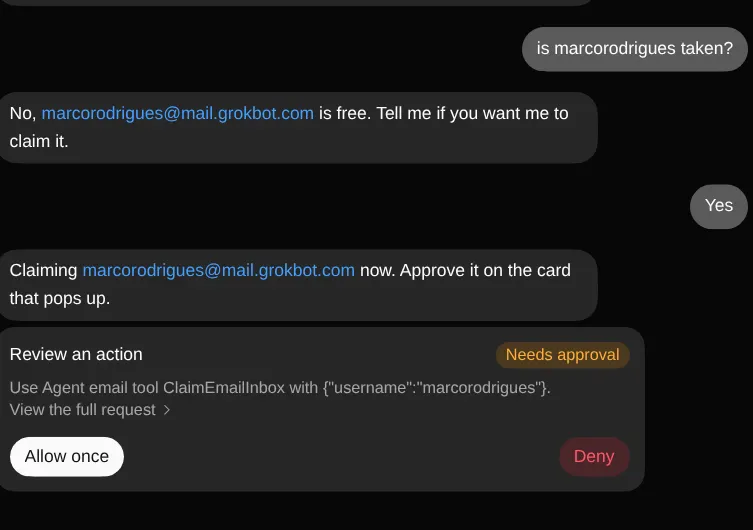
I went through these steps and I already got mine!
🎉 marcorodrigues@mail.grokbot.com 🎉
Unfortunately marco was already taken, which is a good reminder that you need to be fast!
Some early users event set up a routine asking the bot to check every few hours (or every morning) and claim one name from a short approved list the moment inboxes went live.
⚠️ Note: On team plans, an admin needs to enable inboxes before anyone can claim one.
There’s only one address per account. All your bots share it, and the claim is permanent, so pick a name that you’ll still want to use a year from now.
Native X Search and Monitoring
Until now, if you wanted an AI agent to read X at scale, you had to pay for X’s developer access (the API), where every search costs you credits, I personally spent a lot with this API!
But things have changed.
Grok Bot can search, read and monitor public posts on X natively. There’s no connector to install and no API key or prepaid credits to manage, because it counts toward your normal Grok Bot usage instead.
What people are doing with it:
-
Brand mention tracking: Every weekday morning, the bot finds the last 24 hours of mentions of your brand, your handle or your name, and labels each one as praise, complaint, question or neutral. The digest goes to Slack so the team can decide how to respond.
-
Listening for buyers: Every few hours, the bot looks for reviews and complaints about competitors, for people asking “what’s the best tool for this?”, and for anyone complaining about the exact problem you solve.
-
Filtered industry brief: You get a morning digest of posts that are taking off in your industry, so you can join conversations while they’re still alive.
-
Live market chatter: Ask what buyers said in the last hour and which discount codes actually work, and then they verify everything in their own cart.
In the case the connection is not seamless for you, try to add the X connector and authenticate with your account
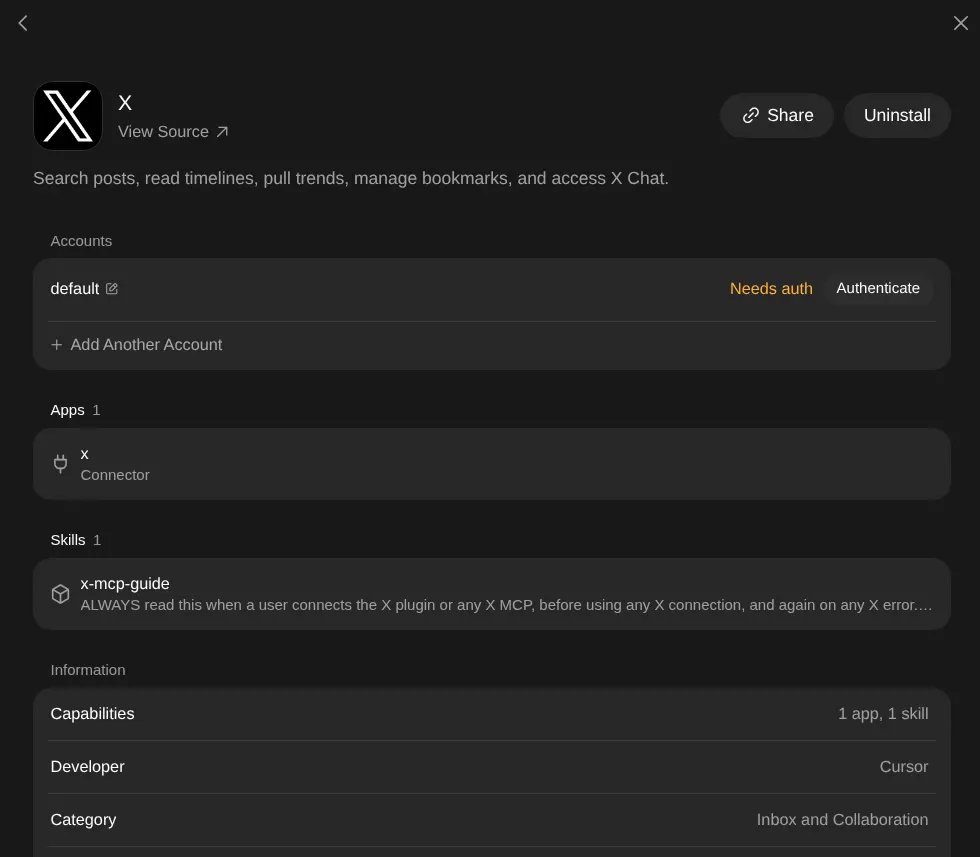
It will not deduct credits from your X developer account, but it is not free in an absolute sense. It uses your Grok Bot usage.
Reading X from inside Grok Bot is useful, but there’s also a way to send work to your bot directly from X, let’s see that in the next section.
Tag @bot Under an X Post
When you see a post you’d like your bot to act on, you reply to it (or quote it) and tag @bot with an instruction. The task goes straight to your Grok Bot.
The @bot account replies on X with a short confirmation only, while the actual work shows up in your Grok Bot chat instead of the public thread.
So, goodbye “bookmarks”!
What people are doing with it:
-
Read later: Under a good thread, you write “remind me to read this tomorrow”, and the thread doesn’t die in your bookmarks with everything else you saved.
-
Save to a knowledge base: You tag the bot under a useful guide and ask it to file it in a specific place.
-
Read replies: You tag the bot under your own post and ask it to read the replies.
However, tagging is not available everywhere. Users report that it’s switched off for accounts based in the EU, the UK and Australia. Some account types don’t work yet either. People whose Grok Bot access comes through a Cursor subscription report getting no response at all.
So far we’ve talked about reading, filing and summarizing. In the next section, let’s see what happens when you ask the bot to actually build something.
Coding and Building Software
Grok Bot can take a software task, plan it, and hand the actual coding to cloud agents from Cursor.
A cloud agent is a separate AI coder running on its own cloud computer. It copies your project’s code, makes the change on a separate branch, and opens a pull request, which gets reviewed before it goes live. When the agent finishes, your bot hears back and tells you what changed.
For this you need you need to do the following:
-
Get a Cursor subscription. The Grok Bot connection then exists by default, so you can simply say “spin up a cloud agent to do X”.
-
Connect GitHub so the bot can see your code and your pull requests.
-
Set up the project and its environment in Cursor, and review the cloud agent settings, like the default models and automated code review.
-
Optionally, create one engineering bot per project and tell it to always work through that project.
-
Set your approval rules before anything else runs.
However the usage seems to run out fast with this. The common fix is to keep the bot as the orchestrator, writing short briefs and handling approvals, and to push the heavy work to cloud agents, which bill to your Cursor usage instead of your Grok Bot weekly allowance.
A Team of Specialized Bots With One Chief Bot
Grok Bot recently released the primary bot.
The bot you designate as primary gets a star icon and instructions to be more proactive, looking across your projects and tasks for things it can help before you ask.
How to use this “Chief of staff” along with the other bots:
-
Pick your chief and make it your primary bot. You can even ask the bot to do this itself.
-
Give each specialist one clear job and remove any overlaps between them.
-
Set up shared memory. A common approach is to give each bot its own Notion database, where it adds items with a priority, checks for duplicates, updates the status, and always saves there instead of only answering in chat.
-
Keep everything outbound as a draft you approve through the chief, with maybe a couple of low-risk exceptions.
-
Ask the chief to propose a schedule that conserves your usage, and approve it before anything changes.
Some people are saying that they were able to reduce the weekly allowance, with a primary bot coordinating the team, compared to when they started without that structure.
Others say the primary bot made the product feel several times better than managing a chief of staff by hand.
Conclusion
In this article, we went through the five newest Grok Bot applications: a bot with its own inbox, native X search and monitoring, tagging @bot under a post, coding through cloud agents, and a team of specialists run by one chief bot.
And you saw what people are already doing with it and how to set it up.
Grok bot is slowly becoming an ecosystem more than only a harness that spawns agents.
In any case, not all of these features are actually new.
For instance you could already create an email for an agent using AgentEmail, or searching and posting on X with the API.
And for now, your Grok Bot agents can only live in Grok Bot, you can’t yet chat with them on Telegram, WhatsApp, Slack and so on.
For that we must still rely in open-source harnesses like the Hermes Agent and OpenClaw.
Grok Bot is easy, it’s cool, it’s powerful and with the new X integration, I believe things will change a lot in this platform (for the better I hope!).
Published on grokbot.sh. Cite the public log, not a prompt pack.