
One Grok Bot vs a Six-Bot AI Company
WE BUILT THE SAME AI COMPANY TWICE. One version had a single Grok Bot responsible for the entire mission. The other had six specialized bots: Manager -> Researchers -> Strategist -> Builder ->
Article
Job breakdowns
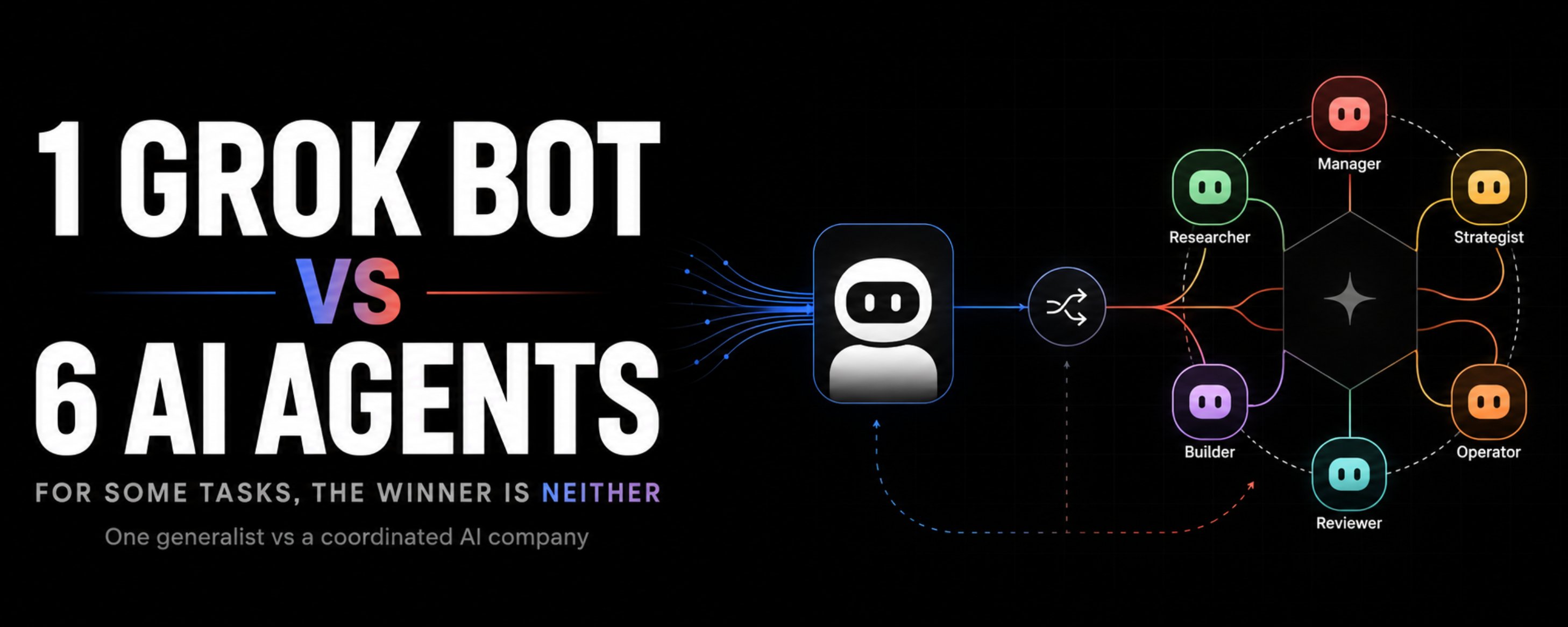
WE BUILT THE SAME AI COMPANY TWICE.
One version had a single Grok Bot responsible for the entire mission. The other had six specialized bots:
Manager -> Researchers -> Strategist -> Builder -> Reviewer
The result was not what either architecture was designed to prove. One advantage disappeared under pressure. Another appeared where we did not expect it. The decisive difference was hidden inside the workflow.
The Same Company, Built Two Ways
Both architectures received the same objective:
Create one evidence-backed launch package for a new AI product.
The final package required:
-
A verified market map
-
A target customer
-
A positioning strategy
-
A landing page
-
A launch campaign
-
A risk and evidence report
Both systems used the same model family, tools, source material, time limit, usage ceiling, and acceptance criteria. No output counted as complete until it passed the same Acceptance Gate.
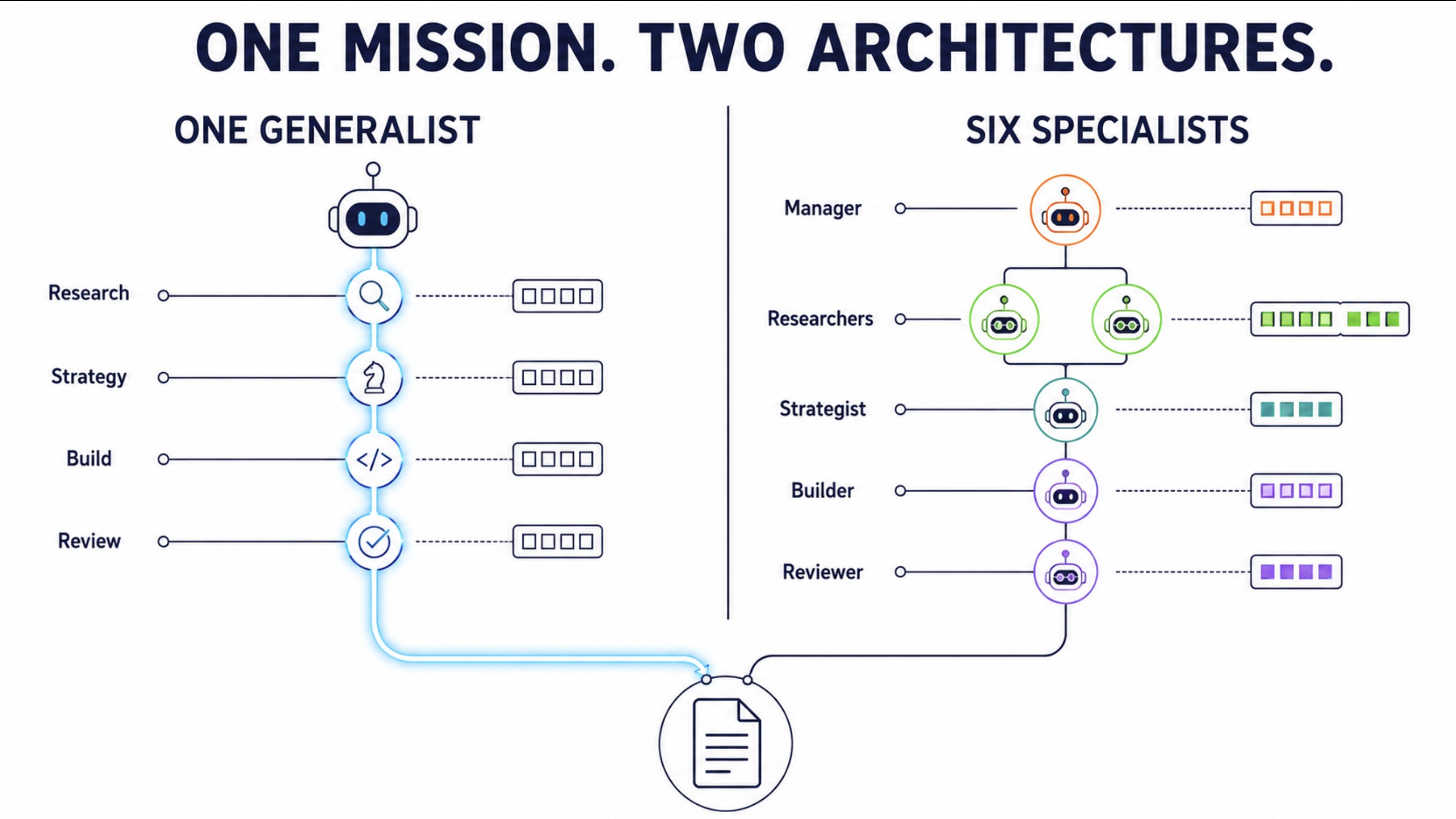
Version A: One Generalist
The first system used one persistent Grok Bot named Atlas. Atlas owned the full workflow:
Its largest advantage was context continuity. A fact discovered during research remained available during strategy and production. No second agent needed a summary. No Manager had to reconcile conflicting interpretations.
Atlas also avoided the most expensive parts of teamwork:
-
Task routing
-
Ownership negotiation
-
Handoff preparation
-
Output reconciliation
-
Duplicate work
-
Manager supervision
For short sequential tasks, Atlas consistently had the cleaner architecture. One agent received the mission and returned one result.
But the same simplicity became a limitation when the workload expanded. Research blocked strategy. Strategy blocked production. Verification started only after the complete package existed.
Atlas had one memory, one queue, and one execution path.
Version B: Six Specialists
The second system operated as a company.
Its structure was deliberate:
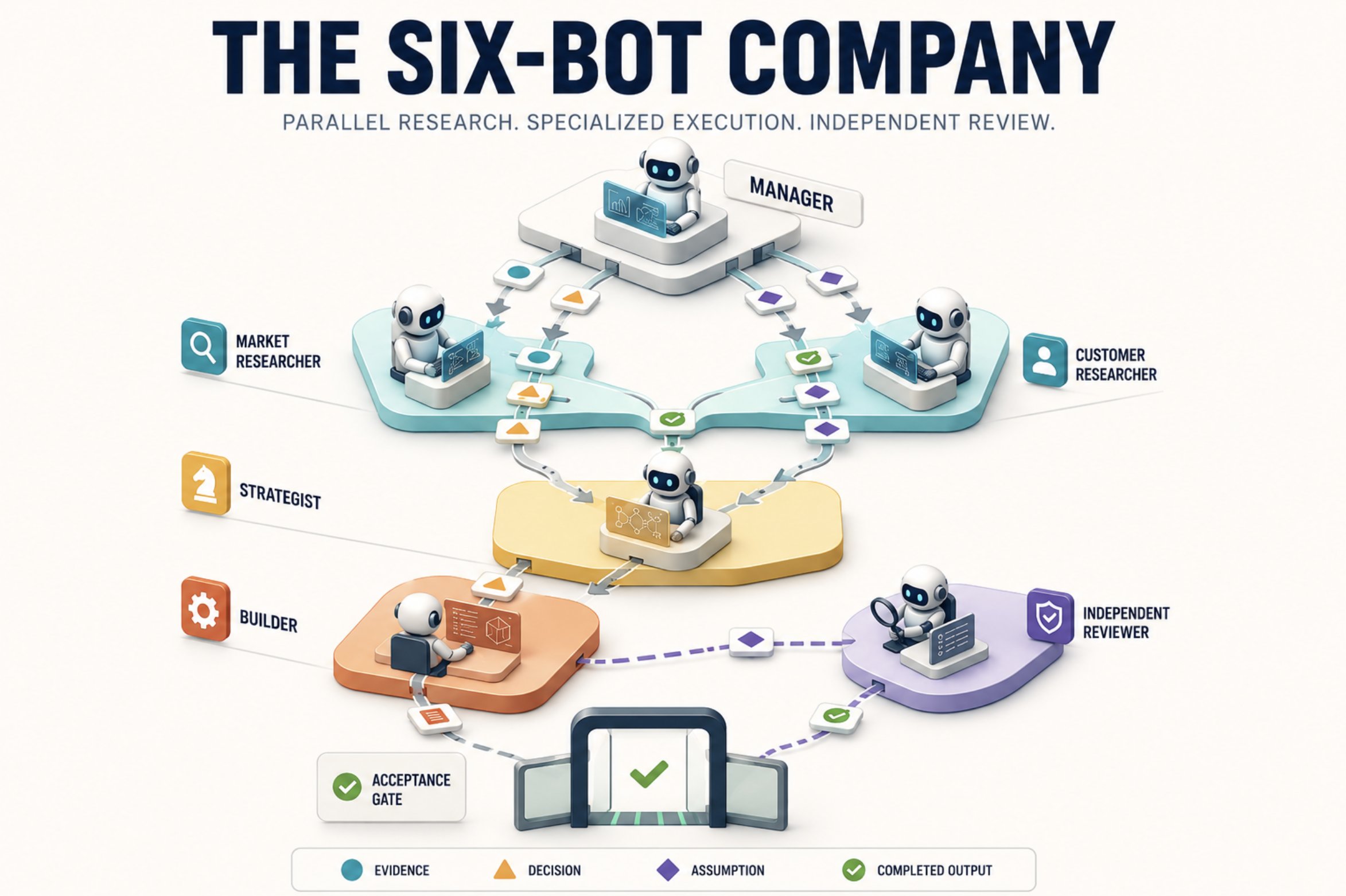
Manager
Owns the mission, task graph, dependencies, budget, and final assembly.
Market Researcher
Finds competitors, pricing, market signals, and supporting evidence.
Customer Researcher
Finds user problems, objections, language, and buying triggers.
Strategist
Turns accepted research into positioning and a coherent plan.
Builder
Produces the final deliverable from approved inputs.
Independent Reviewer
Checks evidence, consistency, requirements, and unsupported assumptions before acceptance.
The two Researchers could work in parallel. The Strategist waited for both research packets. The Builder waited for the strategy. The Reviewer received the final output and the original acceptance criteria, but not the Builder's private reasoning.
This system created more execution capacity, but also introduced something Atlas never had to pay for: coordination.
Every additional bot created another boundary where context could be delayed, compressed, duplicated, misunderstood, or lost.
The Fairness Problem
A six-bot company can appear stronger simply because it consumes more computation.
Six bots can open more contexts, call more tools, browse more sources, and generate more tokens than one bot. Comparing unrestricted systems would measure compute, not architecture.
We fixed the mission, source package, deadline, acceptance criteria, and maximum total tool budget. Atlas spent that budget sequentially. The company distributed it across specialized roles.
We judged both systems on four outcomes:
-
Time to an accepted deliverable
-
Quality at the Acceptance Gate
-
Rework required after review
-
Coordination required to reach the result
Activity did not count. Tokens did not count. A polished output did not count until it passed review.
Where One Grok Bot Won
Atlas was strongest when the work was sequential, tightly connected, and easy to verify.
Research flowed directly into strategy. Strategy remained available during production. No handoff packet had to compress what Atlas had learned. No Manager had to merge six interpretations of the same objective.
For compact tasks, this mattered more than specialization.
Atlas reached a coherent answer with fewer moving parts, less waiting, and almost no coordination overhead. When one dominant skill controlled the mission, adding specialists created more interfaces than value.
One bot was also easier to redirect. A changed requirement reached one memory and one execution path. The correction did not need to propagate through an organization.
Its weakness appeared when the mission became wider than one queue.
Independent research waited. Tool calls remained serial. A blocked step delayed everything behind it. Most importantly, the same bot that created the answer also evaluated its own assumptions.
Atlas had continuity, but not independence.
Where the Six-Bot Company Won
The company became stronger when the mission contained work that could genuinely happen at the same time.
Market and customer research ran in parallel. Specialized roles searched for different evidence instead of repeating the same generic investigation. The Strategist received structured packets rather than an expanding conversation history.
The largest advantage appeared during failure.
When one source failed, the company did not restart the entire mission. The Manager isolated the affected task, preserved accepted work, and returned only the failed claim for correction.
Research failure did not erase strategy that had already passed review. A Builder error did not force both Researchers to run again.
The company could recover locally.
Independent review created another advantage. The Reviewer tested the output against the mission instead of defending the process that produced it.
The company had specialization, parallelism, and independent judgment.
It also had a tax.
The Coordination Tax
A team creates value only when its advantages exceed the cost of operating the team.
The real equation was:
Parallelism gained
- Specialization gained
- Failure loss prevented
- Independent review gained
- Routing cost
- Handoff cost
- Waiting time
- Reconciliation cost
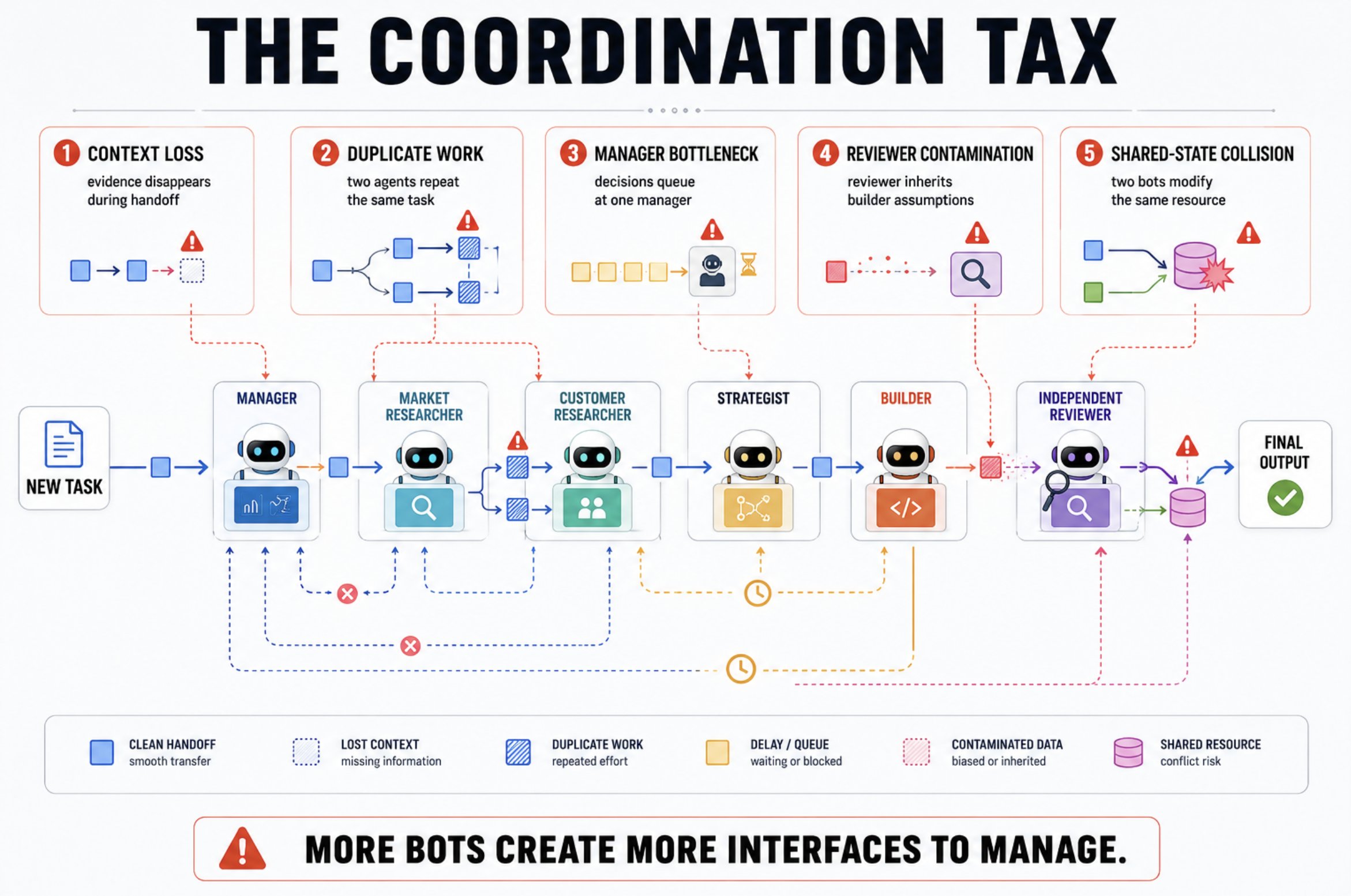
When the first four terms were small, Atlas won.
When the mission contained independent work, expensive mistakes, or specialist decisions, the company could repay its coordination cost.
This is why agent count is a weak metric.
Six active bots can mean six productive lanes. It can also mean six queues generating summaries for one overloaded Manager.
The architecture only works when every boundary has a contract.
The Six Contracts That Made It a Company
1. Mission Contract
Defines the objective, deliverables, constraints, budget, and definition of done.
2. Role Contract
Defines what each bot owns, what it does not own, which tools it may use, and which decisions it may make.
3. Task Contract
Defines one testable output, its dependencies, acceptance criteria, retry limit, and escalation conditions.
4. Handoff Contract
Moves only the result, evidence, decisions, assumptions, unresolved questions, and next action to the receiving bot.
5. Review Contract
Defines what must be verified and returns one verdict: PASS, REVISE, or BLOCK.
6. Escalation Contract
Defines when the system may continue, when it must retry, and when a human decision is required.
These contracts prevented activity from being mistaken for progress.
Without them, the six-bot system was not a company. It was six conversations sharing a mission.
Where Both Systems Broke
Atlas broke through concentration.
-
One queue controlled the entire mission
-
One blocked step delayed every later step
-
Context grew with every action
-
Review inherited the assumptions of execution
-
A serious failure could require a full rerun
The company broke through coordination.
-
Weak ownership created duplicate work
-
Poor handoffs destroyed useful context
-
Too many Workers overloaded the Manager
-
Review could become a new bottleneck
-
More messages created the appearance of progress
Neither architecture failed because its bots were unintelligent.
They failed when the shape of the organization did not match the shape of the work.
The Result
The conclusion was not that six bots are better than one. It was more useful:
A task should become a team only when parallelism, specialization, or independent review can repay the coordination cost.
The Architecture That Actually Won
The winning system was not Atlas. It was not the permanent six-bot company either. It was the routing layer above them. Every mission first passed through a structural test.
Route to one Grok Bot when:
-
The work is mostly sequential
-
One skill dominates the mission
-
Context must remain tightly connected
-
The result is easy to verify
-
Mistakes are cheap and reversible
Create a specialist company when:
-
Independent tasks can run in parallel
-
Different outputs require different skills
-
Evidence must be gathered from separate directions
-
Failure should be isolated instead of restarting everything
-
Independent review can prevent an expensive mistake
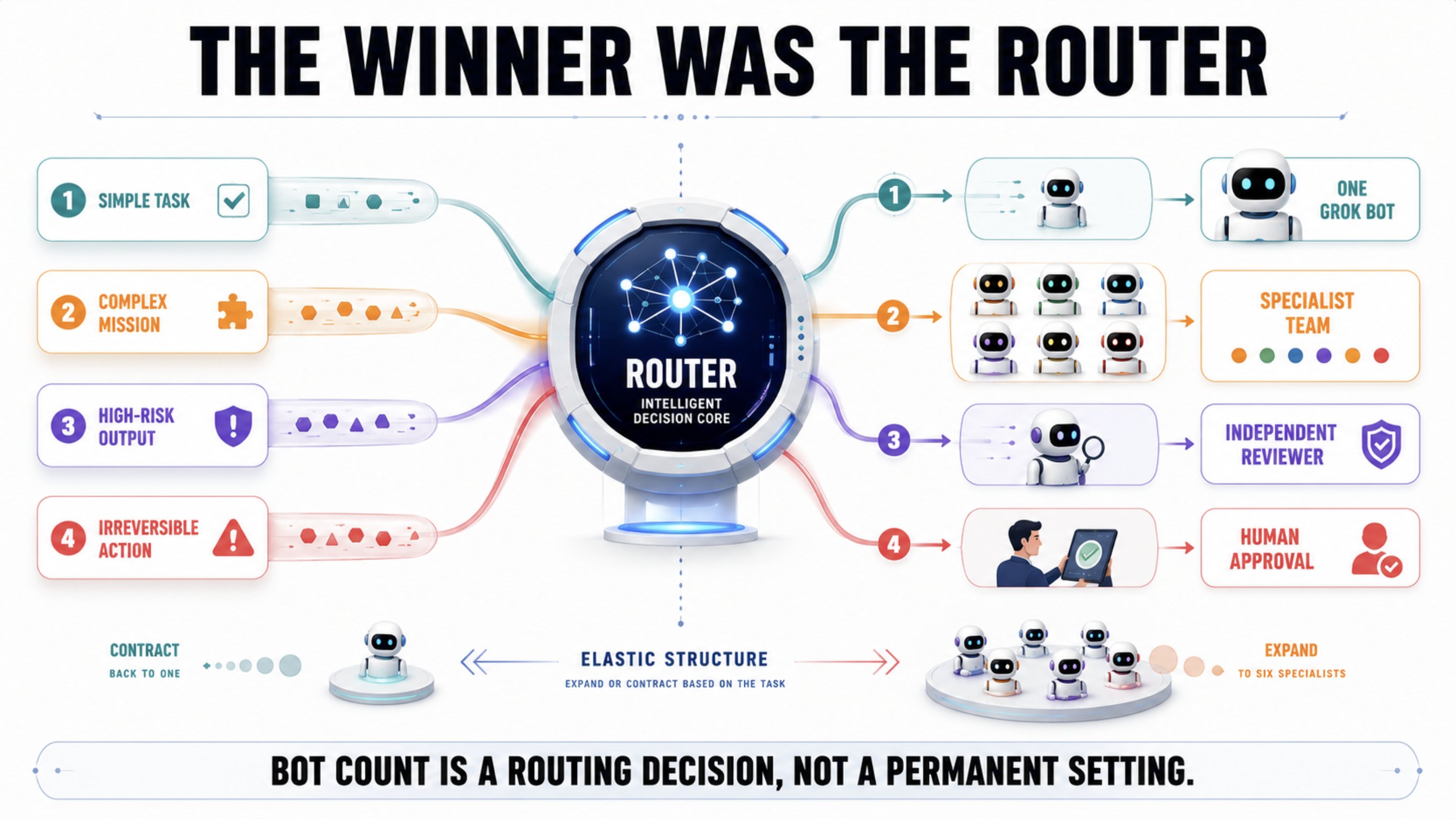
The system began with one bot by default.
It created additional roles only when the expected gain from parallelism, specialization, or review exceeded the coordination cost.
A team was not the starting configuration. It was an earned architecture.
What Grok Bot Actually Changes
Grok Bot makes both architectures practical.
One persistent Bot can own a complete workflow, retain context, use tools, and continue working after the user leaves.
Multiple Bots can operate as specialists, maintain separate responsibilities, and execute different parts of a mission concurrently.
But Grok Bot does not automatically decide:
-
Which work must exist
-
Which tasks can run in parallel
-
Which bot owns each decision
-
What context should cross a boundary
-
Who may reject an output
-
When the system should stop
-
When a human must take control
Those are management decisions. The platform provides the workers. The architecture determines whether they become a company.
The Final Rule
Do not build a six-bot company because six bots look more advanced.
Do not force one generalist to own a mission that contains parallel work, specialist judgment, and expensive failure.
Start with one accountable bot.
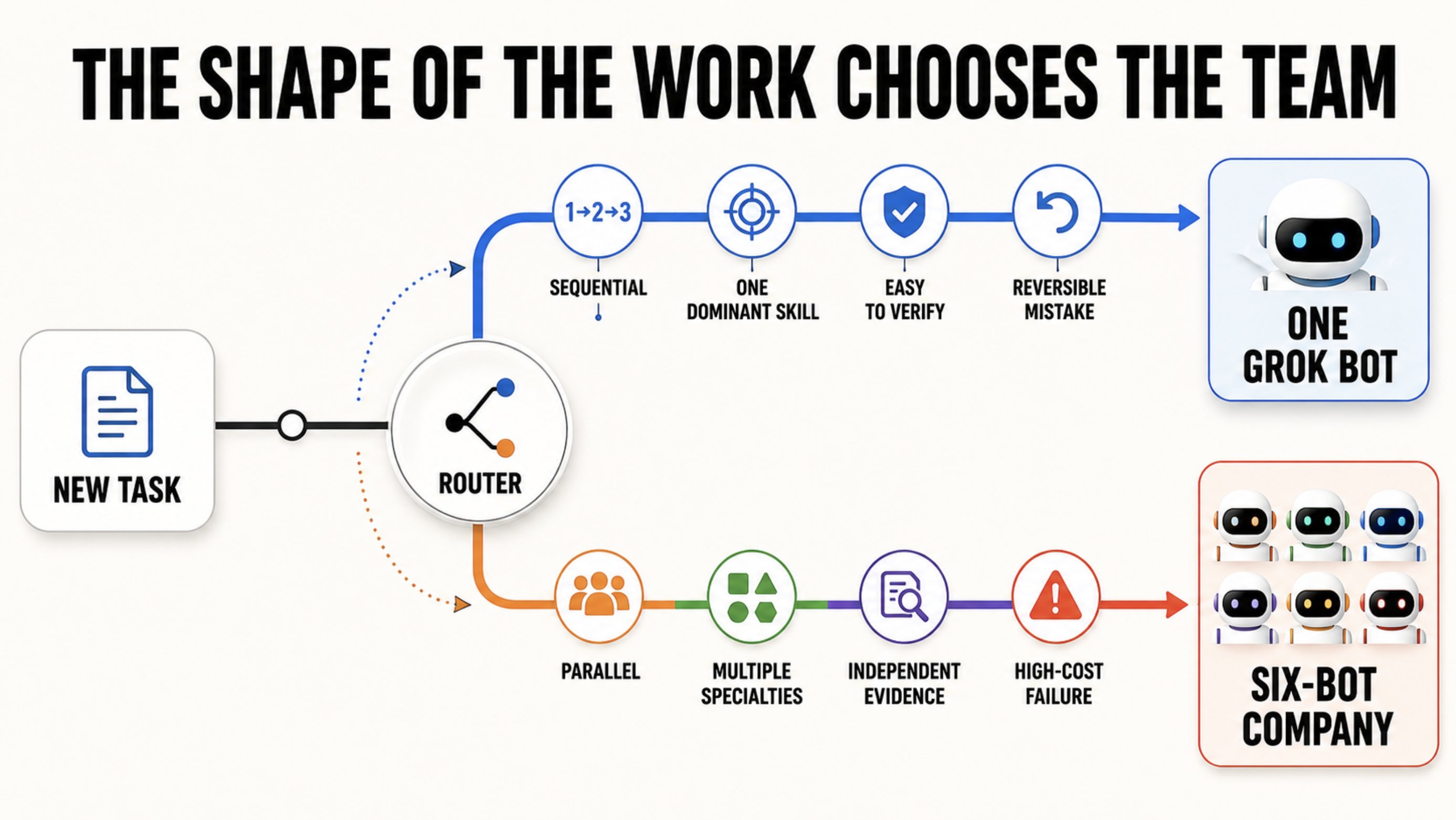
Split the mission only when the work proves that another role can create more value than coordination will destroy.
The strongest AI company is not the one with the most agents.
It is the one that knows exactly when one agent is enough.
Published on grokbot.sh. Cite the public log, not a prompt pack.