
Meet Silvia. The Craziest AI Tool You've Never Heard of.
Silvia just beat OpenAI, Claude, and Grok on a tax benchmark. While this is an impressive feat, this is not the important headline. Far from it. And you know what's crazier? You've probably never
Article
Job breakdowns

Silvia just beat OpenAI, Claude, and Grok on a tax benchmark. While this is an impressive feat, this is not the important headline. Far from it. And you know what's crazier? You've probably never heard of this AI financial tool.
Silvia is part of ProCap Financial ($BRR), which started out as a Bitcoin Treasury Company, but has now morphed into an agentic finance firm led by Anthony Pompliano (@apompliano). It's main product, Silvia, now boasts over $60 billion in connected financial account assets.
The Vertical AI Pure Play
Silvia beating OpenAI, Grok, and Claude on a tax benchmark serves as a good litmus test for pure play vertical AI companies.
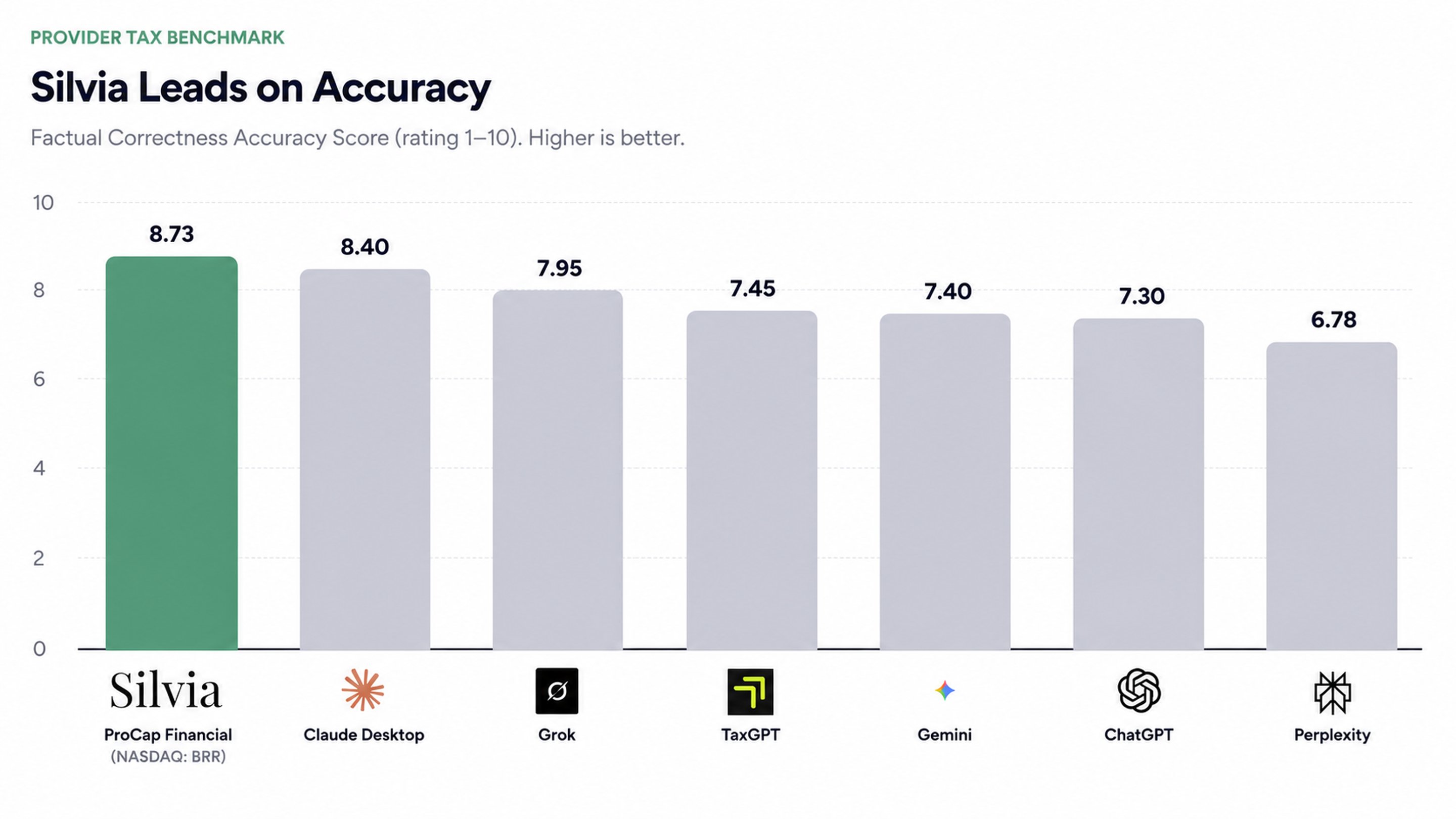
ProCap Financial is trying to prove to the market that a small, specialized team can build a better and more tailored financial product than the largest frontier labs. The team is not training a more powerful foundational large language model, but is instead focusing its efforts on building an AI harness and surrounding it with proprietary data, context, tools, and workflows.
This is the vertical AI thesis in its purest form, and personal finance is one of the largest opportunities to test it.
What Is Silvia?
ProCap Financial describes Silvia as "a personal AI CFO for serious investors." However, it's functionality and applicability is far wider than just investment analysis and research. In fact, ProCap Financial branding it as such is quite limiting, since the product can do so much more.
I would demo the product, but I do not want to go through the rigmarole of hiding my personal information. That said, I will include some screen shots here and there, so you can see the intuitive nature of Silvia.
First, users don't just connect brokerage and retirement accounts. You connect all of your assets and liabilities.
Assets:

Liabilities:

This provides Silvia with a consolidated view of your overall financial position. Like most financial technology companies, Silvia's account integration and visibility is handled by Plaid. Once your accounts are connected, Silvia provides users with a continuously updated view of their net worth, asset holdings, and liabilities.
But aggregation is only the first layer.
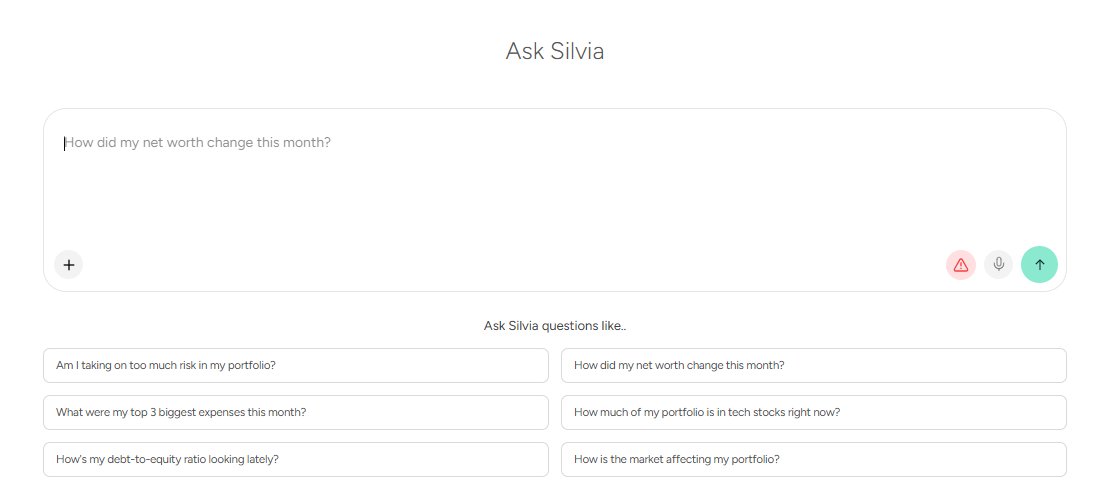
Once those accounts are connected, you can interact with Silvia through chat, email, and voice. The product can perform portfolio tracking, concentration analysis, fee analysis, scenario modeling, document analysis and financial research.
A user can ask:
-
Where did my cash go last month?
-
How concentrated am I in one company or sector?
-
How much am I paying in investment fees?
-
Which positions could be candidates for tax-loss harvesting?
-
What would selling this asset do to my tax exposure?
-
How would purchasing another property affect my liquidity?
-
How has my net worth changed, and what caused the change?
None of Silvia's functions are 'revolutionary' per se, but layering in real context makes the insights far more valuable and personalized.
Context. Context. Context.
General-purpose AI models know an extraordinary amount about finance. They can explain capital gains, asset allocation, tax-loss harvesting, retirement accounts, estate planning and portfolio construction.
However, what they lack, is real context about your personal financial situation. OpenAI and Grok are beginning to make strides and offer users the ability to connect their financial accounts, but that is not their primary focus. These frontier labs are not harnesses, like Silvia, so you can only use their proprietary models, which is limiting.
What if OpenAI has the best model in 2027 but in 2028 it turns out to be Anthropic or xAI? As an investor and defender of your hard earned capital, don't you want to use the best model available? This is largely why I gravitate towards Silvia. It is model agnostic. It is constantly changing between leading models.
ChatGPT may understand how tax-loss harvesting works, but it does not inherently know:
-
Which securities you own and your cost basis
-
Your average holding periods
-
Your realized/unrealized capital gains
-
Your tax jurisdiction
-
Your income
-
Your private investments
-
Your liquidity requirements
-
And your long-term financial goals
Without this level of detail and context, even the frontier labs can only provide you with a generic answer. The whole premise of Silvia is to close that growing gap.
Instead of asking users to describe their financial lives repeatedly, Silvia builds a persistent financial graph containing their accounts, assets, liabilities, transactions, and positions. Silvia then reasons against that graph. Moreover, users can also upload various personal documents in what Silvia calls the "vault." This provides Silvia with even deeper insights into your broader financial life.
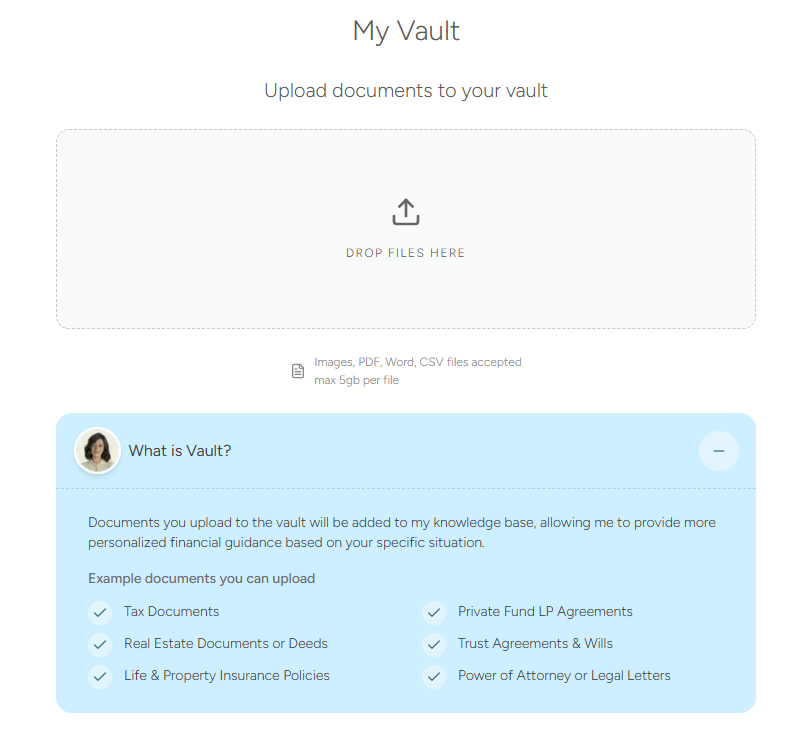
This level of specificity and context changes the entire interaction. It's no longer:
“Explain tax-loss harvesting to me like I am seven years old.”
It's now:
“Review my entire portfolio, identify potential tax-loss harvesting opportunities, explain the tradeoffs and show me how each transaction will impact my financial position.”
While the underlying large language model may be similar, the usefulness of the answer is completely different. This is why vertical AI solutions are growing in popularity across various domains. For example, in healthcare a popular tool is Abridge for clinical conversations. Likewise, in the legal field, Harvey AI is by far the most popular.
Financial Software Evolution
The first generation of personal-finance software was primarily about visibility. Products - such as NerdWallet, Credit Karma, YNAB, Personal Capital, and Copilot Money - aggregated accounts, categorized transactions, and displayed various charts.
This solved an important problem and still does to this day. It helps users see their finances all in one place. However, a dashboard still requires the user to interpret the information, identify the problem, and decide what to do next.
Silvia, on the hand, moves from pure product visibility to real financial intelligence.
The platform’s potential architecture has several layers:
-
The financial graph: This is the structured representation of the user’s financial life: accounts, positions, assets, liabilities, cash flows, financial goals, and more.
-
Persistent memory: This includes the user’s goals, preferences, financial history, tax circumstances, liquidity needs and tolerance for risk.
-
Specialized retrieval: Rather than relying entirely on what a model learned during training, Silvia can retrieve current information from financial databases, tax statutes, regulations. and other proprietary sources.
-
Analytical tools: The platform runs calculations, examines documents, models complex scenarios, and compares positions across the user’s portfolio.
-
Proactive agents: The most important long-term layer may be agents that continuously monitor the financial graph and surface relevant changes without waiting for a prompt.
This final layer is where Silvia is materially different from traditional financial dashboards and general AI assistants. A dashboard only tells you what happened after the fact. A chatbot answers when you ask a general question. It has to be prompted. An AI CFO though, notices what matters and how your financial situation is shifting before you know to even ask.
Initial Customer Profile
Right now, most of Silvia's customer base is affluent, digitally native, self-directed investors. This is an interesting market.
These users often have financial lives that are too complicated for a basic consumer budgeting app. They may often have a large swath of public equities, crypto, real estate, private investments, and other alternative assets across numerous platforms. At the same time, this specific customer still wants to control their own investment decisions rather than delegate everything to a traditional wealth manager.
Silvia’s early user data supports this market positioning. As of February 2026, ProCap reported approximately 12,000 Silvia users and $30 billion in tracked assets. By July, the company reported more than $50 billion in connected assets. In August, management said the figure had surpassed $60 billion.
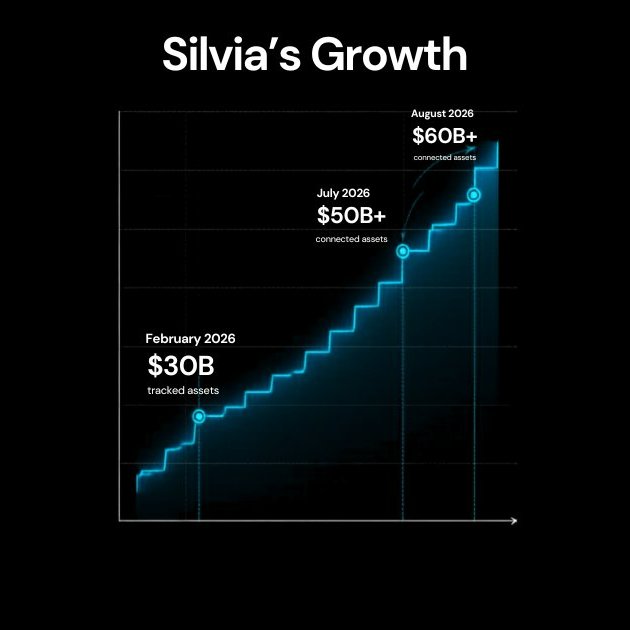
Earlier company disclosures also said:
-
The average user had a net worth exceeding $2.5 million
-
The average user had connected more than 12 accounts
-
Approximately 94% of users engaged with Silvia’s AI features
-
More than 10% of monthly active users became paying members within two months of monetization
-
Silvia users see a typical net worth gain of 16-41% in less than a year on the platform.
While the growth in connected assets is notable, these numbers needs to be interpreted carefully. Connected assets are not assets under management.
Silvia does not necessarily manage, custody, or earn an advisory fee against those assets. One wealthy user connecting a large portfolio can add millions of dollars to the headline figure.
The strategic value of $60 billion in connected assets is not the asset figure itself. It's the amount of financial context those connections place inside Silvia’s product.
Tax Benchmark
Silvia recently published a tax benchmark comparing its performance with Claude Desktop, Grok, TaxGPT, Gemini, ChatGPT, and Perplexity.
Across ten expert-level tax scenarios, Silvia received the highest factual-accuracy score:
-
Silvia: 8.73
-
Claude Desktop: 8.40
-
Grok: 7.95
-
TaxGPT: 7.45
-
Gemini: 7.40
-
ChatGPT: 7.30
-
Perplexity: 6.78
The company also released a broader dataset containing 200 expert-level U.S. tax questions. Half were questions built around statutory details, current-year figures, interactions between multiple tax provisions, and differences between federal and state law. The other half were structured client scenarios designed to resemble realistic financial-planning questions.
As you can see, a specialized system with the right technical architecture can outperform a more powerful general-purpose product inside a narrow domain (vertical AI). Remember, Silvia is not building a better foundation model than OpenAI, Anthropic, or Google. It is building a better financial context layer around these frontier models.
Silvia's Future
Silvia’s product traction is further ahead than its current financial traction. This makes Silvia a very early-stage commercial product. From a product roadmap standpoint, there is a lot coming down the pipeline. Here is the current roadmap:
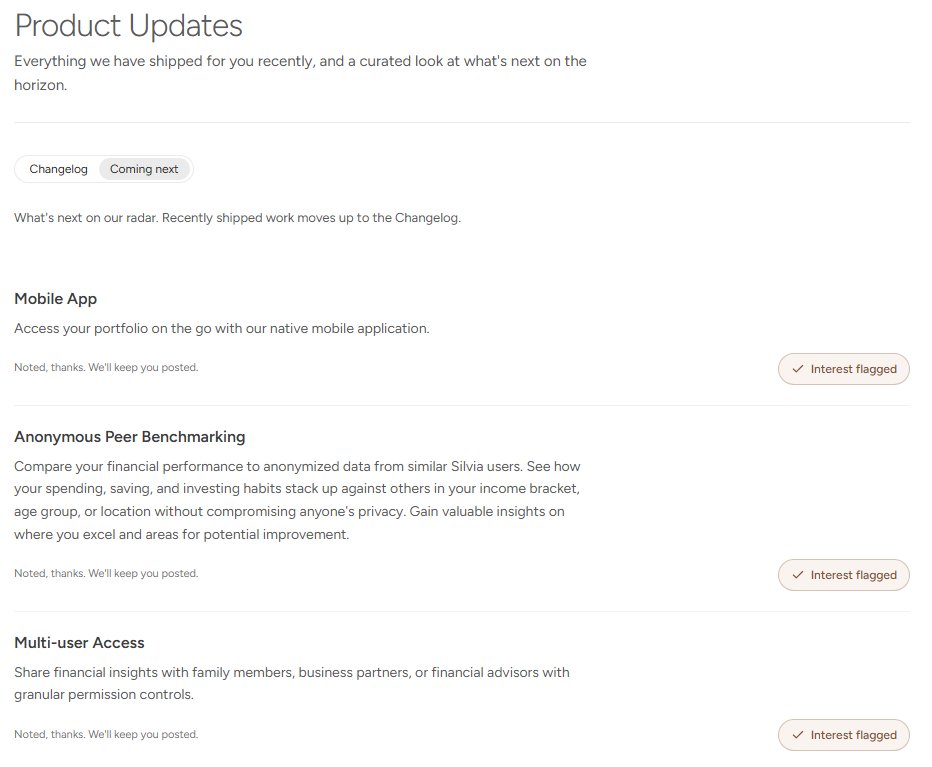
And...
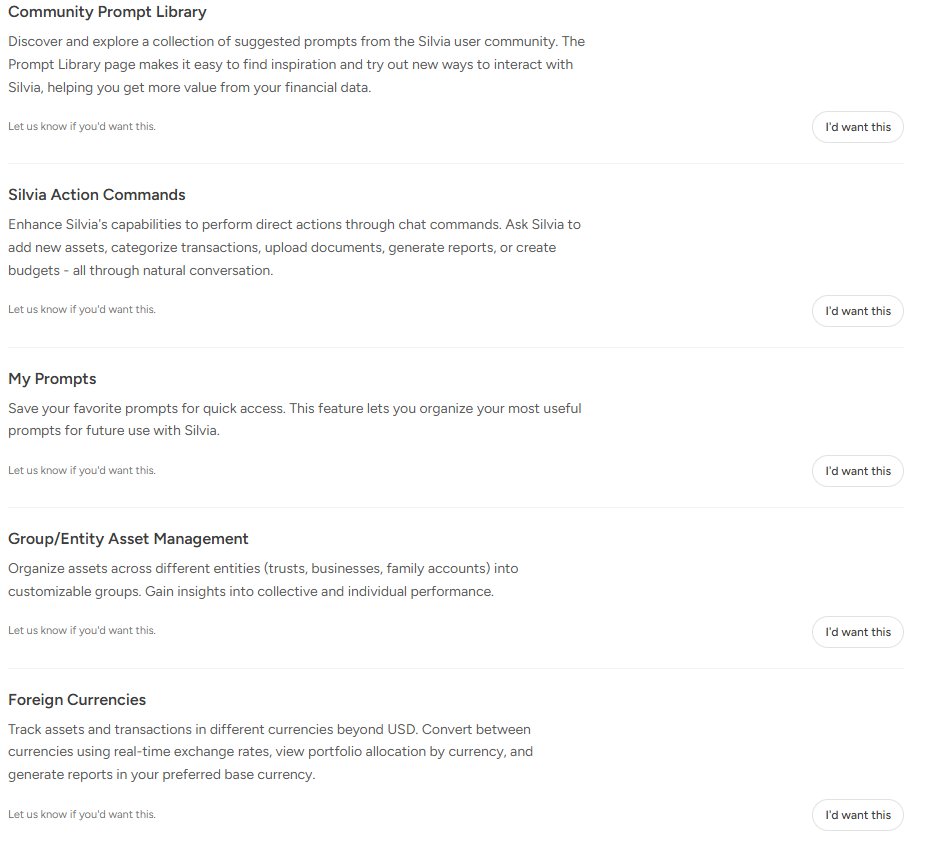
For me personally, I really want to see a mobile app and I would like to share my profile/account with my Wife (and eventually my kids). Those are the top two features I am patiently waiting for.
Now, with that in mind, there are a few other things I would love to see eventually. This is just my thoughts (hopefully someone on the Silvia team reads this):
-
Tax-intelligence products: Silvia could expand from answering tax questions into year-round monitoring: estimated-tax planning, gain and loss tracking, asset-location analysis, tax-document review, and alerts tied to changes in legislation. Eventually, it would be great to file taxes on the platform.
-
Collaborative Workspaces: I would love to one day give my accountant, attorney, spouse, and close advisers controlled access to the same financial graph.
-
Embedded financial services: Once Silvia identifies a need or recommendation, it could eventually connect me with the appropriate products/providers. This might include lending, insurance, tax services, estate planning, specific investment research, or other financial tools.
-
Proactive financial agents: The largest opportunity is shifting from pure analysis to action. Help me execute trades, update key financial/legal documents, file my taxes, etc.
Today, most AI products wait for instructions. However, this is rapidly shifting. Grok Bot and GPT-Work are now making it easier than ever to create and manage multiple agents.
If Silvia moves in this general direction, then that is when an AI CFO becomes a true partner and a financial operating system.
Major Questions Remain
Make no mistake, Silvia already has several ingredients for a compelling vertical AI product:
-
A valuable customer segment
-
High-value financial context
-
Broad account connectivity
-
Frequent user engagement
-
A clear problem
-
Early paid conversion
-
Evidence that specialized retrieval improves model performance
However, major questions still remain.
-
Can Silvia retain paying users after the novelty wears off?
-
Can it deliver consistently accurate analysis across thousands of individual financial situations?
-
Can it earn enough trust for users to rely on proactive recommendations?
-
Can subscription revenue support the cost of data providers, inference, security, compliance, and product development?
-
Can Silvia expand without crossing into regulated investment, tax, or legal advice?
-
Can it protect some of the most sensitive data a consumer can provide?
-
And can it build distribution before banks, brokerages, Intuit or the frontier labs close the product gap?
These are not small questions, and in the AI space, an impressive chat answer is not enough. The answer must be accurate, current, explainable, secure, and appropriate for the user’s actual circumstances.
Larger Opportunities Ahead
Silvia is not interesting because it placed first on one benchmark. I am a fan of this novel product because it represents something much larger. For decades, wealthy families have paid teams of professionals to aggregate information, monitor risk, coordinate decisions, and ensure that important financial details do not fall through the cracks.
Technology has gradually made pieces of that service more accessible, and AI will compress the cost even further. That said, the result likely won't be an autonomous system that replaces every accountant, advisor, and attorney. In my opinion, a more realistic outcome is an intelligence layer connecting the individual, their assets, and the wider team that helps them navigate the complexities of personal finance. And this is the opportunity Silvia is pursuing.
Disclaimer: I am an investor in $BRR. However, this is did not influence this essay. I am merely trying to capture my thoughts in a concise manner.
Published on grokbot.sh. Cite the public log, not a prompt pack.