
Kimi K3 for finance: the four workflows that actually work.
How Kimi K3 quietly changed retail investing: Warren Buffett reads five hundred pages a day. That's the discipline that produced sixty years of returns nobody could copy, because nobody wanted to
Article
Job breakdowns
How Kimi K3 quietly changed retail investing:

Warren Buffett reads five hundred pages a day. That's the discipline that produced sixty years of returns nobody could copy, because nobody wanted to read that much.
The reading is still the edge. Only now the reading is free.
Kimi K3 shipped in July 2026 with a one-million-token context window. In practical terms: it holds eight full 10-K filings in a single conversation, or four years of quarterly earnings transcripts for one company, or an entire industry's annual reports side by side. It reads them in minutes and answers with citations. Free on kimi.com. Three dollars per million input tokens on the API.
For ninety years, the bottleneck to serious investment research was human stamina. That bottleneck moved this year.
This is what to do about it. Four workflows, one compliance line, and one thing that hasn't changed.
01 · What actually shifted
Retail investors have always been outgunned on one specific dimension: throughput of primary-source reading. Wall Street analysts don't have some mystical edge on picking stocks. What they have is a research bench.
Someone reads the entire 10-K. Someone else attends every quarterly call. Someone else tracks Form 4 filings. The analyst synthesizes.
That bench costs money. Retail investors couldn't build one, so they skipped the primary-source layer and traded on headlines. The professionals kept their edge because the reading wasn't fun and wasn't cheap.
The throughput math
A human analyst reading carefully covers roughly 250 words per minute. A large-cap 10-K runs 90,000 to 120,000 words. That's six to eight hours of focused reading for one company. The same analyst has thirty-nine more to cover before Friday.
Kimi K3 processes that same 10-K in under two minutes and holds seven more in the same session for cross-referencing.
The cost math
One thorough 10-K analysis on the API: roughly fifteen cents.
A comprehensive portfolio review across forty holdings: under twenty dollars.
That's the price of an analyst team, minus the analyst team.
The people who move first won't have a monopoly on the edge. They'll have it long enough to matter.
02 · The tool, in three facts
Everything below assumes you understand three things about Kimi K3 that matter for financial use in ways they don't matter for other tasks.
It's open-weight
Moonshot AI released the full weights on Hugging Face on July 27, 2026, under a modified MIT license.
Why this matters for finance: if your compliance rules require that no data leaves your infrastructure, you can self-host and nothing touches a Chinese API endpoint. Most retail investors won't need this. Institutional readers will.
The context window is one million tokens
This is the number that makes multi-document workflows possible in a single pass, instead of a chain of summaries that lose fidelity at each hop.
Why this matters for finance: every summarization step degrades signal. Kimi K3 lets you skip the chain entirely for documents up to about 750,000 words at once. An entire industry's annual reports fit in one conversation.
Reasoning is always on
Moonshot calls it "thinking mode." There is no way to turn it off. The model runs explicit reasoning steps before every answer.
Why this matters for finance: the reasoning chain is often more useful than the surface answer, especially when you want to verify what the model actually concluded from what it read.
Access, cheapest to most controlled
-
Free on kimi.com (rate-limited but real)
-
$3 input / $15 output per million tokens via the Moonshot API
-
$0.30 input on cache hits (relevant for re-analyzing the same document)
-
Self-hosted from the open weights if you need full data control
Now the workflows.
03 · The four workflows
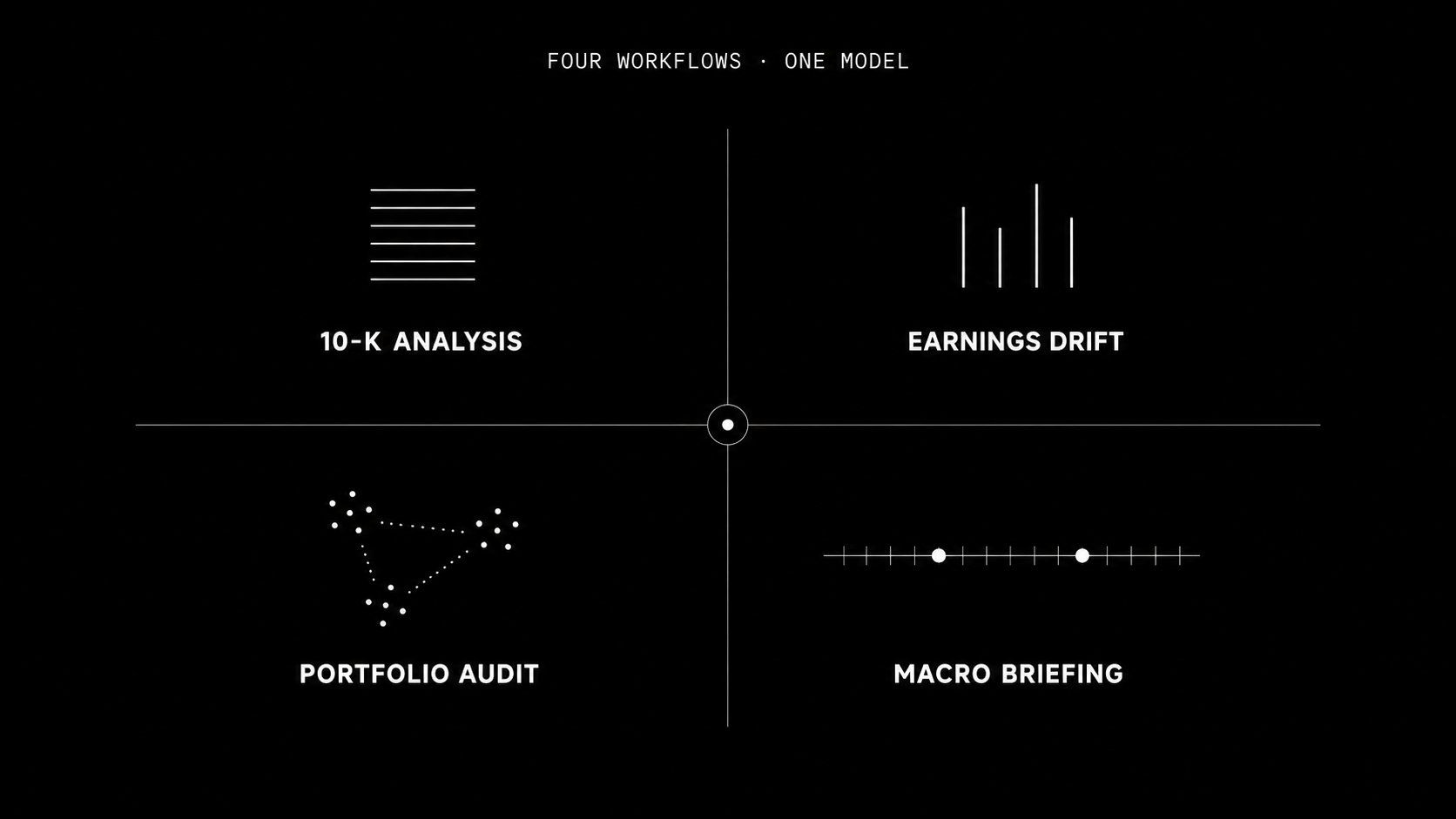
Each workflow below has three parts: what it replaces, the prompt structure that works, and what the model can't do for you. The prompts are meant to be copied and adapted, not read as prose.
Workflow 1 · Reading the 10-K
The 10-K is a company's most complete annual disclosure to the SEC. It's boring on purpose. It's boring because it contains everything that matters, and management would prefer you not find it.
Download any 10-K from SEC EDGAR (free, always has been). Feed it to Kimi K3.
The prompt:
The output is what a competent junior analyst would spend six hours producing. Page citations are the critical part — they let you verify anything the model claims by opening the actual filing at the actual page. This is not optional. It's the discipline that separates real work from a summary machine.
Replaces: hours of skimming, highlighting, and note-taking that most retail investors quietly skip because they're not paid to do it.
Doesn't replace: the judgment about which companies deserve the reading in the first place.
Workflow 2 · Earnings call drift
The interesting signal in earnings calls is almost never the current quarter's numbers. Those are in the press release before the call starts. The signal is how management's language changes across successive quarters, especially in the unscripted parts of the Q&A section.
Four transcripts fit comfortably in Kimi K3's context. One prompt processes a full year of quarterly calls and surfaces patterns that would take a human twenty hours to spot.
The prompt:
Replaces: the invisible work of tracking narrative shifts across a year of calls, which nobody does unless it's their job.
Doesn't replace: talking to management yourself, if you can get on the call.
Workflow 3 · Portfolio audit
Buffett has said, roughly, that a portfolio should be defensible in one sentence per position. If you can't articulate why you own it, you don't own it, you're holding it.
Kimi K3's role here is not to pick stocks. It's to force you to defend your own portfolio against your own written thesis.
Export your holdings from any brokerage as CSV. Write your investment thesis in 200 words: what buckets of exposure you want, and why. Feed both to the model.
The prompt:
Most portfolios have three or four positions that don't map cleanly to the stated thesis, and one bucket that's supposed to exist but doesn't. This forces you to notice.
Replaces: the annual portfolio review that most retail investors never actually do.
Doesn't replace: the discipline to rebalance once you see the gap.
Workflow 4 · Macro briefing
Macro trading is context-heavy in a specific way. The story that matters isn't one indicator; it's the pattern across many indicators against the calendar of upcoming releases.
For this workflow, Kimi K3 works best wired to a data source through its tool-use interface (OpenAI-style function calls, or MCP servers). This lets it retrieve current numbers rather than rely on stale training data.
The prompt:
The output is not a trade recommendation. It's the briefing document a macro research desk would produce for an internal morning meeting.
Replaces: the manual synthesis of release calendars, historical reactions, and positioning.
Doesn't replace: your view.
04 · The line you don't cross
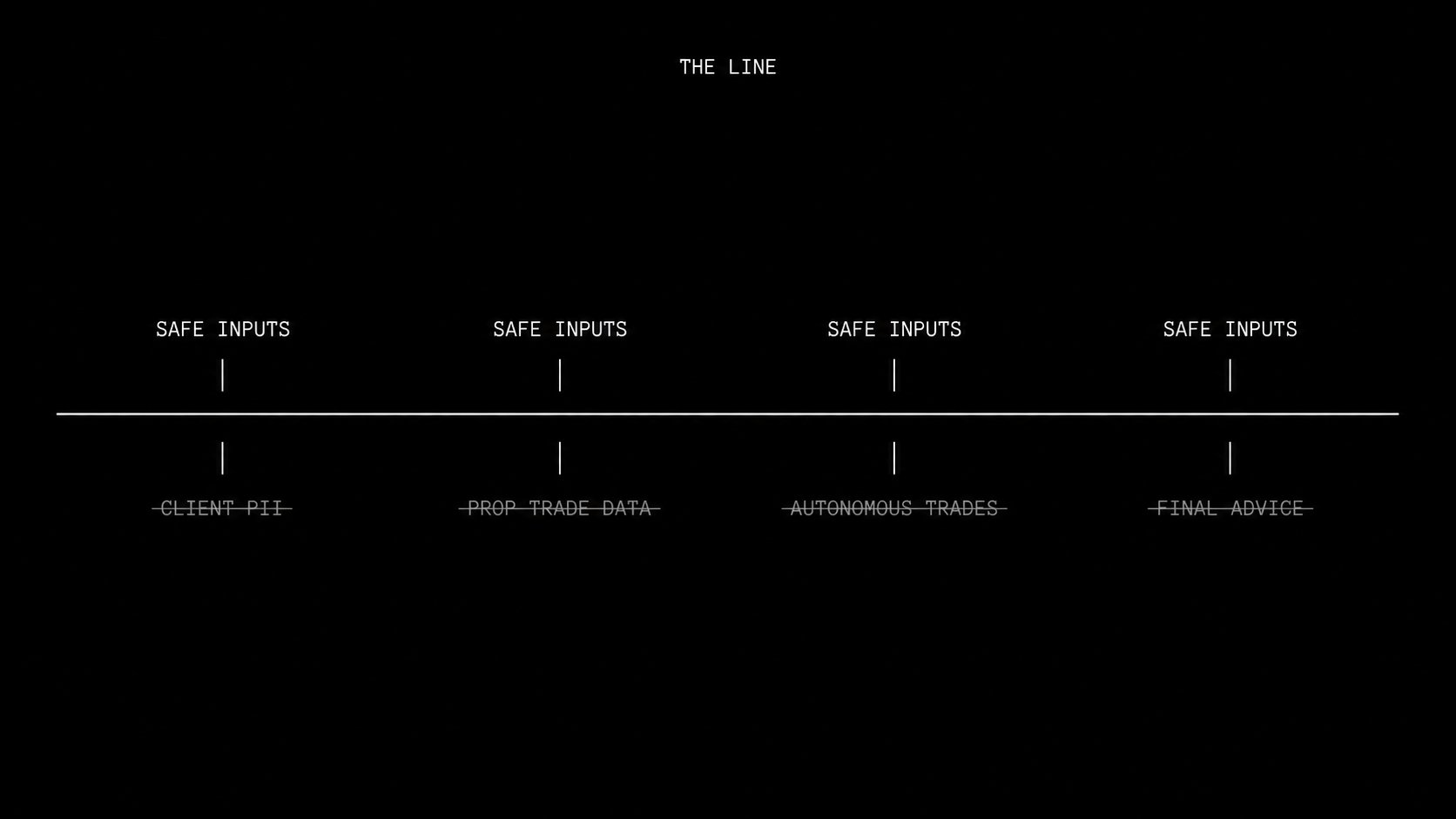
Four things Kimi K3 should never touch, regardless of how well it performs on benchmarks.
Client personally identifiable information
Never route client PII through the hosted Moonshot API. Data residency rules vary by jurisdiction and the compliance cost of a violation is not proportional to the benefit. If you must work on client-adjacent research, self-host from the open weights.
Proprietary trade data
Same reasoning, different sensitivity. Positioning information, order books, execution algorithms. Nothing goes to a hosted model in another jurisdiction that you wouldn't email to a stranger.
Autonomous trading decisions
Kimi K3 is a research assistant, not a portfolio manager. Every workflow above outputs analysis that a human then acts on. The model does not click Buy. Not now, not with agent frameworks, not later.
Final regulated advice
Client-facing investment advice must come from a licensed human. Kimi K3 can draft the memo. A human signs it. The signature is not a formality; it's the accountability boundary regulators care about.
Every workflow in this article assumes a human at the end of it. If you're building anything that removes that human, you need a lawyer, not a field guide.
05 · What still requires you
The reading isn't the edge anymore. The reading became free this year. What still requires a human is everything upstream and downstream of it.
Upstream
Choosing which companies deserve the reading.
Kimi K3 will analyze Enron's 2001 10-K with the same care as Berkshire's, and it will find real signal in both. It won't tell you which one to buy. It won't tell you which one to short. It won't tell you whether to be in the market at all.
Downstream
The judgment about what the outputs mean for your specific situation.
A management team hedging its language in Q4 might mean the story is breaking, or it might mean their lawyers got involved after a lawsuit. A portfolio position drifting from its thesis might be an error, or it might be a good outcome you should let ride. Kimi K3 finds the pattern. You decide what the pattern is worth.
The trade
You gave up hours of tedious primary-source reading. You got back the same hours to spend on judgment.
That was always the good trade. Most retail investors couldn't make it because the reading was too expensive to skip and too long to do. That constraint held for ninety years. It stopped holding this July.
The last time this happened in retail investing was probably 1975, when the SEC ended fixed commissions and made discount brokerage possible. That took five years to fully filter through to who was investing and how.
The current shift is faster.
@lumenxbt
Published on grokbot.sh. Cite the public log, not a prompt pack.