
I Let a Grok Bot Run My Fantasy Draft.
Back in the day, there was Rotoworld Fantasy Football Forums. Each player had their own thread. Perfectly organized. A world of opinions at your fingertips. Then podcasts multiplied. Paywalled
Article
Job breakdowns
Back in the day, there was Rotoworld Fantasy Football Forums. Each player had their own thread. Perfectly organized. A world of opinions at your fingertips. Then podcasts multiplied. Paywalled analytical sites. Paywalled draft guides and live drafters.
There used to be an edge in fantasy football.
You watched the games, paid attention to players, and trusted your own intuitions. Fantasy has always been probabilities and luck. The edge that is slowly dying is probability.
So what is the point of playing anymore?
I have been asking myself that for four years. I even have a new rule - if I win a championship in a league now, I am retiring from that league. As you get older, pile on responsibilities, and have kids, managing a fantasy team stops feeling like joy and starts feeling like a second job. That burden scales hard once you are in more than three leagues.
A typical week for a fantasy football manager:
Tuesday night: review last week, review bye weeks, set waiver claims, review potential trades
Wednesday morning: see what you won, what is left, who got cut, review potential trades
Thursday night: lock the early game roster spots
Friday–Saturday: another waiver pass
Saturday night / Sunday morning: lock overseas games, manage rosters for first slate of games, rmanage rosters for second slate of games, and finally...manage rosters for Sunday Night Football.
Based on how many teams you manage...multiply this effort.
For some people, that ritual used is the fun. I am tired now. Four kids under nine. Work that eats my attention constantly. I want sleep, read a book, spend quality time with my wife., touch grass....anything but stare at the waiver wire or try to devise a trade.
And yet I still love the concept of managing a fantasy team.
It is 2026 and I am effectively a cyborg. I run teams of AI agents for research, prospecting, sales tools, apps, and games. So why can’t a Grok Bot run my fantasy football team?
Fantasy apps will tell you they don’t allow it. No official write API. Fine.
I trained a Grok Bot, armed it, and let it draft. 100% agentic.
It nailed the draft and now I am going to run week-to-week the same way.
Here is what I built, how draft day worked, and what happened when other bots graded the draft results of my league.
The Mission
Build a system where:
-
A Grok Bot watches and operates your logged-in fantasy account (I use Sleeper)
-
The bot is the decision and review brain
-
A deterministic model ranks legal choices from the live board and real draft state
-
A guardian blocks bad, stale, or duplicate actions
-
You can take over instantly from your phone
The bot is not trying to be clever on the clock. Its edge is a league-specific board, a correct read of the live room, and a hard refusal of catastrophic mistakes.
Step 1 — Make the league machine-readable
You would not walk into a draft without knowing the rules. Neither can your bot.
League truth I stored:
-
12-team, full-PPR, 6-point passing TD
-
QB / 2 RB / 2 WR / TE / 2 FLEX
-
No kicker or defense
-
14-round snake, 90-second clock
-
Two keepers, traded draft picks, FAAB
-
23 keeper cells, 145 live selections
-
Keepers: Jordan Mason (R11), Harold Fannin (R14) — twelve live picks left
-
Prior-year draft history, roster data, traded-pick maps
Generic tools do not understand your scoring, keeper holes, or traded picks. That is edge number one.
Step 2 — Build a football-data foundation
Rotoworld threads used to be the grind. Now it is podcasts or a $500 data suite. Underneath, fantasy is still luck with a coat of math. Average WR separation is interesting. It does not guarantee the throw, the protection, or a clean catch.
Start with a paid chatbot. Brief it hard: new coaches and schemes, free-agent depth-chart shifts, camp news, strength of schedule, boom/bust profiles, target and carry shares plus trends. Have it research and ingest public data sources...there is more than enough public information to make very strong probabilities and cases.
Ask it to build a game plan for your Grok Bot: football intelligence that can draft a league-winning roster.
What you do not want:
-
Popular opinion treated as fact
-
One loud voice owning the board
-
An “intelligence” system that is just recycled takes
Build a shared brain first — GitHub, Notion, or Drive. That is what the bot reads on draft day and all season.
TLDR
-
Stand up a second fantasy brain
-
Scope the plan with a chatbot
-
Execute with your Grok Bot
We built usage histories, offensive environments for all 32 teams, coaching verification, scheme confidence, rookie mappings, Sleeper IDs. The goal was simple: stop drafting raw ADP. Separate high-usage players with a real ceiling from empty boom/bust names, “safe” dead weight, and young keeper options.
Step 3 — Turn data into a league draft product
You are not reshuffling consensus. Free sites already do that.
What I needed:
-
A 240-player league-specific board
-
League-adjusted projections and custom scoring
-
Keeper-adjusted market timing
-
Overall and positional tiers
-
Fallback and rookie-option boards
-
Hard-avoid and manual-review gates
-
A keeper-cell map and a QA file that documented the limits
Weights favored league-specific value above replacement, prior-year usage, usage-backed ceiling, useful weekly floor, offensive environment, injury penalties, and late-round rookie keeper value.
Step 4 — Put your philosophy in the system
This is the MOST IMPORTANT STEP in the whole process. It is also the only real differentiator.
If 100 people run Steps 1–3 the same way, the boards rhyme. The drafts rhyme. You already know Zero RB, Late QB, dual-threat QB, RB/WR/RB/WR. Talking scenarios with a chatbot helps. It is not enough.
Your edge is not “I have a Grok Bot.” Your edge is a Grok Bot acting on your draft philosophy — with enough backbone to hold the line or deviate on purpose.
Open voice memo. Talk. Blabber. Copy Transcript. Paste it in. Make the model relay what it heard.
Mine sounded like this:
High-usage players who create weekly separation. Maximize RB/WR/FLEX. Take QB/TE only when the positional edge is real. Later rounds for asymmetric keeper or contingency upside. Keepers: Mason and Fannin. No Mason handcuff with Aaron Jones this year. Real doubt on Fannin’s breakout case — year two, QB carousel, Cleveland.
Core rules I locked in
-
At least two RB/WR through three picks
-
Usually four RB/WR through five
-
No early capital on a second QB
-
Avoid QB2 + TE2 unless the values are absurd
-
One-plus-one-plus-optional-rookie structure for the back end
Keeper nuance matters. Fannin as a last-round keeper made the bot float another top TE. I pushed back, then refined the doctrine: Bowers was already kept elsewhere; McBride was the only elite-TE exception still live; Warren and Pitts were not early “Fannin insurance.” If McBride was gone, do not chase the middle of a TE run.
Key point: do not hand the bot if-then orders (“if McBride is there, take him”). Teach it how to rationalize from roster state, remaining board value, and how you think about risk.
That is how a generic board becomes your draft.
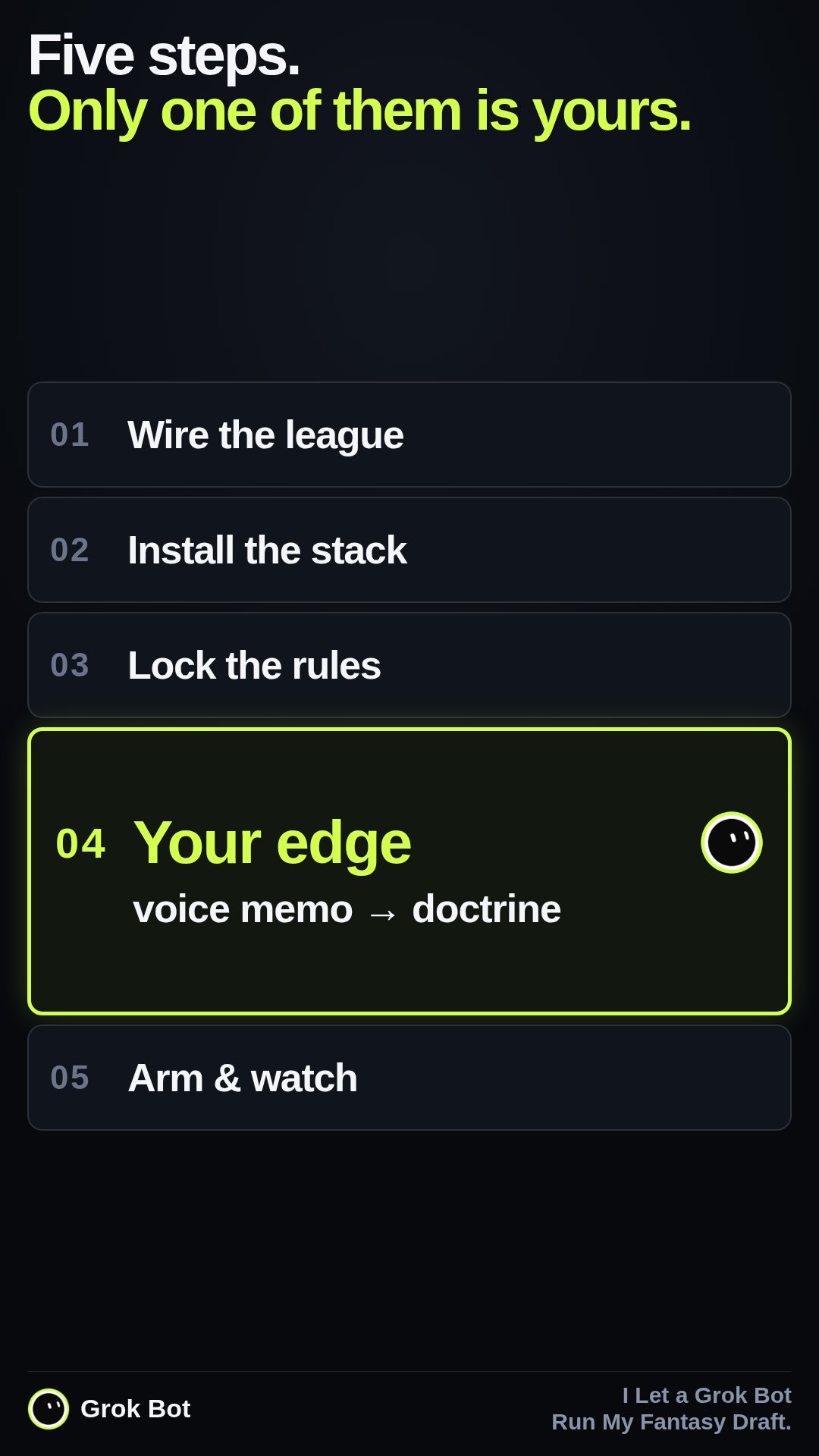
Step 5 — The live draft decision engine
I am not making the pick. I am not in the chair.
I armed the system. For my first draft, I had the phone on, in the draft, watching, and kill switch ready. That is the point.
Steps 1–4 already decided the football. This step is the hands.
Sleeper will not give you a write API. The bot can see the league. It cannot submit through those endpoints. So a computer stays logged into the draft window. API is the ledger. Browser is the hand.
The chain
-
Watcher — polls Sleeper API. One question: is it our turn?
-
State adapter — whose turn, who owns the pick, names gone, names left, every roster, keepers, real order, traded picks, timer, pause state. API and browser disagree? Freeze. Ledger wins.
-
Ranker — short list only. Rolling queue of 8–12 legal names. On your turn: one pick, two backups, exact Sleeper IDs, a reason, and one timing question: can we wait?
-
Grok Bot — review brain. Structured recommendation. No inventing a fourth name.
-
Guardian — bouncer. Wrong league, stale state, already drafted, hard avoid, roster break, you hit stop: door shut.
-
Click — one click on that ID. Read the official cell. Match: ledger. No match: freeze. No second click.
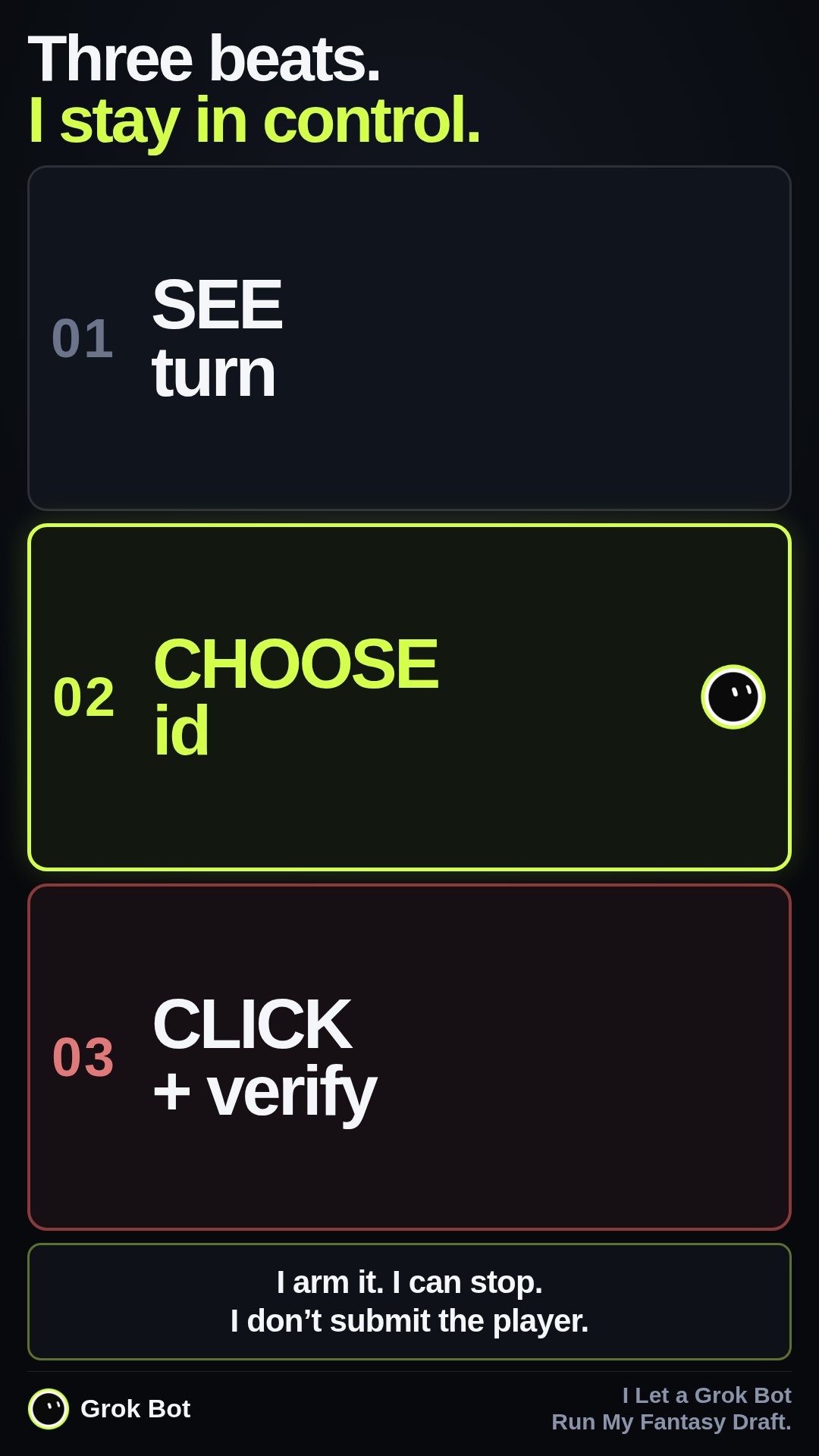
I trained the system before the draft and ran many mock drafts to ensure that it functions properly. I can stop it. I do not submit the player.
Draft day
Sixty minutes before:
-
Computer logged in, phone as backup
-
No sleep mode, no surprise updates, one clean process
-
Refresh injuries, roles, ADP, keepers
-
Confirm the league-specific rules and other nuances (ie: Keepers)
-
Confirm live order, rebuild cells
-
Start in “show me” or “ask me every time”
Do not start in full auto because the board looks pretty. Auto is a mode you earn after the loop has been broken on purpose and still refused the wrong click.
Every turn: reconcile state, recompute the next pick, refresh the queue, Grok Bot recommends, guardian validates, one click if armed, verify Sleeper, write the ledger.
It worked. The Grok Bot drafted the team. I watched. I did not need to be in the chair. The training worked and it nailed it.
Results — graded by bots that never saw my intel
After the draft, I did not grade myself.
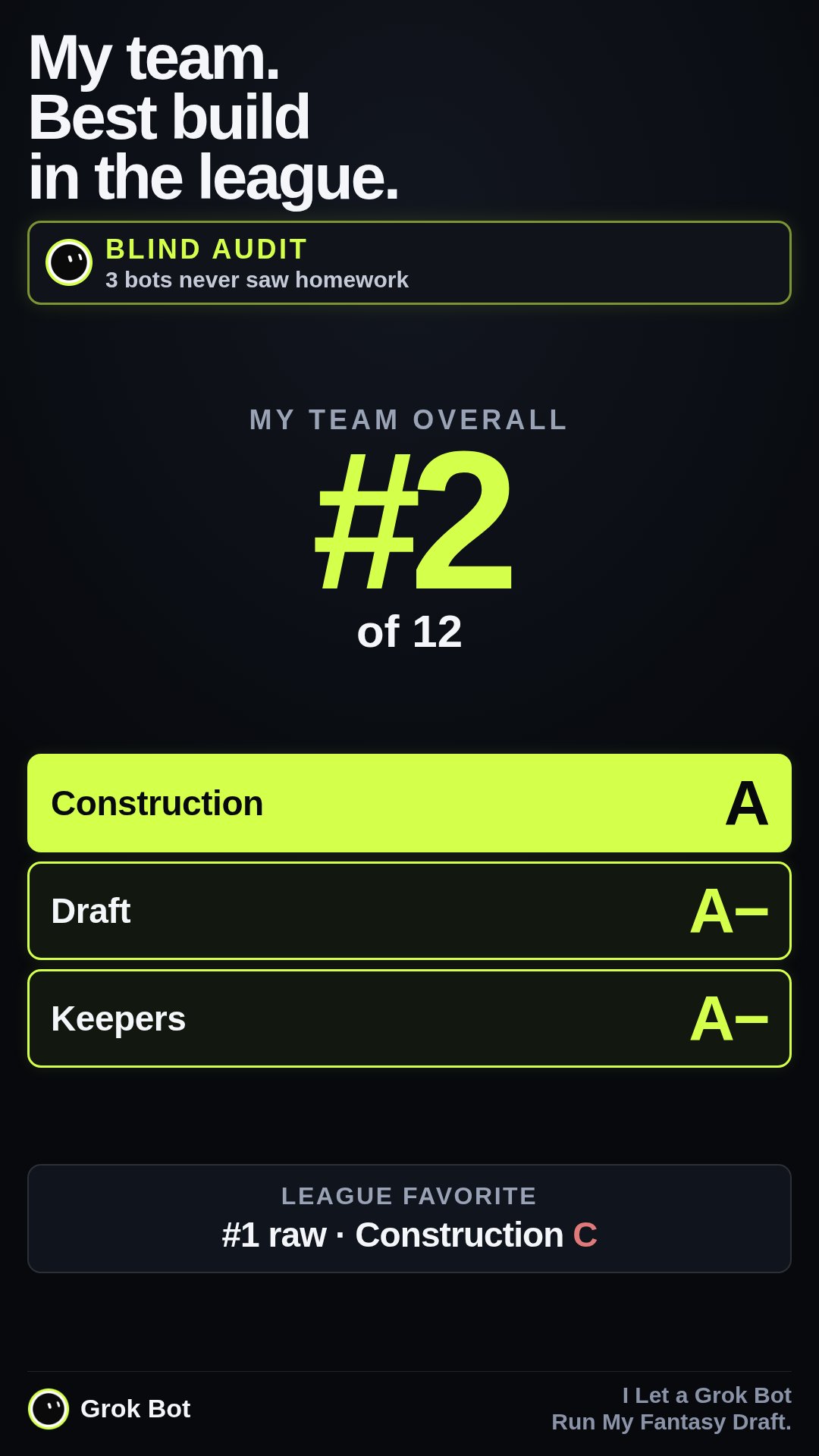
I ran an independent review with separate bots. They got the official Sleeper draft, roster shapes, and keeper cells. They did not get my football intelligence, doctrine, board weights, or voice-memo philosophy. Blind on purpose.
Three reviewer bots audited slots 1–4, 5–8, and 9–12. Final report checked against 12 rosters, 168 selections, and 23 keeper cells.
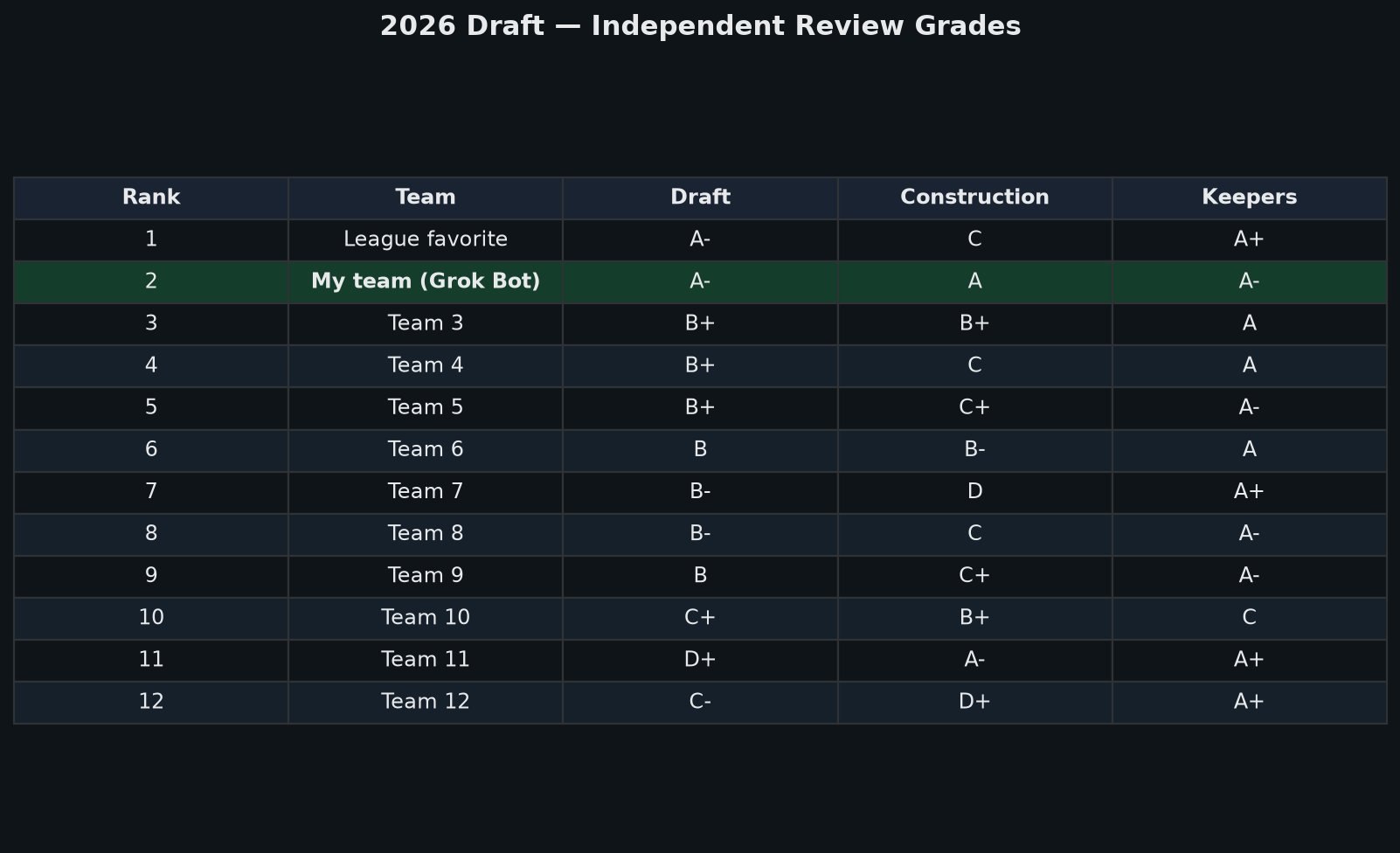
Grades separate from power ranking:
-
Draft — player value and market timing
-
Construction — allocation quality (depth, QB/TE discipline, injury resilience)
-
Keepers — keeper economics
Independent review grades
-
League favorite — Draft A- · Construction C · Keepers A+
-
My team (Grok Bot) — Draft A- · Construction A · Keepers A-
-
Team 3 — B+ · B+ · A
-
Team 4 — B+ · C · A
-
Team 5 — B+ · C+ · A-
-
Team 6 — B · B- · A
-
Team 7 — B- · D · A+
-
Team 8 — B- · C · A-
-
Team 9 — B · C+ · A-
-
Team 10 — C+ · B+ · C
-
Team 11 — D+ · A- · A+
-
Team 12 — C- · D+ · A+
Bottom line
-
The league favorite is still preseason #1 on raw roster power — with a C construction grade. Stars can paper over bad allocation.
-
My Grok Bot team came in #2 overall with the best construction grade in the league (A). Depth, flexibility, injury resilience — not the single loudest starter projection.
-
Other rooms got dinged for the same sins: QB2/TE2 while starving the RB room, or pretty geometry with repeated player-value reaches.
Anyone can buy consensus. The edge is a bot that drafts like you — then survives a cold audit from bots that never saw your homework.
What’s next
Draft day was Article #1.
Next: how I set up the Grok Bot for week-to-week — waivers, lineups, the Tuesday-through-Sunday grind.
Then: how to get a five-team trade through, and a season run by a bot that plays like me instead of like a consensus board.
If you are still grinding every waiver cycle by hand, you do not have to quit fantasy. Hand the chair to a Grok Bot. Keep the part you actually love.
Follow along. I am posting the full season as the Grok Bot runs it live.
Published on grokbot.sh. Cite the public log, not a prompt pack.