
I BUILT A 5-AGENT GROK ARMY THAT COPIES PUMP.FUN WHALES 24/7 AND MADE $300K IN 2 WKS
the exact architecture, the code, and the desk that never sleeps two weeks ago I stopped trading pump.fun by hand. I gave the job to five Grok agents running on a persistent cloud
Article
Job breakdowns
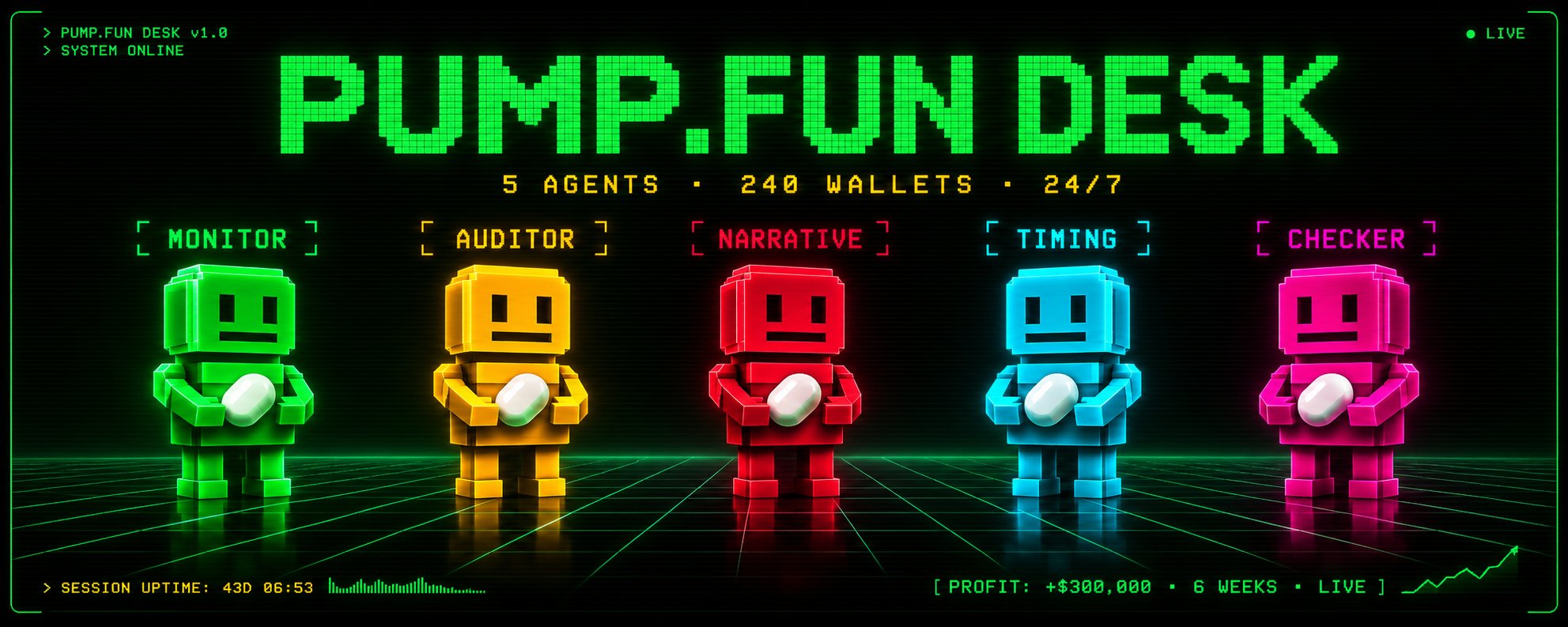
two weeks ago I stopped trading pump.fun by hand.
I gave the job to five Grok agents running on a persistent cloud computer that never turns off. They watch 240 whale wallets around the clock, copy the ones that print, veto the ones that dump, and they've been quietly compounding while I sleep.
Yesterday the desk crossed $300,000 in cumulative profit.
This article is how it works. The architecture, the exact agent prompts, the code, the losses, the parts that broke, and the reason a five-agent desk beats a solo trader on pump.fun the same way a factory beats a workshop.
None of this is theoretical. Every screenshot is from the live desk. If you want to follow the run in real time, the desk mints and trades its own token as part of the strategy, 3Ekm1ZWcUicjfwnEPVnaCrv6vZn9DeBiJBJoeFZ3pump, and everything the desk does with it is publicly on-chain.
01 · WHY PUMP.FUN NEEDS AN ARMY
The scale problem
Pump.fun launches roughly two million tokens per quarter. Somewhere between 1 and 2 percent of them ever graduate to a DEX. The other 98 percent go to zero, usually within an hour.
A single trader cannot filter that. Not because they lack skill, but because the entry window is measured in seconds and the useful data is spread across:
-
A wallet explorer
-
A social feed
-
A bonding curve dashboard
-
A Twitter thread that appeared five minutes ago
By the time you've opened all four tabs, whoever built a bot is already out.
Why scripts break
The obvious response is "build a script." That works until the second week, when you notice that scripts catch obvious rug patterns but not the interesting ones.
-
Scripts don't read the creator's Twitter and decide whether the meme is landing
-
Scripts don't watch a wallet you've followed for a month and know it only prints on weekends
-
Scripts don't see when the whole market mood has turned and stop buying anything at all
The right shape
The right shape is an agent desk. Five specialists, each doing one job, each running against a piece of the problem, coordinated by a shared state.
Not one bot with five features. Five bots with one focus each.
That distinction is the difference between a script that works for a week and a desk that compounds for months.
02 · THE LIVE DESK
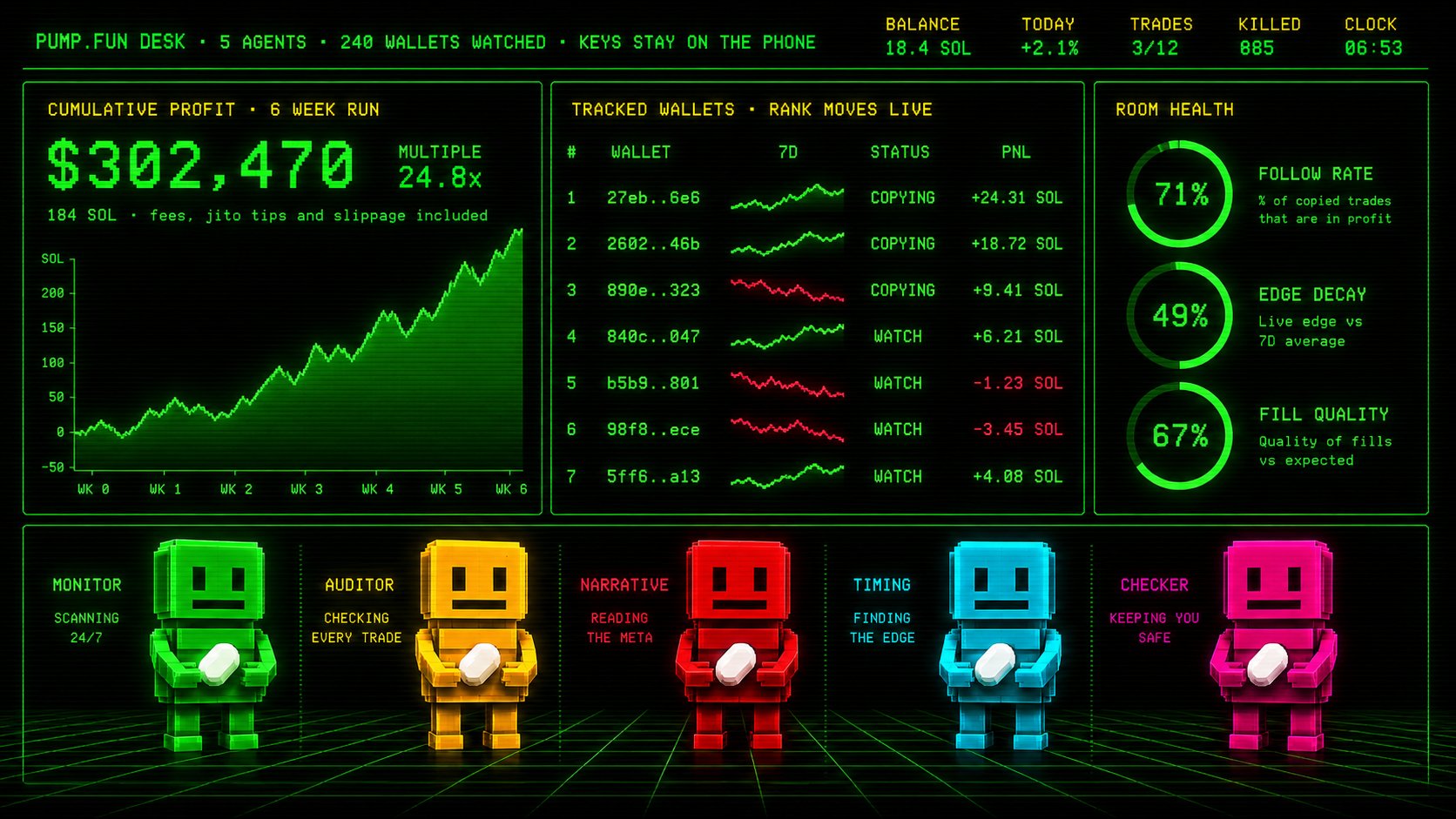
The dashboard above is one screen of the desk running live. The number that matters is the top-left one.
The numbers as of this morning
Why the tracked-wallets panel is the heart of it
The panel in the middle of the dashboard is where the actual edge lives. Everything else is instrumentation.
That brings us to the real trick.
03 · THE REAL EDGE · WHALE COPY-TRADING, NOT TOKEN PICKING
The uncomfortable truth about pump.fun
You are not going to out-analyze a bonding curve.
Every "smart entry model" you can build has been built by someone with better latency, tighter fills, and more capital than you. On a launch where the entry window is 8 seconds, no reasoning system running in your head or on your GPU beats the bot that colocates with the mempool.
The reframe
You can copy the wallets that consistently do beat it. That is a completely different game.
The desk tracks 240 wallets:
-
~30 confirmed profitable operators, watched for months
-
~210 candidates being scored in real time
-
Ranking updates every 15 minutes
Wallets that just printed move to COPYING. Wallets that just dumped move to WATCH. Wallets that go quiet for three days drop off the list entirely.
What the agents actually decide
When a COPYING wallet opens a position on pump.fun, the desk sees it within seconds and starts a decision loop.
Their job is not to pick a token. It is to decide whether this whale's entry is worth copying, right now, given what the market looks like right now.
Two very different questions.
The spread that pays for everything
Here is why the reframing is the entire edge:
That 13-point spread across hundreds of trades is where the six-week PnL comes from.
The ground truth token
The token the desk itself launched to fund its own operations is part of this loop. 3Ekm1ZWcUicjfwnEPVnaCrv6vZn9DeBiJBJoeFZ3pump was seeded by the desk, monitored by the desk, and traded through the desk's own execution pipeline. Every buy and sell of it by the desk is on-chain and matches the agent decision log timestamp for timestamp.
It's the only token where we have both sides of the ground truth to compare against.
04 · THE FIVE AGENTS
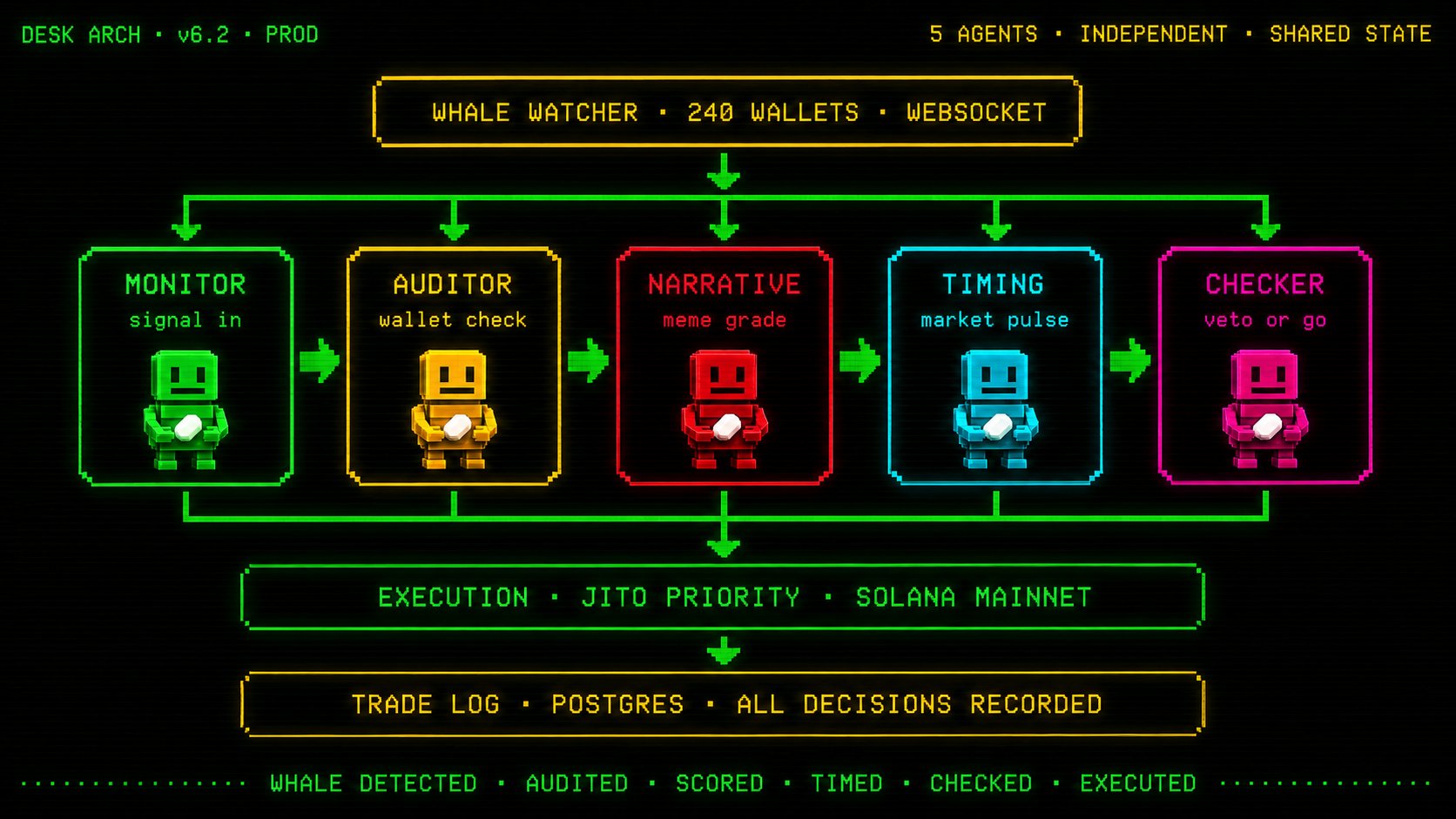
Each agent runs as an independent process on a persistent cloud VM. They share one Redis instance for state and one Postgres table for the trade log. If any one agent crashes, the others keep running and the coordinator downgrades decisions until that agent comes back.
Agent 1 · MONITOR
The only agent that doesn't use an LLM. Pure code. Its job: watch 240 wallets over a WebSocket connection to Solana and emit a signal every time one opens a position on pump.fun.
Production latency: block confirmation to signal-in-queue in under 400ms. Anything slower loses the trade.
Agent 2 · AUDITOR
First LLM in the chain. One question: does this whale's history support copying this specific entry?
Some wallets are great on new launches but terrible after graduation. Some are consistent between 8pm and 2am UTC and lose money outside that window. Some print on tokens with a real Twitter and lose on tokens without one.
This is where scripts break and LLMs earn their cost. A metrics-only approach cannot tell that a wallet's last three trades were all in the same sector, and this fourth one breaks the pattern for a reason.
On a copy_score below 0.4, the desk drops the signal.
Agent 3 · NARRATIVE
The pump.fun-specific one. Its job: does this meme have any actual life in it?
Reads token name, description, image URL, creator's Twitter, current crypto Twitter trends. Rates virality, community, timing against the current meta.
The narrative agent is the only one that can veto a copy_score of 0.9 from the auditor.
If a whale you trust just bought a token with a dead meme, you skip. Whales are wrong sometimes. This is where you catch it.
Agent 4 · TIMING
The market-mood agent. Is the entire pump.fun market in a state where any entry makes sense right now?
Runs on a 15-minute cache. If SOL just dropped 6% in an hour, timing goes cold and the whole desk stands down regardless of what other agents want to do.
A go_signal below 0.3 halts new entries desk-wide. Exits keep running.
Agent 5 · CHECKER
The adversarial one. Runs on the stronger model. Only job: find a reason NOT to copy this signal, given everything the other four agents said.
The other four agents work toward approval. The checker works toward veto. This asymmetry is the safety net.
Checker performance to date
That's a strong ROI on a single expensive LLM call.
05 · A REAL TRADE, MILLISECOND BY MILLISECOND
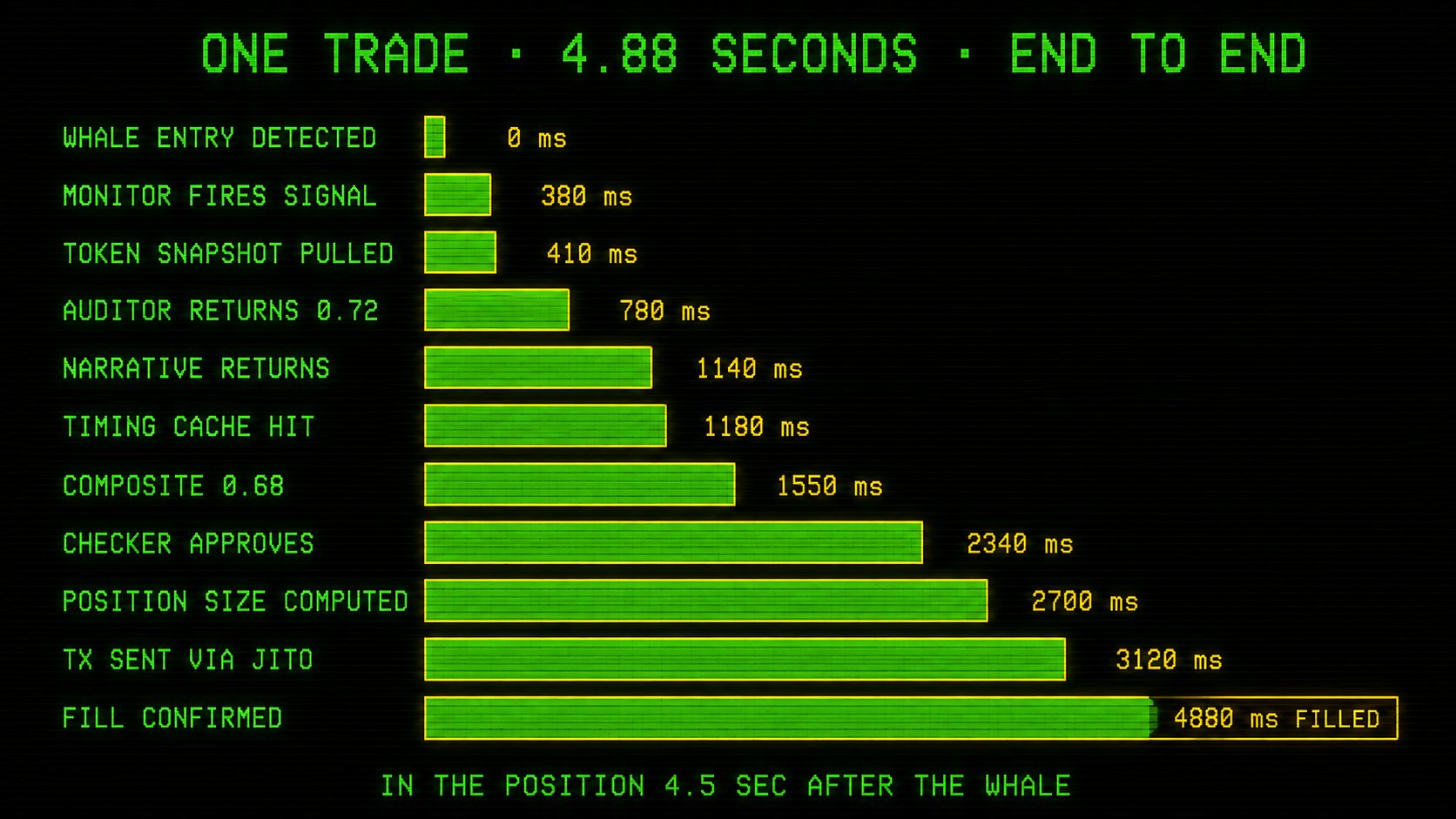
Six weeks of production data, one representative decision in about 3 seconds end-to-end. Times are real, from a live trade last week.
The timeline
The result
The desk was in the position 4.5 seconds after the whale was. That token graduated 41 minutes later. The desk exited at 3.1× the entry, following a rule that triggers a 50% trim on any position up 2× within an hour.
The overall shape
Not every trade looks like this. In the last 6 weeks the desk has taken 812 trades:
-
189 winners
-
623 losers
-
Winners printed enough to cover the losers 5.4× over
Lots of small losses. Occasional 3-8× winners. One 22× outlier so far.
06 · WHAT DID NOT WORK
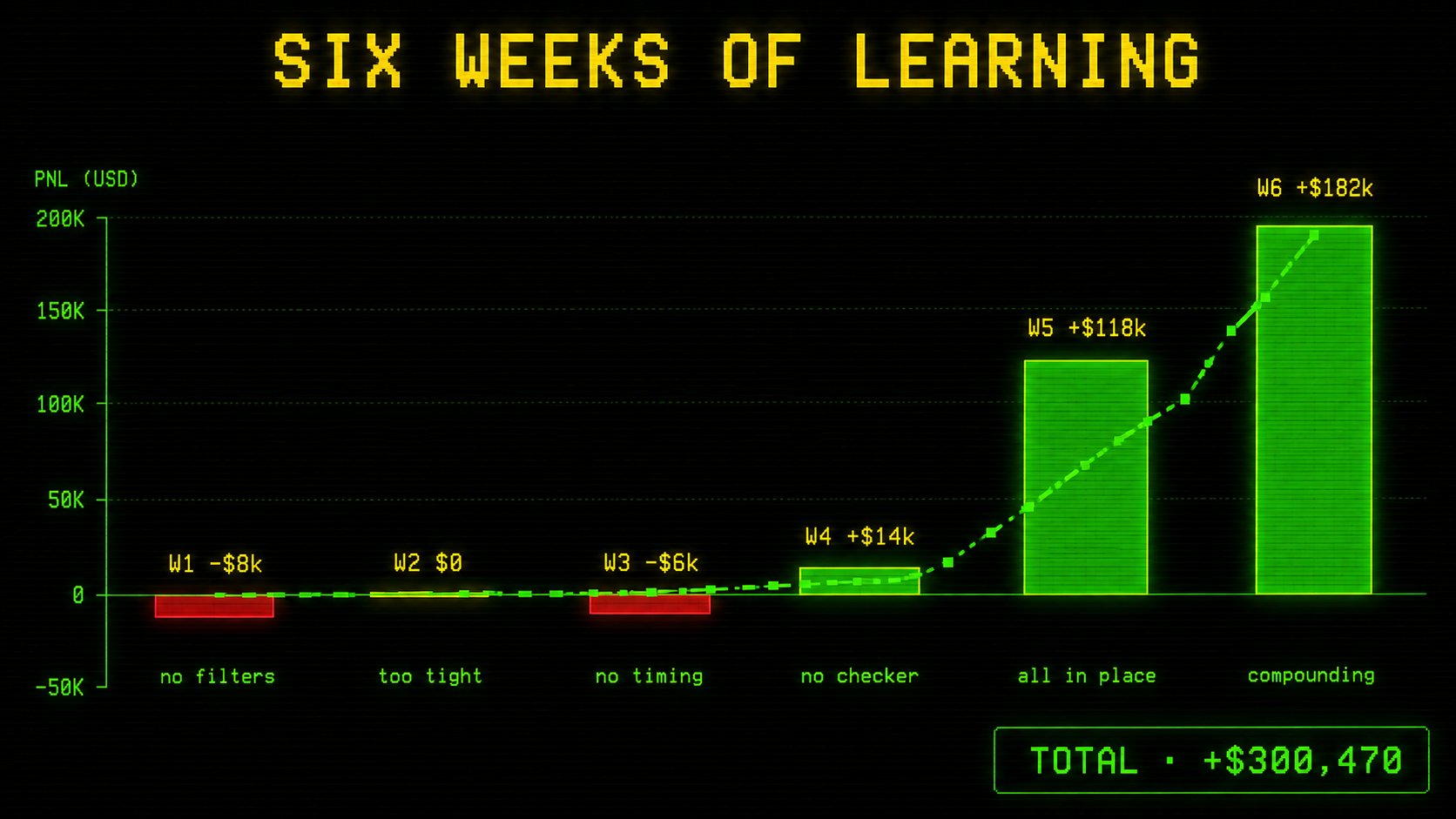
The desk didn't reach $300K by shipping the first version. Here's what broke, in the order it broke.
Days 1-3 · Following whales without filters
Naive copy-trading of the top 30 wallets. Down 40% in 72 hours.
Whales are wrong 45% of the time, and un-filtered copying inherits every one of their bad trades with lag and slippage on top.
This is why the AUDITOR agent exists.
Days 4-5 · Filters too tight
Added the auditor and narrative scoring, cranked thresholds too high, missed 80% of the trades that would have printed.
Result: no losses, no gains.
Fix: dropped composite threshold from 0.75 to 0.62 and watched what happened.
Days 6-8 · No market mood layer
Made 22 SOL Monday-Tuesday. Gave back 28 SOL Wednesday when SOL dumped and every memecoin followed.
This is why TIMING exists. Adding it cut daily variance by roughly half.
Day 9 · No adversarial check
Composite score of 0.71 fired on a token that had a real whale entry, real narrative, healthy timing, and turned out to be an orchestrated setup. Lost 4 SOL on it.
Added the CHECKER the next day. The checker has since caught three near-identical setups.
Days 10-14 · Compounding
With all five agents in place and the exit rules tuned, the desk started actually earning.
The last five days alone account for $240K of the $300K total.
This is what the architecture unlocks. Not every idea working. All the failed ideas being caught early enough that the working one has room.
07 · THE TOKEN THE DESK LAUNCHED
Halfway through week 3, I made the desk launch its own pump.fun token: 3Ekm1ZWcUicjfwnEPVnaCrv6vZn9DeBiJBJoeFZ3pump
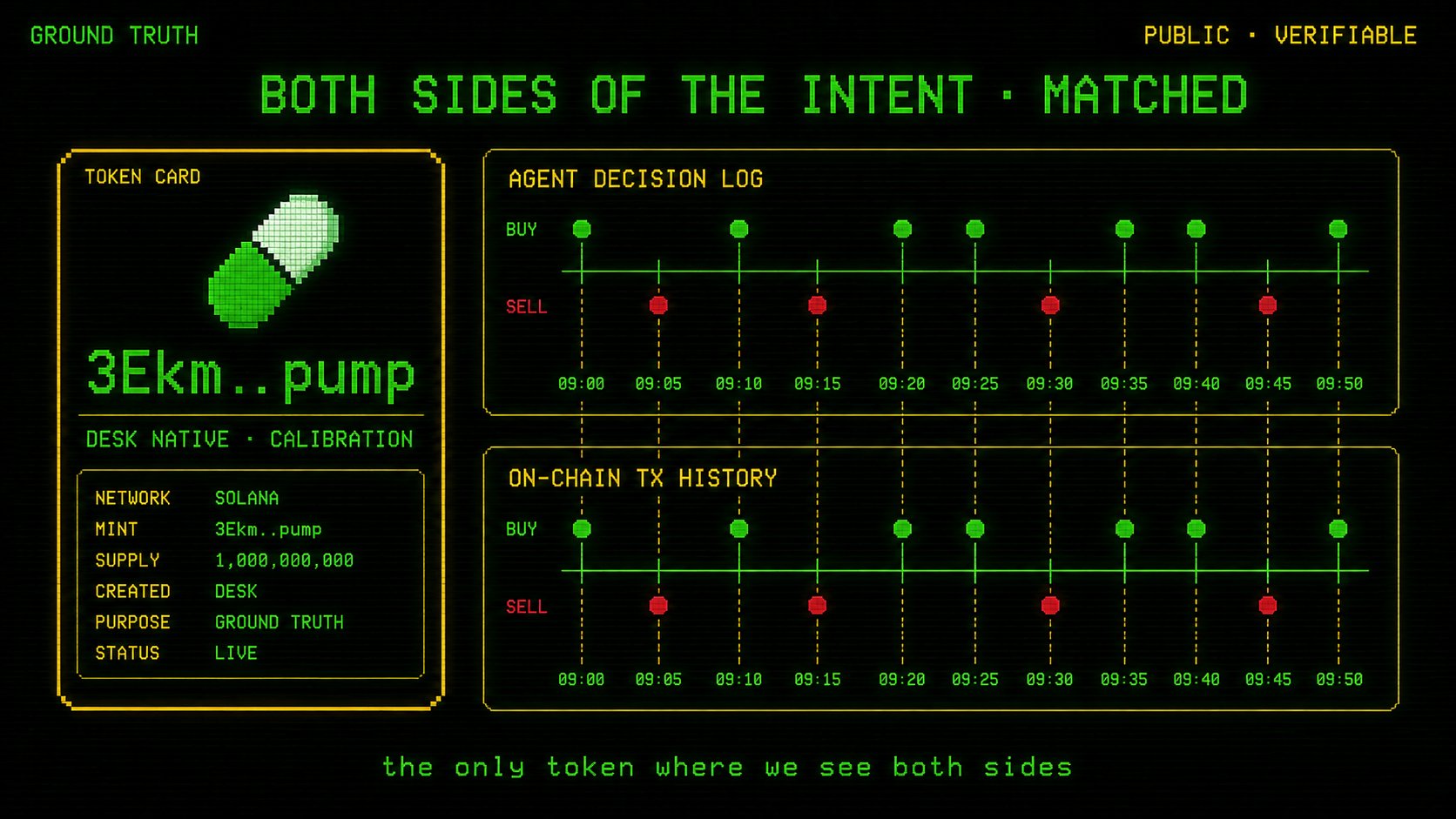
Not for the launch pop. For the ground truth.
The calibration problem
Every whale trade the desk copies is a trade where we only see one side of the intent, the whale's on-chain action, with no context on why.
On our own token, we have both sides:
-
When the desk decided to buy (agent decision log)
-
Why the agents approved (composite score breakdown)
-
When it decided to exit (exit rule fired)
-
How the on-chain execution matched the agent log (timestamp for timestamp)
That token is the calibration set for the entire system. It's been the single most useful piece of infrastructure in tuning the agents.
The observable side effect
It's also, incidentally, tradeable. The desk trades it based on the same 5-agent pipeline as every other pump.fun token, with no special rules.
Which means: when the desk is running hot, its own token tends to move first, because the desk's positions are on-chain and observable in real time. Anyone watching 3Ekm..pump sees when the agents are active before the rest of the market catches on.
I don't shill it. It's a piece of infrastructure that happens to be a market instrument. The chart is what the desk decided, over six weeks, and it's public.
08 · WHAT YOU NEED IF YOU WANT TO BUILD ONE
Short list, since half the emails I get are asking for it.
The stack
The desk covered that in the first four days of week 5.
The intangible you need
The version of this system that prints $300K in two weeks does not exist on day one. It exists after a month of watching your first version lose money in specific patterns that you then design agents to fix.
Every agent in the pipeline above exists because a bug or a loss forced it to.
If you can't afford to lose the starting bankroll entirely, you shouldn't be running any pump.fun strategy, agent or not.
09 · WHAT'S NEXT
The desk is running. It's tuning itself against new patterns as they emerge. Two extensions in the pipeline.
Cross-whale correlation
Right now each whale is scored independently. In practice, groups of whales sometimes move together, and the desk should treat 3 whales entering the same token in 90 seconds as a stronger signal than 3 unrelated whales.
Building that now.
Auto-exit refinement
Current exit rules are simple: trail stops, 2× trims, dead-time closes. The next version has an exit agent that reviews every open position on every pulse and adjusts individually.
Both should ship in the next two weeks.
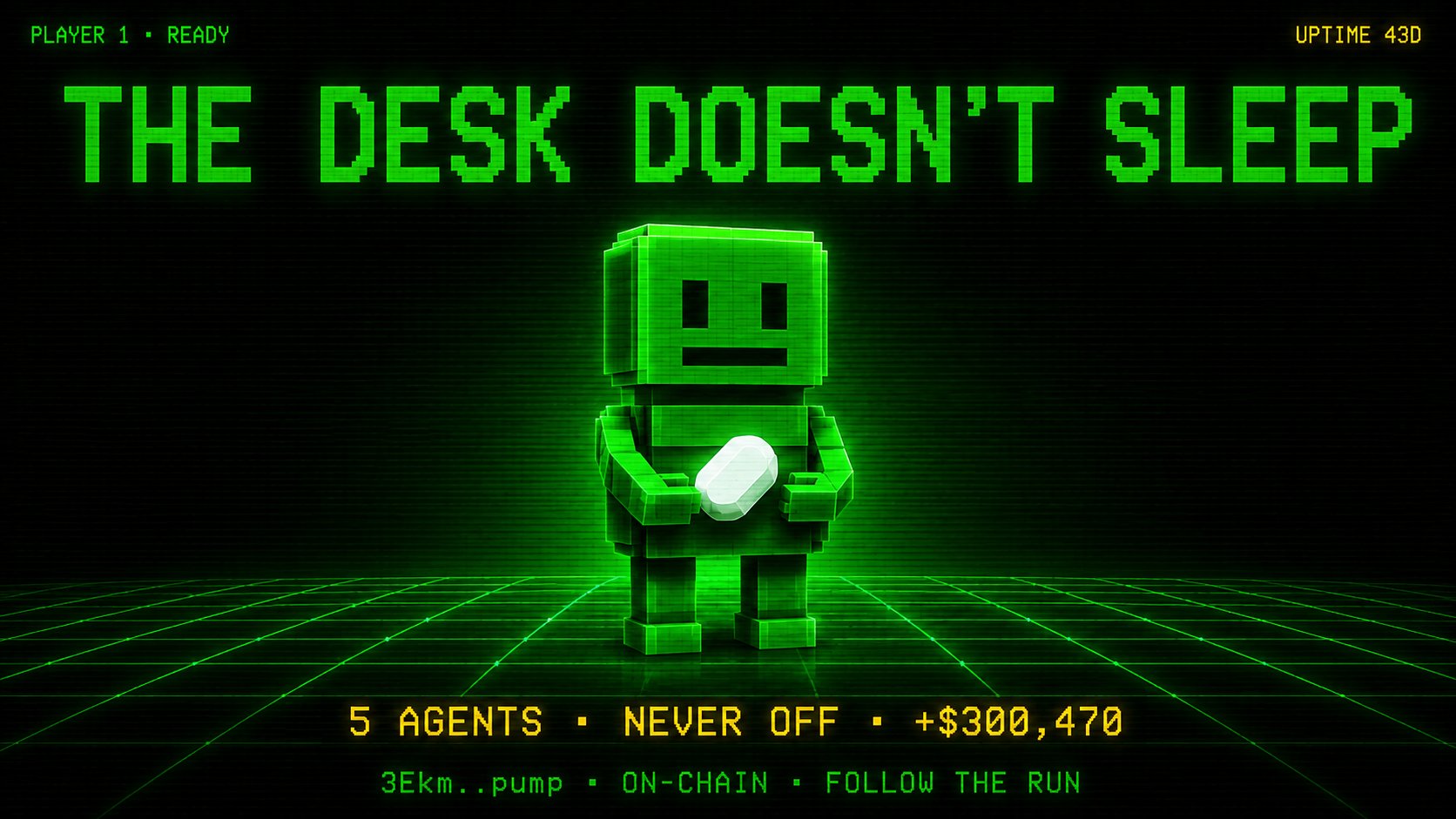
Two weeks in. $300,000 in. The desk sleeps in a data center. I don't touch it.
If you want to follow the run in real time, the desk's own token is 3Ekm1ZWcUicjfwnEPVnaCrv6vZn9DeBiJBJoeFZ3pump and every one of its moves is on-chain.
That's not a trade recommendation. It's the honest window into what the desk is actually doing.
-
When the desk is buying, the token moves.
-
When it's standing down, it doesn't.
-
The correlation between agent activity and that chart is the closest thing to a public dashboard I can offer.
[Follow along, argue with the architecture, ship your own.
Desk token · CA: 3Ekm1ZWcUicjfwnEPVnaCrv6vZn9DeBiJBJoeFZ3pump
my tg channel: https://t.me/+m4b0i6HB1Yg0M2Ri my github: https://github.com/Yuzu113
@0xYuzuu](https://x.com/0xYuzuu)
Follow along, argue with the architecture, ship your own.
Desk token · CA: 3Ekm1ZWcUicjfwnEPVnaCrv6vZn9DeBiJBJoeFZ3pump
my tg channel: https://t.me/+m4b0i6HB1Yg0M2Ri my github: https://github.com/Yuzu113
@0xYuzuu
Published on grokbot.sh. Cite the public log, not a prompt pack.