
Hybrid AI for Small Business: Grok Bot for Judgment, Hermes for Chores
TL;DR: Interactive cloud agents (in my case, Grok Bot) are best for judgment in the moment. Local agents (in my case, Hermes on a Linux workstation) are best for scheduled and long-running work. I
Article
Job breakdowns
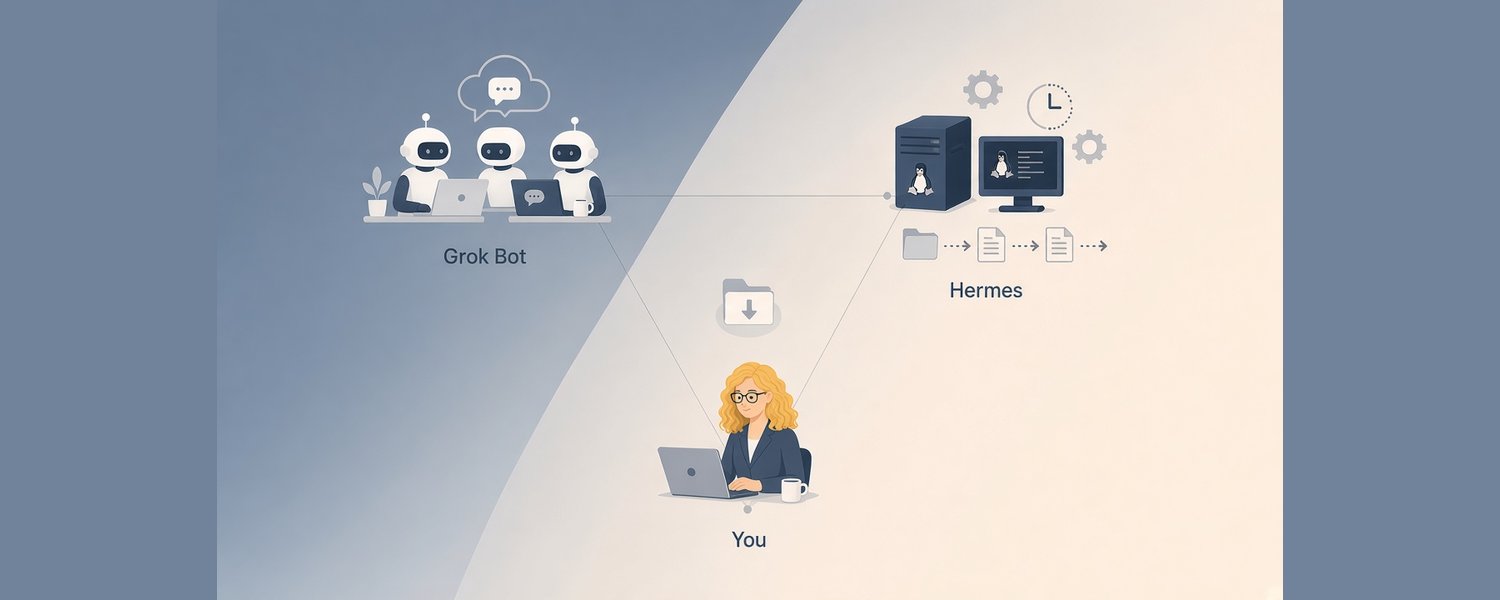
TL;DR: Interactive cloud agents (in my case, Grok Bot) are best for judgment in the moment. Local agents (in my case, Hermes on a Linux workstation) are best for scheduled and long-running work. I burned a full weekly Grok Bot token budget in three days by letting the cloud desk do both. Moving batch work to Hermes fixed the meter and improved the stack: build and refresh locally, analyze with Grok Bot when I need a mind in the loop.
I burned through an entire weekly Grok Bot token budget in three days.
I was building: a small team of specialized agents, tools that pulled data, jobs that were supposed to run on a schedule, handoffs between systems, the whole vision of software that finally bends around how a small operation actually works. It felt productive the entire time. The meter told a different story.
When the agents came back, I did something unglamorous. I asked one of them — the systems architect — to move all "batch" work to the workstation. Anything that needed me in the loop stayed on Grok Bot. Anything that was batch, scheduled, long-running, or content to finish without a conversation moved onto a Linux workstation on my desk running Hermes.
That split fixed the budget problem. More usefully, it fixed an architecture problem I had not quite named yet.
The mistake is treating "AI" as one machine
Hosted interactive agents are good at a narrow job: reasoning with tools, right now, while you are watching. They hold context, call APIs, draft, decide, poke a teammate agent, and show you something. Latency matters. Your attention matters. You are paying for a live session. Grok Bot fits that job well.
Local agents are good at a different job: work that should happen whether or not you are staring at a chat window. Refresh a dataset. Rebuild an artifact. Run a pipeline every N minutes during business hours. Mirror files. Keep secrets on hardware you control. Fail, retry, log, and move on. That is where Hermes earned its keep for me.
If you run both kinds of work through the same interactive meter, you pay session rates for work that should have been a scheduled job.
Small businesses feel this faster than enterprises. You do not have a platform team to hide the waste. You have a weekly token cap and a week that still has four days left.
Hybrid is a placement rule, not a model menu
Hybrid is not "sometimes I use a big hosted model and sometimes I use a model on my laptop." That is a catalog. Hybrid is a rule about where work lives.
Grok Bot / interactive (or your cloud desk)
-
Decisions that need you
-
Ad-hoc analysis on top of tools that already exist
-
Coordination between agents in real time
-
Anything where the product is the conversation
Hermes / local batch (or your workstation runtime)
-
Scheduled jobs
-
Multi-minute or multi-hour runs
-
Recurring builds and refreshes
-
Persistent services (small private UIs, workers, watchers)
-
Secret-heavy paths you do not want copied into a hosted workspace
-
Anything that should still run if you close the chat app
The handoff is the product. Grok Bot agents should not re-derive the universe every morning. They should use what Hermes already computed: a file in a drop folder, a tiny API on a private network, a status JSON, a pack of images, a database that got updated overnight. Hermes should not pretend to be your project manager. It should ship artifacts and get out of the way.
I put the workstation on a private mesh network (Tailscale) so it is not hanging on the public Internet. Grok Bot reaches it the way it would reach another machine on a private fabric. SSH for operations. An HTTP port bound only to that private address for UIs only my devices can see. Webhooks for outbound posts when a job finishes. Boring networking. That is the point.
What the burn looked like, in practice
The Grok-Bot-only week looked like progress:
-
Stand up a team of specialized agents
-
Wire connectors and automations
-
Ask Grok Bot to supervise loops that really wanted to be cron
-
Rebuild the same reports by re-prompting instead of by re-running a job
-
Keep long context warm because it felt safer than writing state to disk
Token budgets punish that pattern. Interactive products are priced for bursts of judgment, not for being your daytime desk and your night shift.
After the architect pass, the shape flipped:
-
Hermes owns compute that repeats
-
Grok Bot owns judgment that does not
-
Shared drop directories are the contract
-
Secrets live in tightly permissioned files on the workstation, not in chat and not in backups that wander
-
A thin weekly ops habit (prune memory, back up config, note what changed) keeps the hybrid from rotting
I still build tools. I just build most of them where overnight work does not eat the budget that buys live help during the day.
A build sketch you can steal
You do not need my industry. You need the skeleton.
-
One interactive desk. Mine is Grok Bot: a small set of agents with clear jobs — a lead who routes, specialists who speak when asked, and one systems person whose job is placement and hygiene. Resist twelve generalists.
-
One local workstation. Linux is fine. A dedicated user. A directory layout you could explain on a napkin: jobs/ for code the machine runs, drop/ for artifacts humans and Grok Bot agents may see, backups/ with an explicit deny-list for secrets, and a config area for tokens and webhooks with permissions set so only the right account can read them.
-
A local agent runtime. I use Hermes (the open agent stack associated with Nous Research / the Hermes line of work). You want something that can run tools, keep memory, schedule work, and not require a browser tab to stay open. That is your night operator. If you are starting from scratch, look at Hermes docs and examples first; then wire cron (or the runtime's own scheduler) to the jobs you refuse to re-prompt every morning.
-
Placement rules written down. If it needs a human in under a second, Grok Bot. If it can wait five minutes, Hermes. If it runs every day whether you are sick or not, Hermes. If you are about to paste a secret into chat to "just test," stop and put it in a locked file on the workstation instead.
-
Handoff formats, not vibes. Dated filenames. Status JSON. Image packs with a latest pointer. One poster that does not print webhook URLs into logs. Grok Bot should consume these like a grown-up interface even when the "interface" is a folder.
-
A private network. Tailscale or WireGuard. Userspace networking is enough on constrained hosts. You usually do not need public port forwarding.
-
Light observability. Cron exit codes. A morning status line Hermes (or cron) can write into the drop folder. A changelog when ownership or cadence changes. You are not building an enterprise monitoring suite. You are preventing mystery.
-
A secrets policy. One page is enough: where tokens and webhooks may live, what backups must exclude, and what never goes in briefs or chat. Write it before the second webhook.
Cost is a symptom. Placement is the disease.
People frame this as "local models are cheaper." Sometimes they are. Often the win is not the model at all. It is not asking a metered interactive agent — Grok Bot, in my case — to be a batch scheduler.
Grok Bot tokens buy flexible tool use, multi-agent coordination, judgment under ambiguity, and a UI that meets you where you already work.
Hermes on local cycles buys repetition, retention, better privacy defaults, and services that stay up.
If you invert that — local for fuzzy strategy chats you never log, Grok Bot for every fifteen-minute refresh — you will feel poor and under-tooled at the same time.
What changed after the move
I still use Grok Bot heavily. That is intentional. When something breaks in the moment, or I need a read on a live situation, or I want a tool adjusted while I am looking at output, I want a sharp interactive agent with the team graph available.
I do not ask it to regenerate the same nightly book from scratch because the vibe was off. Hermes already did the grind on the workstation. A Grok Bot agent opens the artifact, reasons over it, and talks to me like a colleague who slept.
Token use flattened. Capability went up. That combination usually means you fixed placement, not that you simply used less AI.
For small business specifically
You do not need a platform organization. You need honesty about which tasks are conversations; a workstation you already kind of own; one private network; one drop folder both sides respect; Grok Bot (or another interactive desk) for the conversation; Hermes (or another local runtime) for the chores; and one person — or one systems agent — whose job is to keep batch work off the metered path.
The pitch to a skeptical partner is simple. Grok Bot is more like staff time. Hermes on the workstation is more like equipment you already own. You do not want to rent the same shovel by the hour every night.
Failure modes worth naming
Fake hybrid. Everything still prompts through Grok Bot; the workstation is storage with feelings. If the meter still spikes on a schedule, you did not move the work.
Secret gravity. Backups and "helpful syncs" love to vacuum tokens into places chat can read. Write the secrets policy before the second webhook.
Agent sprawl. Ten interactive agents that all do batch work are ten ways to pay for cron. Specialization helps only if placement is enforced.
UI cosplay. A local dashboard nobody opens does not help. Prefer artifacts Grok Bot agents already load from the drop folder.
Perfection before the split. You will guess wrong on a few jobs. Move them anyway. Continuous reclassification beats a one-time migration ceremony.
The long-term approach
Use Grok Bot as a high-bandwidth control surface. Use Hermes as durable labor on hardware you control. Connect them with boring pipes: files, queues, private HTTP, webhooks. Keep the interactive budget for interactive moments. Let the machine you own do the repetition.
I learned that the expensive way — three days, one weekly Grok Bot cap, a domain-specific desk I will not itemize here. The correction was not "use less AI." It was put each kind of work in the right place.
If you are early, skip my mistake. Draw the line between conversation and chore on day one. Put the chores on Hermes. Keep the conversation on Grok Bot. Then spend your tokens on the part that actually needs a mind in the loop.
Published on grokbot.sh. Cite the public log, not a prompt pack.