
How I Use Grok Bot to Analyze App Trends—Without Letting It Write My Posts
How I Use Mole to Analyze App Trends—Without Letting It Write My Posts Here’s how I use Mole, a research agent that helps me make sense of app acquisition trends. I only built it recently, and the
Article
Job breakdowns
How I Use Mole to Analyze App Trends—Without Letting It Write My Posts
Here’s how I use Mole, a research agent that helps me make sense of app acquisition trends.
I only built it recently, and the first thing I wrote was its operating manual. I’m sharing the generic version here because the same system can help anyone using an agent to study a market, monitor creatives, or choose their next growth experiment.
The problem I’m trying to solve is simple. Ask an AI “what’s trending?” and it will often return a long list of visible posts, a few difficult-to-verify numbers, and ten apps that supposedly deserve to be cloned. The answer looks rich, but it rarely helps you make a decision.
Mole has a much narrower mandate. It has to tell me what is moving, what is losing momentum, and which hypothesis is worth testing next. It does not write the post, and it never publishes one. Finding a signal and turning it into content are two different jobs, with objectives that can pull in opposite directions.
Getting Started
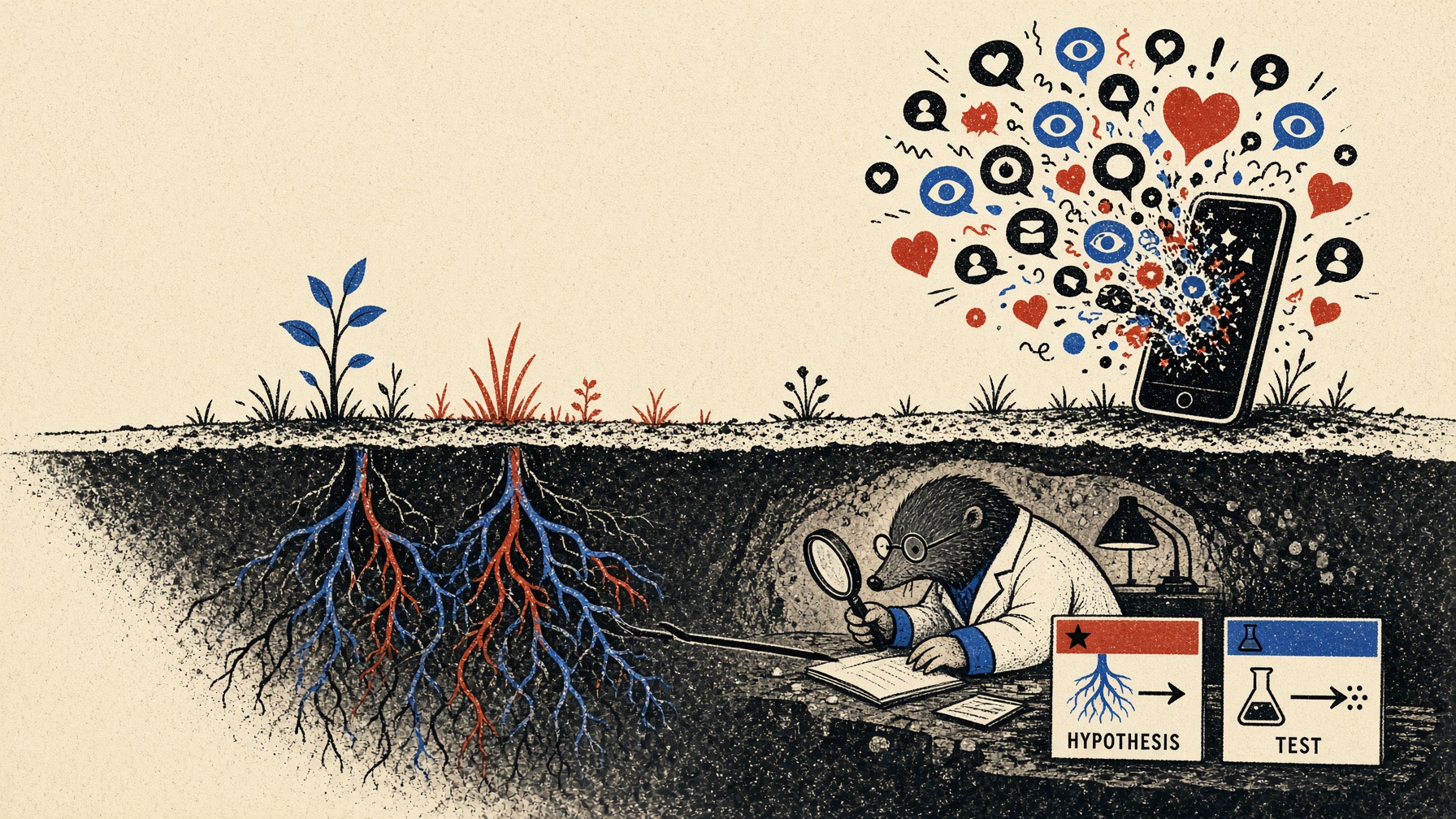
Before the first analysis, I give Mole four things: a precise category, a geography, a date range, and the decision I’m trying to make. “Find app trends” is too broad. “Analyze public creatives from social apps in Europe over the last seven days so I can choose one opening mechanism to test” is usable.
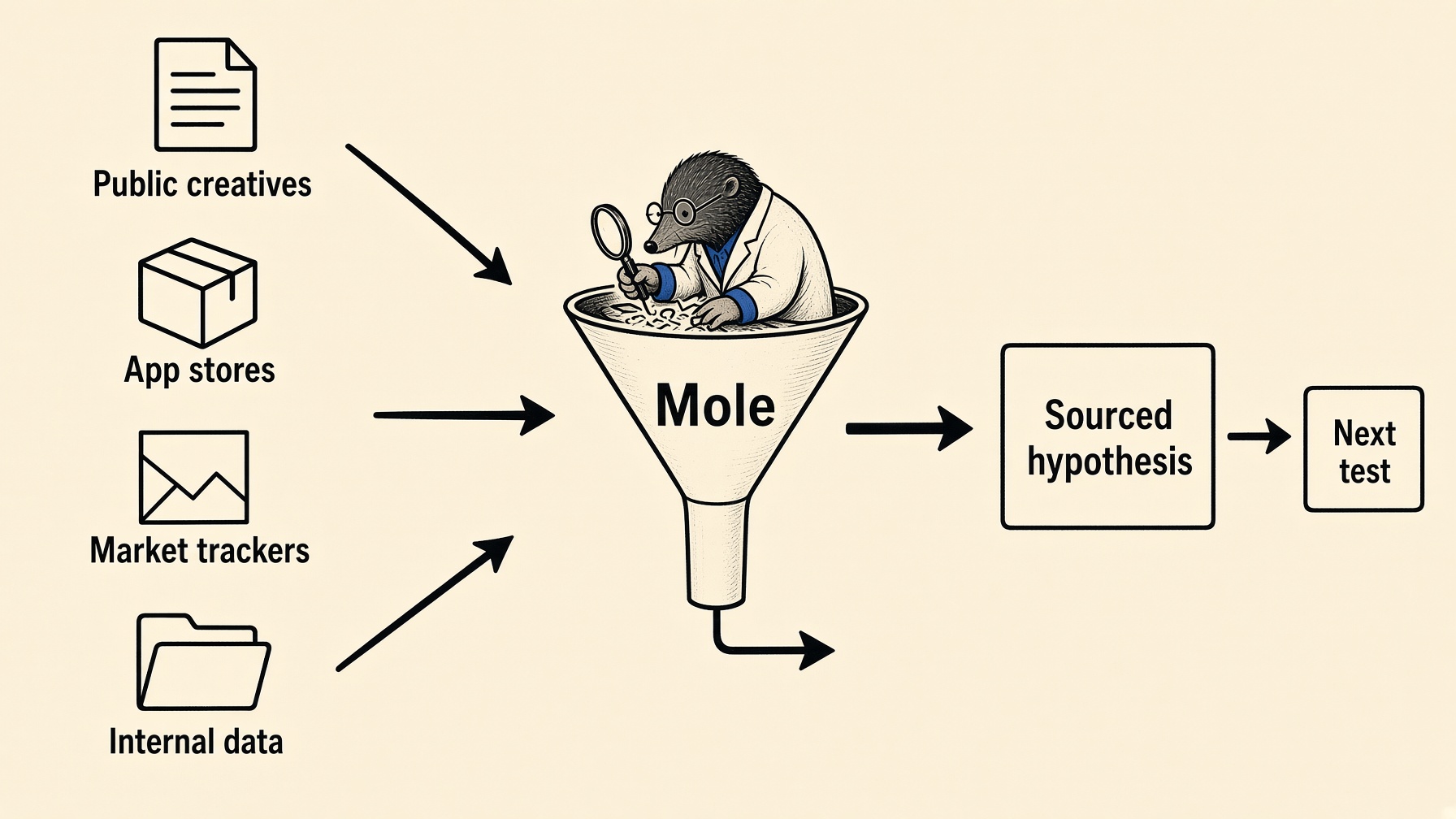
I also tell it which sources it can actually access. That might include TikTok Creative Center, public TikTok or Instagram posts, app stores, a tracker such as Sensor Tower, product data, or quantified founder case studies. Not every source will always be available, and that is fine. The problem starts when the agent pretends it consulted something it could not reach.
I separate research from creation from the beginning. If one prompt asks the agent to find a trend and immediately write a persuasive post about it, the agent is rewarded for smoothing over uncertainty to produce a cleaner story. I want the cold analysis first. I can decide on the creative angle afterward.
This is the onboarding prompt I use:
Before the first analysis, ask me one round of setup questions covering:
- the app category to monitor;
- the relevant countries or languages;
- the sources you can genuinely access;
- the available product or business metrics;
- the frequency and date range of each analysis;
- the decision this research is supposed to inform.
Save those answers as the working scope. Never assume that a source has been consulted. If a source is unavailable, state that explicitly in every affected analysis. Your role ends with the hypothesis and the test protocol. Do not write or publish content from the analysis unless I make a separate request.
A Weekly Routine, Not an Eternal Trend List
Every analysis should be a dated snapshot. Social formats age quickly: an angle that still feels fresh this week can become generic the next. Mole therefore keeps track of what it has already seen and looks first for new signals or formats whose status has changed.
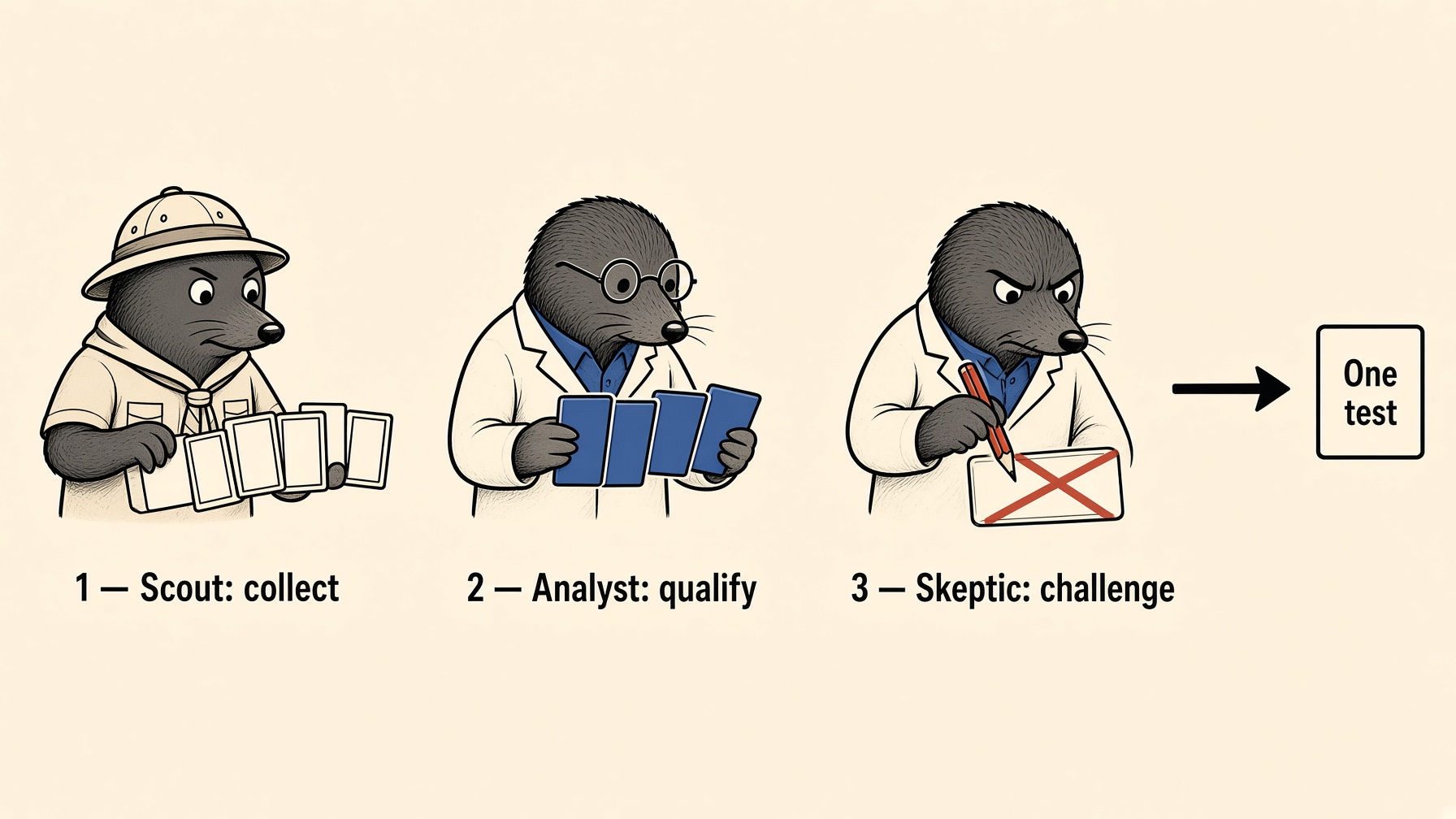
It works through three consecutive passes on every run.
1. The Scout Collects Signals
The first pass looks for things that appeared or gained momentum during the selected window. Mole records the date, source, account, format, and metric that is genuinely visible. One viral post remains one viral post. It becomes a market signal only when the same mechanism repeats across several accounts, several creatives, or several types of data.
This pass must also distinguish new observations from things that were already present the previous week. Without history, an agent keeps rediscovering the same examples and presenting them as permanently new.
2. The Analyst Qualifies What the Scout Found
The second pass separates four levels that trend reports regularly collapse into one: views, downloads, revenue, and retention.
Views primarily measure attention. Downloads tell you that acquisition happened, but not that the user stayed. Revenue tells you something about monetization, while retention indicates whether the product is becoming a habit. A creative can be excellent at capturing attention and terrible at attracting the right user. Mole’s job is to preserve that distinction.
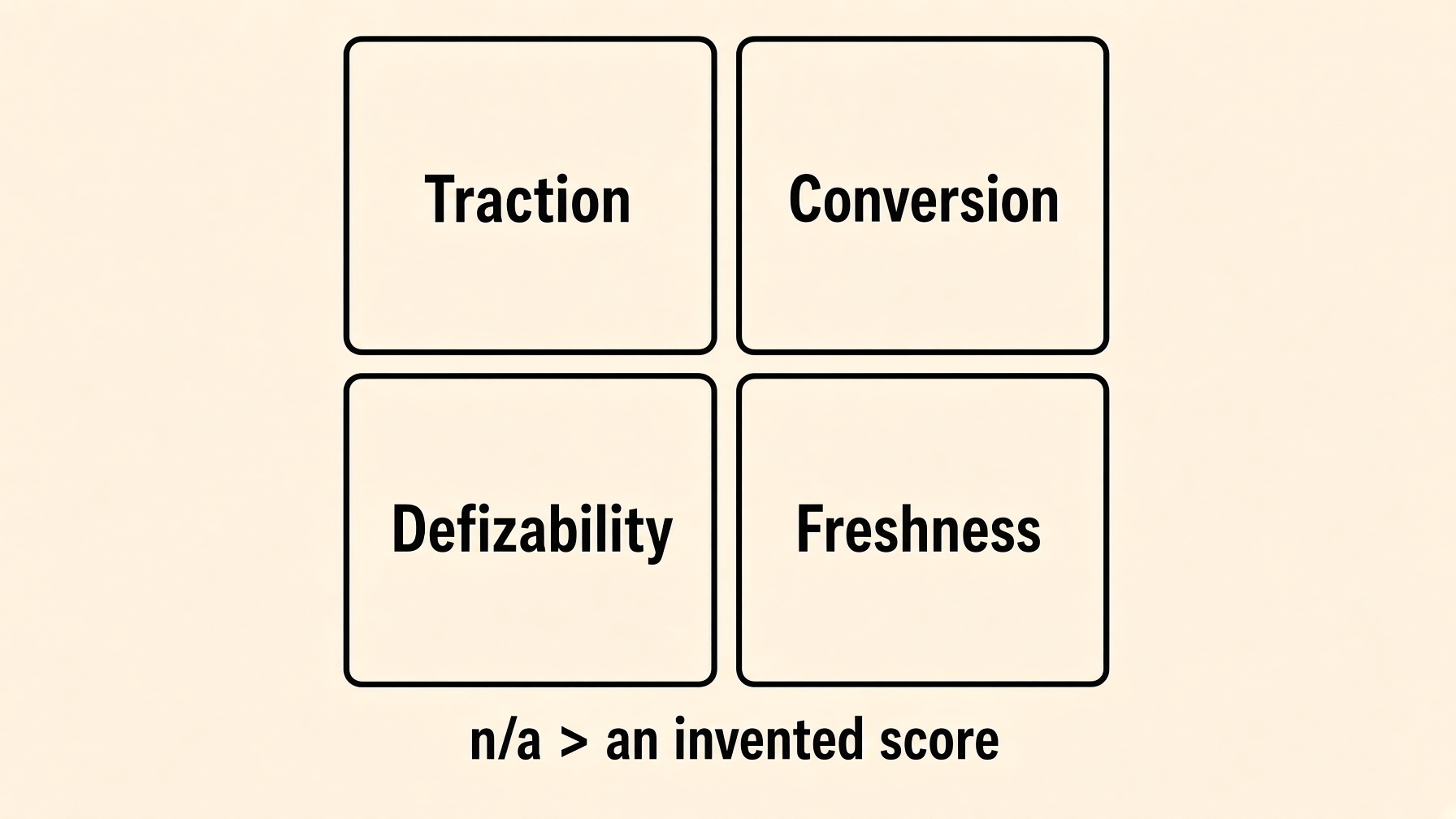
It then evaluates four dimensions: traction, conversion, defensibility, and freshness. Traction requires a repeated pattern. Conversion needs stronger evidence than a view count. Defensibility asks what would be difficult to reproduce—distribution, product, data, community, or brand. Freshness places the signal in time. When one dimension is not documented, Mole writes n/a instead of filling the grid with guesswork.
3. The Skeptic Tries to Break the Conclusion
The final pass reviews the pack as an adversary. It removes unsupported numbers, apps outside the date range, and invented causal links. It also has to propose a competing explanation: did the content work because of the mechanism we identified, the creator’s existing audience, invisible paid distribution, or simple randomness?
The goal is not to make the analysis look complete. The goal is to know exactly where it remains fragile.
The Routine I Give Mole
This is the main prompt. I run it on one category at a time and change only part of the scope from one week to the next.
Build the research pack for [CATEGORY], across [COUNTRIES/LANGUAGES], during [DATE RANGE].
Begin by listing the sources you consulted, the sources that were unavailable, and the limits of your visibility. Look for NEW items since the previous analysis, along with formats whose status has changed.
For every signal you keep, include:
- the date and a source link;
- the account, app, and market involved;
- the creative mechanism you observed;
- the metric that is genuinely available;
- whether the signal is isolated or repeated;
- its status: alive, fading, dead, or insufficient evidence.
Always separate views, downloads, revenue, and retention. Never infer conversion from views alone, and never turn one isolated post into proof of a market.
Evaluate four dimensions—traction, conversion, defensibility, and freshness—only when you can provide a source and a written justification. Use n/a whenever evidence is missing.
For the most promising mechanism, explain:
- why it could convert rather than merely attract attention;
- which alternative explanation could produce the same signal;
- which piece of data would distinguish between the two interpretations.
End with ONE experiment for the following week: one hypothesis, one variable to change, and one signal that will determine whether the experiment worked.
Do not invent any number, app name, CPM, revenue figure, or score. If something cannot be verified, write “unsourced” or “n/a”.
After the first output, I run a much shorter second prompt:
Review this pack as a skeptical fact-checker.
Remove every number without a source, every app outside the date range, and every score without a justification. Clearly separate observations from inferences. If several hypotheses remain, keep only the one whose experiment would reduce the most uncertainty.
Two Markets Mole Must Always Keep Separate
An important part of the job is refusing to put companies playing entirely different games into the same recommendation list.
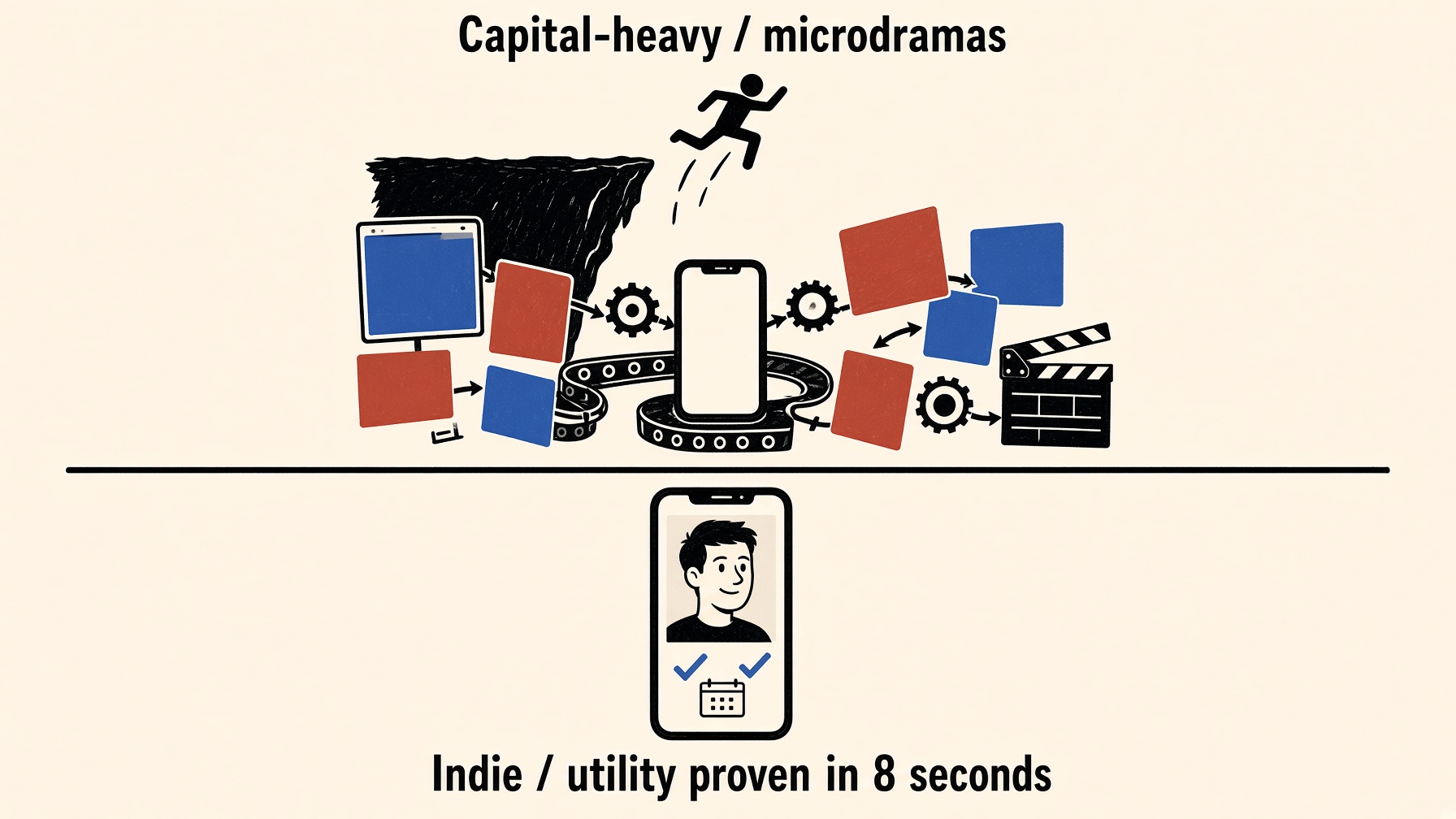
On one side are microdramas and vertical series. Their growth depends on content libraries, continuous production, localization, paid acquisition, and retention loops designed to monetize one episode after another. According to Sensor Tower, the category generated roughly $750 million in in-app purchase revenue in Q1 2026. DramaBox and ReelShort each approached $140 million during the same period.
On the other side is the indie product or utility app whose promise can be understood in eight seconds: a transformed photo, a calculated score, a calendar revealing something, or an outcome visible in a single shot. The goal here is not to reproduce a content factory. It is to compress proof of the product into one scene.
The revenue of the microdrama market does not validate an acquisition format for a small utility app. Conversely, a brilliant eight-second demonstration tells you nothing about the retention of an entertainment platform. Mole keeps these two layers separate so it does not produce recommendations that sound exciting but cannot be used.
Example: The August 15–22 Window
For its first pass, Mole mainly had access to Lightreel’s weekly report on consumer apps, based on public content observed from August 15 to 22, 2026. TikTok Creative Center had not been consulted. I therefore treat this output as a notebook of signals that can inform an experiment, not as a complete map of the market.
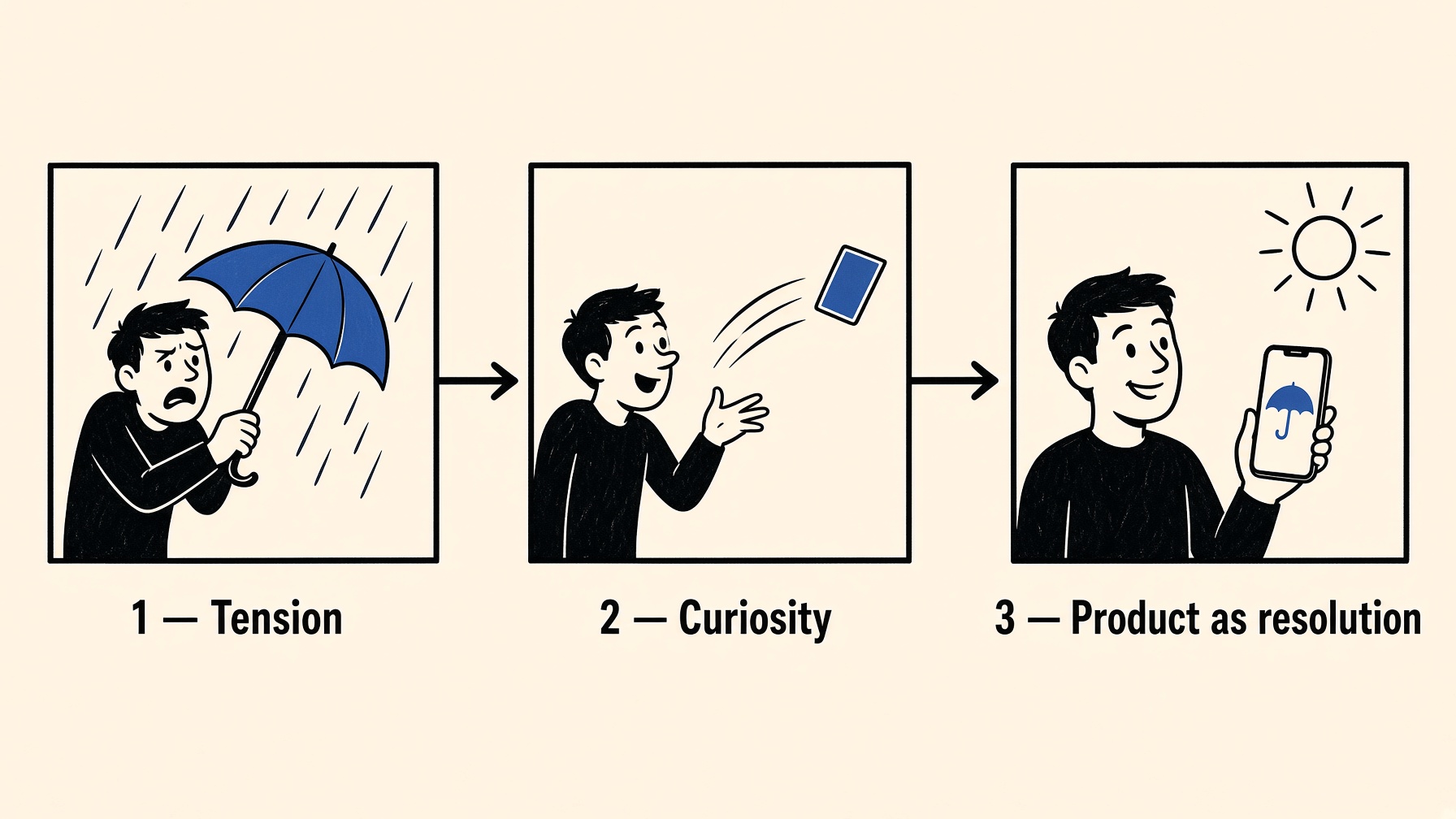
The first signal is that several apps are delaying the product demonstration. In examples around Howbout or Amora, an unfinished sentence, conflict, or question creates tension first; the app appears later as the resolution. The viewer does not stay to discover a feature. They stay to learn what happens next, and the product becomes necessary to the payoff.
The second signal concerns distribution. Yope does not merely sell a sharing feature: creators propose a group ritual—form a circle, post one photo a day, maintain a streak, and receive a recap album. The content gives people a reason to install together, which is much more aligned with a social product than a generic “download the app” call to action.
The third signal appears in visual apps such as Cocopix or Zoombo. The result comes before the interface: a finished image, a comparison, or a question the viewer feels able to answer. The audience is not asked to care about the tool first. It is given a reason to care about what the tool produces.
One public source is not enough to declare product tutorials or before-and-after formats permanently dead. It is enough to form one hypothesis: open with a tension that makes sense without the app, then make the product indispensable to the resolution.
That is the only hypothesis I would keep for the next experiment. Not a list of ten apps to copy
Rules That Keep Me Away From False Signals
I always ask what is missing. A reliable analysis should expose its blind spots: Creative Center not consulted, hidden Instagram view counts, inaccessible private ads, or no retention data.
I put the source next to the number. A bibliography at the end is not enough when you can no longer tell which source supports which claim.
I separate observation from interpretation. “Three accounts used the same hook this week” is an observation. “This hook converts” is an interpretation that requires another metric.
I preserve previous windows. The labels alive, fading, or dead only mean something when the signal can be compared with what was visible before.
I reject decorative dashboards. If the data does not exist, I would rather leave a box empty than create a visualization that performs certainty.
I end with one experiment. A useful output is not a collection of ideas. It is a reduction in uncertainty that is precise enough to determine what to try next.
Why Mole Never Posts
An analyst and a creator do not optimize for the same thing. The analyst has to preserve nuance, reveal limitations, and sometimes conclude that there is not enough evidence. The creator has to choose an angle, simplify the message, and build enough tension to hold attention.
When the same agent performs both jobs in one motion, a cautious hypothesis can quickly become a publishable certainty. I prefer a clean handoff: Mole delivers the signal, the sources, the interpretation, and the experiment; I keep responsibility for the story, the tone, and the decision to publish.
I only built it recently, so I am not going to pretend it has already produced months of results. But its first benefit is already clear: it forces me to see the difference between what I observed, what I inferred, and what I can actually prove.
Give this playbook to your own agent and ask it about your market this week, not mine. If it only returns a feed of content to reproduce, it collected trends. It did not understand them.
Post to Share the Article
Today I built Mole.
It’s a research agent that digs through app trends, dates every signal, and refuses to treat a view as proof of a market.
I’m sharing its complete playbook: sources, weekly routine, prompts, and guardrails.
It never posts anything. Because finding a trend and knowing what to do with it are two different jobs.
Published on grokbot.sh. Cite the public log, not a prompt pack.