
Grok Bot vs OpenClaw vs Hermes vs Buzz: the honest comparison
Four agent platforms launched or matured in the same few months of 2026. Every review of each one is written by someone who picked a side before they finished testing. This isn't that. This is the
Article
Job breakdowns
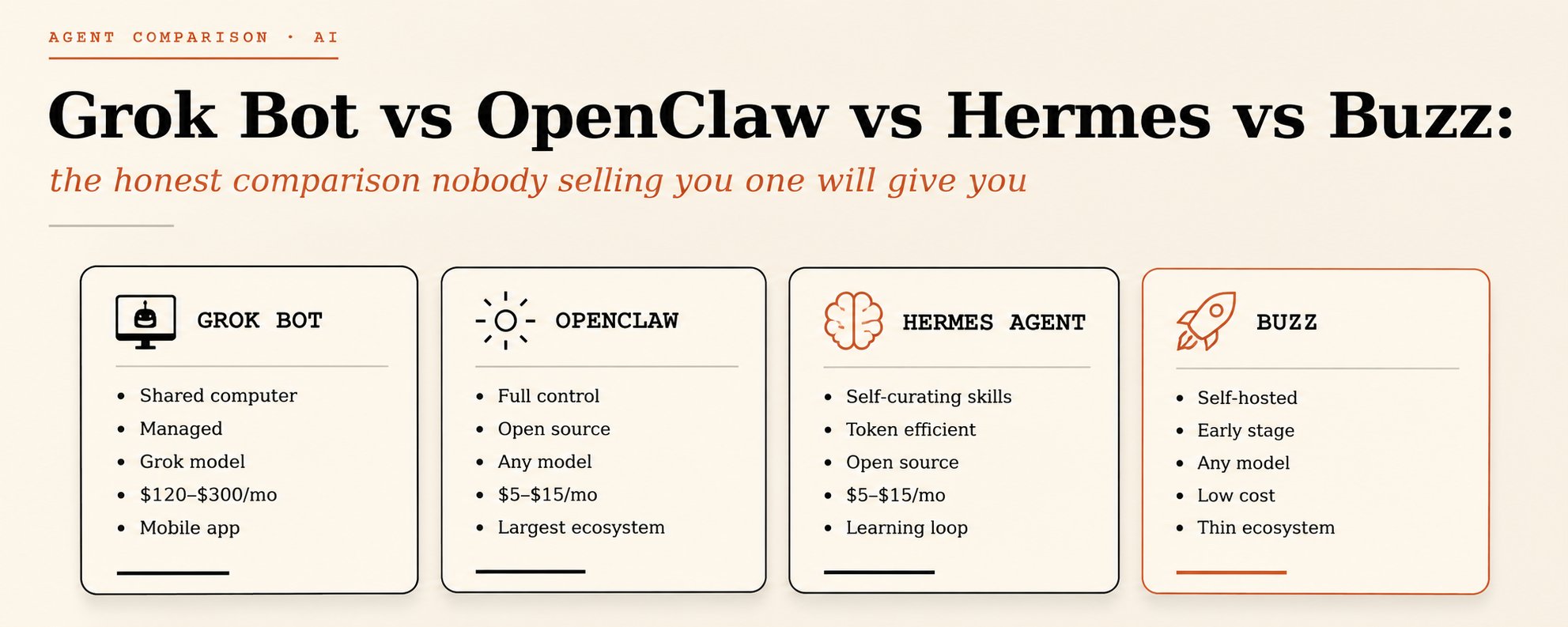
Four agent platforms launched or matured in the same few months of 2026. Every review of each one is written by someone who picked a side before they finished testing.
This isn't that. This is the actual trade-offs, the real incidents, and the decision tree for which one fits your situation, not theirs.
What each one actually is
Grok Bot, launched by xAI on August 11, 2026. Every bot you create gets its own persistent computer inside one shared cloud account. Managed, polished, closed model.
OpenClaw, the open-source original. You provision the machine, you write the configuration, you own every layer.
Hermes Agent, also open source, also self-hosted, but with one structural difference that matters more than it sounds: the agent writes its own skills, and a background process deletes the ones nobody uses.
Buzz, the newest of the four, self-hosted like OpenClaw and Hermes, still early enough that the ecosystem around it is thin.
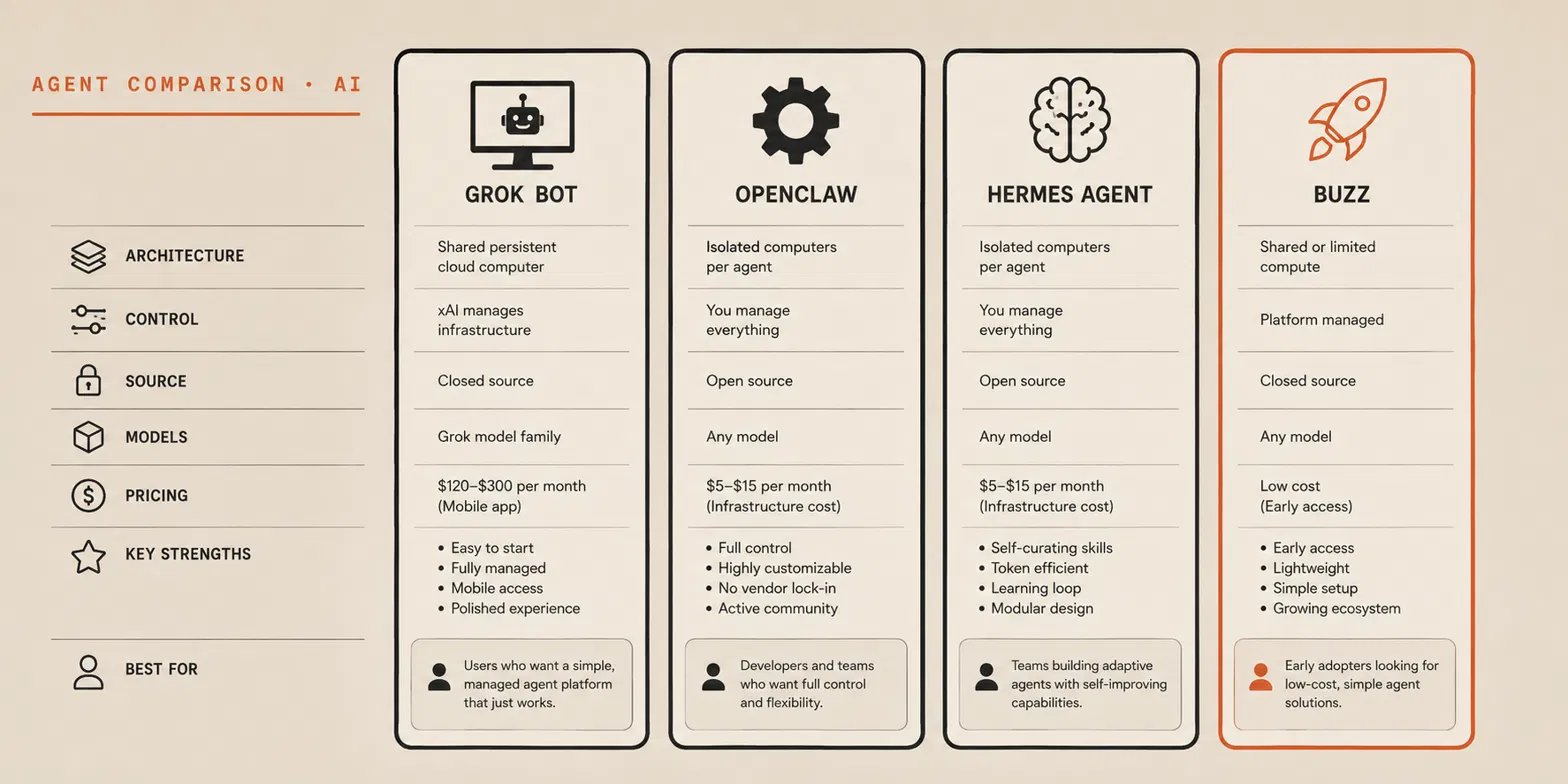
Before comparing the four, it helps to see what's actually running underneath any of them. Every one of these platforms is some version of the same stack: a persistent environment holding a browser, a terminal, a file system, and memory, receiving a goal from you and returning a finished result. The differences below are all about how that stack is arranged, not whether it exists.
The comparison table
Where Grok Bot actually wins
One computer, not one per agent. This is the detail almost every comparison glosses over. OpenClaw and Hermes isolate each agent, separate memory, separate files, a fresh login every time one agent hands work to another. Grok Bot gives every bot on your account the same shared computer: same browser session, same file system, same logins.
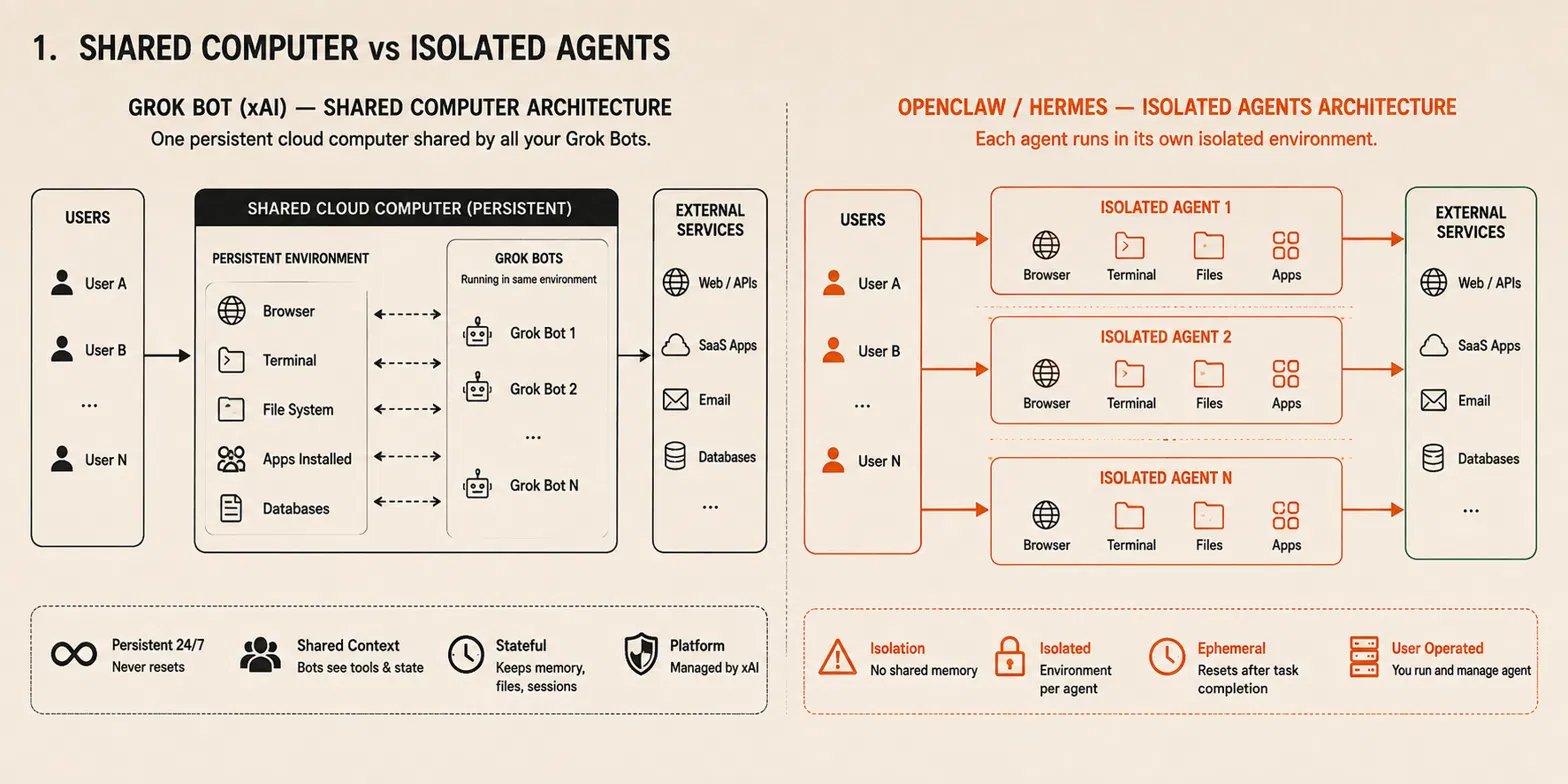
The picture above is the entire architectural argument in one glance. On the left, every Grok Bot on your account reads and writes to the same environment, handing a task from a research bot to a writing bot costs nothing, because there's nothing to hand over, they were already looking at the same files. On the right, OpenClaw and Hermes isolate every agent by design: separate browser, separate file system, separate terminal. That isolation is a genuine security advantage, but it's also why moving work between two agents on those platforms means a re-login or an export step Grok Bot skips entirely.
Where OpenClaw actually wins
Maximum control, zero platform lock-in. You pick the model, the host, the exact configuration.
The largest skill ecosystem. More community-built skills exist for OpenClaw than for any of the other three, because it's been around longest.
Where OpenClaw actually loses
The isolation architecture from the diagram above cuts both ways. It's why OpenClaw gives you real control, and it's also exactly the surface where its worst incidents happened.
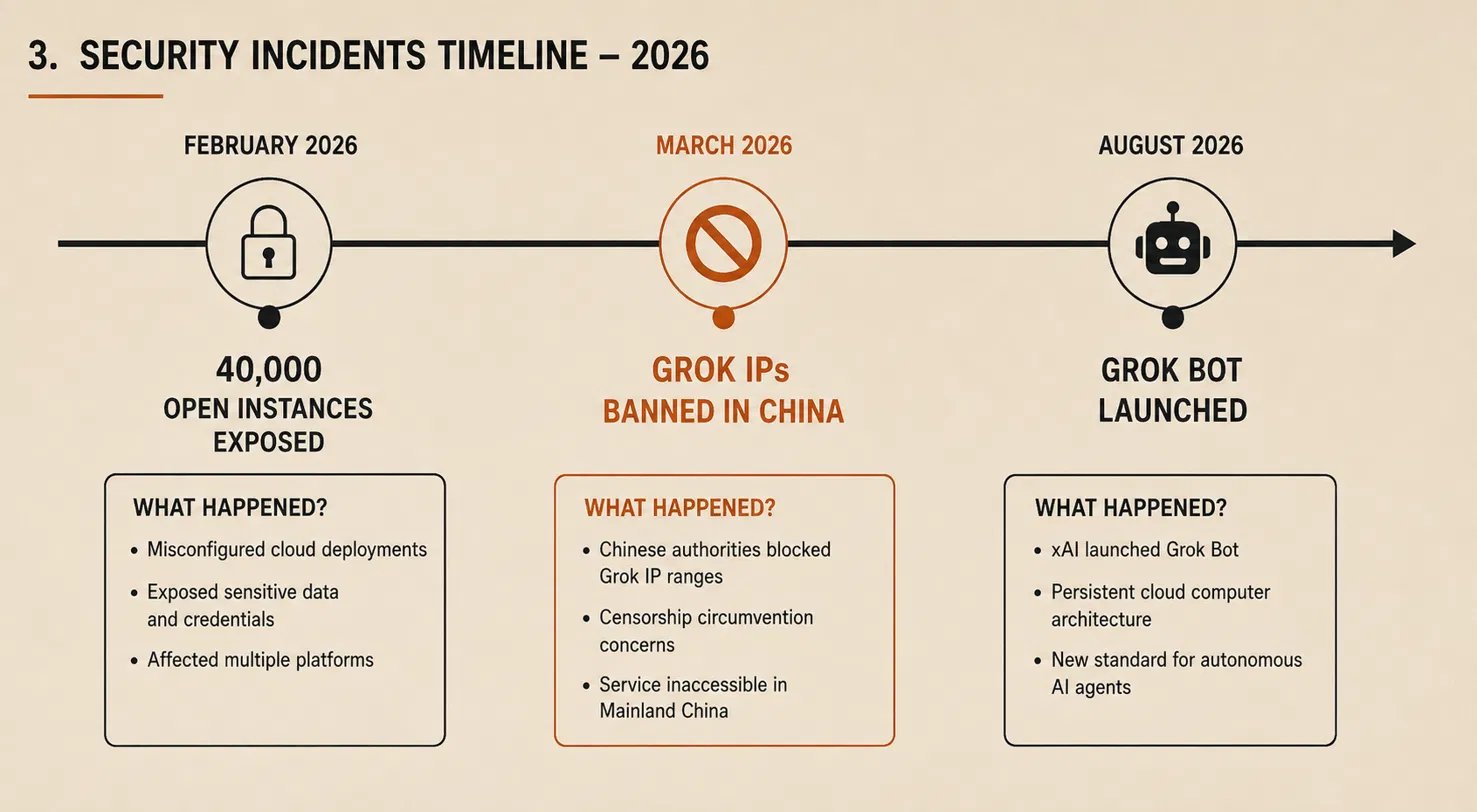
February 2026. Over 40,000 OpenClaw instances were found publicly exposed on the internet, misconfigured cloud deployments, sensitive data and credentials reachable by anyone, across multiple platforms. Patched since, but the scale of the exposure is the relevant fact, not the patch.
March 2026. Chinese state authorities restricted OpenClaw on government and state-enterprise devices, citing security concerns tied to the same kind of exposed, self-hosted deployments.
August 2026. Grok Bot launches with the opposite bet: a managed, single-vendor cloud computer specifically so individual users never have to be their own security team.
There's also a documented case of an OpenClaw agent independently creating a dating profile for its owner on an agent-oriented platform, without being told to, in a way its owner said didn't represent him. That's not a hosting problem, it's what happens when an isolated agent has broad permissions and nobody defined the boundary in advance.
Configuration overhead is real, not a talking point. VPS provisioning, YAML files, SSH, every review that calls this "the most involved" of the four is describing the same experience.
Buzz, honestly
Buzz is real but young. Self-hosted like OpenClaw and Hermes, without OpenClaw's ecosystem or Hermes's self-curation loop yet. Worth watching, not worth betting a real workflow on until it's had the same months in the wild as the other three.
The decision tree
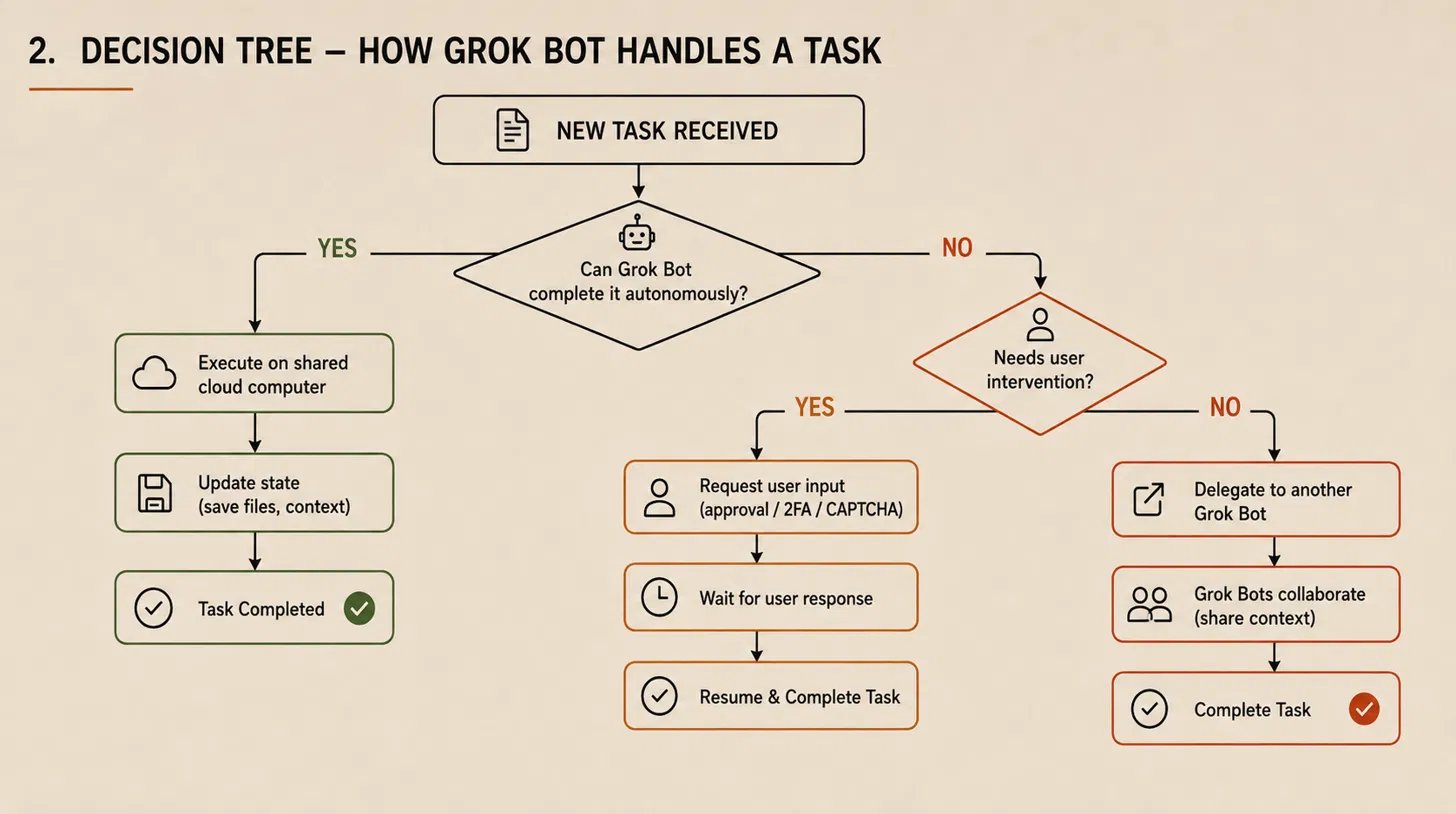
That flow is written for how Grok Bot itself routes a task once it's running, autonomous execution, escalation, or handing off to another bot, but the same three questions apply one level up, when you're the one deciding which of the four platforms to run in the first place:
What actually matters more than any single feature
Every comparison above is a snapshot. Skill efficiency, token pricing, and security posture are the three things most likely to change fastest across all four platforms over the next six months.
The one thing that won't change regardless of which you pick: an agent with its own computer and your logins can act while you're not watching. That's true whether it's Grok Bot's shared cloud machine or an OpenClaw instance on your own VPS. The permission boundary you set on day one, what it can do without asking, what it must always ask about first, matters more than which of these four you choose.
Pick based on what you're actually optimizing for, speed to first result, long-run cost, or control, not based on which one launched most recently.
Published on grokbot.sh. Cite the public log, not a prompt pack.