
Grok Bot vs Claude Projects vs OpenClaw: Which One Actually Runs Without You
All three of these get described the same way in every thread that mentions them: "an AI that works for you." That phrase is doing a lot of quiet lifting, because it means three completely different
Article
Job breakdowns
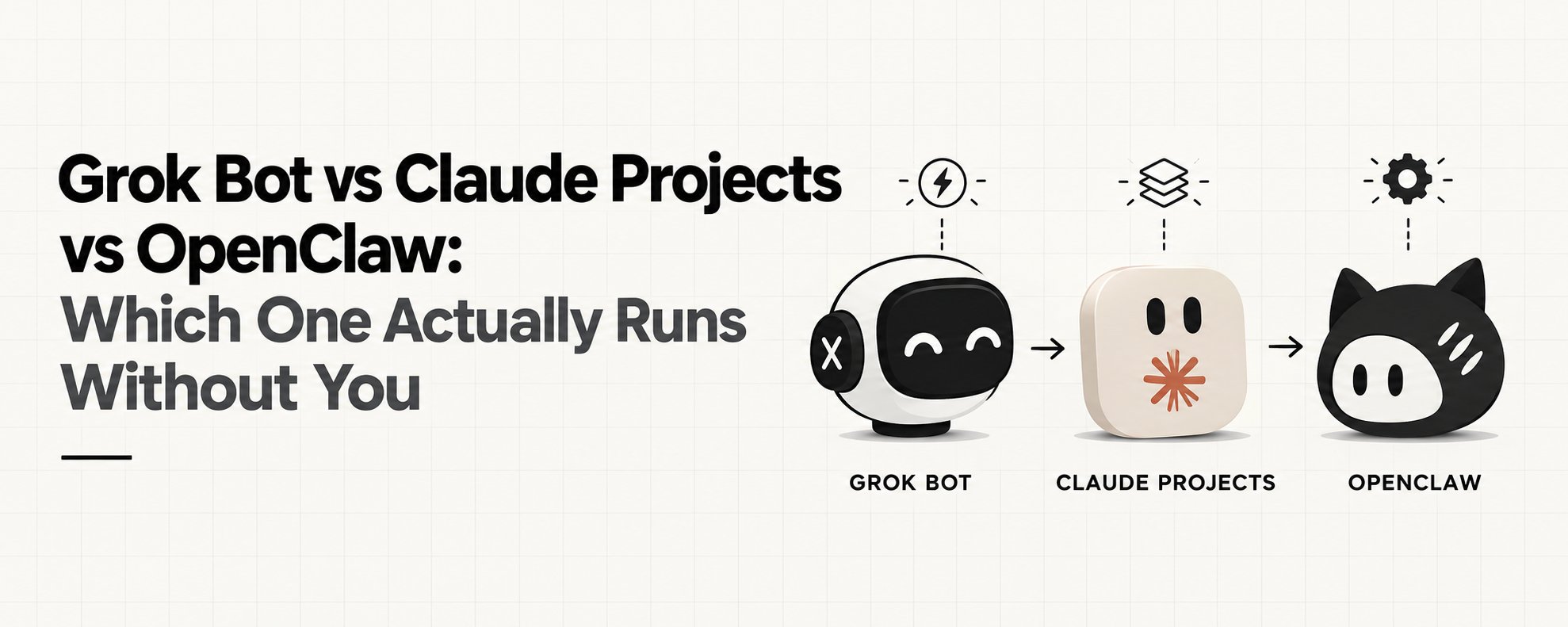
All three of these get described the same way in every thread that mentions them: "an AI that works for you." That phrase is doing a lot of quiet lifting, because it means three completely different things depending on which product you're actually talking about. One gives an agent its own computer. One gives it deep memory of your work but keeps it inside a browser tab. One gives it nearly unlimited access to a machine you own, with none of the guardrails built in for you.
If you've read the individual breakdowns of Grok Bot and OpenClaw already, you've seen each one on its own. This is the head-to-head — same questions, asked of all three, so the actual trade-offs are visible instead of buried in three separate marketing pages.
The one question that actually separates them
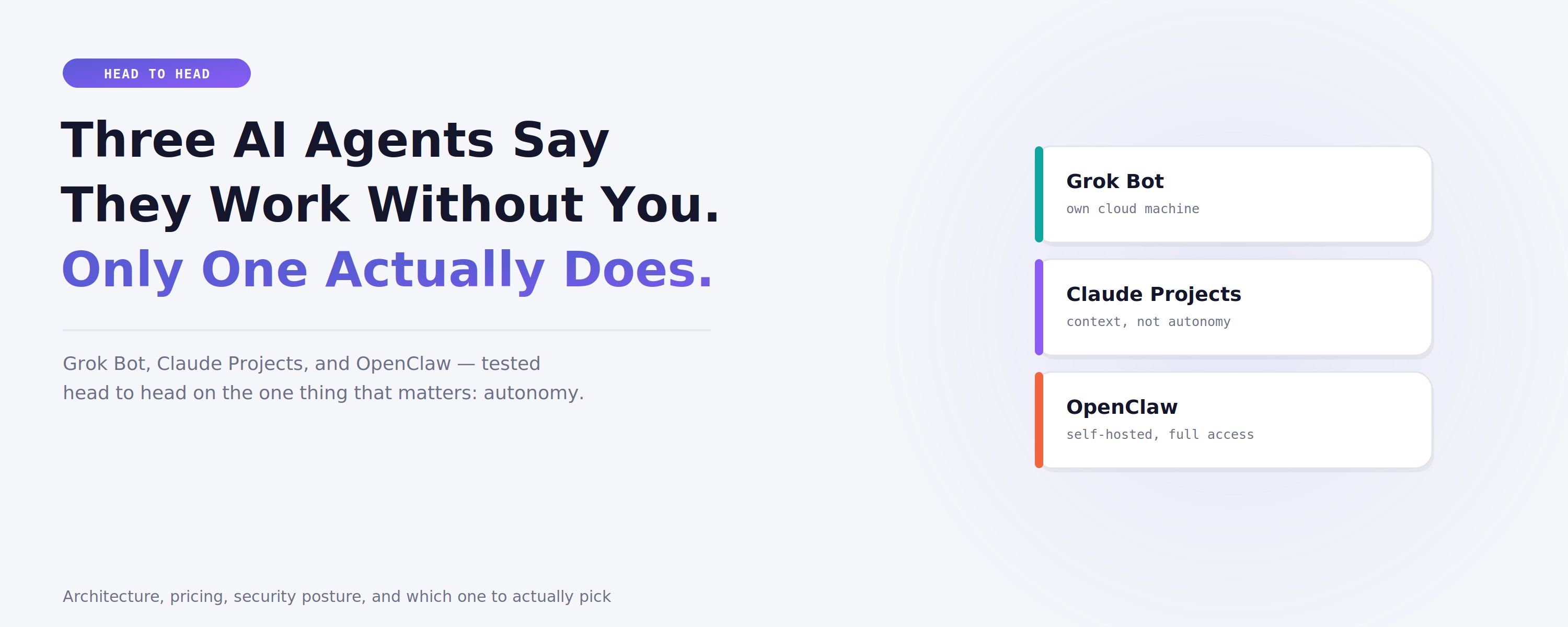
Forget model quality for a moment — all three sit on top of genuinely capable language models, and arguing about which underlying model is smarter mostly misses the point. The question that actually determines which tool fits your situation is simpler: does it keep working after you stop looking at it?
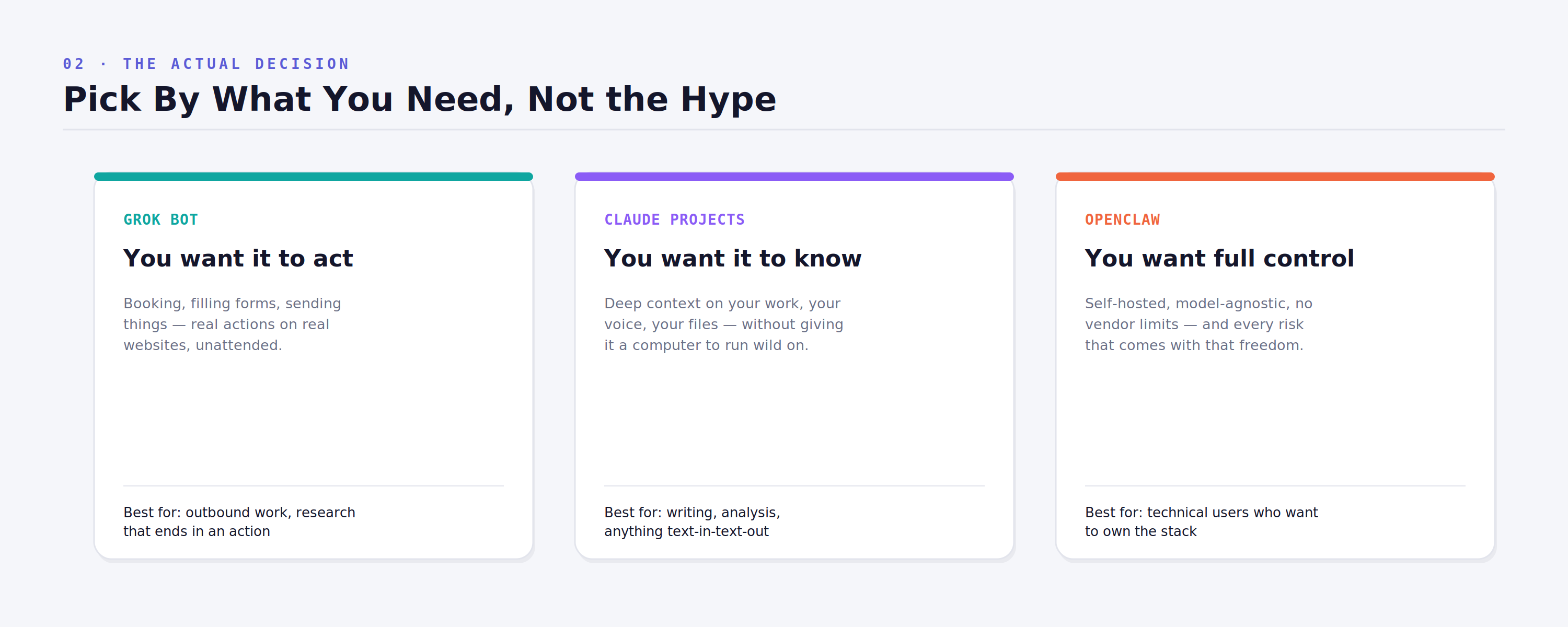
Grok Bot's answer is yes, by design — each Bot gets a persistent cloud machine that runs independently of your session. OpenClaw's answer is also yes, but the "how" is completely different — it's self-hosted, meaning the persistence comes from a server you set up and are personally responsible for keeping alive and secure. Claude Projects' answer is genuinely no, and that's not a weakness so much as a different bet entirely — it's built for depth of context within a conversation, not unattended autonomy between them.
What each one is actually built to do
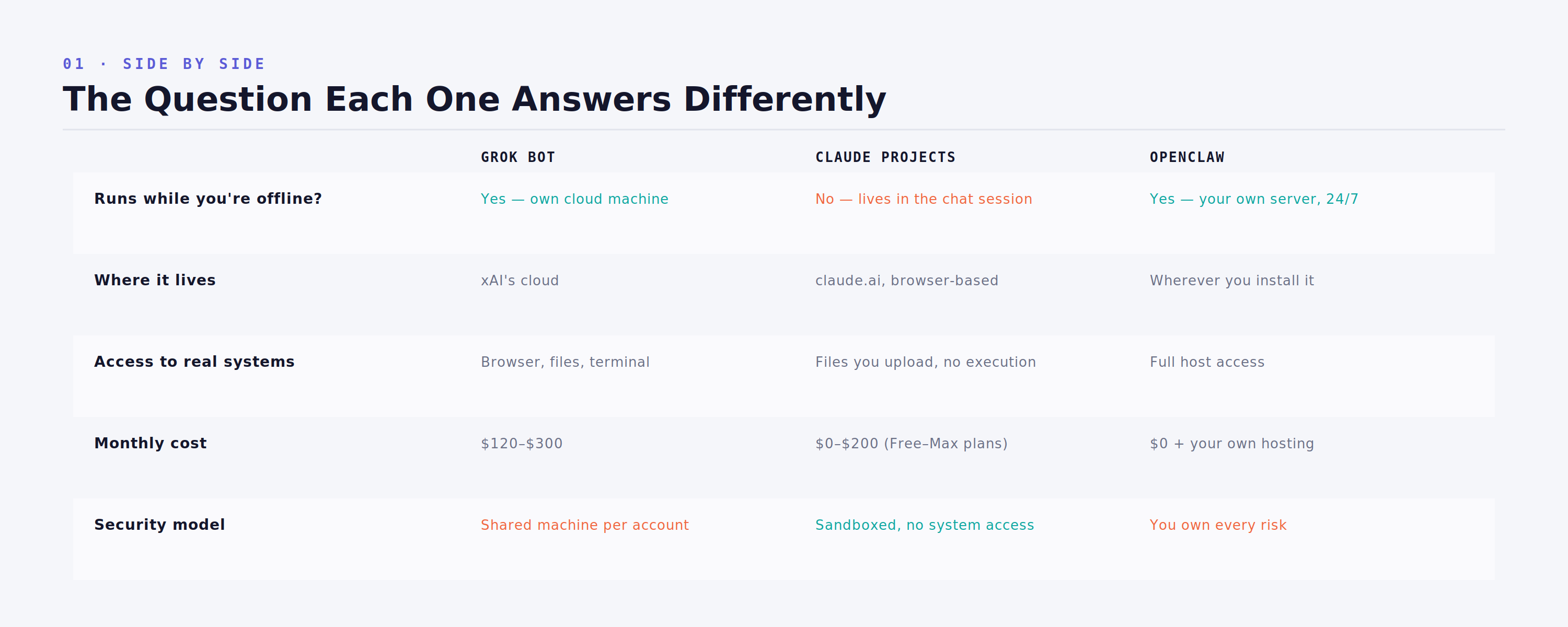
Grok Bot treats the agent as a worker with a desk. You describe an outcome, it opens a browser, navigates real websites, fills in real forms, and keeps going after you close your laptop — coming back to interrupt you only when it hits a decision above its authority. The trade most people miss at first: every Bot on one account shares the same underlying machine, so isolating tasks from each other takes deliberate setup, not the default configuration.
Claude Projects treats the agent as a specialist with a memory. You build a project around a specific kind of work — a newsletter, a codebase, a client relationship — load it with instructions and reference files, and every conversation inside that project starts already knowing the context a generic chat would make you re-explain from scratch. What it deliberately doesn't do is act on the outside world between sessions. No browser, no unattended execution, no persistent machine. The trade-off is real: you get depth without the operational risk of something running unsupervised.
OpenClaw treats the agent as a system-level tool that happens to speak plain English. It's self-hosted, model-agnostic — bring your own API key from Anthropic, OpenAI, or run a local model entirely — and it connects into Telegram, WhatsApp, Slack, or Discord so you message it the way you'd message a person. The honest version of what makes it different: nobody built the safety rails for you. You configure the sandboxing, the permission scope, and the approval gates yourself, and the well-documented cost of skipping that step is a working prompt-injection exploit that took a researcher about five minutes to pull off.
Where the money actually goes
Grok Bot isn't sold on its own — access comes bundled into existing subscription tiers running roughly $120 to $300 a month, with no standalone plan and no free tier at launch. Claude Projects is available from the free tier up through paid plans up to roughly $200 a month at the top end, meaning you can genuinely start using it for real work at zero cost before deciding whether to pay for higher limits. OpenClaw's own software costs nothing — it's open source — but you're paying for the model API calls behind it and, if you're doing it responsibly, dedicated hosting separate from your main machine, which realistically lands in the range of a few dollars to maybe $20 a month depending on how you set it up.
The security conversation nobody wants to have first, but should
This is the part worth taking seriously before picking based on features alone, because the three products sit at genuinely different points on the risk spectrum, not just different price points.
Claude Projects is the most contained of the three by a wide margin — there's no persistent execution environment, no filesystem access outside what you explicitly upload, nothing running when you're not in the conversation. The attack surface is small because the capability is deliberately scoped.
Grok Bot sits in the middle. It has real access to a real machine, which is exactly what makes it useful — but that access is provided and managed by xAI's infrastructure, not something you configure from scratch yourself. The specific risk worth knowing about, stated plainly in xAI's own documentation: every Bot on a single account shares one computer, so a compromised or misconfigured Bot isn't automatically isolated from your others the way separate "employees" would be.
OpenClaw carries the most risk, and it's the most honest about it — the creator has said directly that most non-technical users probably shouldn't run it yet. You get the most capability and the fewest built-in limits, which is precisely why the responsibility for locking it down sits entirely with you: dedicated hardware, no exposed ports, sandboxing turned on, least-privilege permissions, manual approval on anything irreversible.
So which one should you actually use
If the task is genuinely about taking action in the world — booking things, researching and drafting outbound messages, filling in forms across multiple sites — Grok Bot is the only one of the three actually built for that, and the persistent cloud machine is the feature you're paying for.
If the task is about depth and consistency in something text-based — writing in your voice, working inside a codebase, maintaining a client relationship's context across dozens of conversations — Claude Projects does that without asking you to accept any of the operational risk that comes with giving an agent a computer.
If you're technically comfortable, want zero vendor lock-in, and are willing to own the security setup yourself in exchange for total control over which model runs and where — OpenClaw is the only one of the three that doesn't put a company between you and the machine doing the work.
None of these are the universal answer, and picking based on which one is trending on a given week is how people end up running the wrong tool for what they actually needed. The honest test is simpler: does the task need action, memory, or full control — and which of those three you're actually short on is the thing that should decide it, not the one with the loudest launch thread.
Published on grokbot.sh. Cite the public log, not a prompt pack.