
Grok Bot: The AI Team That Never Sleeps
The Grok 4.6 model, persistent computer, loops, graphs, routines, and approval system behind agents that finish real work Most people will use Grok Bot like a chatbot They will create one Bot Give it
Article
Job breakdowns
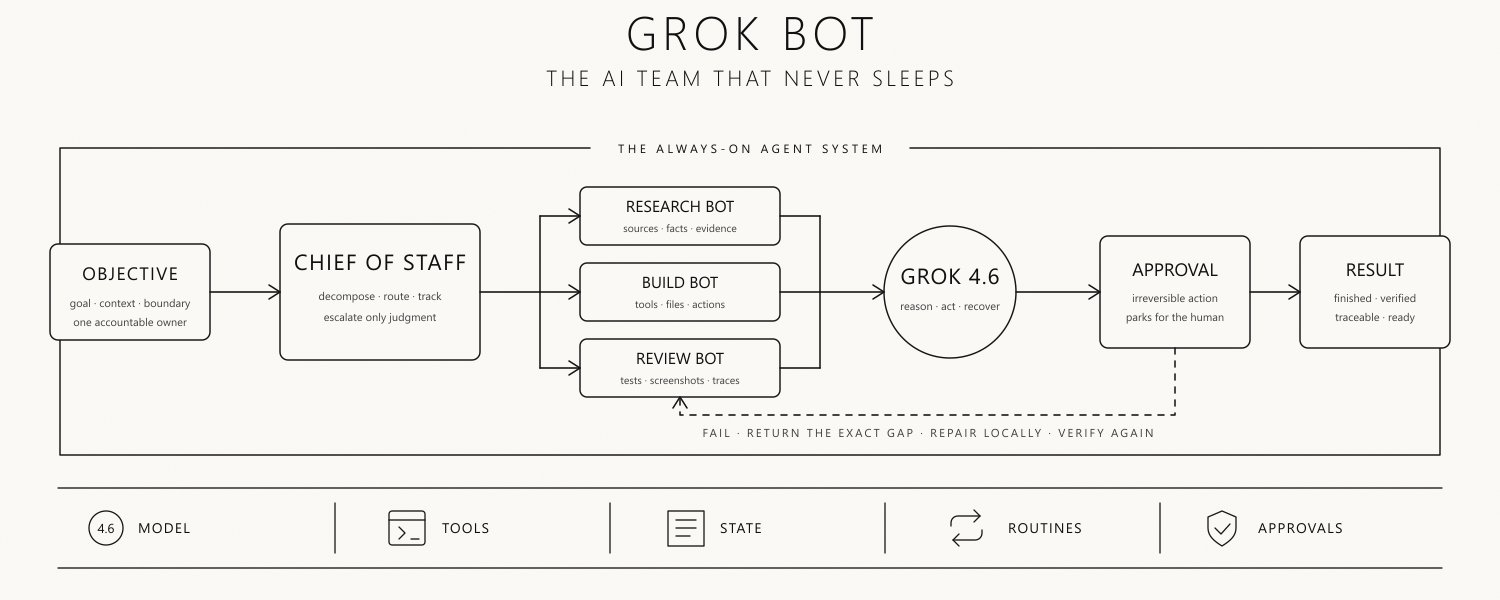
The Grok 4.6 model, persistent computer, loops, graphs, routines, and approval system behind agents that finish real work
Most people will use Grok Bot like a chatbot
They will create one Bot
Give it a vague request
Connect every account they own
And wait for magic
That is the fastest way to turn an always-on agent into an always-on source of confusion
Grok Bot is more interesting than another chat interface
It gives an agent a persistent computer, real tools, durable context, recurring routines, and other agents it can coordinate with
Grok 4.6 supplies the reasoning
The harness supplies the environment
The loop supplies improvement
The graph supplies coordination
And the approval system decides where autonomy ends
Elon Musk framed Grok Bot and Grok 4.6 as parts of the same rollout
We will widen the Grok Bot beta after we fix basic issues with the early beta and release Grok 4.6 later this week
- Elon musk
That framing matters
The model and the Bot are being improved as one agent system
The product is not the model
The product is the operating system around the model
This article shows how to design that system properly
I publish practical breakdowns of AI agents, workflows, and production systems on Substack Join the newsletter here
Grok Bot changes the unit of work
A chatbot returns an answer
A Bot returns a completed job
That sounds like a small distinction
It changes the entire architecture
The Bot can keep a browser session open
It can work across websites and desktop tools
It can create and organize files
It can run commands in a terminal
It can use connectors when an API exists and computer use when one does not
It can continue when your laptop is closed
It can return tomorrow with the work already sitting in the tool where a human would have left it
That is the real shift
The output is no longer a paragraph explaining what you should do
The output is the changed CRM, prepared draft, reproduced bug, organized folder, updated spreadsheet, or review queue
The useful abstraction is not "an AI that knows things"
It is "a teammate that owns a result"
Start with proof, not spectacle
The first assignment should not be impressive
It should be real enough to matter and small enough to verify in under a minute
This gives you a visible result, a short path to inspect, and a clean failure if the Bot misunderstands the job
Trust should expand in the same order as evidence
First one bounded task
Then one repeatable routine
Then one schedule or trigger
Then a handoff between Bots
Only then should the system receive broader permissions
Grok 4.6 is the brain, not the whole agent
Grok 4.6 was trained with long-running agents and multi-step knowledge work in mind
SpaceXAI says the model received a longer supplemental training run, regenerated SFT trajectories across different agent harnesses, and reinforcement learning across coding, knowledge work, web development, CAD, and other tool environments
That matters because long work fails differently from one-turn chat
The model must preserve a goal across many actions
It must decide what to inspect next
It must recover after a tool produces something unexpected
It must test its own work instead of treating the first plausible output as finished
SpaceXAI reports stronger results for Grok 4.6 across agentic coding and knowledge-work evaluations, including CursorBench, DeepSWE, FrontierCode, APEX-Agents, and AA-Briefcase
But a benchmark score does not decide which account the Bot can open
It does not remember your approval policy
It does not decide whether a failed branch should retry, escalate, or stop
It does not protect a publish button
Those responsibilities belong to the system around the model
The release order matters
A persistent agent magnifies both model capability and model error
The smarter the model becomes, the more important its operating boundaries become
One model, three control layers
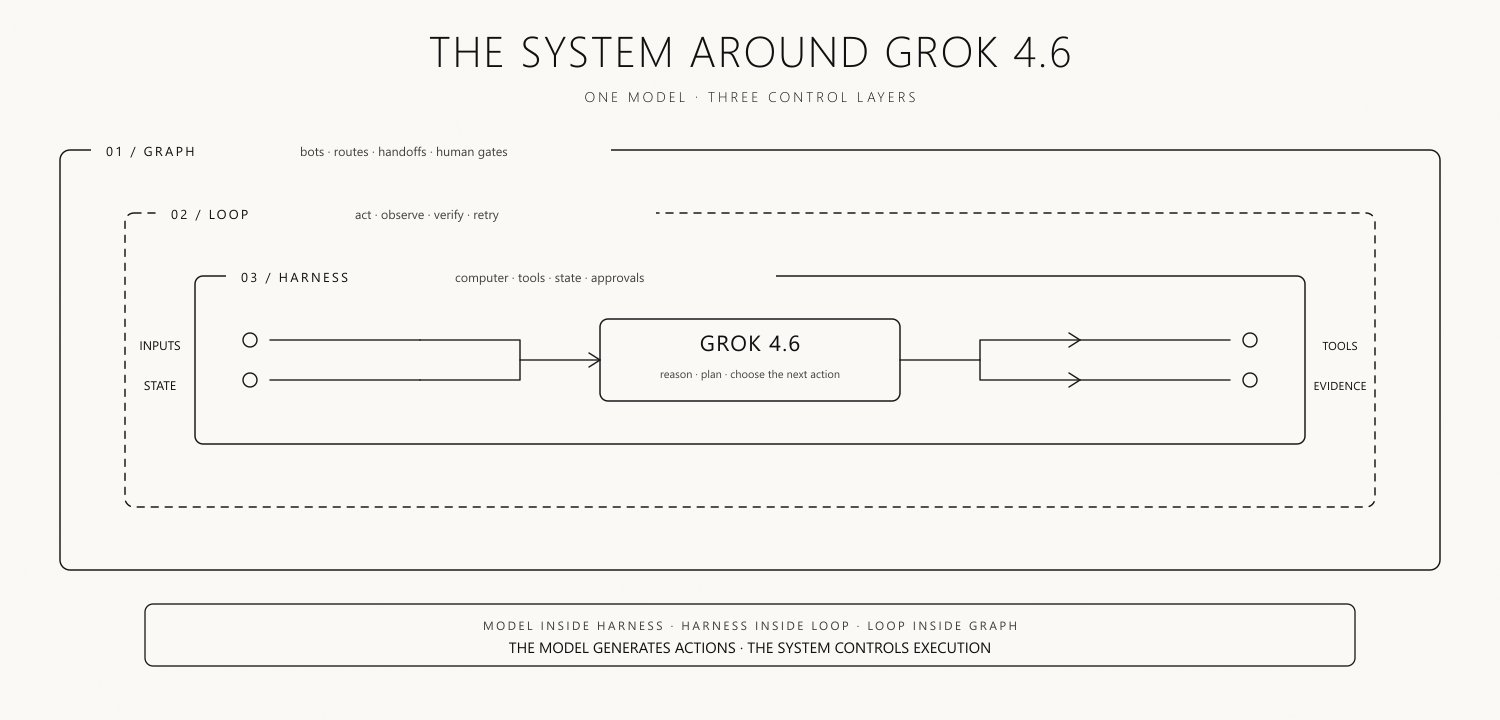
The cleanest way to understand Grok Bot is to separate the model from the three layers that control it
Most weak setups collapse the model and all three control layers into one enormous prompt
The prompt describes the role, stores the history, invents the workflow, approves the actions, checks the output, and decides whether to retry
That makes every failure look like a prompting problem
It is not
If a Bot forgets an important preference, you have a state problem
If it opens the wrong tool, you have a routing problem
If it sends something that should have remained a draft, you have a permission problem
If it repeats the same failed action, you have a loop problem
If five Bots constantly ask you who should do what, you have a graph problem
Better prompts can improve a run
Better architecture improves every future run
Layer 1 / Harness engineering
The harness is the world in which Grok 4.6 acts
For Grok Bot, that world includes the persistent cloud computer, browser, filesystem, terminal, connected apps, saved files, memory, routines, approval rules, and activity history
A good harness does seven jobs
Give the Bot a job before giving it a task
Do not start with:
Start with a bounded role
The role description is durable infrastructure
The next message is only the current assignment
Mixing those two makes the Bot relearn its own job every morning
Give it the smallest useful tool surface
More access does not automatically create a better agent
It creates a larger failure surface
Connect the systems required by the role
Do not connect the entire company because the Bot might need it later
Connect once, authorize per role
Connections are account-level plumbing
Once a service is connected, other Bots on the same account may be able to work through that connection
That makes the second specialist faster to launch
It also makes one careless connection larger than one Bot
The integration answers what the system can reach
The role contract answers what this Bot is allowed to do with it
Keep those as two separate decisions
Store work outside the conversation
Messages are for coordination
Files and structured state are for continuity
The next Bot should inherit the state of the work
Not a lossy summary of a thirty-message thread
The shared computer is a feature and a security boundary
This is the detail most people will miss
Your Bots can collaborate because they share one user-scoped persistent computer
They can share files, browser sessions, and app logins
Each Bot can have its own screen and work in parallel
But those screens are not separate security boundaries
If one login exists on the shared computer, treat it as available to every Bot on that account
This makes handoffs much easier
It also means role descriptions alone cannot enforce strong isolation
If two Bots need genuinely different trust levels, separate the underlying accounts, environments, or credentials
Do not confuse a polite instruction with a security control
Hand off the login, never the password
The cloud computer becomes most useful on software that has no clean API
The Bot can navigate until it reaches an authentication wall, then park the run and give the screen to you
You authenticate directly inside that session
The Bot continues from the same state after control returns
The Bot receives an authenticated session, not a credential written into a conversation
That distinction matters because chats are coordination surfaces, not secret stores
Memory enables coordination
Isolation limits blast radius
You need to know which one your architecture is buying
Draw the approval line by reversibility
The best approval policy is not based on task size
It is based on whether the action can be safely undone
A good run ends with every reversible step complete and every irreversible step clearly staged
The Bot should not return at 10 percent because one future step needs approval
It should complete the other 90 percent, show the exact proposed action, and stop at the boundary
That is how autonomy remains useful without becoming reckless
The harness defines the world the Bot may enter
The loop defines what must happen before the work may continue
Layer 2 / Loop engineering
An always-on Bot needs a feedback loop
But "keep trying until it works" is not a loop
It is an unlimited budget attached to an undefined result
A production loop needs five things
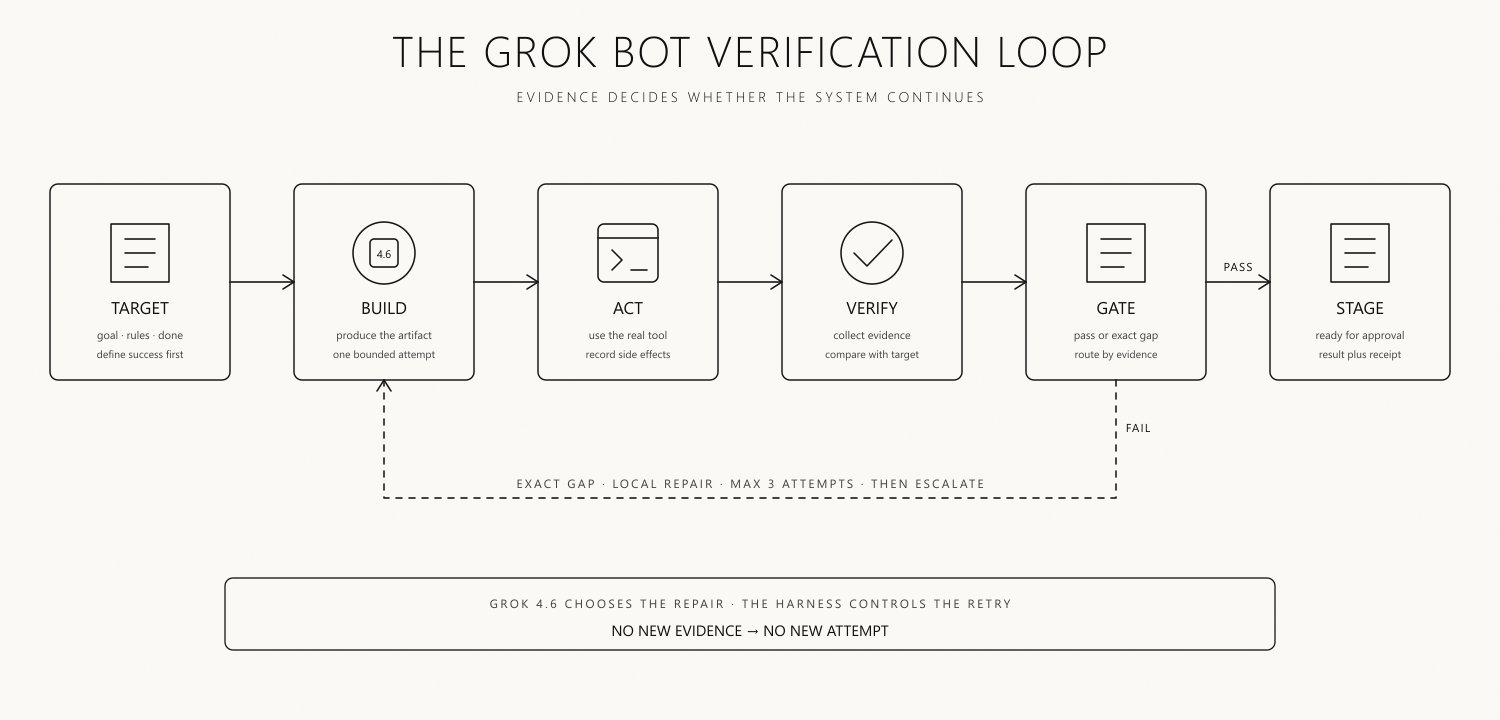
The useful pattern is simple
The model chooses how to repair the local gap
The harness decides whether another attempt is allowed
That separation prevents the same model from silently expanding its own budget
Turn demonstrations into routines
Grok Bot can watch a workflow, save the path as a routine, and run it again on demand or on a schedule
This is more powerful than writing a perfect automation spec from memory
The best first routine is
-
Repeated at least weekly
-
Spread across two or more tools
-
Stable enough to demonstrate
-
Easy to verify from a visible result
-
Reversible until the final step
Run it manually with the Bot watching
Correct the edge cases
Save the routine only after the result is right
Then add a schedule
Do not automate an unclear process faster
Clarify it first
Grok Bot gives a saved path two useful ways to wake up
A schedule makes the Bot punctual
A trigger makes it responsive
Both should point to the same tested routine rather than inventing a fresh workflow every time they fire
The strongest trigger instruction is usually attached immediately after a successful run
Make verification independent of the first answer
Never use one vague prompt for generation and approval
-
For code, verification can be tests and a clean diff
-
For visual work, it can be a screenshot and a checklist
-
For research, it can be source coverage, contradiction checks, and claim-to-evidence mapping
-
For operations, it can be counts before and after the change
The loop should move because evidence changed
Not because the Bot still feels optimistic
Now one Bot can complete one bounded job reliably
The next problem is coordinating several jobs without turning the human into the route
Layer 3 / Graph engineering
One Bot is a loop
A team of Bots is a graph
The moment several agents can work at once, routing becomes more important than prompting
The chief does not need to perform every job
It owns intake, decomposition, routing, shared priorities, status, and escalation
Specialists own the work inside their lane
The group thread should receive an objective, not a pre-written task list
If the human still has to copy every artifact between Bots, assign every step, and tell each specialist when to begin, the system is not coordinating
It is a collection of chat windows
Hire specialists, not personalities
Do not create five Bots that are all "smart assistants"
Create five clear ownership boundaries
Specialization reduces context pollution
It also makes failure attributable
When a generalist produces bad work, you do not know whether the problem was research, execution, verification, or authority
When a specialist fails, you know which contract to repair
Pass ownership, not transcripts
The worst multi-agent system copies a complete conversation into every agent
The better system passes a compact handoff packet
The artifact carries the detail
The handoff carries the state
The thread carries the discussion
Do not ask one giant context window to be all three
Parallelize only independent work
Several Bots running at once does not automatically create speed
The graph needs real independence
If one branch needs another branch's output, keep the dependency
If it does not, cut the edge
Then join only where the next decision needs the complete set
The goal is not maximum parallelism
The goal is minimum unnecessary waiting
A graph becomes an organization when those routes persist as roles, authority, and cadence
When the graph becomes an organization
Grok Bot makes it easy to create more agents
That does not mean more agents always improve the system
At some point the architecture stops looking like software and starts looking like a company
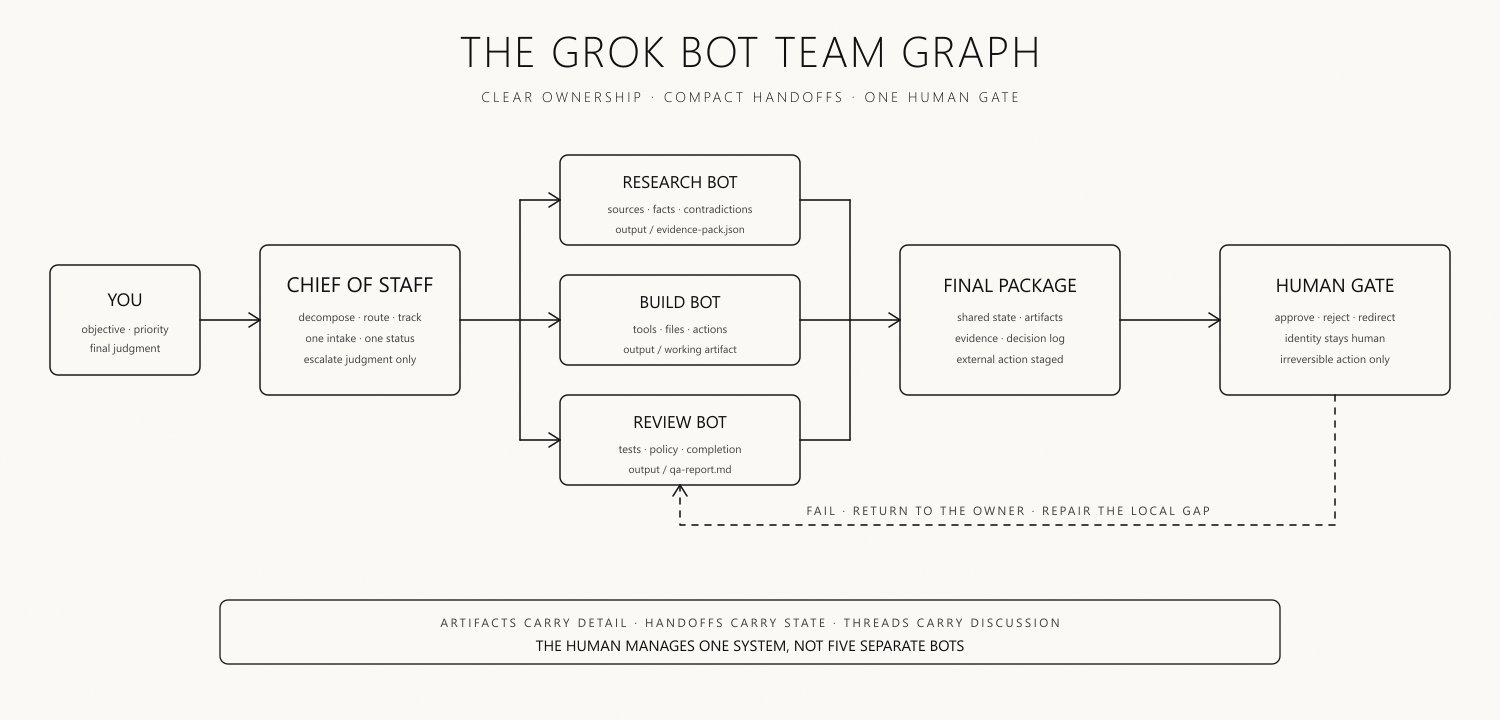
Every team needs
A Bot that can message another Bot is not automatically coordinated
It is only connected
Coordination appears when ownership and handoff rules are explicit
A practical one-person company graph
For a solo operator, a useful first team might look like this
The chief receives one objective
It decomposes the work
It routes each part to a specialist
It tracks the shared deadline
It does not rewrite every artifact itself
And you are pulled in only at the decision where your judgment or identity is required
That is not prompt engineering
It is management encoded as a graph
The ten-step Grok Bot operating system
The best way to start is not by creating ten Bots on day one
Build one reliable job, then expand the system around evidence
The previous sections describe the architecture
This is the order in which to build it
1. Start with a real recurring job
Choose something you already do
The result should be visible and easy to judge
2. Define the role in one sentence
If the role needs six unrelated verbs, split it
3. Define done before execution
4. Connect only the tools required by the role
Add access when a real blocked task proves it is needed
Do not pre-authorize hypothetical work
If a connection is shared across the account, document that explicitly in the role contract and approval policy
5. Demonstrate the workflow once
Show the Bot the real path across your tools
Explain why you make each judgment
Correct the first output in the same thread
The best demonstrations are recurring, multi-tool, stable, and visually checkable
6. Save the successful path as a routine
The routine should include inputs, output location, verification, schedule, and approval boundary
7. Add a checker before adding autonomy
Do not promote the routine because it succeeded once
Run it several times
Compare the output against the same rubric
8. Bound retries and define escalation
9. Add a specialist only when a bottleneck appears
Split the research from writing when the shared context becomes noisy
Split checking from building when self-review becomes weak
Split operations from analysis when permissions diverge
The graph should grow from real pressure
Not from the desire to look sophisticated
10. Audit the system every week
Always-on automation rots quietly
Sites change
Credentials expire
Routines drift
Preferences change
Weak output can repeat for days before anyone notices
Ask each Bot for a weekly receipt
Then spot-check one artifact yourself
The Bot can summarize its history
It should not be the only judge of its own history
For every routine, ask three uncomfortable questions
If the answer to the third question is no, delete or redesign the routine
The goal is not to accumulate automation
The goal is to remove work without accumulating invisible failure
The autonomy ladder
Do not jump from first message to unattended operation
Promote a Bot through evidence-backed levels
Movement between levels should require proof
This creates a system that earns autonomy instead of receiving it because the demo looked good once
When a routine degrades, move it down the ladder
Autonomy is a runtime privilege
Not a permanent personality trait
Three production patterns worth copying
Once a Bot has earned autonomy through clean runs, these are strong systems to build first
Pattern 1 / Overnight research desk
The Scout searches only approved lanes
The Source Checker rejects unsupported claims
The Cluster Bot merges duplicates
The Brief Bot writes the executive summary
The human receives one compact review queue in the morning
Pattern 2 / Bug reproduction and repair
The first Bot owns reproduction
It captures the exact steps, logs, screenshots, and environment
Only then does the debugging Bot receive the case
This prevents the builder from repairing an imagined failure
Pattern 3 / Content system with a public gate
Every reversible step finishes automatically
Nothing public leaves the system without approval
The human reviews one package instead of managing five Bots
Failure modes that will waste the most time
- One generalist owns everything
Its memory fills with unrelated preferences
Its thread becomes impossible to audit
Its permissions become broader than any single task requires
- The Bot receives tasks but no definition of done
It stops at something plausible
You expected something complete
Both sides think the other was unclear
- Every Bot receives the full transcript
Context grows faster than useful state
Old instructions compete with current work
Handoffs become summaries of summaries
- Shared computer is mistaken for isolation
Different Bot names create a visual boundary
They do not create a credential boundary
- The loop has no hard stop
The Bot retries a bad path with slightly different wording
Cost rises while information does not
- The checker is the builder in the same context
The same assumptions survive into the review
Confidence becomes evidence
- Everything waits for approval
The Bot becomes a slower interface for work you still manage manually
- Nothing waits for approval
The system can represent you, spend money, delete data, or change production before you see the plan
- Routines are never deleted
The system fills with automations that technically run and practically create no value
The best automation portfolio is not the largest
It is the one where every routine would be missed if removed
The Grok Bot launch checklist
Before you leave a Bot running overnight, ask
If several answers are no, the system is not ready for more autonomy
It is ready for a better harness
The real advantage of Grok Bot
Grok 4.6 is the reasoning engine
-
The persistent computer gives it somewhere to work
-
The harness turns access into controlled execution
-
The loop turns mistakes into targeted repair
-
The graph turns several Bots into a team
The approval boundary keeps identity and irreversible decisions with the human
Most users will ask whether Grok 4.6 is smarter than another model
The better question is whether the system around it can turn intelligence into reliable work
Because the future of agents will not be decided by the model that writes the most impressive answer
It will be decided by the system that finishes the job, proves what happened, and knows when to stop
That is the system behind Grok Bot
If you read this far
-> Subscribe to my Substack
-> Join my Telegram
-> Bookmark the article so you can use the checklist when you build your next agent
-> Follow @0xwhrrari
Published on grokbot.sh. Cite the public log, not a prompt pack.