
Grok Bot + Kimi K3: The Complete Guide to a 300-Agent Setup That Runs Itself
Everyone is building Grok bots. Almost nobody wires them to a workforce that can actually do the work. This is the setup where Grok decides and Kimi's 300-agent swarm builds, on repeat, without you.
Article
Job breakdowns
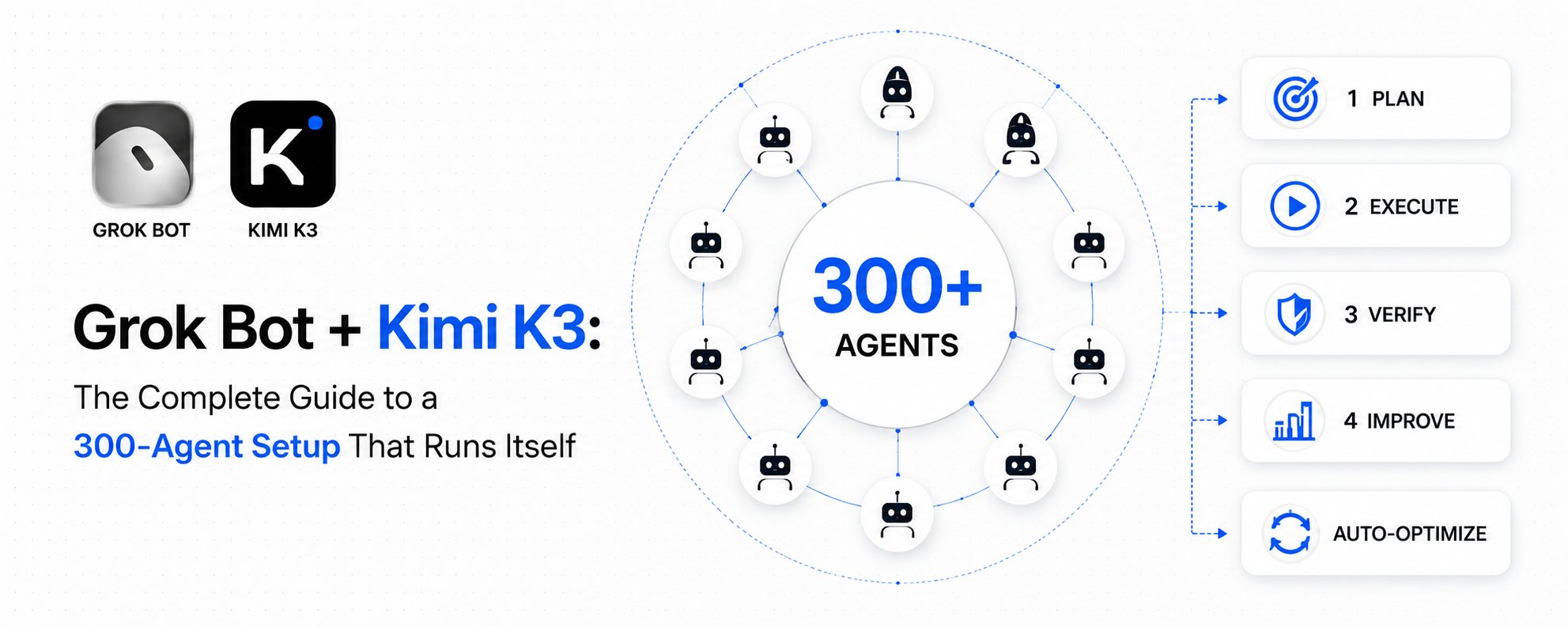
Everyone is building Grok bots. Almost nobody wires them to a workforce that can actually do the work. This is the setup where Grok decides and Kimi's 300-agent swarm builds, on repeat, without you.
Grok triggers 300 Kimi agents build runs itself
Follow my Substack to get fresh AI alpha: https://substack.com/@0xmorty
A bot that can decide but cannot build is just a chat window with ambition.
Every timeline is full of Grok bots right now. Most of them are a clever trigger wired to nothing. They can decide what should happen, phrase it well, and then stall, because deciding is not doing. The moment the job is "analyze 100 companies" or "build the report and the deck," a lone bot is out of its depth. It needs hands.
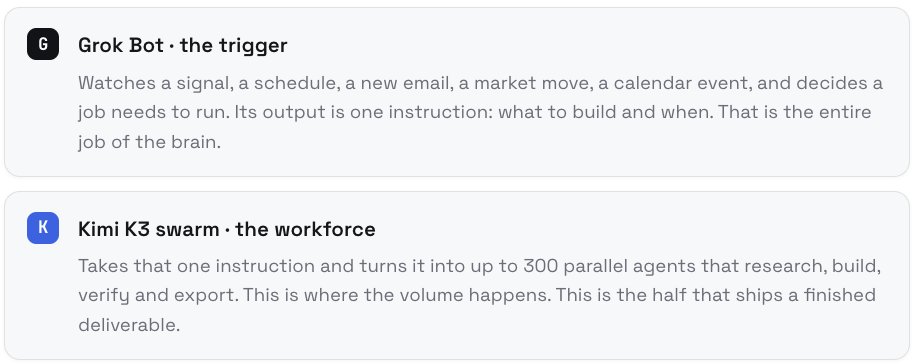
This guide is about those hands. Grok Bot is a fine brain: it watches, it decides, it triggers. But the work itself, the volume, the parallelism, the finished deliverable, is carried by Kimi K3 and its 300-agent swarm. Grok says go. Kimi does the work of a department. That split is the whole setup, and it is what lets the thing run itself.
Grok Bot is the brain that decides. Kimi K3 is the workforce that builds. A setup that runs itself needs both, but the work lives on the Kimi side.
The architecture
Two halves, one loop
The setup is deliberately simple. One half decides, the other half does. Keeping them separate is what makes it reliable: the brain never gets bogged down in execution, and the workforce never has to guess what to do.
This separation is not just tidy, it is the reason the setup can be left alone. When one component tries to both decide and execute, it fails at the seam: it starts a job, loses the thread halfway, and produces something half-finished that still needs a human. By giving Grok exactly one job, deciding, and Kimi exactly one job, building, neither half has a chance to drift. Each does the thing it is best at and nothing else.
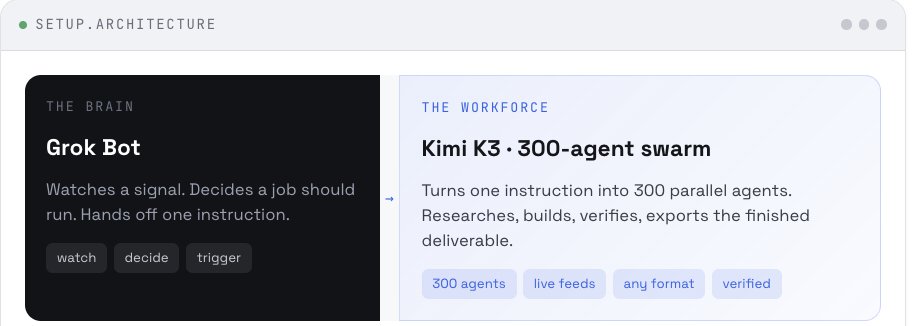
Grok Bot decides and triggers. Kimi's 300-agent swarm does the actual building. The work lives on the right.
The engine
Why Kimi K3 does the heavy lifting
A trigger is easy. A workforce that can actually finish the job is the hard part, and it is the part Kimi K3 was built for. When Grok says go, here is what it is handing the work to.
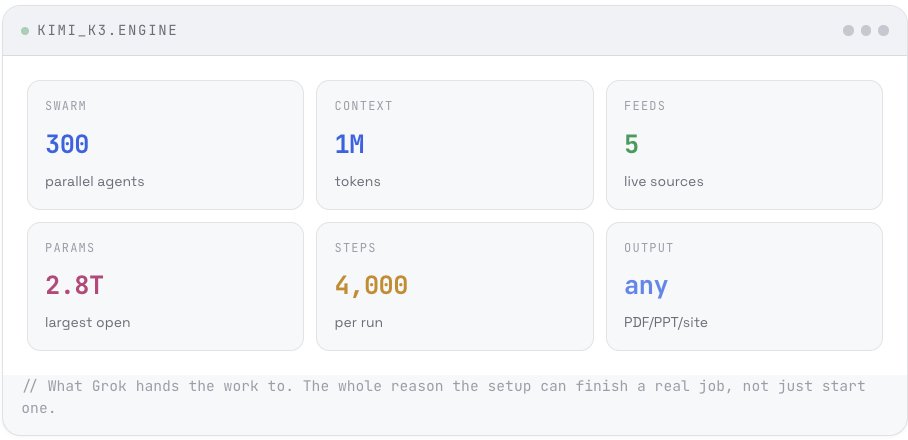
Each of these matters for a setup that runs unattended. The 300-agent swarm means a hundred-item job finishes in parallel, not over an afternoon. The 1M token context means an agent can hold an entire codebase or dataset at once. The five live data feeds mean the output is built on current numbers, not stale ones. And 2.8 trillion parameters means the quality holds up when nobody is watching.
That last point is the one people underestimate. A setup that runs while you sleep only works if you trust the output you wake up to. A weaker model left unattended produces confident mistakes that nobody catches until they are already in a document you sent. Kimi K3 is a frontier-tier model, which means the work it produces at 3 AM is the same quality it would produce with you watching. Unattended is only useful if unattended is still good.
The guide
The setup, step by step
Here is the whole thing, start to finish. No code required. The goal is a loop where Grok triggers and Kimi builds, on repeat.
- Give Grok a signal to watch
Point the Grok bot at whatever should kick off work: a schedule, an inbox, a market threshold, a new row in a sheet. This is the trigger condition.
- Write the decision, not the work
Grok's prompt should decide what to build and hand off one clean instruction. It should not try to do the building. Keep the brain a brain.
- Wire the handoff to Kimi
Grok's instruction becomes the launch prompt for Kimi Agent Swarm. One sentence in, up to 300 agents out. This is the moment the work crosses from brain to hands.
- Let Kimi fan out and build
Kimi K3 spins up the swarm, pulls from live feeds, builds the deliverable, and exports it in whatever format you need: report, deck, sheet, site.
- Persist and repeat
The output lands on disk, and the loop resets to step one. Next time the signal fires, the whole thing runs again without you. That is the setup that runs itself.
On repeat
The loop that runs itself
Put the five steps in a circle and you have a system that does not need you in the room. Grok waits for the signal. Kimi does the work. The result gets saved. The loop resets. Nobody presses a button.
The word "loop" is doing real work here. A one-off automation runs once and stops. A loop runs every time its trigger fires, indefinitely, which means the value compounds. Set it up once on a Monday and it is still producing on Friday, and the Friday after that, with no additional effort from you. The setup cost is paid a single time. The output arrives forever.
One trigger
What one cycle actually produces
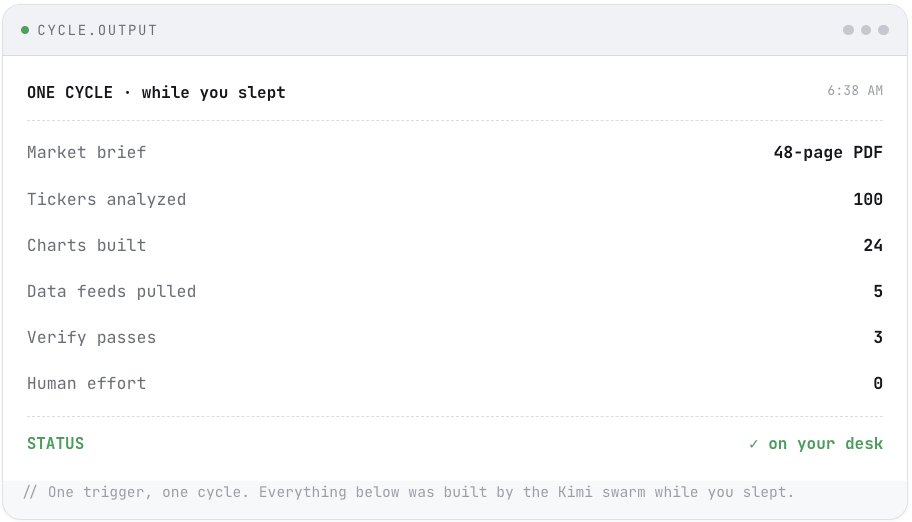
Here is a single pass. Grok fires one instruction at 6 AM. By the time you are awake, Kimi has finished.
You did not touch it. Grok decided the brief was due and handed off one line. Kimi did the work of an analyst team: pulled the numbers, built the charts, verified them, and exported the finished document. The only thing you do is read it over coffee.

A Grok bot alone would have written you a to-do list. Grok plus Kimi wrote you the finished brief.
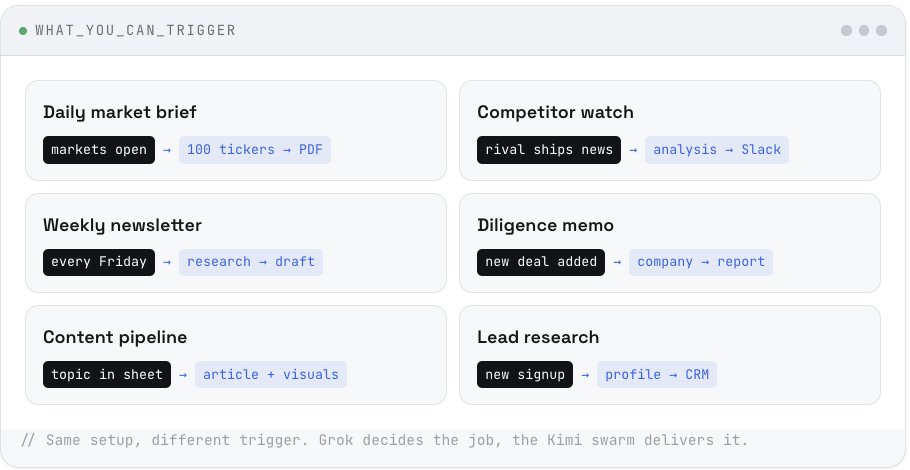
And the market brief is just one example. The same Grok-triggers-Kimi-builds loop runs any job you can describe in a sentence. Change what Grok watches for and what it asks for, and the same 300-agent workforce produces something entirely different.
Why it lasts
Why the work belongs on Kimi
You could wire a Grok bot to a single model and call it a setup. It would start jobs it could not finish. The reason this particular setup runs itself is that the workforce half is strong enough to be left alone.
-
It finishes, not just starts. 300 parallel agents mean a real job completes in one cycle, not across a week.
-
It stays current. Five live feeds mean every run is built on today's numbers, so the loop never goes stale.
-
It holds quality unattended. 2.8T parameters mean the output is still good when nobody is checking it.
-
It exports anything. Report, deck, sheet, or site, all from one launch, so Grok never has to specify a format twice.
Grok is the easy half to build. Kimi is the half that makes it worth building. A trigger is a novelty. A trigger wired to a 300-agent workforce is a system that quietly does your work while you sleep.
Grok decides. Kimi builds. You sleep.
Anyone can stand up a Grok bot. The setup that actually runs itself is the one with a real workforce behind the trigger. Wire Grok to Kimi's 300-agent swarm and you stop starting jobs. You start waking up to finished ones.
Published on grokbot.sh. Cite the public log, not a prompt pack.