
Grok Bot Just Stopped Being One Model
Claude Opus 5.5 is rolling out as the primary brain, but the more important change is that Grok Bot is starting to choose the intelligence behind the work. For most of the AI era, choosing a product
Article
Job breakdowns
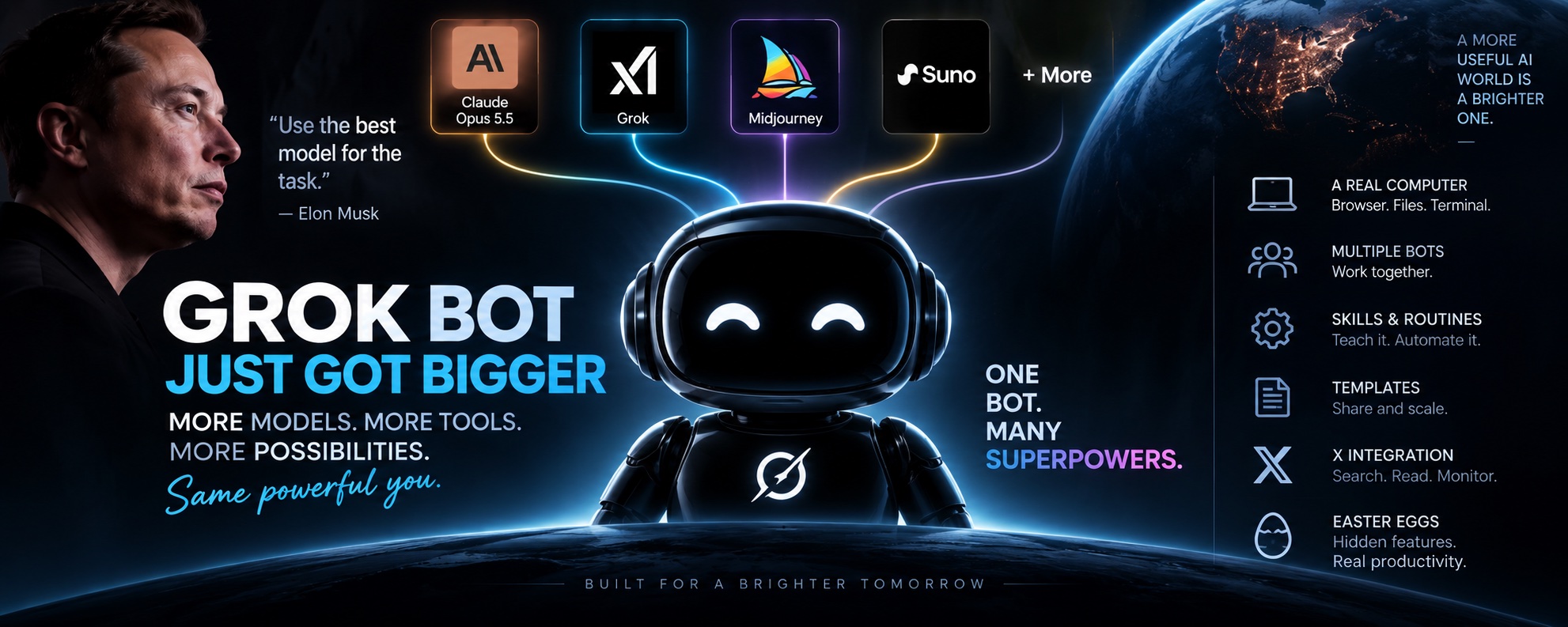
Claude Opus 5.5 is rolling out as the primary brain, but the more important change is that Grok Bot is starting to choose the intelligence behind the work.
For most of the AI era, choosing a product has also meant choosing a model company. Open ChatGPT and you are using OpenAI. Open Claude and you are using Anthropic. Gemini means Google. Grok means xAI.
Grok Bot is beginning to break that relationship.
Elon Musk said this week that the system will increasingly use whichever backend is most likely to produce the best result for a given task. He specifically named Claude Opus 5.5, Midjourney, Suno and other leading APIs. He later explained the basic routing idea: simple jobs can go to smaller and faster models, while more difficult work can be handed to larger ones.
Akshaya Dinesh, who works on the product at SpaceXAI, added another important detail. Opus 5.5 has already been running inside Bot internally and is rolling out automatically as the primary model. When someone asked how to force that model manually, her answer was essentially that users should not need to.
The system chooses for you.
That is the part I find most interesting. Grok Bot is no longer best understood as Grok with access to a browser and a few tools. The Bot itself is becoming the product. The language model is one component inside a larger system that includes memory, a persistent computer, connectors, reusable skills, routines and other Bots. SpaceXAI’s own documentation describes Bots as persistent AI teammates with a browser, filesystem and terminal that can continue working while your computer is closed.
The model inside that system can now change depending on the job.
That may turn out to matter more than another benchmark win.
The product is becoming the harness
Think of Grok Bot less like a chatbot and more like a manager with a computer.
You give it an outcome. It figures out how to get there.
There is no good reason one AI company should be best at every kind of work. A frontier language model might be excellent at reasoning and coding. Another company may make better images. Someone else may have the strongest music model. A smaller model may be perfectly adequate for extracting information from a document and cost far less to run.
Until now, users have been expected to understand those differences themselves. We learn which model is better at coding, switch to another for writing, open a different service for images and another one for music.
Grok Bot is moving toward a different idea. You tell the system what you want, and the system decides which intelligence should handle each piece of the job.
If that works well, users eventually should not care whether a particular step was completed by Grok, Claude, Midjourney, Suno or a smaller model whose name they have never heard. They should care whether the work came back right.
That is a much cleaner way for normal people to use AI.
Opus 5.5 is primary, not exclusive
That distinction is important.
Opus 5.5 appears to be becoming the primary reasoning model inside Grok Bot, but Musk’s broader announcement makes clear that the product is not simply replacing Grok with Claude.
The goal is routing.
Dinesh gave a good example of why the team is excited about this. During a customer call, she asked Bot about a requested feature. Within seconds, it had created a product requirements document, spun up a cloud agent, built the change and produced a pull request ready to merge.
That is a much better demonstration of where agents are headed than asking which chatbot writes the best paragraph.
The system understood the request, planned the work, delegated execution and returned something useful. The person using it did not have to stop and decide which model should write the PRD, which agent should build the feature or how the pieces should be handed from one system to another.
At the same time, primary does not mean exclusive. Musk has said simple requests should still go to smaller and faster models. Midjourney and Suno are completely different kinds of systems, so clearly the ambition extends beyond choosing between two language models.
There also does not appear to be a published switch that lets users manually force every task onto Opus or move a job back to Grok.
For now, the router is making the call.
That makes the router part of the product
This may be the least obvious consequence of the announcement.
Once Grok Bot can choose among models, the quality of the routing decision becomes almost as important as the quality of the models themselves.
“Use the best model” sounds simple until you try to define best.
A very short question can require difficult reasoning. A 3,000-word prompt can be mostly clerical. A job that starts as research may suddenly need code, an image and a spreadsheet. Something that looks complicated may actually be simple extraction work.
The router has to understand the task rather than just the length of the prompt.
It also has to balance intelligence, speed and cost. Sending everything to the largest model would probably produce strong results, but it would eliminate much of the efficiency that routing is supposed to create. Sending too much work to smaller models could make the product feel inconsistent.
That means one of the most important parts of Grok Bot may increasingly be invisible.
You could ask the same product ten different questions and have several different models working behind the scenes. If the router gets those choices right, the whole system simply feels smart.
If it gets them wrong, users may experience the product as strangely inconsistent without knowing why.
That is probably the biggest product risk in this new architecture.
There is also a new privacy question
Using outside models creates another issue that deserves attention.
If a task is routed to Claude, some information required for that task necessarily has to reach Anthropic’s model infrastructure. The same basic logic applies if an image goes to Midjourney or music goes to Suno.
That does not mean every Grok Bot conversation is being sent to every outside company. It also does not mean prompts are automatically being used for training. Those are much stronger claims, and there is no basis for making them simply because outside APIs are involved.
But it creates a reasonable question: what information is going where?
Someone asked under Musk’s announcement for an opt-out because they did not want their Grok Bot work routed to Anthropic. There was no public answer in the thread.
As people begin using Bots for more serious business and personal work, I think this will matter. Users may want to know which provider handled a task, what information was sent, what retention rules apply and whether sensitive work can eventually be restricted to particular providers.
The technical strategy makes a lot of sense.
The privacy controls will need to keep up with it.
The best Grok Bot Easter eggs are the useful ones
There are a lot of supposed Grok Easter eggs floating around X. I would be careful with most of them.
A funny response from @grok or somebody saying there is a hidden animation is not the same thing as a feature the product team has actually demonstrated.
The more interesting hidden capabilities are practical.
One of my favorites is that you can teach a Bot by showing it how you work.
Instead of spending an hour trying to describe every step of a workflow in a giant prompt, you can demonstrate the process. Grok Bot can observe the browser workflow and turn what it learns into a reusable skill that can be reviewed, corrected and run again later. SpaceXAI’s documentation now describes this directly as “Teach a task.”
Imagine showing a Bot how your company creates a weekly report, updates a CRM, submits a particular form or handles a repetitive administrative process. You perform the task once, correct the parts it misunderstands, save the process and let the Bot do it the next time.
That feels much less like prompting and much more like training a new employee.
Bots can work as a team
Another capability that deserves more attention is that Bots can coordinate with other Bots.
You might have one Bot focused on research, another on engineering, another on writing and another acting as the person coordinating the project. SpaceXAI’s docs say Bots in group chats can pass work among themselves, share context and hand ownership of a task from one Bot to another.
That starts to change the unit of AI from a conversation to a team.
In a recent Grok Bot workshop, the team demonstrated a chief-of-staff style Bot operating inside a group chat with an explicit rule that it should ask before sending email. I like that example because it shows where this is probably heading.
You do not necessarily want one giant AI doing everything.
You may want several specialized workers with clear roles, plus one system responsible for coordinating them.
Humans have organized work that way for a very long time.
AI may end up doing the same thing.
A Bot has a real computer
This is probably the most important capability people overlook.
Grok Bot has a persistent computer with a browser, filesystem and terminal. It can use connectors where they exist, but it can also interact with websites more like a person when necessary.
That changes what an agent can do.
Traditional software automation works beautifully when every service provides a clean API. Real life is not like that. Plenty of websites and smaller services were built for humans clicking buttons, not agents calling APIs.
Fatih Arslan, a SpaceXAI engineer, gave a good family-assistant example. A Bot could work from a shared grocery list and then go to the grocery website to place the order. The grocery company does not need to have built a special Grok integration for that exact workflow.
The Bot has a browser.
That is the Easter egg I think more people should understand. The same system that can read a website can sometimes operate the website too.
Of course, this is also why permissions matter. A Bot that can buy the right groceries can buy the wrong groceries. The usefulness and the risk come from the same capability.
Routines make the Bot useful when you are not there
Another feature that is easy to underestimate is routines.
A routine lets a Bot take a workflow it already knows and run it again without requiring you to start the conversation every time.
You might want a morning research report, a weekly company update or a recurring check on something you care about. Once the workflow is reliable, the Bot can run it in the background while your laptop is closed. SpaceXAI’s current documentation says a single Bot can own dozens of routines and keeps recent run history so users can inspect what happened.
This is where the product begins to move beyond chat.
A chatbot is something you visit.
A persistent agent can keep doing a job after you leave.
That distinction is going to matter more as these systems become reliable enough to trust with recurring work.
Templates may be more important than prompts
One of the quieter Grok Bot features is the ability to share a Bot as a template.
This does not simply hand another person your entire Bot, computer, logins or conversation history. SpaceXAI describes templates as a recipe rather than a clone. The recipient gets a blueprint containing selected instructions, memories, skills and plugins, then creates their own copy.
I think that could eventually become a much more interesting way to distribute AI software.
Imagine somebody builds an excellent commercial real estate research Bot. Someone else creates one for recruiting, fantasy sports, procurement or running an X account.
Today people sell prompts.
Tomorrow they may distribute workers.
A worker is much more useful than a prompt because it can contain instructions, learned workflows, tools, routines and domain knowledge.
If that ecosystem develops, Grok Bot could eventually have something that looks less like a prompt library and more like an app store for specialized digital employees.
The X connection is a natural advantage
Grok Bot also has an integration that is difficult for competing agent products to match in exactly the same way.
X.
A connected Bot can search posts, read timelines and check mentions. That gives creators, investors, researchers and anyone following fast-moving events a way to make X part of an ongoing Bot workflow. SpaceXAI describes this as the first version of the integration, so it is reasonable to expect the connection to get deeper over time.
For a researcher, that could mean having a Bot watch what people in an industry are saying while another piece of the workflow handles deeper research.
For someone working in markets, it could mean combining real-time discussion with other sources.
For creators, it could become a way to monitor conversations without sitting on the timeline all day.
The important point is not that Grok Bot can read X.
It is that X can become another input into a persistent worker rather than another app you personally have to check.
The model race may become the orchestration race
For the last few years, we have treated AI like a horse race.
Which company has the smartest model? Who is winning the benchmarks? Did Claude beat Grok this week? Did Gemini pass GPT?
Those questions will continue to matter to the companies spending billions of dollars building frontier models.
I am starting to think they may matter less to everyone else.
If Grok Bot can call Opus when Opus is better, Midjourney when Midjourney is better, Suno when the task is music and a cheap smaller model when the job is simple, then SpaceXAI does not have to win every model category for Grok Bot to become a very good product.
It has to become very good at orchestration.
Which system understands your work?
Which one remembers how you like things done?
Which one has access to the tools you actually use?
Which one knows when to hand part of the job to a specialist?
Which one can coordinate several agents without requiring you to become the project manager?
And most importantly, which one actually finishes the work?
Those questions may eventually matter more than another two-point lead on a benchmark.
There is still a cost problem to solve
None of this makes computing power free.
Long-running agents can consume dramatically more resources than ordinary chats. A Bot might research dozens of sources, create a plan, spin up another agent, write code, test it, revise the result and use several models along the way.
That is much more work than answering a question in a chat window.
A Cursor Ultra user recently commented that he keeps running into his Grok Bot usage pool while trying to use it as an everything-assistant. That is a useful reminder that the dream of persistent digital workers comes with real computing costs.
As routing gets smarter, I would like the economics to become easier for users to understand too. The ideal system probably hides the technical complexity while still giving people enough visibility to understand why one task consumed significantly more resources than another.
Otherwise, an invisible router can also create an invisible bill.
The bigger bet
The most interesting part of this week’s announcement is not that SpaceXAI is willing to put Claude inside a product with Grok in the name.
It is what that decision says about where the company thinks the product layer is heading.
Grok can keep improving. SpaceXAI can keep trying to build the best frontier models in the world. But Grok Bot no longer has to wait for Grok to become the best model at every possible task.
If Claude is better at one kind of reasoning, use Claude. If Midjourney makes the better image, use Midjourney. If Suno is the right tool for music, use Suno. If a smaller model can handle a routine job faster and more cheaply, use the smaller model.
Users do not need to join a model tribe.
That is probably the right abstraction.
The product is no longer just the model. It is the system that knows which model, tool and computer should handle the work, then coordinates everything until the job is finished.
For the last few years, the question everyone has been asking is which AI is best.
Grok Bot is beginning to ask a much more useful question.
Which AI is best for this particular piece of work?
If the router gets good enough, most people eventually will not know the answer.
They will just know the work got done.
Published on grokbot.sh. Cite the public log, not a prompt pack.