
Grok Bot Galaxy Day 1: a bot committed the file. The humans still had to log in.
Day 1 ran 8 hours 45 minutes. At [2:34] (https://x.com/i/broadcasts/1AxRnZbVpjaxl?t=9240) a bot committed index.html while the hosts were on a guest. At [5:28] (https://x.com/i/broadcasts/1AxRnZbVpjaxl?t=19680) GitHub CLI auth was still fai
Article
Job breakdowns
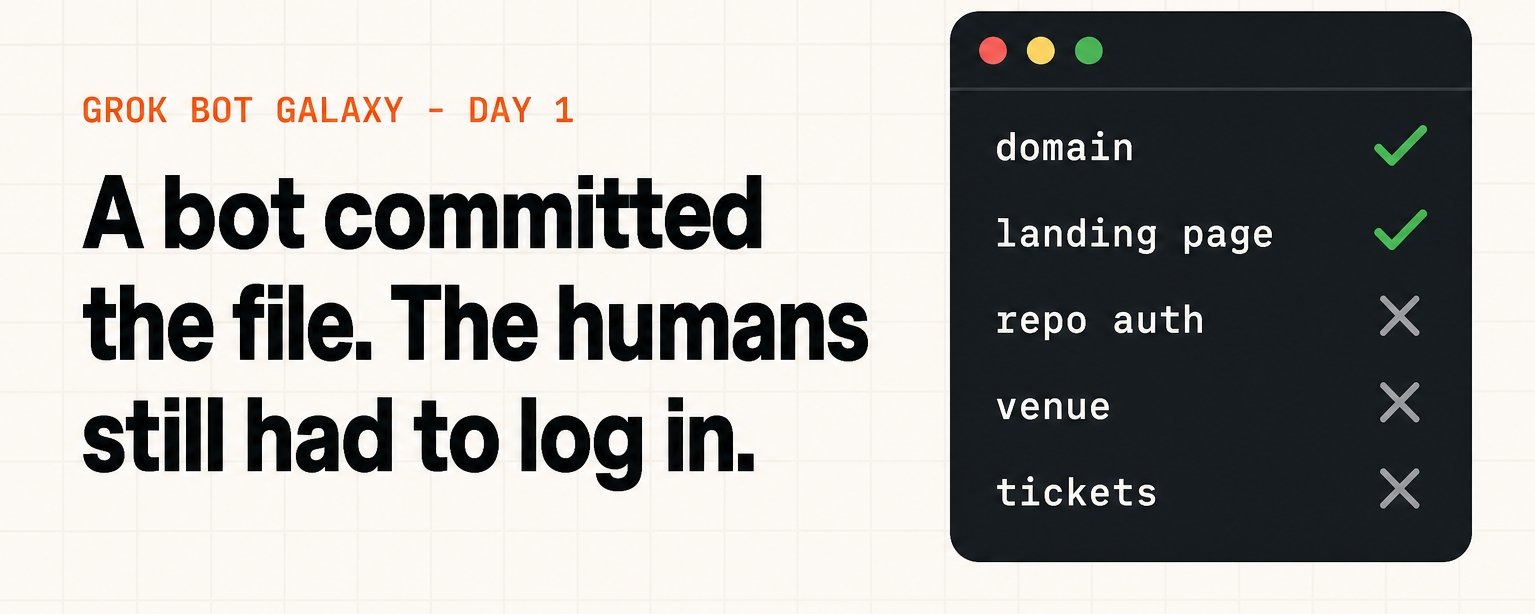
Day 1 ran 8 hours 45 minutes. At [2:34] (https://x.com/i/broadcasts/1AxRnZbVpjaxl?t=9240) a bot committed index.html while the hosts were on a guest. At [5:28] (https://x.com/i/broadcasts/1AxRnZbVpjaxl?t=19680) GitHub CLI auth was still failing.
On stream they talk as if each bot has its own computer. The docs say the computer belongs to your account, and a login placed on it is available to every bot you run.
Where Day 1 ended
• A live domain, DNS connected [4:52]
• A landing page the team calls "vanilla HTML and JavaScript", "really prototyped" [5:28]
• A signup form wired to a database — with viewers told "maybe don't submit yet" [4:52]
• No venue, no date, no tickets. The team's own status line: "she's got ticketing designs. We just talked about like figuring out venues… That's pretty much it." [7:16] (https://x.com/i/broadcasts/1AxRnZbVpjaxl?t=26160)
• The idea itself still open at [5:38]: "It seems like we're almost going generic pop-up at this point."
The best moment of the day is the one in the title. At [2:34] (https://x.com/i/broadcasts/1AxRnZbVpjaxl?t=9240), while the hosts were interviewing a guest, a bot committed index.html to the repo unattended. It is the only unattended artefact of the day — everything else that exists was made with a human driving.
The most useful finding is underneath it. At [7:26] the workshop presenter explains why a bot can act at all: "we have armed it with its own computer."
The official documentation (https://docs.x.ai/grok-bot/computer-and-apps) is stricter:
"All of your Bots use the same persistent cloud computer… The computer is assigned to your user account, not an individual Bot."
and the line that matters if you deploy this at work:
"Treat a login or file placed on the computer as available to all of your Bots."
The isolation boundary is your account, not the bot. Sign one bot into a system and every other bot you run can reach it.
What this is
Grok Bot Galaxy was a three-day livestream that began on 15 September 2026: a small team builds a company on camera, using their own AI agents to do the work.
I transcribed the full Day 1 replay locally — 26,855 cues — so every claim below carries a timestamp that links into the replay (https://x.com/i/broadcasts/1AxRnZbVpjaxl).
What it isn't: a product spec. No price, tier, quota or availability date was stated anywhere in the 8h45m. The docs (https://docs.x.ai/grok-bot/overview) answer what the stream skipped.
What shipped vs what didn't
• Live domain — Working, DNS connected · [4:52]
• Landing page — Exists; "vanilla HTML and JavaScript" · [5:28]
• Signup form + database — Wired; viewers told not to submit · [4:52]
• Code in the repo — One unattended commit at [2:34]; CLI auth failing by [5:28] · [2:34], [5:28]
• Deployed site doing something — "right now it doesn't do anything. It's just an HTML page" · [2:38] (https://x.com/i/broadcasts/1AxRnZbVpjaxl?t=9480)
• Ticketing designs — Asserted, never shown · [7:16]
• Venue — None booked; phone calls deferred off-camera · [5:30], [7:14]
• Events platform (permissions, staff tools, admin) — Brainstormed ~20 minutes, nothing built · [4:54]–[5:14]
• A platform others could use — "a stretch goal for us coming out of these three days" · [7:16]
• Verification skill — A PR reviewed on stream; the skill never invoked · [5:16], [5:26]
The visible stalls were access
The agents handled what people assume is hard: generating designs in several directions and regenerating on feedback, naming, market research, writing and committing code.
Each time the build stalled, it stalled on identity and permissions:
• A database credential never arrived; the deploy was deferred and the agent told to unblock itself [2:42]–[2:48]
• A platform invite never reached the person it was sent to [2:36]
• API keys stayed a manual, human step [5:14], [5:26]
• Code couldn't reach the repo — CLI auth failing [5:28]
• When an agent lacked credentials, the fallback was "come back to me with a video or a screenshot" [2:48] — the agent's output became something for a human to finish
Said plainly on air at [2:36] (https://x.com/i/broadcasts/1AxRnZbVpjaxl?t=9360): "Humans have to do this stuff, right?"
That is the roadmap for anyone planning agent work inside a company: credential vaulting, scoped permissions, audit, delegated identity.
One caveat I can't resolve: nobody scored output quality, so this doesn't prove the model would have finished the hard parts if the keys had arrived. It proves the keys were the visible blocker.
Six claims worth checking
-
A bot acts autonomously in a repo. One unattended commit, observed [2:34] — and repo auth broken by [5:28]. That is a demo of a write, not a durable loop. Check: give an agent write access, leave, read the commit log, then ask what reviewed it.
-
A bot has "its own computer" [7:26]; the docs say the computer is assigned to the account, not the bot. Check: sign one bot into something, then see what a second bot can reach.
-
Bots compound over weeks — a prep bot improves in "two or three weeks" [7:38]. Check: same task, same bot, weeks apart, scored against a fixed rubric. Nobody measured this on stream.
-
~2,500 PRs in a month by one engineer (≈83/day), self-reported [0:18]. Check: commit history shows volume, not value. Ask merged-vs-reverted and review time.
-
Routines run on schedules, webhooks and signals. Visible in the UI, never observed firing [7:26]–[7:36]. Check: set one, wait, inspect the log — and price it. They warn a 15-minute routine is an anti-pattern and "100 times a day" is waste [7:56].
-
Agents reach internal systems (VPN, internal tools), stated with no egress or audit discussion [1:20]. Check: what can the VM reach, what is logged, who approves an outbound call.
What broke
A keynote that goes perfectly teaches you nothing.
• The flagship demo's payoff never landed: an audience QR code for a coffee-order form returned "no access" [1:06], was still broken at [1:14], and the promised data → slides → email chain fell back to a "sample data set" [0:56]
• Approval prompts interrupted constantly [0:42]–[0:58]. When an attendee said the bots "keep stopping you, and they don't work on their own", the presenter conceded: "this is actually not, I would say, particularly normal" [1:16] (https://x.com/i/broadcasts/1AxRnZbVpjaxl?t=4560)
• The stream itself went down [2:38], a guest cancelled on air [2:44], and screen sharing failed repeatedly, leaving ~20 minutes of the build narrated blind [1:34]–[1:56]
• Wrong-bot routing twice in three minutes — "I typoed" [2:24], "Oh, wrong bot. Oops." [2:26]
• An in-app update skipped on purpose: "I don't know if I'm brave enough to do that on stream" [2:30]
• A memory failure mode volunteered by the presenter: bots don't know when another bot has been deleted [1:24]
• In the workshop, a demo task was still unfinished when the demo ended [7:52]
And the gap: no eval suite, no automated gate and no held-out task appeared in the whole build. The only checks were human — including one PR read on stream [5:16]. That is fine for a three-day stunt. It is not fine for the framing the day opened with — human and AI teammates collaborating inside companies [0:30], especially once you have conceded, as they did at [8:02] (https://x.com/i/broadcasts/1AxRnZbVpjaxl?t=28920), that the agents are not deterministic: "they inherently don't, sadly". The suggested workaround is code plus a flowchart so the agent can "cosplay being deterministic" [8:04].
Two things worth stealing from the workshop
-
Give the bot durable context, not a longer prompt. The build team pushed a hand-written founding document to every bot [2:28].
-
Price your routines. Browser use is expensive [7:54]; frequent schedules are the anti-pattern — they call a 15-minute routine an anti-pattern and "100 times a day" waste [7:56].
Four questions before you put this in front of your team
-
What can the bot's VM reach? Internal access was claimed [1:20] with no egress, logging or approval discussion.
-
Who else gets the credential? Per the docs, every bot on the account. Decide which agents share a machine before you grant a token.
-
What reviews the output when nobody is watching? On stream the only review was human and on camera; no automated check ran at all.
-
What does a routine cost? They warn browser use is expensive and decline to give numbers: "people were like this is expensive, which is true in some ways, not true in others" [7:54].
Where to read more
• Use the computer and apps (https://docs.x.ai/grok-bot/computer-and-apps) — read this first: the shared-computer boundary, signing in once, taking over a sensitive step
• Grok Bot overview (https://docs.x.ai/grok-bot/overview) — the teammate model and what persists
• Create and manage bots (https://docs.x.ai/grok-bot/bots) · Message and collaborate (https://docs.x.ai/grok-bot/chat-and-collaboration)
• Day 1 replay (https://x.com/i/broadcasts/1AxRnZbVpjaxl)
How I made this
I transcribed the Day 1 replay locally: 26,855 cues over 8h45m. Of 263 two-minute blocks, 137 contain some speech (~4.6 hours of blocks; a block counts even if it holds twenty seconds of talking). The rest is hold music and dead air, including a ~76-minute stretch from [5:40] to [6:54].
Three limits. The transcript has no speaker labels, so a presenter is inference from context. The model name is garbled in the audio and the corporate entity is inconsistent, so I name neither. The four workshop demos ran in a demo environment with placeholder data, said plainly at [7:32].
Day 3 is the reveal. Day 1 is the baseline.
Published on grokbot.sh. Cite the public log, not a prompt pack.