
Grok Bot for Traders: The 6-Bot Desk I Actually Run (Full Setup + Charters)
Most traders open Grok Bot, type "long or short?", and click buy on whatever comes back. That's hiring a trading desk and using it as a Magic 8-Ball. Here's the reframe that changed how I trade. A
Article
Job breakdowns
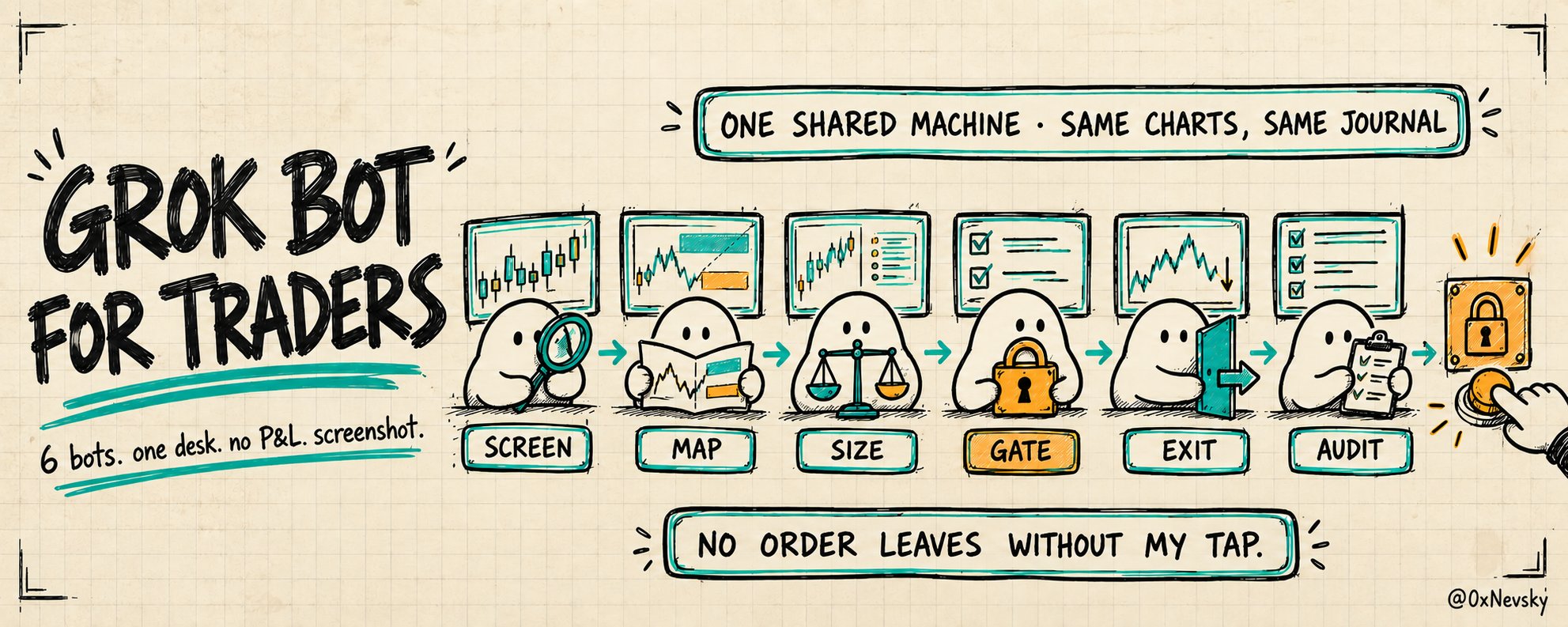
Most traders open Grok Bot, type "long or short?", and click buy on whatever comes back. That's hiring a trading desk and using it as a Magic 8-Ball.
Here's the reframe that changed how I trade. A Grok Bot is not an oracle. It's a team of workers on one shared cloud machine. They see the same chart data, the same files and the same journal, and they keep watching the market after I close the laptop. I don't ask it for calls. I give it rules, and it enforces them better than I ever did.
One thing up front. You won't find a "$55 → $9,340 in a week" screenshot here. My feed is full of them, and I know how they work: you see the one account that survived, never the hundred that went to zero. What you'll find instead is the exact machine I built, the rules it runs on, the charters you can copy, and the pass/fail numbers I wrote down before the first test, so you can hold me to them.
How my desk works, in one minute
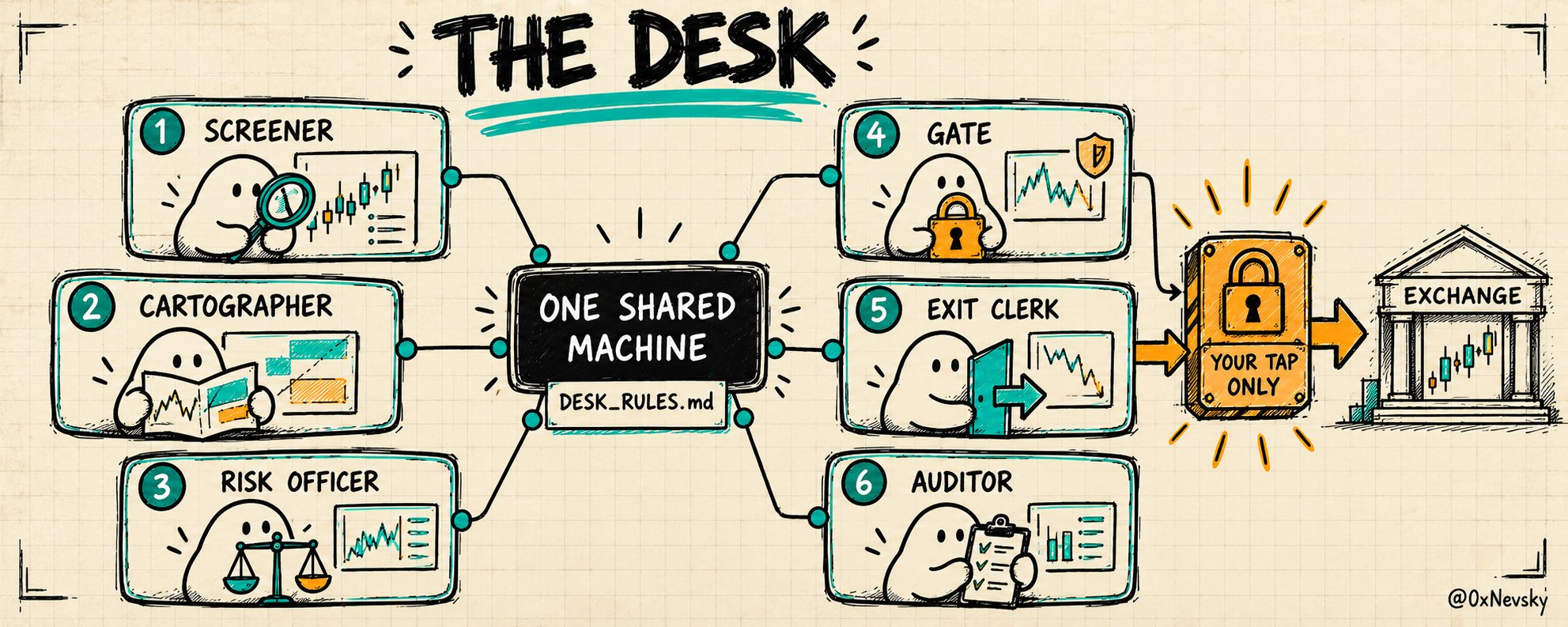
I designed a dashboard and connected it to a Grok bot. Inside it are six bots, each with a charter: what it owns, what "good" looks like, and where it has to stop.
They all run on the same persistent machine, so the bot that spots a trend change and the bot that maps the entry are looking at the same state. Nothing gets re-explained and nothing gets lost between them.
Every scan runs on a routine, on each 4H and daily close, whether I'm awake or not.
And there's one rule above all the others: the gate. Scanning, mapping zones, sizing, drafting the trade — all of that finishes on its own. Sending an order to the exchange doesn't. That waits for my tap.
Now, the six bots.
1. The Screener — it finds the turn
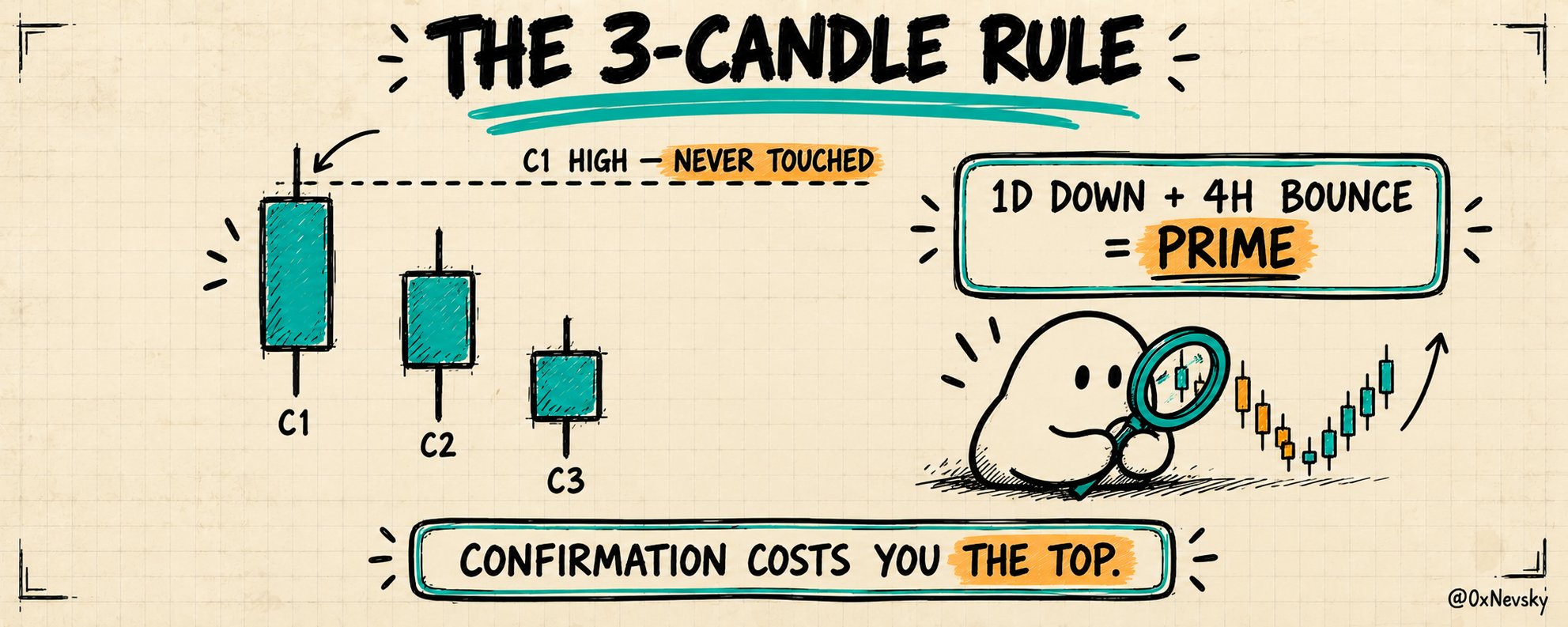
Most bots scan for "coins that are moving." Mine scans for one thing: a confirmed trend change on the daily, using a three-candle rule.
For a short: candle one closes down. Candle two closes below candle one, and it can't take out candle one's high. Candle three's body closes below candle two, and neither of them touches that first high. Dojis count. Candle two doesn't have to be red.
The part that surprised me: when the daily has flipped down but the 4H is bouncing, the bot doesn't reject the coin. It flags it as the prime candidate. The daily signal outranks a local pullback, and that pullback is exactly where the entry forms.
The desk is short-only. It still tracks bullish three-candle setups, but only as a precondition. It never trades them.
The honest catch: confirmation costs you the top. You enter after the turn is proven, not at the exact high. That's the price of not guessing.
2. The Cartographer — it maps the zone
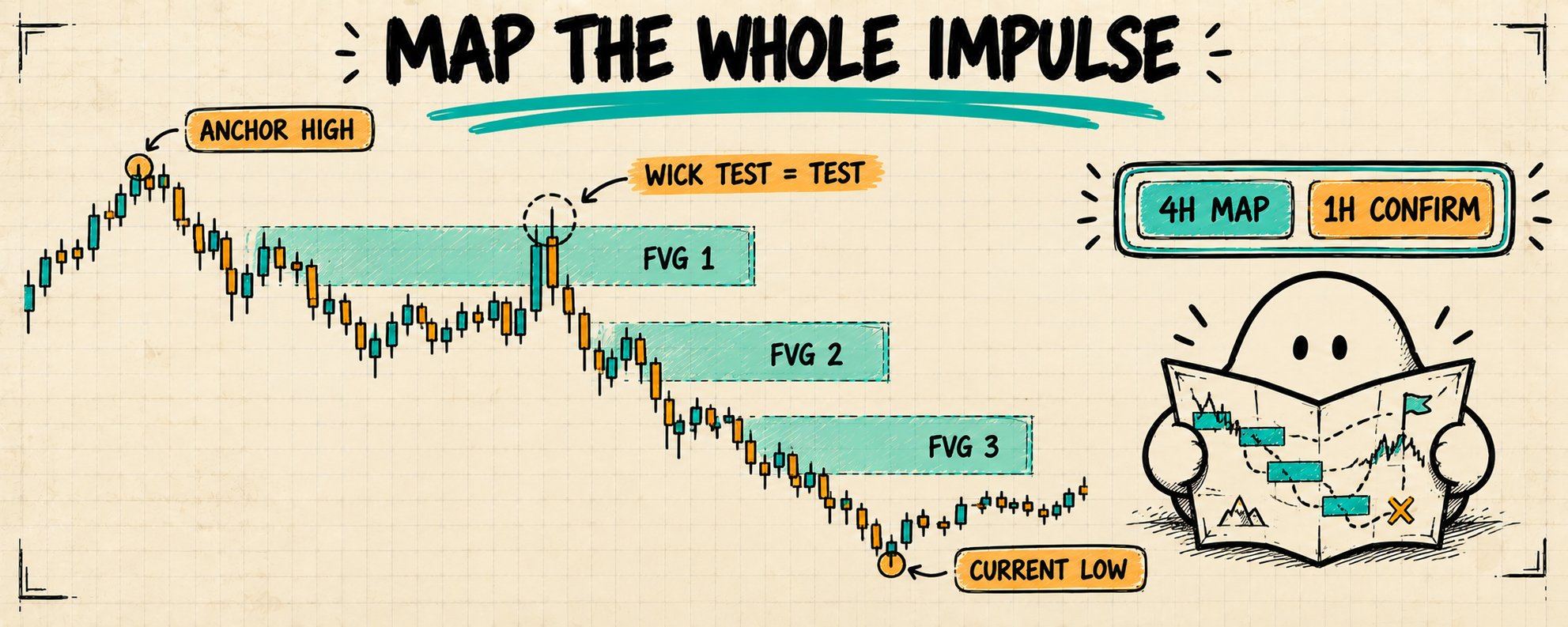
Once a coin passes the Screener, the second bot maps where price is likely to react. It looks for fair value gaps (FVGs), the inefficiencies left behind when the trend broke.
It doesn't just look at the break point. It scans the entire impulse, from the anchor high down to the current low, on the 4H, and builds a ladder of zones. A partial wick test counts as a test. Confirmation comes from the 1H.
A human does this for three coins and gets tired. The bot does it for every coin on every close and never gets bored.
3. The Risk Officer — it sizes before I get excited
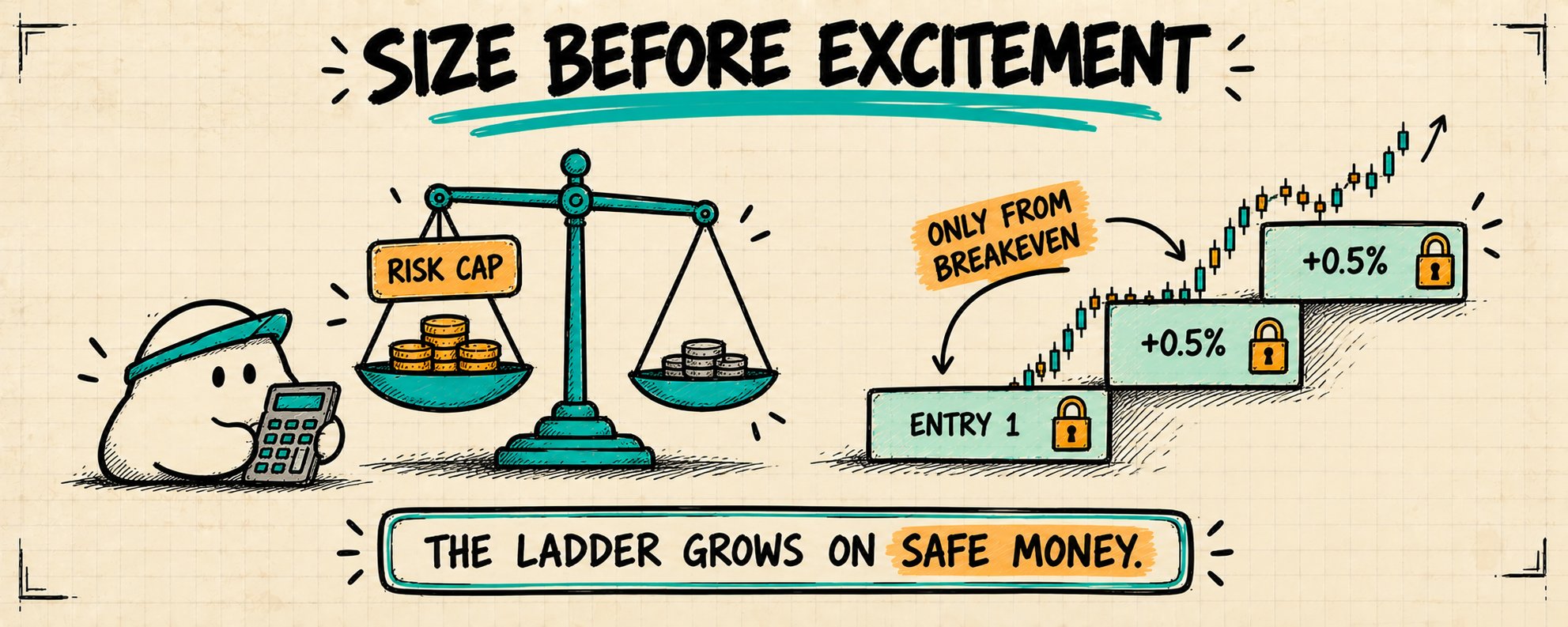
This bot never sees a chart. It sees three numbers: account, stop and risk.
Every position is sized against a hard risk cap before I ever see the alert. Scaling in has one rule: the next add is 0.5% risk, and only once the previous entry is at breakeven. The ladder can only grow on money that's already safe.
The honest catch: this gives you a boring equity curve. Lots of small scratches and a few trades that run. If you need dopamine, this bot will frustrate you. That's the point.
4. The Gate — it pings, I press
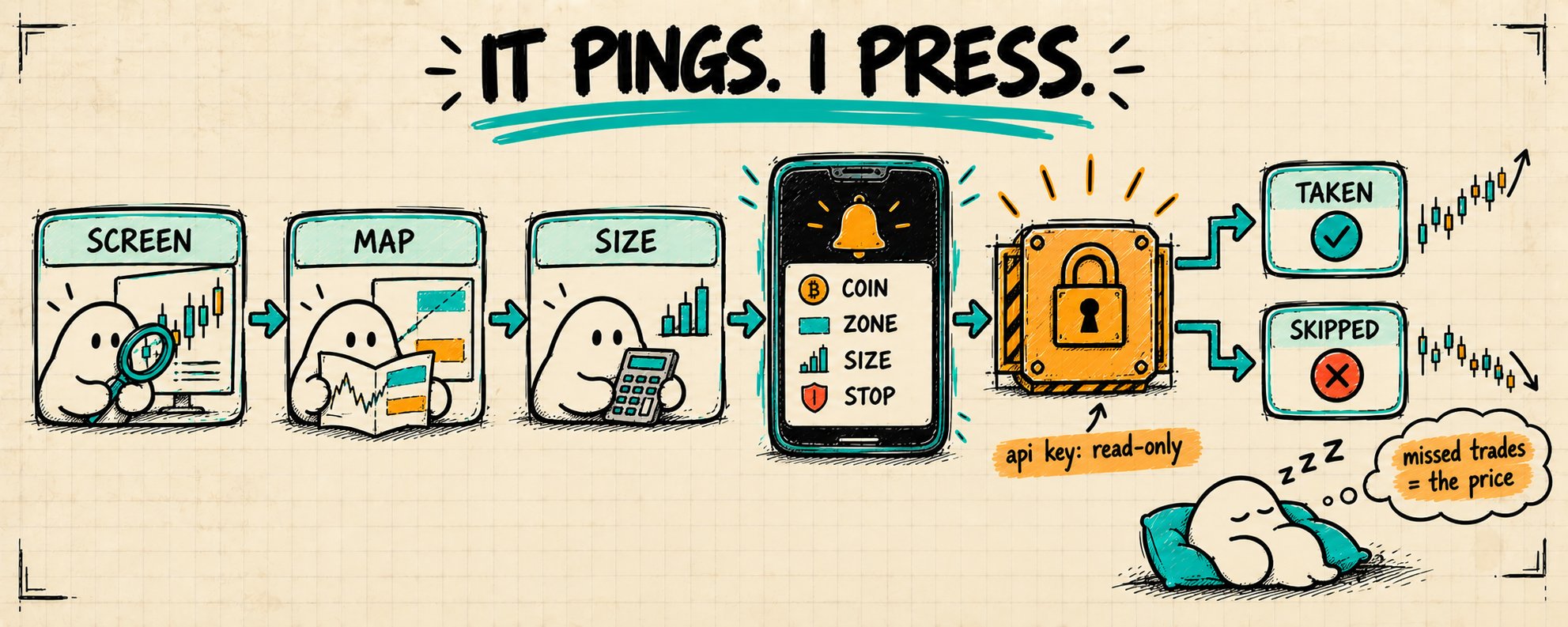
Everything above runs by itself. Execution doesn't.
When a setup is complete, I get a Telegram alert with the coin, the zone, the size, the stop and the chart. I confirm or I skip. The bot has never placed a trade on its own.
The full-auto crowd will call this slow, and they're right. I miss alerts while I sleep, and some of those would have paid. I accept that. "It executes without me" is exactly the risk that turns a good week into a wiped account. The bot does the work. I carry the accountability, so I keep the button.
5. The Exit Clerk — it closes without negotiating
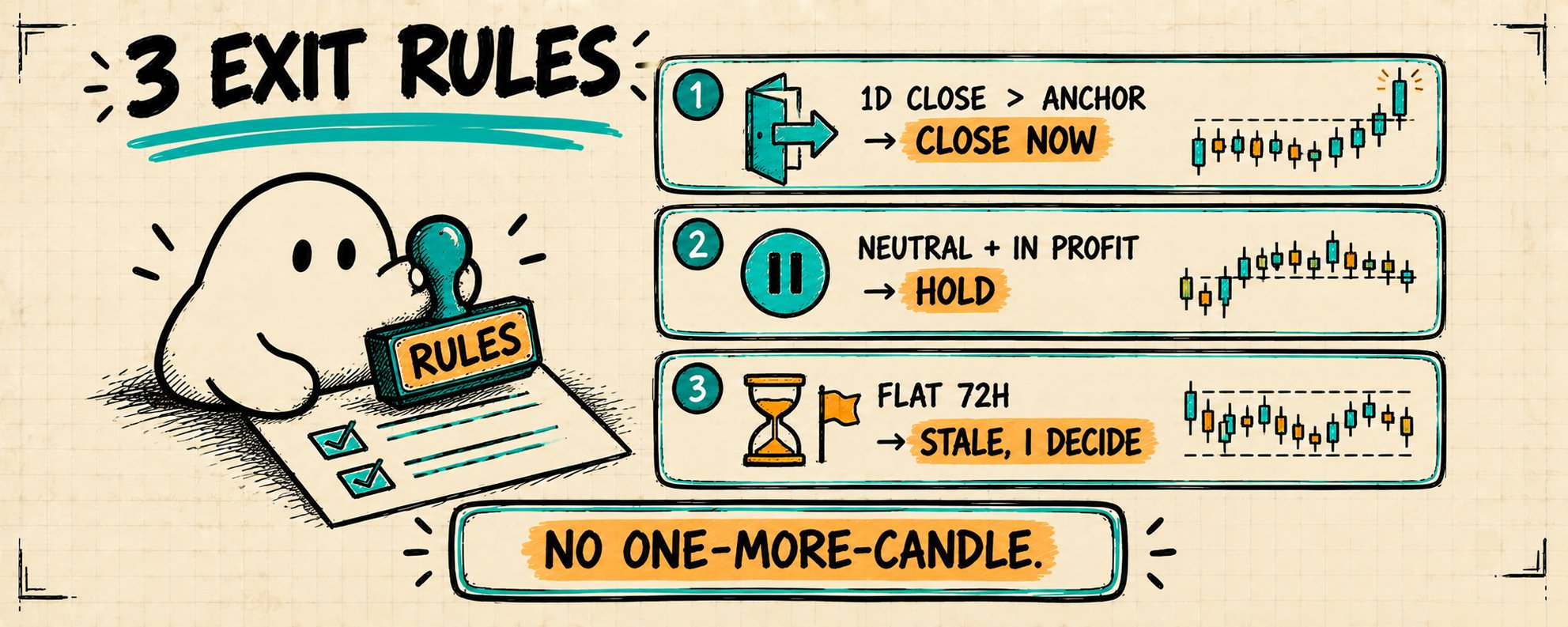
Entries get all the attention. Exits are where accounts die. This bot runs three rules:
-
Daily close above the anchor → close immediately. No "let's see the next candle."
-
State flips to neutral while in profit → let it work. Don't cut a winner because the scanner got quiet.
-
No time stop. If a position goes nowhere for 72 hours, it gets a STALE flag and I make the call manually.
The honest catch: rule one is the hardest to obey, because it fires when the trade almost worked. That's exactly why a bot enforces it, not me.
6. The Auditor — it grades the desk, including me
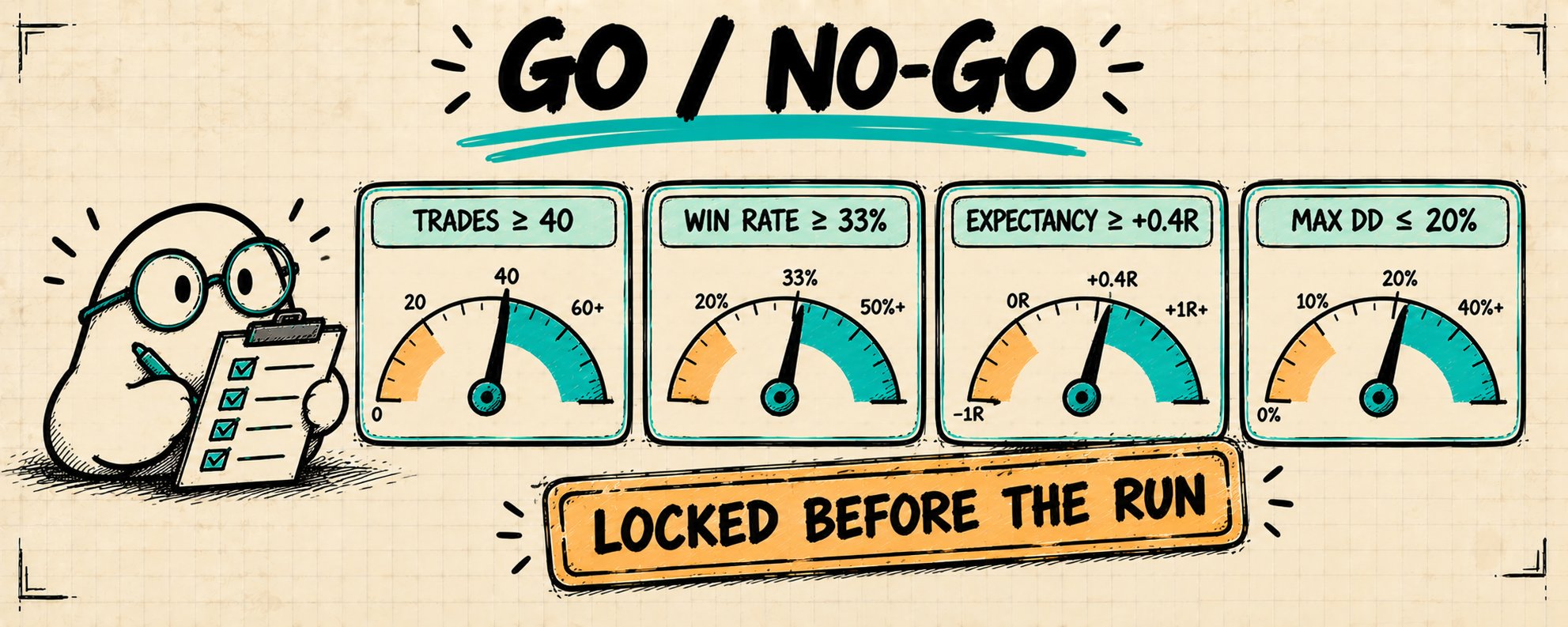
Every fill, fee and slip goes on its own line, and every trade is logged in R.
Before the first test run, I wrote down the numbers this desk has to hit to deserve real capital:
-
40+ trades (anything less is noise)
-
Win rate ≥ 33%
-
Expectancy ≥ +0.4R
-
Max drawdown ≤ 20%
These are locked before the run, not tuned after it. The backtest is next. Pass or fail, the results go in the follow-up. If the desk fails, you'll see that too.
Build your own desk: the full setup (copy my charters)
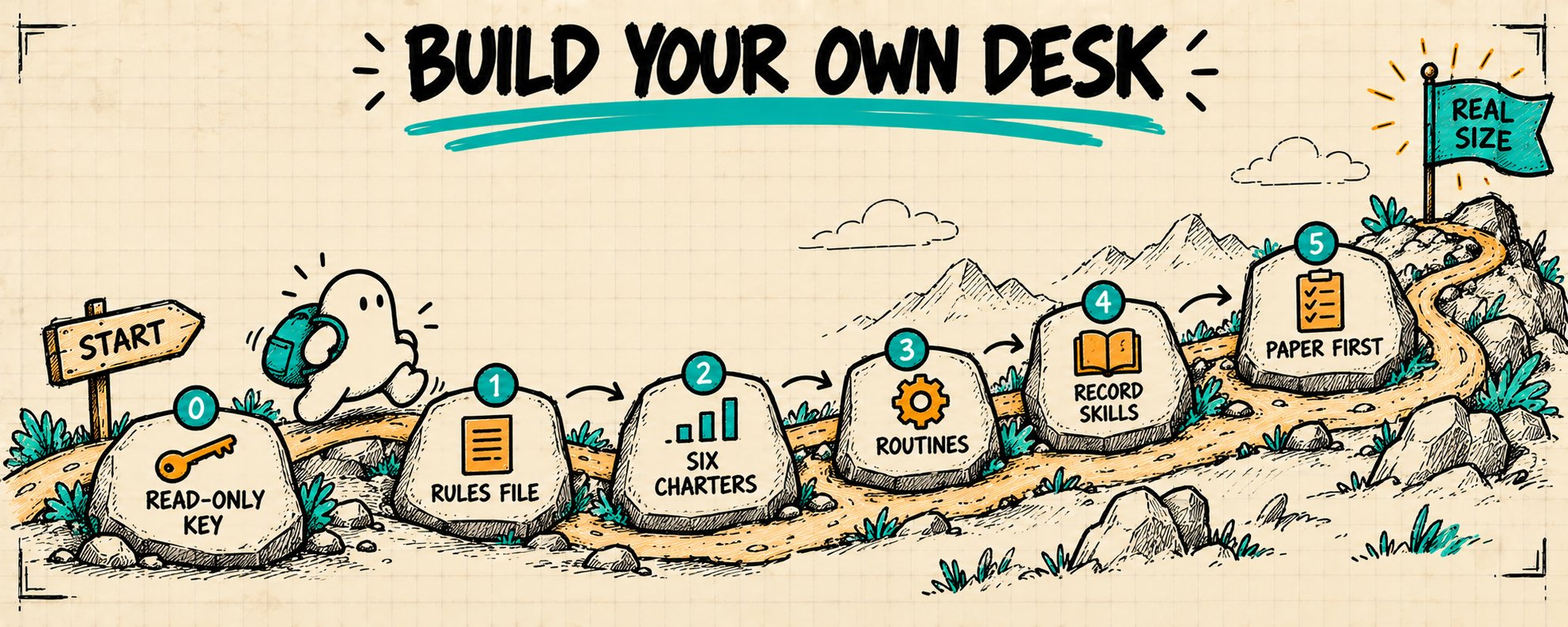
This is the exact structure I run. Swap in your own rules where you see brackets.
Step 0: What you need
-
A Grok Bot plan that runs bots persistently. They have to keep working after you close the tab.
-
An exchange API key set to read-only. Disable trading and withdrawals completely. The desk only needs to see your positions. This is the gate at the infrastructure level: even if a bot misreads a rule, it physically can't place an order.
-
A Telegram bot for alerts. Create one with @BotFather, and give the desk its token and your chat ID.
Step 1: Write one rules file every bot reads
Don't put your strategy inside six different charters. Put it in one file on the shared machine, and have every bot read it. When you change a rule, you change it once.
Step 2: Create the six bots, in this order
Each charter follows the same shape: what you own → what you do → what you output → where you stop. The "stop" line matters most, because it keeps bots from doing each other's jobs.
Bot 1: Screener
Bot 2: Cartographer
Bot 3: Risk Officer
Bot 4: Gate
Bot 5: Exit Clerk
Bot 6: Auditor
Step 3: Put it on routines
The desk only earns its keep when it runs without you:
-
Every daily close: Screener → Cartographer → Exit Clerk
-
Every 4H close: Cartographer refreshes zones → Exit Clerk
-
Every 1H close: Cartographer checks confirmation → Risk Officer → Gate
-
Every Sunday: Auditor weekly report
Step 4: Record the boring parts once
If there's a workflow you repeat by hand, record it once and save it as a skill. For me, that was marking a zone on the chart and taking the screenshot for the alert. Recording it once means the Gate's messages look identical every time, and consistency is what makes an alert fast to judge.
Step 5: Paper first, money second
Run the full desk with zero capital until the Auditor has 40 trades logged. Only a pass on all four thresholds unlocks real size. It's slow and boring, and it's the only step that separates a system from a screenshot.
What it actually costs
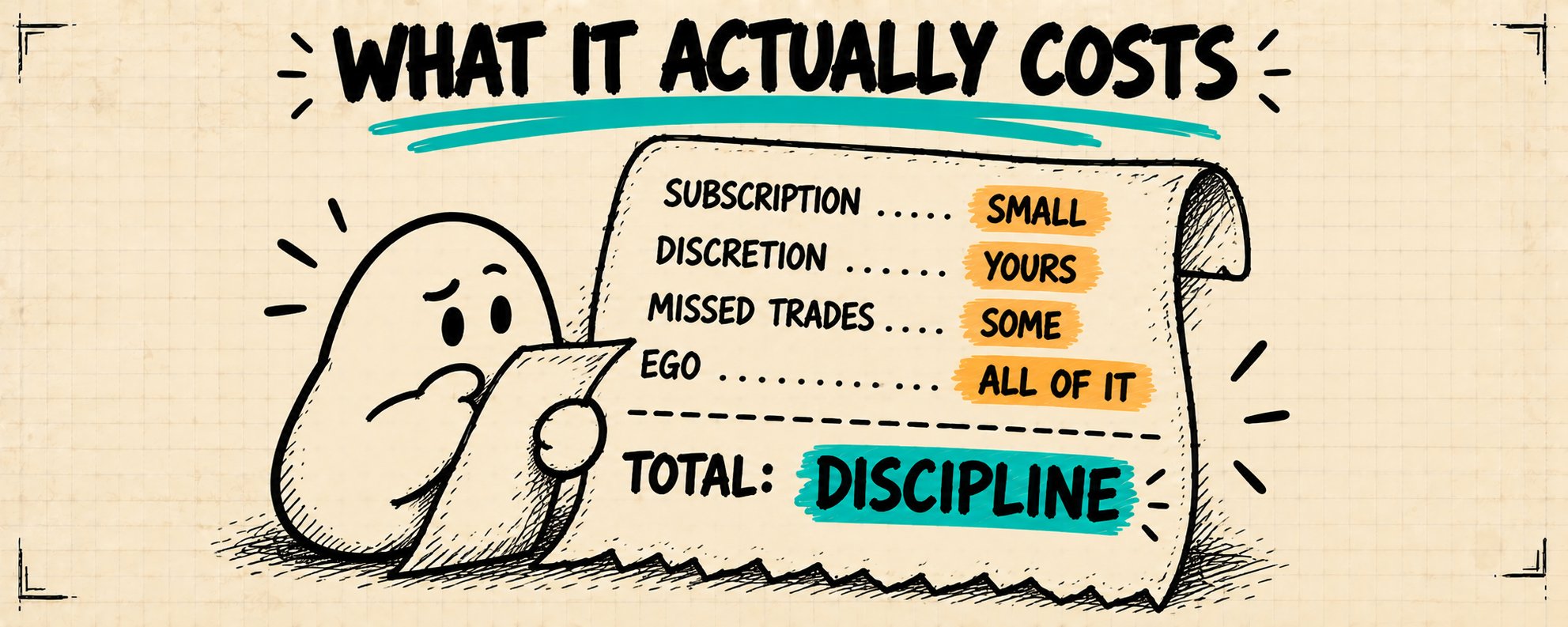
The subscription is the small number. The real costs are elsewhere:
Your discretion. You wrote the rules on a calm day, and now you have to obey them on a loud one.
Missed trades. A gated desk will always be slower than a screenshot.
Your ego. A journal that logs everything will show you, in R, every time you knew better and didn't.
Nobody puts that on the receipt. It's also the only part that actually makes you money.
The point
Grok Bot doesn't find alpha. The screenshots that say it does are usually selling the course underneath them.
What it actually does is close the gap between the rule you wrote and the trade you took. It scans, maps, sizes, waits, exits and grades, every close, with no fear, no revenge and no "just this once."
Don't build six bots tonight. Start with the Auditor, and paste its charter from the setup above. You can't fix a strategy you don't measure.
What's the one trading rule you break most often? Reply below. The most common answer becomes the charter for my next bot.
Follow @0xNevsky for the backtest results: pass or fail, same format.
Published on grokbot.sh. Cite the public log, not a prompt pack.