
Grok Bot Attention Engine: The Build That Kills Its Own Creative Before The Algorithm Does
Every build I've posted so far has been about running someone else's back office — a clinic, a trading desk, a second brain. This one runs the front door. It's the machine that finds attention, tests
Article
Job breakdowns
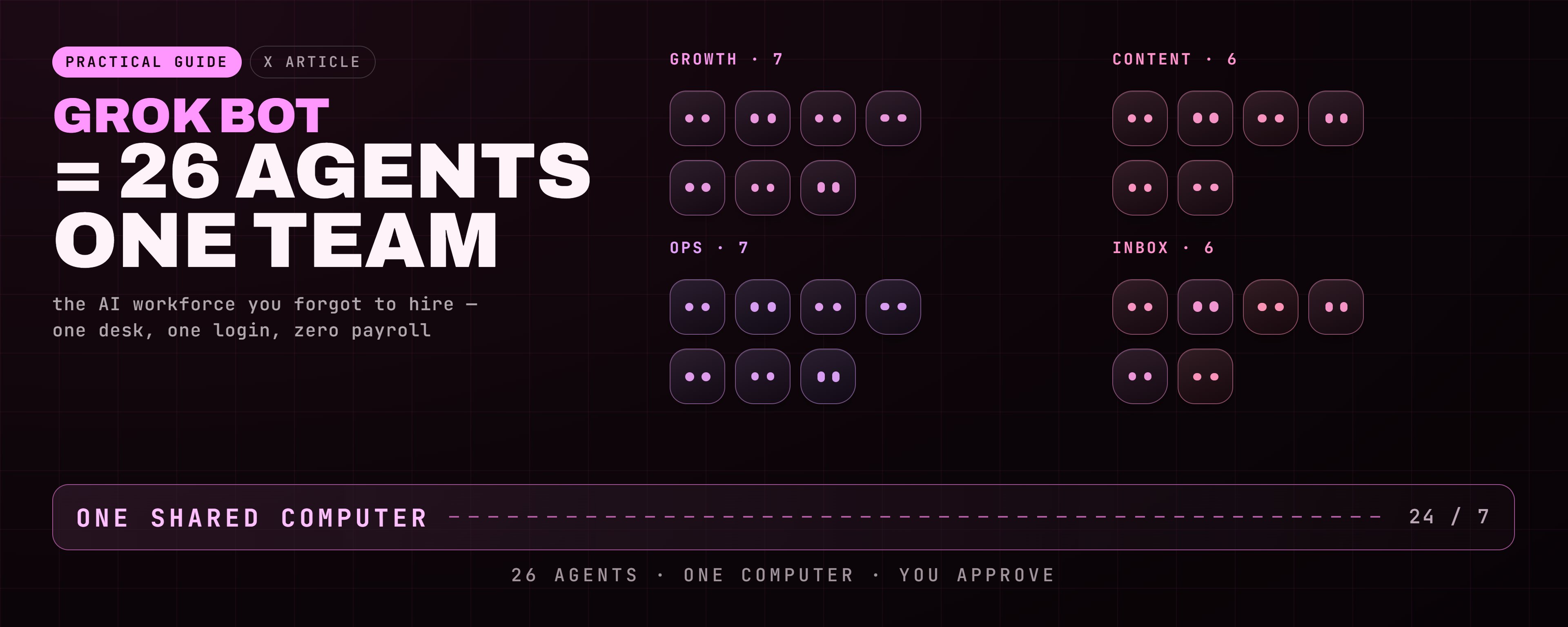
Every build I've posted so far has been about running someone else's back office — a clinic, a trading desk, a second brain. This one runs the front door. It's the machine that finds attention, tests it, and buys it before it gets expensive.
The idea is simple to say and brutal to actually do by hand: instead of one Grok Bot Chief managing seven employees, it manages twenty-six agents, and every one of them owns a piece of the loop that keeps any ad account alive — find the hook, ship the creative, test it, kill it fast if it's dying, scale it fast if it's not, and never let the buying side spend a dollar the creative side hasn't earned.
That's the pitch. Here's the actual build, what it does, and — because a demo nobody can run against real spend isn't worth the electricity — three ways this turns into real income, with numbers I'd actually stand behind.
Why You Actually Need This
Here's the part every "just post more content" pitch skips: attention doesn't run out because you stopped trying, it runs out because the exact audience you're showing an ad to has already seen it. Eye-tracking research on banner blindness has shown for years that once something reads as "ad-shaped," people's eyes learn to skip it in milliseconds — and every major ad platform's own frequency-cap documentation exists because the same creative shown to the same person for the fourth or fifth time converts measurably worse than the first time, no matter how good it was on day one.
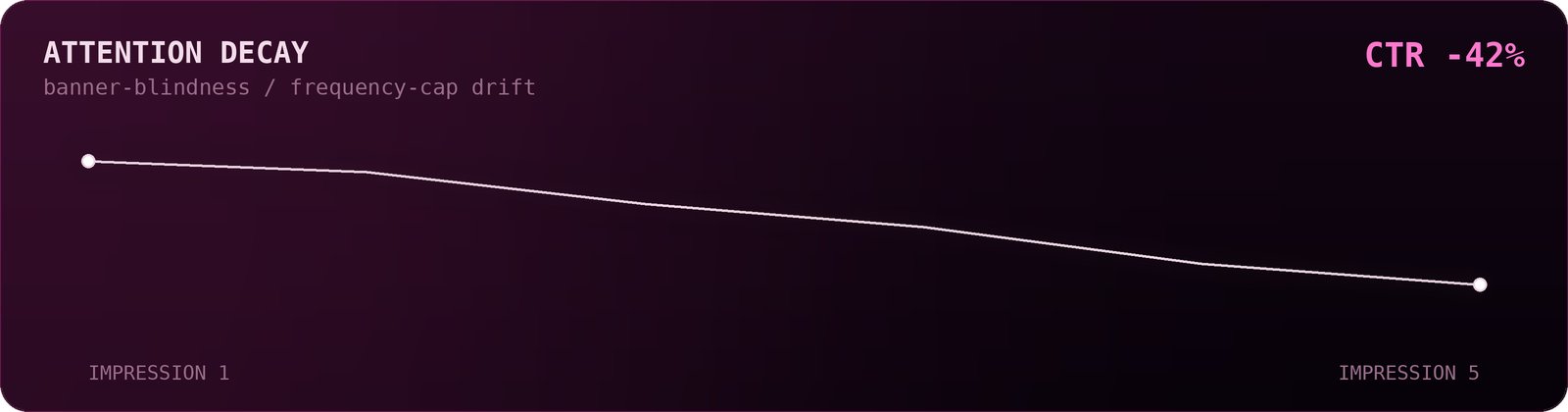
That's not a creative-quality problem. It's a decay curve, and it starts running the moment a creative goes live.
Now stack today's actual pace on top of that curve: three or four platforms, a dozen active ad sets each, new creative needed every few days just to stay ahead of fatigue, and a buying side that has to react to all of it in near real time or bleed spend on something that already died. None of that is a "get a better editor" problem. It's a throughput problem, and throughput problems get solved by adding capacity — not by asking one person to storyboard, cut, caption, launch, watch, and kill faster.
An attention engine isn't a nice-to-have automation trend. It's the only response to that math that actually scales: something else has to hold the twenty-six jobs a two-person creative-and-buying team can't keep doing in parallel, so the calls that actually need a human — which winner to double down on, which market to walk away from — get full attention instead of getting buried under manual reporting.
Why Grok Bot and Not Something Else
Every alternative on the market solves one slice of this and quietly hands you the rest as homework.
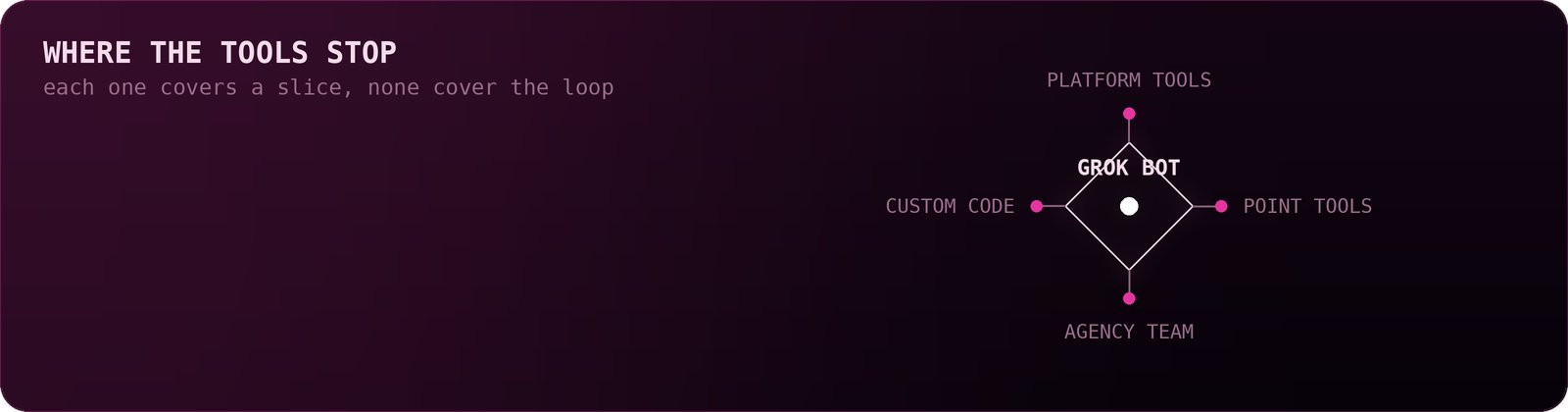
The platforms' own tools — Meta's Advantage+, TikTok's Smart+ — only touch the buying half, inside their own walled garden. They'll shift budget toward what's working. They will not tell you your hook is dying, and they will not make you a new one.
Point tools cover a slice each and none of them talk to each other. Foreplay is built for finding and organizing creative inspiration, priced $59–459/month depending on team size. Madgicx automates bid and budget decisions once a creative exists, priced on a sliding scale from around $99/month at small spend up past $300/month as your ad spend grows. Both are good at what they do. Neither one writes the hook, cuts the clip, or knows that the reason your CPA crept up this week is the same creative got stale, not that the audience got worse — so you're the one stitching two or three subscriptions and a spreadsheet into a loop by hand.
A real team — an editor plus a media buyer — is real people with real payroll, and the loop only moves as fast as the slowest handoff between them.
Custom scripts hitting ad platform APIs can technically do all of it — if you or someone you pay can stand up and maintain the integration, keep up with every platform's API changes, and babysit it forever. That's ongoing engineering work, not a one-time build.
Grok Bot sits in the gap none of those four cover: persistent, multi-agent, and zero-code, with the creative side and the buying side sharing one core instead of living in separate tools that never see each other's data. You get twenty-six specialized agents instead of one dashboard that only shows you half the picture. And you set it up by giving job titles and showing it your winning creative once — not by wiring an API.
What "Attention Engine" Actually Means Here — and What Grok Bot Actually Adds
Worth separating cleanly, because blurring these two is how a build like this turns into vaporware.
The discipline underneath this is the test–kill–scale loop, and it's not mine — every profitable media buyer already runs some version of it, whether that's a spreadsheet of CTR and CPA thresholds or just instinct sharpened by years of watching accounts. Frequency capping, creative rotation, kill criteria — that's performance-marketing practice that predates any of this AI tooling by a long time. I didn't invent the loop and I'm not claiming to.
What Grok Bot adds is the runtime — the part that actually watches every creative, every hour, against every threshold, and acts on the ones a human would only get to check once a day if they were lucky. You could run the identical test–kill–scale logic on a cron job hitting the Meta and TikTok APIs directly if you can code it and keep maintaining it, or on Foreplay plus Madgicx plus a shared spreadsheet if you can't. Grok Bot's actual claim isn't "a smarter media-buying method" — it's the same test–kill–scale discipline every buyer already half-runs manually, running on twenty-six persistent agents you configure by giving job titles instead of writing integration code.
Concretely: it's twenty-six agents, each one a creative or buying function, all reporting into one core process — Grok Bot Brain — that decides what gets tested, what gets killed, what gets scaled, and what spend never goes out the door in the first place.
The 26 Agents, Grouped by What They Actually Do
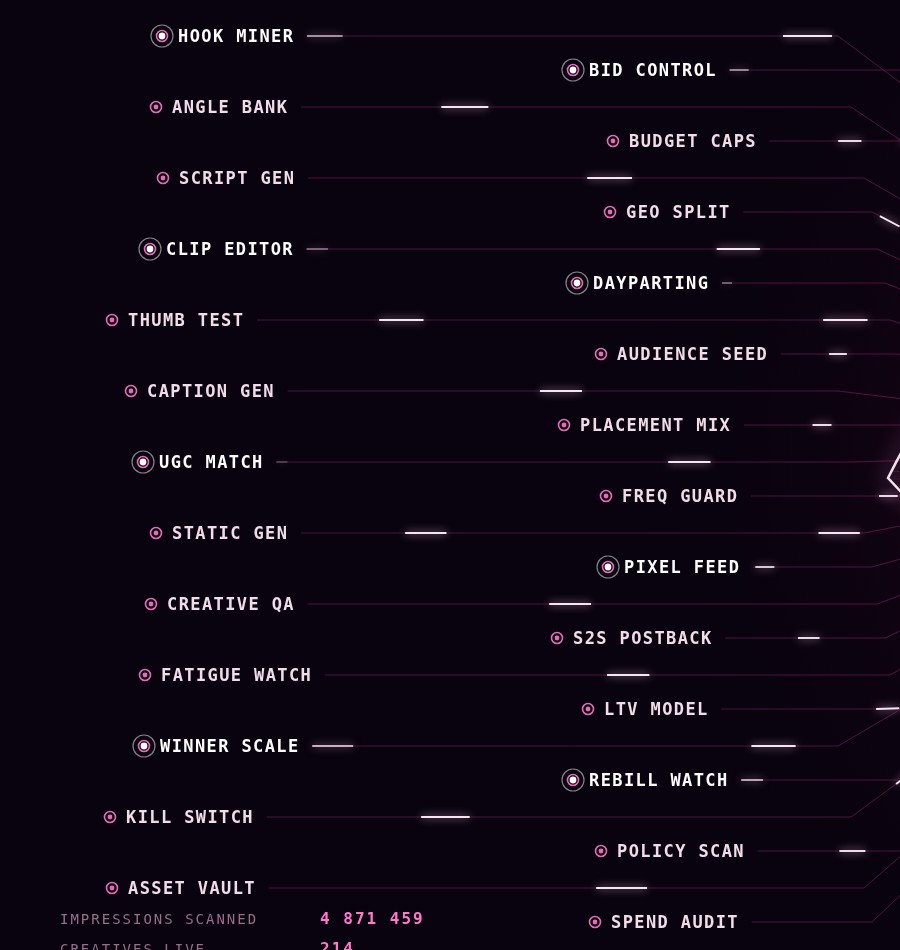
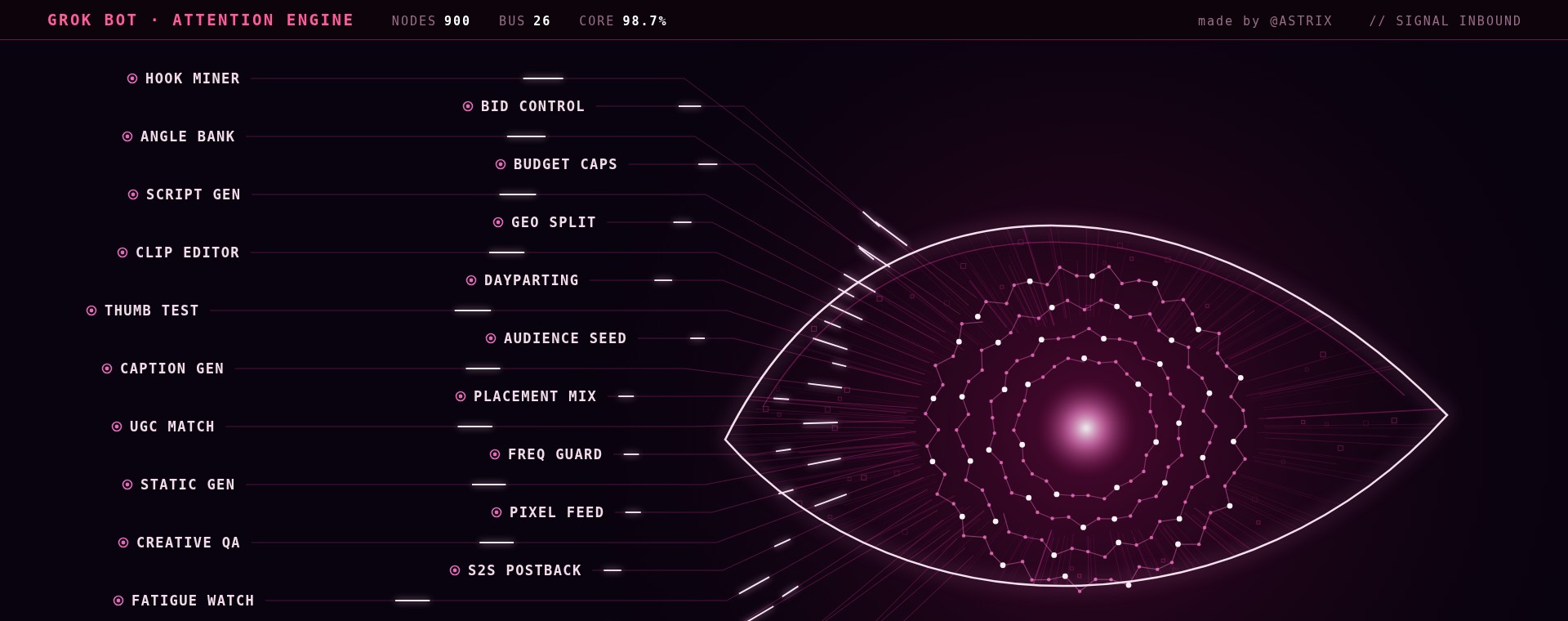
Ideation (find the angle before you shoot anything): Hook Miner, Angle Bank.
Production (get the raw creative made): Script Gen, Clip Editor, Static Gen, Caption Gen, UGC Match.
Testing (find out fast if it's actually good): Thumb Test, Creative QA.
Lifecycle (decide what happens to it next): Fatigue Watch, Winner Scale, Kill Switch, Asset Vault.
Spend Control (don't let the buying side outrun the creative side): Bid Control, Budget Caps, Freq Guard.
Targeting (put it in front of the right audience): Geo Split, Daypart, Audience Seed, Placement Mix.
Tracking (know what actually happened downstream): Pixel Feed, S2S Postback, LTV Model, Rebill Watch.
Compliance (don't get the account banned finding out): Policy Scan, Spend Audit.
Twenty-six sounds like a lot until you notice it's just six real jobs — ideate, produce, test, manage lifecycle, spend, and verify — split into enough pieces that each one stays simple enough to actually trust with real money.
How the Core Actually Behaves
Same rule as every build before this: Grok Bot Brain doesn't do the work, it routes it. A new UGC clip comes in from UGC Match, Thumb Test runs it against the standing panel and it clears on click-through — good hook, no problem there. But three days later Fatigue Watch flags the same creative: CTR is fine, and CPA has crept up 40% against a flat frequency cap, which means the audience isn't tired of seeing it, the appeal itself is wearing out. That's not a call Thumb Test can make alone, because a healthy click-through and a decaying CPA are two different signals pointing in two different directions — so it escalates to the core, which is the only agent holding both the click data and the downstream conversion data at once.
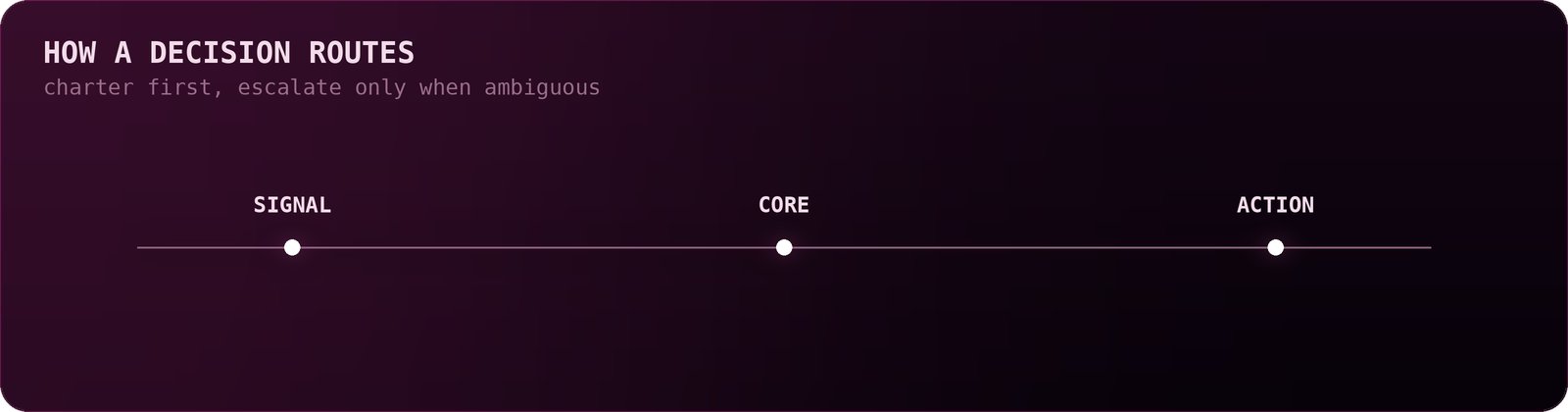
The charter logic is identical to every build in this series: each agent owns what it can resolve alone, and anything ambiguous — is this creative fatigued or is the offer just weak this week, does this new market justify its own budget line or fold into an existing one — escalates to the core.
A Day Inside the Attention Engine
8:02 AM — Hook Miner surfaces three new angles off overnight comment scrapes on the top-performing creative. Angle Bank checks them against the existing library and flags one as a near-duplicate of something that already died two weeks ago — filed as a note, not sent to production.
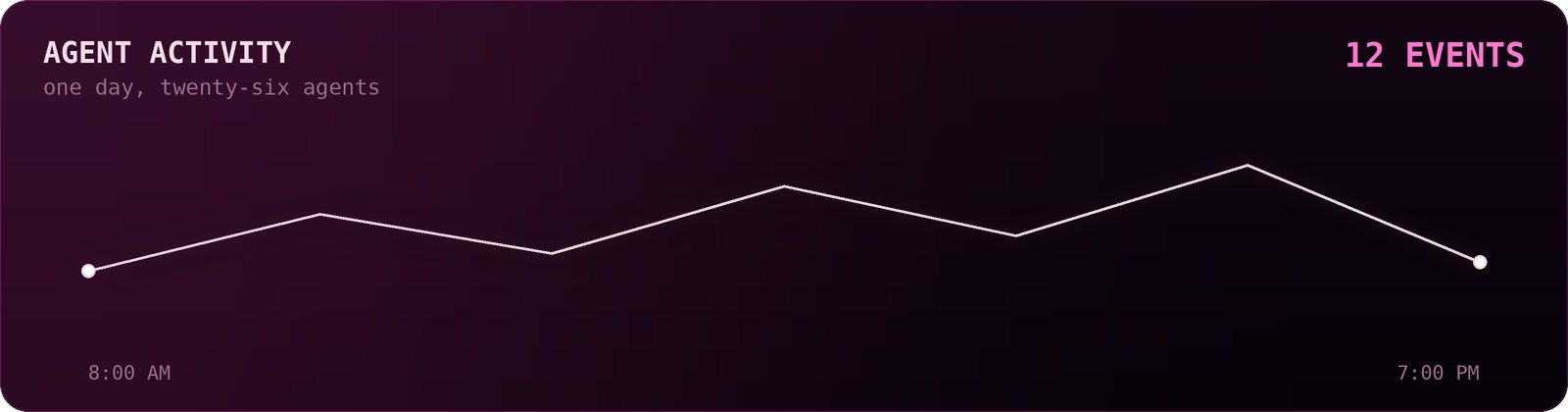
+40 seconds — the other two go to Script Gen and Clip Editor. Two rough cuts exist before the buyer would have finished their coffee.
10:15 AM — Thumb Test runs both cuts through the standing creative panel. One clears. The other underperforms on hook retention in the first three seconds — not killed outright, held back, because one weak signal on day one isn't the same as a confirmed loser.
11:50 AM — Freq Guard flags that yesterday's top creative is about to cross the frequency cap in the US-East segment. It doesn't pause spend on its own — it drops a ceiling recommendation to Budget Caps, which reallocates 15% of that line into the fresh creative that cleared Thumb Test an hour earlier.
2:30 PM — Fatigue Watch catches the actual vulnerability of the day: a creative that's been the account's best performer for eleven straight days finally shows CPA drifting past threshold. Winner Scale and Kill Switch both get the escalation. The core doesn't kill it outright — eleven days of consistent data outweighs one bad afternoon — it throttles the budget 30% and flags it for a same-day rewatch instead of an automatic execution. A system that only ever wins doesn't get trusted; one that knows the difference between a bad hour and a dead creative does.
4:00 PM — Policy Scan catches a claim in one of this morning's new scripts that reads too close to a platform's restricted-claims list. It's held before it ever reaches Clip Editor's export queue — never spent a dollar getting the account flagged.
6:45 PM — the evening digest, compiled by Grok Bot Brain: one creative throttled and queued for human review, one new winner cleared for scale, one near-duplicate angle logged and skipped, one compliance hold resolved before spend. Nothing in that loop required opening five separate dashboards or remembering to check frequency by hand.
How The Machine Actually Decides What's Real
"It watches everything" falls apart the second someone asks how a decision actually gets made. So, precisely:
What's permanent: every creative ever produced lives in Asset Vault indefinitely, win or lose, and every dollar spent is logged in Spend Audit's immutable ledger. Nothing gets quietly deleted because it lost.
What isn't permanent: a creative's "winner" status carries a confidence score, not a permanent label. Without fresh performance data feeding it, that score decays over roughly two weeks — the same creative that crushed it last month doesn't get treated as a sure thing forever just because it once was one.
Decisions run two tiers: a deterministic tier — CTR, CPA, and frequency against hard thresholds, fast and checkable by anyone — and a forecasting tier underneath it, where LTV Model projects a creative's long-term value off early signal, which is also the one tier that can be wrong.
Who catches a bad call: an LTV Model projection is a forecast, not a fact, and it's treated that way — a creative doesn't get promoted to full scale on a projection alone. It needs Rebill Watch's actual downstream data to corroborate the forecast first. One projection is a guess. A projection confirmed by real rebill data is the closest thing to ground truth this system acts on.
What This Is Actually Useful For
Not "automation" in the vague sense. Concretely:
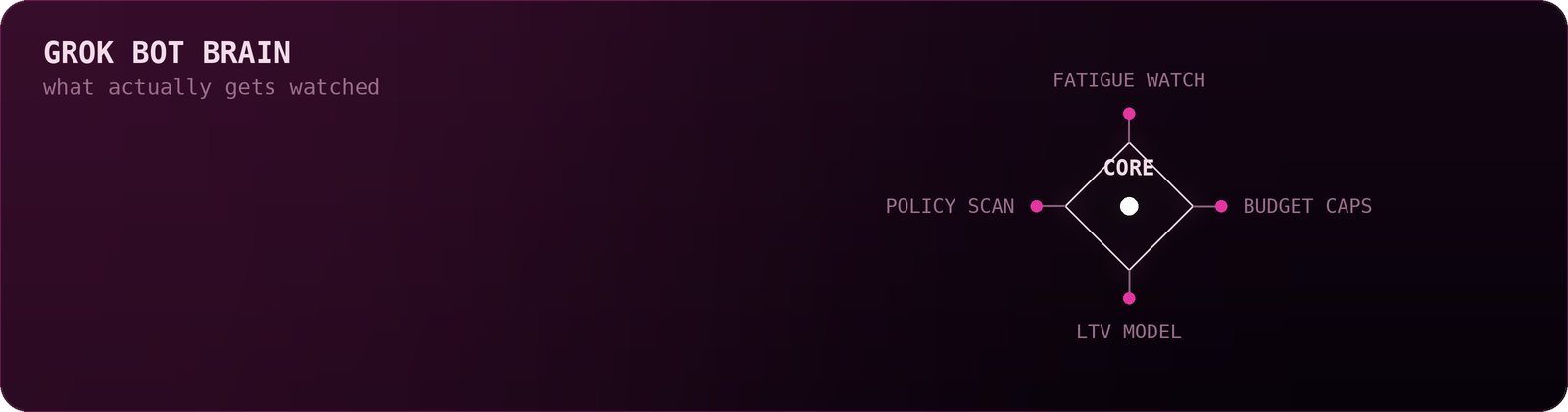
You stop finding out a creative died three days late. Fatigue Watch catches the CPA drift the same day it starts, instead of you noticing it in a weekly report after the damage is spent.
Your budget stops outrunning your creative. Budget Caps and Freq Guard mean spend gets redirected toward what's actually fresh, instead of a winning ad getting hammered past its frequency cap because nobody was watching the clock.
You can actually ask your own account a question. "Which creative is decaying fastest right now and why" is a query against Fatigue Watch and the LTV Model's confidence scores — not a scroll through five days of Ads Manager exports.
You find out about a compliance problem before the platform does. Policy Scan runs before spend goes out, not after an account gets a warning.
How to Actually Make Money With This
Three models, in order of how fast you can start each one.
-
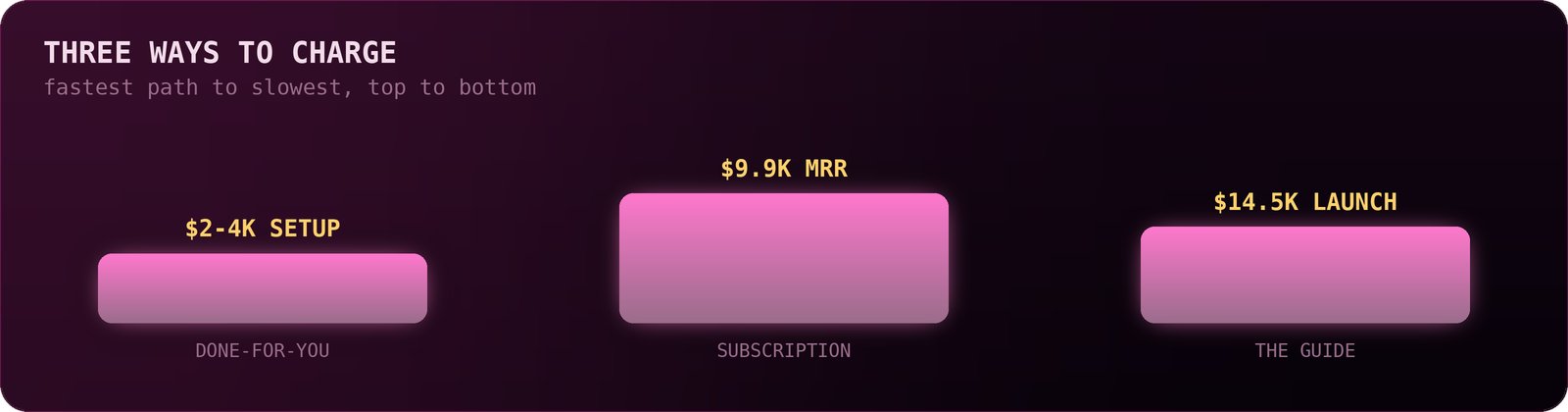
Sell it as a done-for-you build, same as every build before it in this series. This is the fastest path because the pricing logic already exists: a build this size, wired to a real ad account plus a tracking stack, realistically sits at $2,000–$4,000 for setup and $250–$450/month for upkeep — lighter than the clinic build's compliance layer, heavier than a simple bot because it touches real ad spend and needs guardrails a client will actually trust. Out of roughly 30 inbound leads a month, a realistic discovery-call rate sits around 30% — 9 calls. A realistic close rate on a $2,000-4,000 service with real spend on the line runs closer to 15% — call it 1-2 new setups a month, slower than a lower-stakes build because nobody hands a stranger their ad account without a real conversation first. At roughly 2 hours a month of upkeep per retainer client once it's stable, 20 available hours a month caps a solo operator around 9-10 active clients before something has to give. That's the ceiling worth planning around — not a number pulled out of the air.
-
Sell it as a subscription product. Real comparables exist and they're worth knowing before pricing anything: Foreplay runs $59-459/month depending on team size for creative organization alone, and Madgicx scales from roughly $99/month at low spend up past $300/month as ad spend grows, for the buying-automation half alone. A self-serve version of this — hosted, templated, doing both halves at once — realistically sits at $79-149/month per account. That's the harder path because you're doing customer acquisition, not landing clients one at a time, but the math is honest: 100 subscribers at $99/month is $9,900 MRR; 500 subscribers is $49,500 MRR. Nobody hits 500 subscribers in month one. This is the slow, compounding path.
-
Sell the how-to, not the tool. This is what several of these articles have actually been — teaching the build, not just running it. A structured guide covering the charters, the test-kill-scale routing logic, and the escalation rules, priced the way build-log content like this typically sells: $47-$147 for the written guide, $197-$397 with templates and a call. Sell 150 copies of a $97 guide and that's $14,550 — one launch, not recurring, but near-zero marginal cost per sale once the guide exists.
The honest version of "which one": start with #1. It's the only one where you get paid before you've proven anyone else wants this. Once two or three done-for-you builds are running clean on real accounts, #3 becomes almost free to produce — you're writing up what you already shipped. #2 is the one to build toward once #1 and #3 are already paying you, not the one to start with.
What's Real and What Isn't, One More Time
The visual is real code, running in your browser right now, not a rendered video. The 26 agents, the routing logic, the test-kill-scale pipeline — that's the same charter-and-escalation system every build in this series has run on, and it works the same way here as it did for the clinic and the second brain.
What isn't real yet: this wired to an actual ad account, an actual pixel, and actual spend. That's the same gap every build in this series has been honest about — the demo shows you the shape of the system. Wiring it to a real ad account is the setup work, and it's exactly what's worth charging for in model #1 above.
Published on grokbot.sh. Cite the public log, not a prompt pack.