
Grok Bot: a real way to make a profit
Memecoins are back in style. The hype cycle came around again and everyone's chat is full of "who made money on what." So I wanted to test something: what happens if you meet that cycle not by trading
Article
Job breakdowns

Memecoins are back in style. The hype cycle came around again and everyone's chat is full of "who made money on what." So I wanted to test something: what happens if you meet that cycle not by trading manually, but with a team of AI agents from Grok Bot. Not one bot that does everything, but a group of narrow specialists, each one owning a single job and nothing else.
Here's why that matters, and what actually makes money instead of just looking cool in a demo.
I've tried a dozen agent setups for business over the past year, and I keep seeing the same failure. Someone builds one huge agent to handle everything, and after a couple weeks they lose track of what's happening inside it, stop trusting the output, and quietly stop using it. Not because the model is weak. Because nobody can hold a giant black box with ten jobs stuffed inside it in their head.
Grok Bot fixes this with structure, not raw power. One agent, one named teammate, one job. And you can have as many of these teammates as you want. They run in parallel and don't step on each other's context.
Here's the map of what's coming:
-
a real example: building an agent for the memecoin market, step by step
-
how Grok Bot actually works and why the shared computer matters
-
why a squad of narrow agents beats one generalist
-
how to connect the team to your own knowledge base
-
getting started with an interview instead of writing prompts by hand
-
nine more money-making setups, grouped by what they actually do
-
how to run the team without becoming its full time babysitter
The example: an agent that lives inside the memecoin cycle
Here's the scenario that got me into Grok Bot in the first place. Not a bot that "tells you what to buy," but an agent that runs the whole operational loop of a trade, from the first signal to the after-action review, while the actual money decision stays with you every single time.
The fuel for this agent is public data: DEX screeners, on-chain wallet activity, crypto Twitter, and Telegram channels. Nothing insider, nothing shady, just an agent that can watch all of that noise at once, which no human can realistically do 24/7. You hook up the sources, give the bot a read-only wallet, and from that point it has a full picture of the market on screen, the kind of picture you'd otherwise piece together across ten browser tabs.
From there, every new lead goes through the same loop instead of getting acted on by gut feeling:
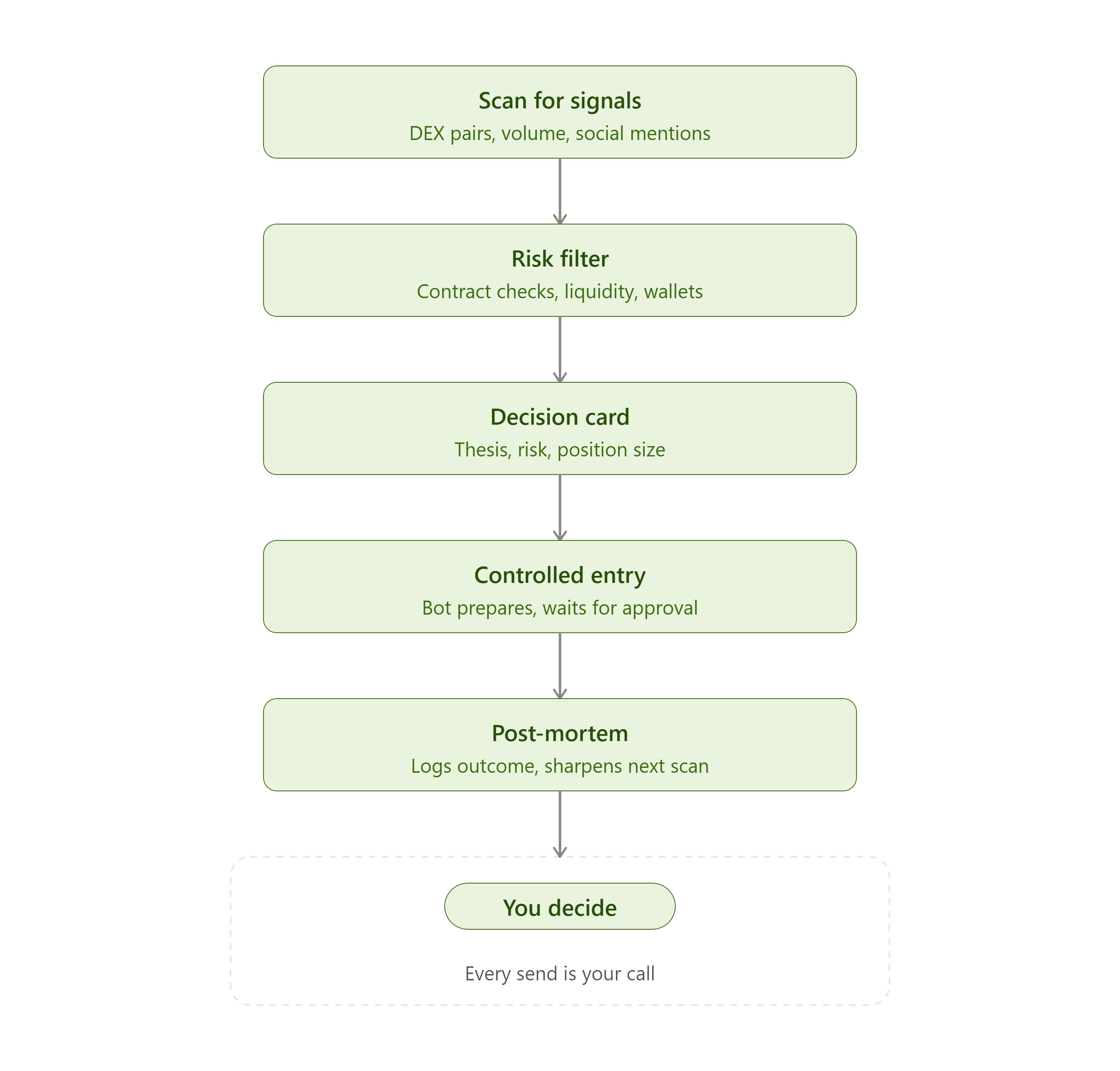
First, raw signal. The bot scans new DEX pairs, volume spikes, and mentions across crypto Twitter and the Telegram channels you follow. Every find gets logged to your storage with a source tag, nothing gets lost in the noise.
Then, a survival filter. It checks the contract for obvious red flags: is liquidity locked, who's holding the top wallets, is there some hidden function that lets someone drain liquidity. Anything that fails gets archived as "rejected" and stops taking up your attention.
Then, a decision card. Ticker, the thesis in plain words, a risk rating, position size relative to your account, and the exact point where the thesis is considered dead. All of it written down before any money moves.
Then, a controlled entry. The bot prepares the transaction and sends it to you for approval. It never sends anything on its own. Once you're in, it tracks price and volume and pings you if reality drifts away from the thesis.
And finally, a post-mortem. After the position closes, the bot checks the outcome against the original thesis and logs what it learned. This isn't busywork, it's the step that makes the next scan sharper than the last one.
In practice, you set the sources and the risk limits once, save the whole loop as a skill, and after that the bot hands you finished decision cards instead of raw data you'd otherwise have to sort through yourself. You're always the one hitting send.
How Grok Bot actually works
xAI put it simply: bots are AI teammates that log into your tools and use them the way you would, then come back with finished work instead of a draft you still need to clean up.
Behind that line is a specific setup, and it's what makes everything else possible.
Every bot runs on its own persistent cloud machine with a browser, a filesystem, and a terminal. So the work actually gets finished inside real tools, not turned into another wall of text you have to move somewhere else yourself.
Here's the part worth noting: all your bots share one cloud computer tied to your account. Files, logged-in browser sessions, and access all carry over across the whole team, so handing a task from one bot to another doesn't mean setting things up from scratch. At the same time, each bot has its own workspace on that machine. Several bots can click through browser tasks at once, but any single bot only runs one hands-on task at a time.
No builder, no flowchart to set up first. You just talk to the bot and it starts working.
Under the hood it runs on Grok 4.6, a model xAI built specifically for long-running agent work, priced well under Claude Fable 5 or GPT-5.6 Sol. That price gap actually matters: keeping an agent "on" all day only makes sense if the token cost doesn't eat the profit it's generating.
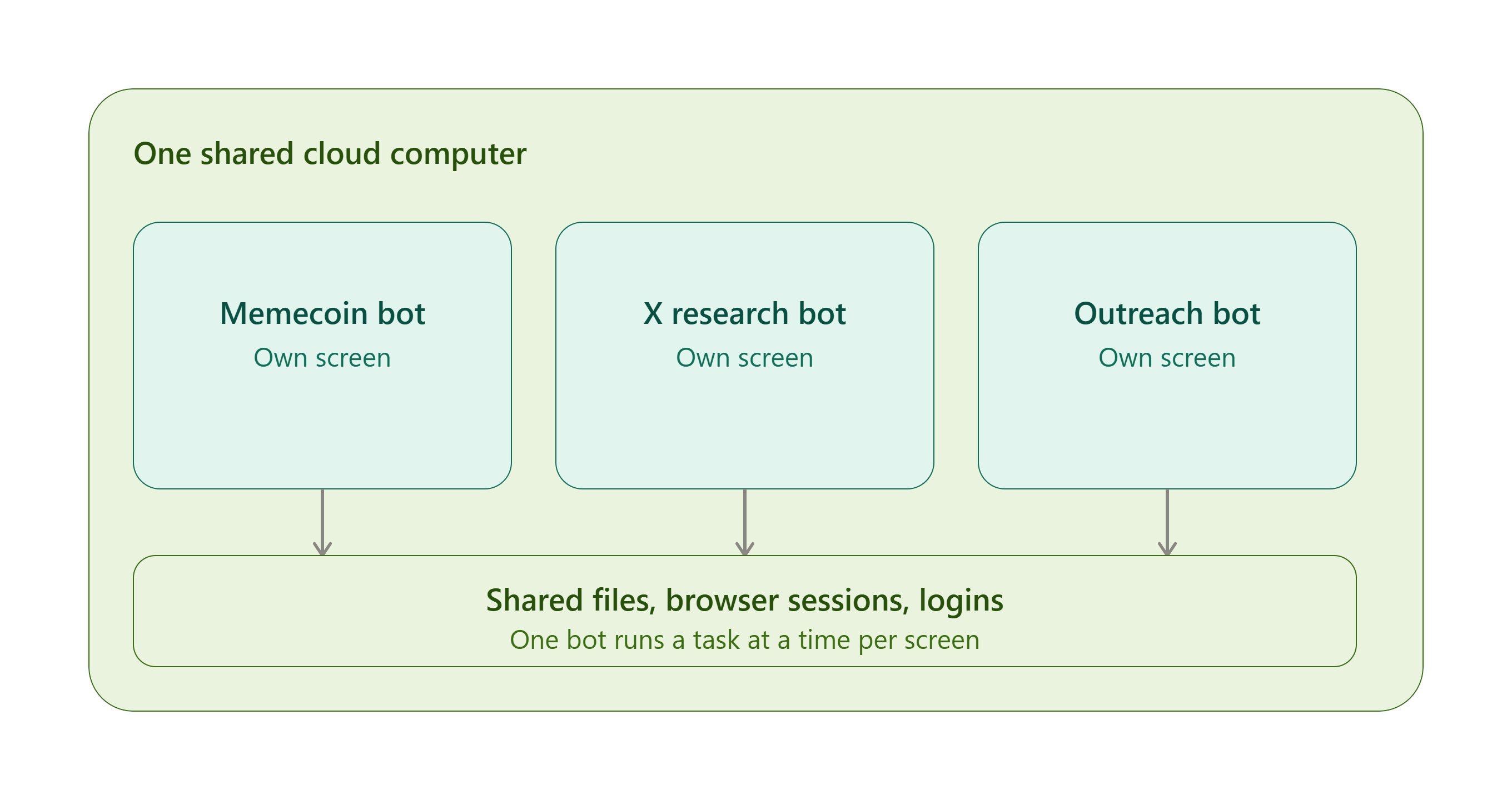
For each bot you set a permanent role (what stays true no matter the task), context for today's job, memory for things it's picked up over time (though not the source of truth, that's what the knowledge base is for), direct connectors to your tools, browser and desktop access for anything without a clean API, saved skills with clear steps and limits, schedules for running unattended, and approval rules that stop risky actions and wait for your go-ahead. That last part is the safety net: if an allow rule and an approval rule both match the same action, the approval rule always wins.
Why one giant agent doesn't work
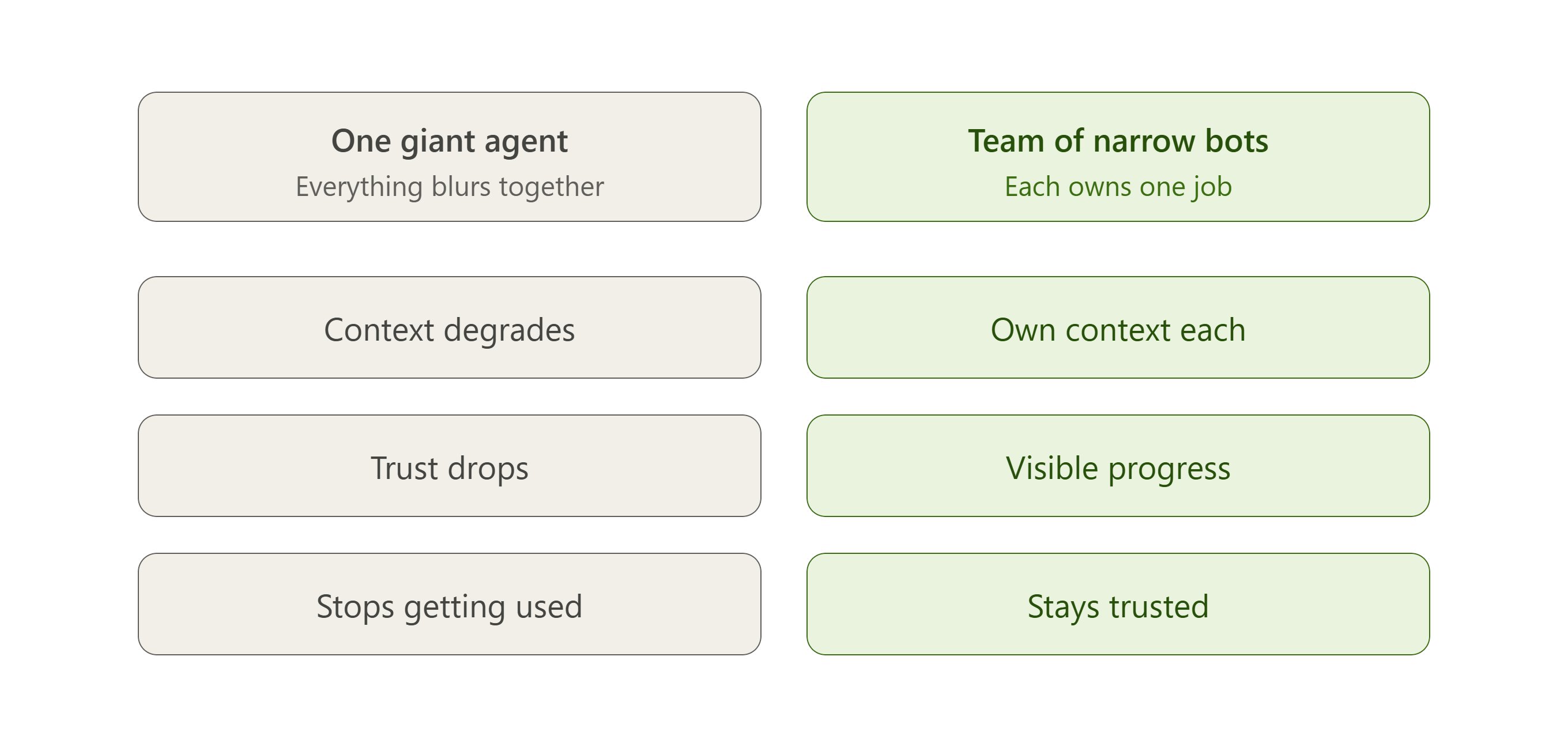
I ran OpenClaw for a while and felt this pain firsthand. Stack a few complex business processes onto one agent and it bloats fast, gets hard to manage. Context, memory, tool calls, all of it breaks down at the same time, not one at a time.
To be fair to OpenClaw, it's an honest tool. It's a personal assistant running on your own machines, and if you want full control over every detail and you're willing to handle security yourself, it gives you that. The tradeoff is maintenance: setups crash and need restarts, models need swapping out when something breaks, and API costs can spiral if nobody's watching the meter.
Grok Bot took a different approach: instead of one big system, it isolates different jobs into different bots. And that turns out to be better on both sides, for the person using it and for everything happening under the hood.
Each bot only carries the context of its own job, only calls the tools it actually needs, and only remembers what that specific job taught it. The official docs land on the same rule I learned the hard way: a bot should own a repeatable outcome, not a vague pile of different questions. One agent, one job, full stop.
There's a less obvious upside too, and it's about management. When each bot owns exactly one thing, opening the app doesn't feel like scrolling one endless log trying to decode what happened. It feels like looking at a team dashboard: you can see exactly where things stand on outreach, on content, on memecoin positions.
The knowledge base is the team's shared memory
Does Grok Bot work with Obsidian? Yes, and it's simpler than you'd think. An Obsidian vault is just a folder of markdown files, and every bot already has a filesystem and terminal on its own cloud machine.
Sync your vault to that machine, using git or any sync folder the bot can reach, and from then on every bot on your team reads and writes to the same knowledge base.
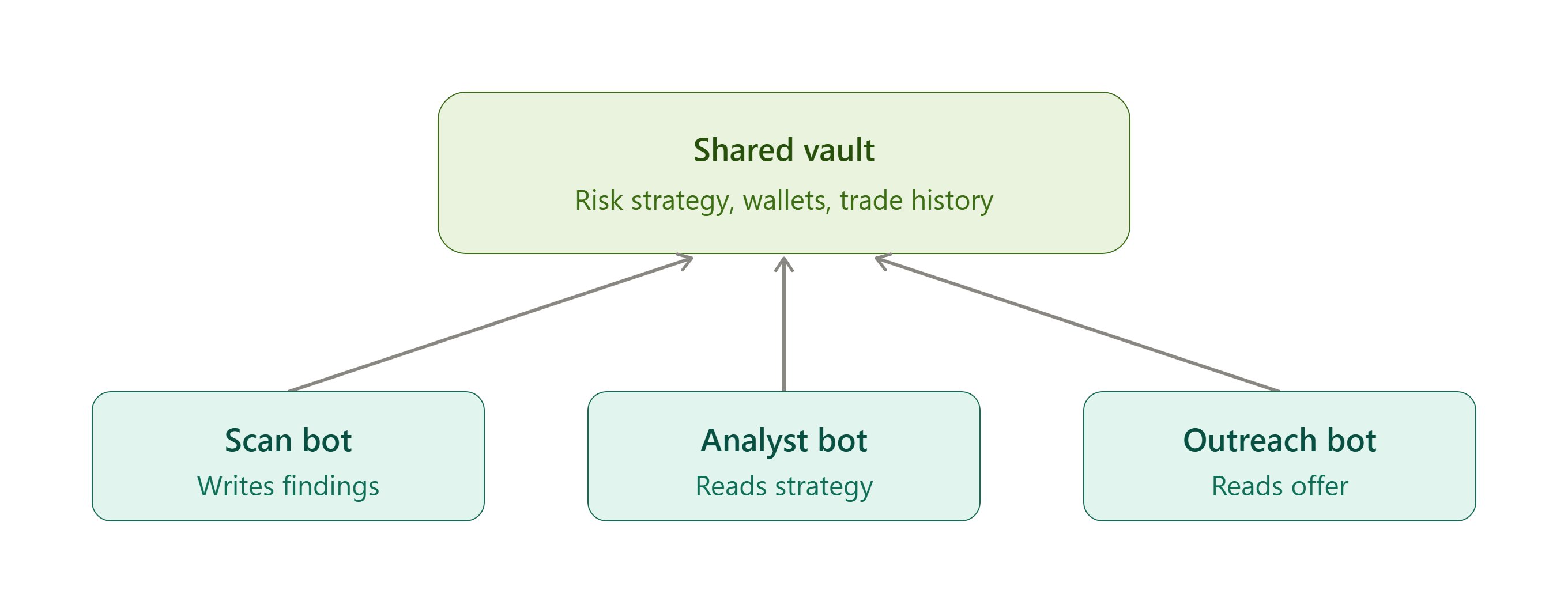
This fixes the weakest part of a bot's memory. Memory holds preferences and short summaries, but the docs are upfront about it: memory is not a substitute for an authoritative source. Your vault becomes that source, holding your risk strategy, the wallets you're tracking, trade history, and project notes, all in files any bot on the team can open.
In practice it looks like this: the scanning bot logs findings as markdown notes, the analyst bot reads your risk strategy before building a decision card, the outreach bot pulls the offer and client profile from that same folder. Open the vault in Obsidian and you see everything the team knows. One source of truth, several bots reading from it.
Getting started: let the bot interview you
The worst way to start is sitting down and trying to write the perfect prompt from scratch. The best way is opening a chat and asking Grok Bot to interview you first, about your strategy, your clients, what a good week actually looks like, and what you flat out refuse to automate.
If you already have another agent running somewhere, here's a shortcut that saves weeks: ask it to dump everything it knows about you into one markdown file, your context, projects, preferences, writing samples. Drop that file into the interview and into your shared vault, and your first bot starts with months of context instead of a blank slate.
For every new job after that, I follow the same order. First, the bot only reads and prepares material, it doesn't act. For a week, you check its output by hand. Then you approve specific actions one at a time. Only after that do you add a schedule so it runs on its own. It helps to do the task yourself once while the bot watches, that way you actually spell out what "done" means instead of leaving it up to the bot.
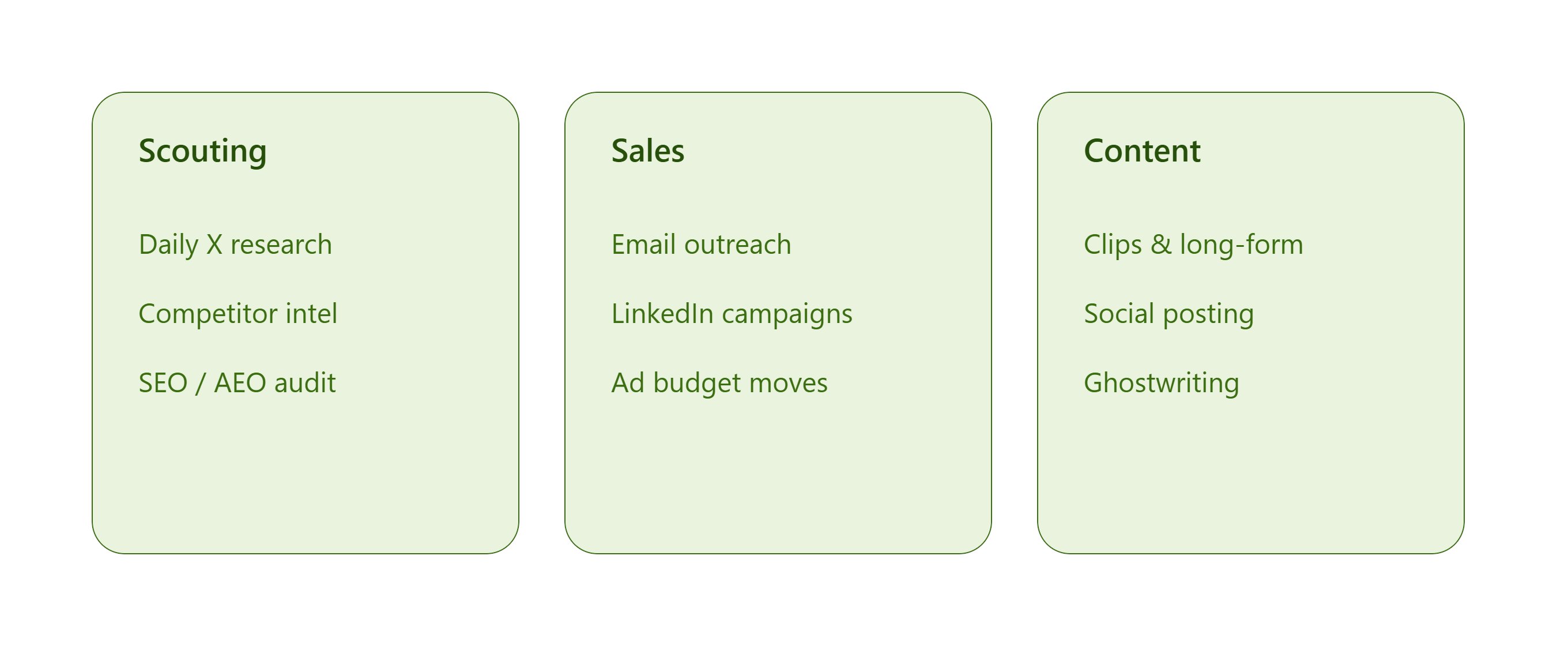
Nine more money-making setups
The memecoin agent is already up and running. Everything below still comes down to one bot, one tool, one job, and I've grouped them by what they actually do instead of listing them randomly.
How to run the team without babysitting it
The team interface is the part people underrate when they're just starting out. Anyone can keep track of what's happening and give the right order to the right bot, even without a deep AI background, simply because every job has its own name and its own card.
Three things keep it manageable. A "chief of staff" bot sitting above the rest, scanning every job and sending you a summary with sources, so you're not the bottleneck. Group chats for handing work between bots (two to six of them passing tasks to each other). And checking the spend dashboard regularly, since there's no detailed action-by-action audit yet, that's still in the works, so keep an eye on the meter yourself.
One rule from my own setup: every bot should double check itself before reporting back. A bot that says "done" without checking is worse than no bot at all, it just creates a false sense of control.
Where human control has to stay
I'm not going to pretend this is a finished product down to the last screw. It's an early beta and the rough edges are real. The shared computer is one physical machine, and separate bots are separate workspaces on it, not separate security boundaries. Passwords, 2FA codes, captchas, payments, the bot always hands those to you, it never touches them itself. Browser work is slower than an API and stumbles whenever a site changes its layout. There's no dedicated spend cap for Grok Bot yet, so you have to watch the usage page yourself. And here's an important detail: approval only controls the proposed action, it doesn't undo work that's already been done.
I want to call out anything touching money specifically: memecoin trades, payments, ad budgets. The line between "the bot prepared a decision" and "the bot sent the transaction" needs to be locked down from day one, not something you plan to tighten up later once you get around to it. Which brings us to the rule: start with one job that's valuable and reversible. Read and prepare only, actions behind approval, and no money moves get fully automated on day one, no exceptions.
Growing the team from here
Let one job run stable before you add another specialist. This rule has no exceptions in any agent setup I've ever run. My own sequence looks like this: an interview with the bot today, the X research job this week, checking its output daily, saving the routine, and only then moving on to whatever's closest to actual revenue, with its own dedicated bot.
A specific role, specific approved actions, and full visibility into every job, that's the discipline every agent setup rewards. Grok Bot just made that the default instead of something you have to build by hand.
One bot, one job, the whole thing visible at a glance, that's what actually makes money, not the size of one giant agent. Get your first job running today.
DMX or TG - https://t.me/papacouch
Published on grokbot.sh. Cite the public log, not a prompt pack.