
Five Grok Agents on Pump.fun: The Memecoin Pipeline That Never Sleeps
On August 11, 2026, xAI launched Grok Bot in beta. This is not a chatbot with an extended context window. It is a persistent cloud agent with its own virtual computer: browser, filesystem, terminal,
Article
Job breakdowns
On August 11, 2026, xAI launched Grok Bot in beta. This is not a chatbot with an extended context window. It is a persistent cloud agent with its own virtual computer: browser, filesystem, terminal, logins to your tools. It works when the laptop is closed, picks up a task where it left off, and remembers how you like things done. xAI calls these "always-on AI teammates," and this is the first time an agent stack of this caliber is available for a subscription rather than requiring your own infrastructure.
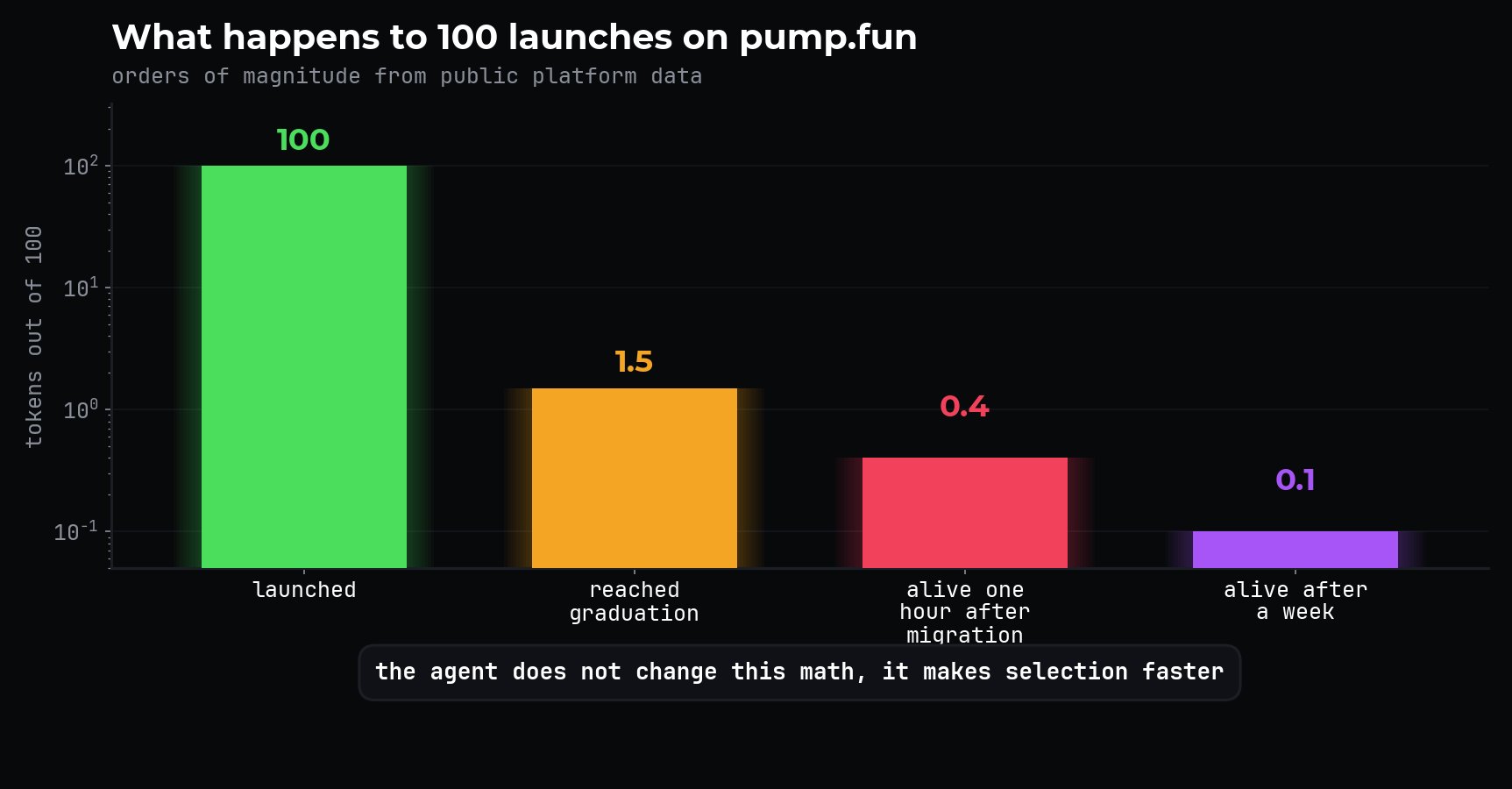
At the same time pump.fun remains the largest memecoin factory on Solana: anyone launches a token in two minutes for about two dollars, a bonding curve drives the price up mechanically, and at a market cap of sixty-nine thousand dollars the token automatically migrates to a DEX. Thousands of tokens launch every day. One to two percent of them make it to graduation. The rest go to zero.
This article is about connecting these two things into a pipeline: a Grok agent that monitors pump.fun launches around the clock, filters the noise, scores tokens on a set of signals, and either buys on the early curve or passes. With architecture, code, a GitHub skeleton, and honest statistics about why most people lose money.
Why Grok Bot, Not a Script
Memecoin trading on pump.fun is a task impossible to solve with a one-shot prompt and hard to solve with a script. Tokens launch around the clock, the entry window is measured in minutes, and the buy decision requires evaluating several parameters at once: the bonding curve, social signals, wallet behavior, narrative.
A script can monitor launches and filter by metrics. But a script cannot evaluate the narrative of a token: why this meme might go viral and that one will not. A script cannot read the creator's Twitter thread and tell whether there is a community behind the token or just a one-time dump. A script cannot adapt its strategy based on the current market regime.
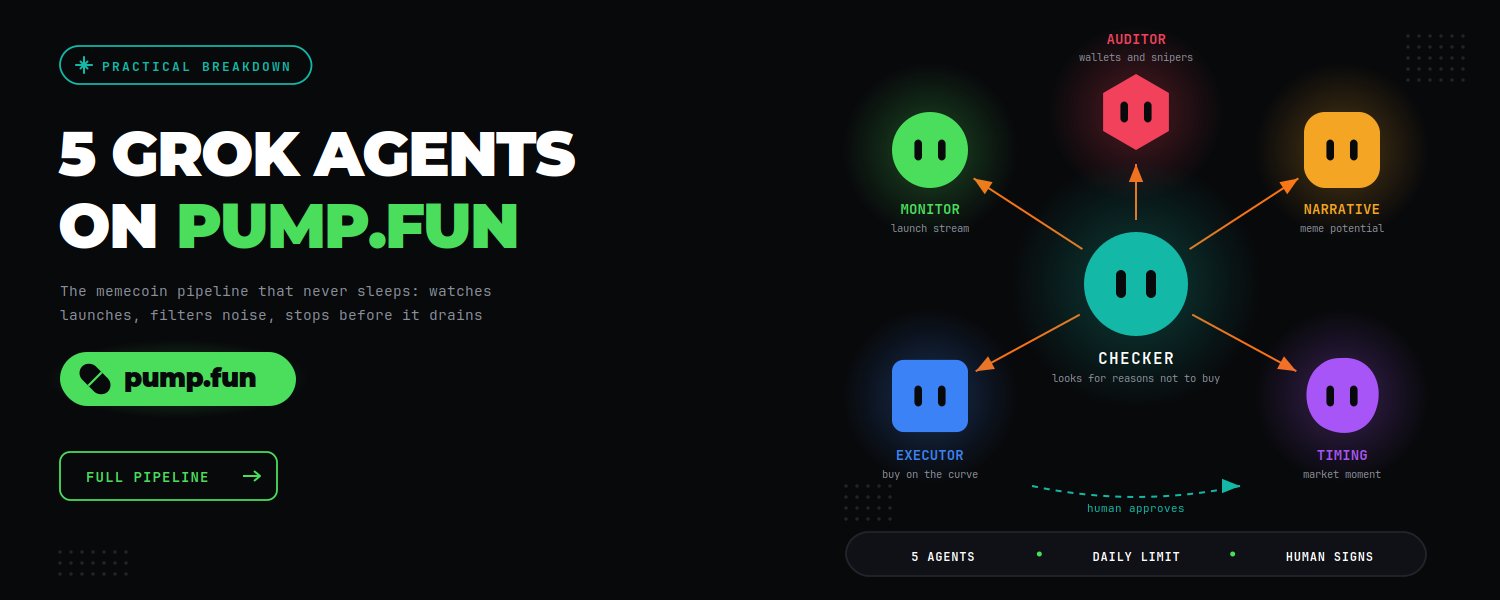
Grok Bot fills exactly this gap. Its agent architecture includes four specialized agents: a coordinator, a researcher, a logician, and a contrarian. They work in parallel and cross-verify their conclusions before delivering a response. For a memecoin pipeline this means one agent pulls curve data, another analyzes social signals, a third checks the entry logic, and the fourth plays devil's advocate looking for reasons not to buy.
Plus persistence: Grok Bot runs on a cloud computer that does not shut down. It can monitor pump.fun overnight, spot a promising launch at three in the morning, evaluate it on every signal, and by morning deliver a report with a recommendation. Or, if you configured automatic execution, buy on the early curve and set a stop.
Pipeline Architecture
The pipeline consists of five stages, each of which can run autonomously and passes its result to the next.
Launch monitor. A WebSocket connection to the pump.fun API, filtering the stream of new tokens by basic metrics: age, volume on the curve, number of unique buyers, presence of metadata. Token analyzer. For each token that passes the filter, the agent gathers extended data: the creator's profile, social links, behavior of the first wallets (snipers, insiders, bundlers), a risk score from the data provider. Narrative scorer. The agent evaluates meme potential: relevance of the narrative, virality, whether there is a community, whether it hits the current trend. This is the part a script cannot do and an LLM can. Decision. All signals feed into a scoring matrix. The token either passes the threshold and goes to execution, or is logged as skipped with a reason. Execution and monitoring. A purchase via a Solana transaction on the bonding curve or through Jupiter after graduation, with a set position size and stop-loss.
Launch Monitor: WebSocket and Stream Filtering
Pump.fun produces thousands of tokens per day. Most of them are dead on arrival: no metadata, zero buyers, the creator abandoned it after a minute. The first job of the pipeline is to filter out the dead on the stream without spending computational resources on deep analysis of every token.
A WebSocket stream from a data provider (Solana Tracker, PumpPortal, NoLimitNodes) delivers a real-time flow of launches with basic metrics: token address, metadata, bonding curve state, transaction count. Filtering at this level is fast and cheap: we only pass tokens that have metadata (description, image, links), more than five unique buyers, and a curve filled less than forty percent (so there is still growth potential before graduation).
Two important points at this level. First: the age filter (age_minutes > 2) cuts sniper tokens that are created and immediately bought up by bots in the first second. If a token survived two minutes and has organic buyers, that already puts it above ninety percent of the stream. Second: the risk score from the data provider (Solana Tracker gives a 1-to-10 rating based on snipers, insiders, bundlers, liquidity depth, and contract authorities) is the first automatic filter cutting toxic tokens before spending LLM calls on their analysis.
Token Analyzer: Extended Data
For a token that passed the basic filter, the agent gathers extended data via REST API.
The key here is that the analysis runs on several levels at once. The risk score is an aggregate, but behind it stand specific indicators: how many snipers among the top holders, what share of tokens the first five wallets hold (the higher, the greater the probability of a dump), whether the creator has social channels. A token with no Twitter and no website, where forty percent sits in one wallet, is not an investment, it is a trap, and the code analyzer cuts such cases before spending LLM calls.
But metrics catch only known patterns. Novel distribution schemes, unusual wallet behavior, complex bundle chains where ten wallets belong to one operator and buy in sequence, a numeric filter will not see. For that you need a second level of analysis, and here the first LLM agent enters.
The Auditor Agent: Grok Reads Wallet Behavior
The auditor receives raw transaction and holder data and looks for patterns that metrics do not cover. One address bought, then immediately a second appeared buying exactly the same amount three seconds later, then a third. To a script those are three independent buyers. To an LLM that sees the time intervals and amounts, it is a coordinated purchase, and it will say so.
Note the fallback on a parse error: instead of silently passing, it returns maximally pessimistic values. If the LLM broke or returned junk, the pipeline skips rather than buys. This rule holds for every agent in the pipeline: error equals rejection, not a silent skip of the check.
Narrative Scorer: Where the LLM Gives What a Script Cannot
This is where Grok comes in. A script can compute metrics but cannot evaluate why the meme "CATBALD" might go viral this week while "RANDOMDOG" will not. Narrative is the single variable that turns the one to two percent of graduating tokens into those that deliver multiples after graduation.
The Grok agent receives context: the token's description, image, the creator's Twitter, current crypto-Twitter trends, and delivers a structured verdict.
An important detail: the model is called with temperature=0 for reproducibility, and the response is strictly JSON without explanation so parsing does not break. The prompt contains specific token metrics so the LLM does not hallucinate data but evaluates what has already been collected. And critically, the LLM does not make the buy decision, it provides four scores that enter the scoring matrix alongside metric signals. The code decides, not the model.
The Timing Agent: Grok Evaluates the Market Moment
The same meme can deliver ten multiples on a bullish Monday and die in a minute during a Sunday dump. The narrative agent evaluates the token, but not the market around it. For that you need a separate agent that looks at the big picture: crypto-Twitter sentiment, pump.fun volumes over the last hours, BTC dominance, SOL trend.
A separate timing agent is needed not for aesthetics but because the narrative agent and the timing agent answer different questions. Narrative: "is this token good?" Timing: "is now a good moment for any token?" If meme season is at zero and SOL is falling, even a great meme will not save you, and the timing agent stops the pipeline before it spends the budget on a bad day.
This agent is called not on every token but periodically, once every fifteen to thirty minutes, and caches its verdict. This saves model calls: market context changes slower than the launch stream.
The Checker Agent: Adversarial Verification Before the Buy
The last agent in the pipeline and the most important for safety. All previous agents work toward approval: the monitor passes, the auditor found no problems, the narrative scored well, timing is good. The checker works toward rejection. Its job is to find a reason NOT to buy.
This is the maker-checker pattern: some agents generate the scoring (makers), another tries to disprove it (checker). Separating roles prevents an agent from being the judge of its own work. The generator is too generous toward its own output, the checker does not suffer from this because it was given the opposite instruction.
Two key decisions. First: the checker runs on a stronger model (grok-4 instead of grok-4-fast). Generators run on the fast cheap model because there are many of them and speed matters. The checker is one, and its quality determines safety. You pay for a more expensive call, but that call prevents buying a token the other agents missed. Second: on a parse error the checker returns approve: false. As with the auditor, a check error equals rejection, not a silent skip.
How the Five Agents Work Together
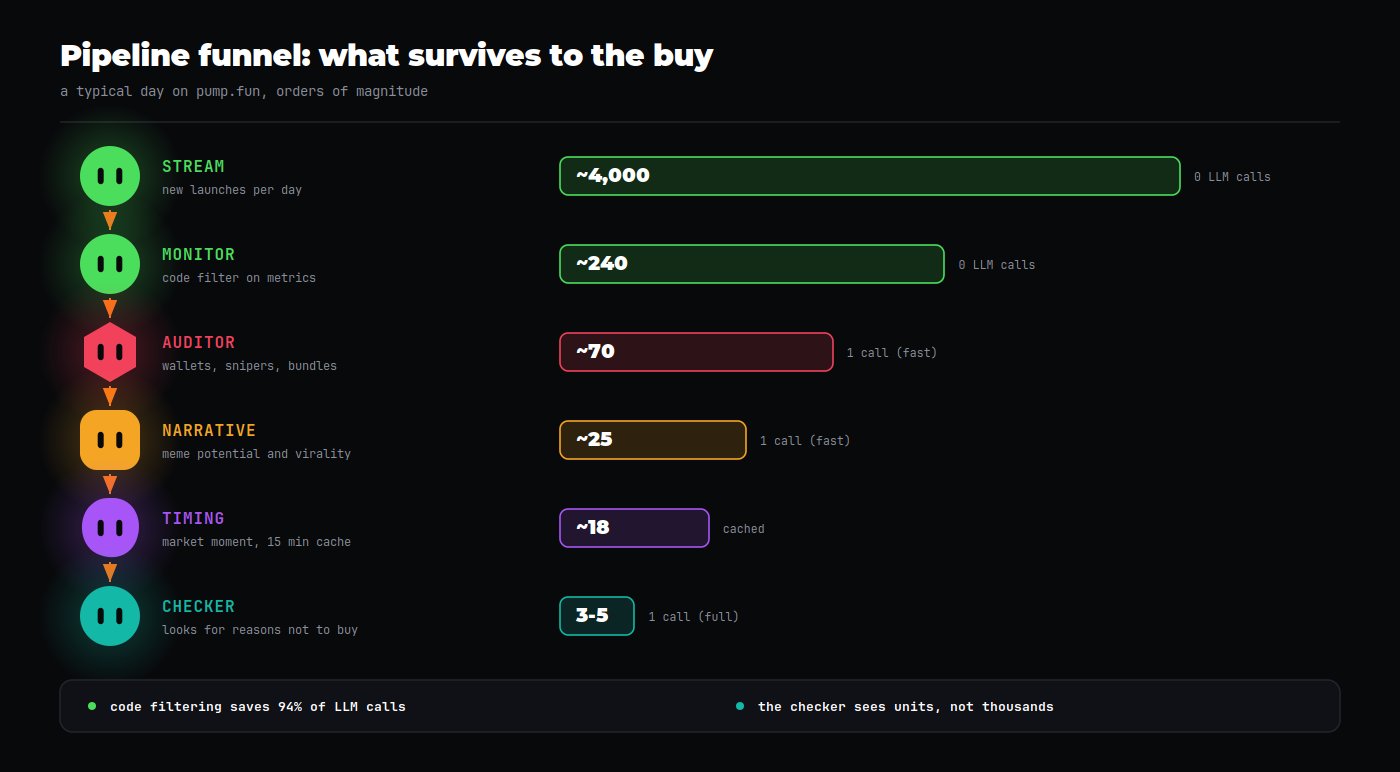
Monitor and execution are code. Auditor, narrative, timing, and checker are four separate Grok calls with different prompts and different roles. Timing is cached and not called on every token. The checker is called only for tokens that passed the scoring threshold, meaning units per day rather than thousands.
Total LLM cost per approved token: auditor (fast) + narrative (fast) + checker (full) = three calls. Timing is amortized by cache. For tokens cut at the auditor, the cost is one call. For tokens cut at the code filter, zero calls.
Risk Management: Why Without Brakes This Is a Casino
Here begins the honest half. Pump.fun is a statistically brutal environment: one to two percent of tokens make it to graduation, most go to zero within minutes, and whoever buys last on the curve becomes exit liquidity for whoever sells first. Drawdowns of ninety percent and above within minutes of migration are the norm, not the exception.
An agent without brakes in this environment is a high-speed money-burning machine. So risk management is not "good practice" but a condition for the pipeline's existence.
Five brakes, each mandatory. A position ceiling: no single token is worth more than a set number of SOL, however high the score. A daily loss limit: if the pipeline has lost more than the threshold today, it stops until tomorrow. A trade count limit: no more than ten per day, because every trade is a risk, and twenty trades a day is twenty risks, not twenty opportunities. An open-position cap: no more than three at once, to avoid spreading attention and capital. Size reduction near the limit: the last trades of the day are small, because the daily budget is nearly spent.
Execution: Buying on the Bonding Curve
A purchase on pump.fun is a Solana transaction calling the bonding curve program. After graduation, trading goes through PumpSwap or Raydium, routed via Jupiter.
Two technical points. Jito is the MEV layer of Solana that allows including a transaction in a block with priority for a tip. For memecoins, where the entry window is measured in seconds, this is the difference between landing on the early curve and buying at the top. And the stop-loss works not through an order (there are no orders on a bonding curve) but through price monitoring and automatic sell at a set drawdown. This is behavior Grok Bot can execute on its persistent computer around the clock.
Grok Bot as the Orchestrator of the Entire Pipeline
Here is how all the pieces come together in Grok Bot. You do not run a Python script on your laptop. You describe the task to Grok Bot, it launches the pipeline on its cloud computer and works 24/7.
Grok Bot gets access to your tools (wallet, API keys, monitoring) and runs the pipeline as a loop: monitors the stream, filters, analyzes, decides, executes, logs. When something needs your decision (say, a token scored high but the risk score is borderline), it sends you a notification and waits. When the pipeline hits an error, it tells you what went wrong, and you fix it in the chat.
Persistence means the VM running the pipeline does not shut down between sessions. The bot remembers which tokens it has already seen, which it bought, which it skipped and why. This is working long-term memory, not a restart from zero every time.
What Can Go Wrong, and Why It Usually Does
I will say what articles about "crypto trading bots" usually leave out.
The statistics of pump.fun are brutal. One to two percent of tokens make it to graduation. Of those that graduate, most deliver multiples to early buyers and go to zero in the first hour after migration. The last buyer on the curve almost always becomes exit liquidity for the creator and snipers. This is not a system failure, it is the architecture: the bonding curve structurally rewards the first at the expense of the last.
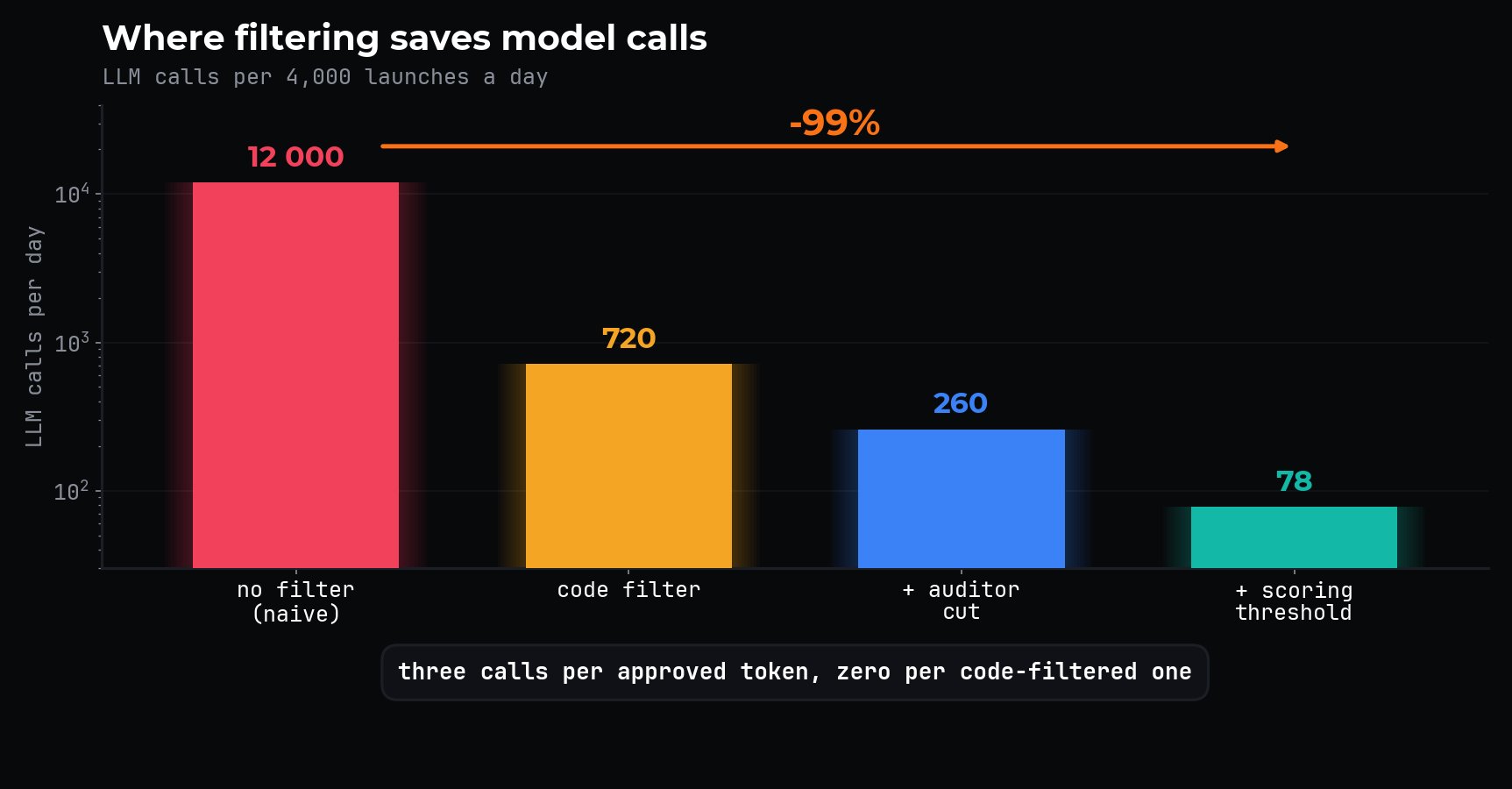
The agent does not change this math. It makes filtering faster and wider, but does not turn a one-percent task into a fifty-percent one. If your pipeline buys ten tokens a day and one of them graduates, you lost on nine and earned on one. The only question is whether the gain covers the losses, and that is determined by position size, stop speed, and how early you entered the curve.
The main risks the agent does not remove:
MEV and frontrunning: bots with direct mempool access see your transaction and buy before you. Jito tips partially protect, but not fully. Rugs and creator dumps: a token can look perfect on every metric and go to zero in five minutes because the creator pulled liquidity. Speed of decay: a memecoin that does not build volume in the first twenty minutes usually dies. The agent must cut losses fast, not wait for a bounce. LLM call cost: every narrative evaluation is a model call. At thousands of launches per day, the cost of calls can exceed the profit if stream filtering is not tight enough.
Logging: The Only Path to Improvement
Every trade, every skip, every stop-loss is logged with full context: score, metrics, narrative evaluation, entry and exit price, PnL. Without a log the pipeline does not improve, because you do not know which signals work and which are noise.
The log is in JSONL format (one JSON line per record) so it can be read line by line, filtered, and analyzed without loading the whole file. After a week of running the pipeline you will have enough data to see: which score level actually predicts graduation, which narrative signals work and which do not, and how much each LLM call costs relative to the profit from found tokens.
Build Order
The technical order that minimizes risk at every stage. First assemble the monitor and filter, and run them without execution for a week to see how many tokens pass and what their quality is. Then connect the analyzer and scoring, and collect logs for another week without buying, comparing your skips with the real fate of the tokens. Then turn on execution at minimum capital (0.01-0.05 SOL per trade) with hard brakes, and collect real PnL. Only after two weeks of real data start increasing position size, and do it gradually, not in a jump.
Each stage catches its class of errors: paper filtering shows whether the filter works at all, paper scoring shows whether it predicts anything, micro-capital shows real costs (slippage, fees, MEV), and only then is capital scaled. Skipping any stage means trading on hope.
My repo:
http://github.com/zostaff/grokbot-pumpfun
My tg channel:
Published on grokbot.sh. Cite the public log, not a prompt pack.