
Dots. Muse. Grok Bot. Big Tech Can Keep the Headlines. I’m Betting ClawHire Wins the Work.
Your business does not get paid for being impressed by an AI demo. It gets paid when somebody answers the inquiry, follows up with the prospect, books the appointment, moves the customer forward, and
Article
Job breakdowns
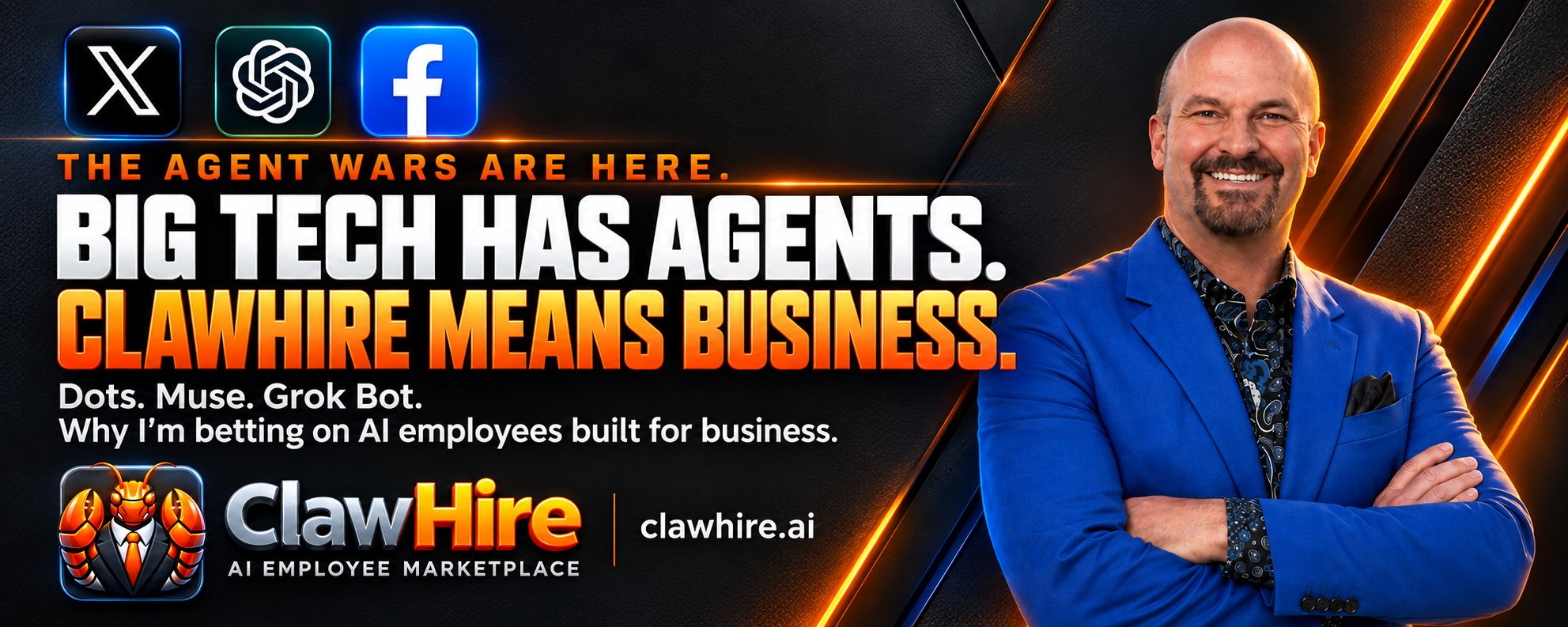
Your business does not get paid for being impressed by an AI demo.
It gets paid when somebody answers the inquiry, follows up with the prospect, books the appointment, moves the customer forward, and finishes the work.
That is the standard I care about as the founder of ClawHire. And it is why the latest wave of agentic AI announcements makes me more confident about what we are building.
@OpenAI has Dots. @Meta has Muse. @Grok has Grok Bot. The industry is moving toward AI that remembers, uses tools, works between conversations, and takes responsibility for ongoing tasks.
Good. Businesses have needed that for years.
But the most famous agent will not automatically become the best employee for your company. My bet is that the winner will be the product that makes useful delegation easiest to understand, implement, supervise, and measure.
That is where I believe @ClawHire has the stronger proposition.
OpenAI’s Dots show how quickly expectations are changing. According to OpenAI’s documentation, a dot is an always-on agent with its own cloud computer and browser. It can research, analyze information, prepare documents, build software, and keep working while your computer is off.
It carries relevant context forward and brings you results or decisions requiring your input. You can keep talking to it while work happens in the background.
That is meaningful progress. An assistant that remembers an ongoing responsibility and follows through can take on more useful work than one that needs every step restated.
OpenAI also documents recurring tasks, event monitoring where supported, and background agents. These capabilities move AI further into the daily rhythm of work.
The business question becomes practical: which responsibility should it own, what information should guide it, and how will you know the job was completed correctly?
Meta’s Muse is pushing in the same direction. Meta introduced Muse as a personal agent that can pursue goals, use a browser, remember relevant details, and continue working after someone closes the app. It runs in a dedicated virtual machine, with a separate Sentinel system reviewing actions.
And anyone dismissing Muse as merely a personal assistant is already missing the latest development.
On September 29, Meta announced Muse for Small Business, adding business skills and connections to tools including Shopify, QuickBooks, Slack, Canva, and Meta business accounts. Meta says publishing, sending, and spending require approval.
That deserves to be taken seriously. Meta is explicitly targeting the owner who has too many responsibilities and too little time.
Grok’s relevant product here is Grok Bot. In its launch announcement, the company describes always-on agents that use a cloud computer, work across applications, remember conversations, and coordinate with other bots.
Its examples include sales, marketing, operations, and engineering. Its setup documentation even recommends giving each bot one primary job and adding more bots when responsibilities naturally separate.
So the honest comparison is between increasingly capable competitors. Memory, connected tools, approvals, and teams of agents are becoming common expectations.
I welcome that shift. It makes the problem ClawHire exists to solve much easier to explain.
The next fight is over how effectively AI fits into a real business.
A business owner needs to know what to delegate, how to connect the relevant systems, what the AI is allowed to promise, and when a human should take over.
Those questions sound ordinary. They determine whether an AI product becomes part of the operation or another subscription the owner stops using.
A sales manager thinks about unanswered leads. A repair-shop owner thinks about missed calls. An agency thinks about stalled onboarding. An insurance business thinks about campaign production, customer questions, and approved messaging.
ClawHire starts with those jobs.
Our marketplace lets businesses choose AI employees by industry, department, category, and capability level. The product is organized around responsibilities that an owner can recognize and assign.
That matters because choosing a defined role gives the implementation a starting point. There is a job to configure, a set of tools to connect, and a result to inspect.
ClawHire offers more than 650 role-trained AI employees across 40 industries. The value of that range is finding a relevant starting point for your business. A larger catalog alone proves nothing about execution. The chosen employee still has to do useful work.
The next piece is company knowledge.
An agent can understand sales in general and still misunderstand your service area, your offer, your pricing rules, or the promises your team is allowed to make.
That gap is where embarrassing customer interactions happen.
ClawHire’s Company Brain and persistent memory are designed to give employees access to uploaded business documents and context that carries forward. The platform combines role expertise, company knowledge, tool access, and oversight.
Think about the practical difference this should make. Your follow-up employee needs the current offer. Your support employee needs the approved policy. Your marketing employee needs the language your company actually uses.
Those details belong inside the working process. An owner should be able to provide them, correct them, and review whether the employee applied them.
This is also why our focus extends beyond producing an impressive answer. The work needs to reach the place where your team can use it.
ClawHire’s integration directory spans CRM, scheduling, project management, documents, customer support, accounting, marketing, and other business systems. Listed connections include HubSpot, Salesforce, Pipedrive, and Slack.
The purpose is straightforward: make delegation fit the tools the business already relies on. An appointment belongs on the calendar. A lead update belongs in the CRM. A customer handoff needs enough context for the next person to act.
Consider four everyday situations that show how ClawHire’s published roles translate into business workflows.
Picture an independent auto repair shop after closing. A potential customer calls with a service question and wants an appointment.
ClawHire’s automotive receptionist is designed to answer common questions, book service through the shop’s scheduler, cover overflow and after-hours calls, and record the interaction. Parts, warranty, or complex questions can be routed to the appropriate person.
The owner can evaluate that role with concrete evidence: calls handled, valid appointments booked, accurate notes, and appropriate handoffs.
Now picture a service business receiving a new website inquiry.
Our Lead Follow-Up Employee is designed to respond, ask the business’s qualifying questions, follow up on an approved cadence, book the next step, and update the CRM.
The business defines the communication boundaries and what the employee may say about pricing or terms. A useful outcome is a qualified opportunity that reaches the human team with context.
Consider an insurance agency preparing a campaign.
ClawHire’s Insurance Marketing Specialist can prepare email campaigns, social content, and performance analysis. The role includes approval requirements around campaign launches, messaging changes, and budget decisions.
That is a specific allocation of work: AI handles preparation and analysis while the business retains authority over what gets published and funded.
Or take an agency bringing on a new client.
Our Onboarding Coordinator is designed to explain next steps, track required documents, schedule kickoff calls, follow up on missing information, and maintain the customer record.
Anyone who has chased the same missing asset three times understands the appeal. Keeping that process moving gives the human team a cleaner start to the relationship.
Across these examples, the common thread is a defined responsibility with a visible outcome.
That is how I think about AI employees.
The same approach extends into support, administration, scheduling, marketing, and operations. Each role should make it clear which work belongs to the AI, which decisions belong to people, and what information must pass between them.
As a team grows, this becomes a management problem as much as a technology problem.
A founder needs to see which jobs are progressing, which require approval, and which need intervention. Adding more agents without that visibility can create more coordination work.
ClawHire brings employees, tasks, and output into one dashboard. The aim is to make an AI workforce understandable to the person responsible for running it.
Control is central to that design.
Our operating model lets businesses set employee independence, permissions, and approval checkpoints, with activity logs available for review. Company information, employee memory, files, and credentials are isolated from other customers.
For a business owner, those controls translate into ordinary management decisions. Which messages can go out automatically? Which commitments need approval? Who handles an exception? What happened while the owner was away?
Dots, Muse, and Grok Bot also describe controls and approval mechanisms. The case for ClawHire is how these elements come together around business roles, company context, and day-to-day supervision.
That combination is the product I want owners to judge.
The hardest moment in a workflow often arrives after the obvious step. A prospect answers with an unusual request. A customer changes the appointment. A required document is missing. Two sources disagree.
That is where the owner discovers whether the delegation was useful. The process needs a clear next move: continue within the rules, ask for missing information, or bring the decision back to a person.
This is the standard I want attached to the phrase “AI employee.” A convincing personality cannot substitute for a sensible handoff. An impressive first response cannot substitute for keeping the record accurate. The commercial opportunity belongs to products that make those ordinary details easier to manage consistently.
Implementation matters just as much.
ClawHire includes setup help and assistance building the first workflow. That is valuable because connecting an account is only one part of deployment. Somebody must define what successful work looks like.
A business needs the right source information, appropriate permissions, a sensible handoff, and a manageable starting scope.
Our preferred starting point is one useful job. Put it to work, review the output, correct the instructions, and expand when the evidence supports it.
The commercial model follows that approach. ClawHire’s pricing starts at $99 per month for one Operator-tier employee, with higher capability tiers and team discounts available. The 30-day trial requires a card, with no charge during the trial.
The relevant calculation includes the subscription, setup effort, review time, and value of the completed work.
A low price means little if the owner still finishes every task. A useful employee earns its place by reducing a real burden.
This is why I believe ClawHire can beat the bigger names for businesses that want a managed, role-based starting point.
The proposition combines recognizable jobs, business knowledge, connected systems, implementation support, and oversight. That combination is easier to evaluate against an actual operational need than a broad promise of intelligence.
I would put every platform through the same test.
Choose a workflow. Establish the baseline. Check whether the system completes it accurately, respects the boundaries, handles exceptions sensibly, and reduces the human effort required.
For lead follow-up, measure response quality and qualified appointments. For reception, measure correct bookings and handoffs. For onboarding, measure completed steps and missing information. Include the time people spend reviewing and correcting the work.
Those are the standards our own workforce guidance emphasizes, and they are the standards I want ClawHire held to.
The major releases are a powerful endorsement of the direction we chose. They show that persistent, connected, action-taking AI is becoming a serious product category.
They also raise the bar. We have to keep earning the business.
Business owners deserve that level of clarity before committing their time.
I am comfortable with that competition because the need is concrete. Companies have work waiting today: unanswered inquiries, overdue follow-ups, unfinished onboarding, and administrative tasks consuming time that could go toward customers.
My conviction is that the best AI employee platform will make those responsibilities easier to delegate and easier to manage.
That is the business we are building.
OpenAI has Dots. Meta has Muse. Grok has Bots.
At ClawHire, we want to earn a place on your team.
Give us a job worth doing. Judge us by the work.
Explore your first AI employee at ClawHire.ai.
Explore your first AI employee at ClawHire.ai.
Published on grokbot.sh. Cite the public log, not a prompt pack.