
How I Actually Use AI Agents (Grok Bot) Day to Day, at Work and on the Side
As an AI consultant, people often ask me which AI tools I actually use myself, not just the ones I recommend to clients. Fair question, because if I am telling banks and lenders in SEA to adopt
Article
Job breakdowns
As an AI consultant, people often ask me which AI tools I actually use myself, not just the ones I recommend to clients. Fair question, because if I am telling banks and lenders in SEA to adopt agentic AI, I should be running it in my own day first.
So today I want to share how I use Grok Bot right now, both in my day job and in my side projects. None of this is a demo. It is the setup I run every day, mostly from my phone.
One rule before anything else
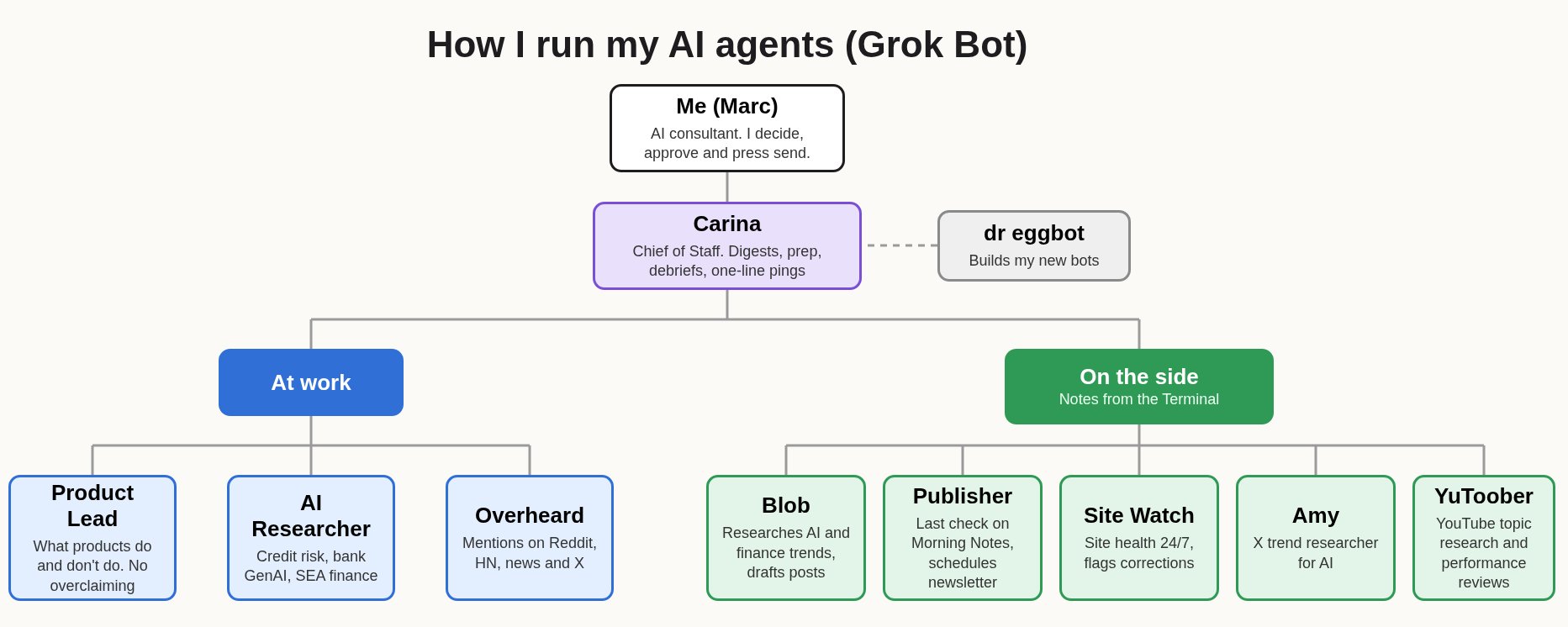
Before I go into the bots, there is one rule that shapes everything: the AI drafts, checks and flags, and I decide. None of my bots sends an email or a message on my behalf, so they prepare it and I press send. Nothing gets published without my yes. I also keep a hard split between my work bots and my side-project bots, so work never leaks into side projects and vice versa. The only place they meet is my Chief of Staff, who sees the pings from both sides, but each bot only works in its own lane.
This is the same governance point I make to clients. Human in the loop only works when you design it into the workflow from day one, instead of adding it as a slogan at the end.
Carina: a Chief of Staff for my whole life
My main bot is Carina, which I treat as my Chief of Staff, and really she is the Chief of Staff of my life. She manages both my work bots and my side-project bots, so basically she keeps track of everything on my plate while I focus on clients.
-
Morning digest: every weekday at 08:00 she sends me what is on my calendar, what is due, what is slipping and what I need to prep. Just this morning it flagged a time mismatch on a meeting invite. I already knew that meeting was cancelled, but that is exactly the kind of thing that slips through on a busy week.
-
Weekly prep: on Thursday afternoon she sends a digest so my Friday team update is ready on time.
-
Meeting prep: talking points in the order we agreed internally, decks checked against our source sheet, and dates kept consistent across slides.
-
Debriefs: after a meeting I send her my rough notes. She logs them to a Notion board with a status and an owner, and remembers them for the next prep.
-
Bot inbox: every other bot, at work and on the side, pings her, and she turns each ping into one line for my phone: who it is from, what they need, the deadline, where, and the one next step.
At work: the specialists
-
Product Lead: knows what each product actually does and does not do, and writes deck and product copy so we never overclaim in a pitch. As we know, overpromising to a bank is the fastest way to lose its trust.
-
AI Researcher: my research counterpart on credit risk, GenAI in banking, SEA finance, and the papers and models behind them.
-
Overheard: watches Reddit, Hacker News, the news and X for third-party mentions of my company, and sends me short alerts.
On the side: a small AI newsroom
Outside of work I run Notes from the Terminal (https://notesfromtheterminal.com/?ref=x), a curated news site on AI in banking and finance for bankers and finance people. My own writing lives on Substack (https://stanleymarcelino.substack.com) and here in X Articles. This is where the bots really became a team.
-
Blob researches AI and finance trends and drafts posts for me.
-
Publisher does the last check on each Morning Note before readers see it, and schedules the email newsletter.
-
Site Watch checks the site around the clock and files corrections or missed items. It never edits the site itself.
-
Amy is my X trend researcher. She tracks which AI and finance topics are trending on X and matches them to what we have covered, so I know which conversations are live and worth joining.
-
YuToober researches topics for my YouTube videos and sends me a performance review of how each one is doing, so I know what to make next.
Carina only sees the exceptions from this side too. For example, today the newsletter send failed twice and needed my approval, and it reached me through her as one line instead of a pile of logs.
And yes, I have a bot that builds bots. dr eggbot (by Poteto) asks me a few questions about the job, then creates the new bot.
What I have learned so far
-
Start with the boring work. Calendar, prep, checks and follow-ups. This is the same bottom-up approach I use with clients: find what is actually bothering people (in this case me), then apply AI there.
-
One bot, one job. When a bot has a clear role, it is easier to trust it and easier to fix it.
-
Keep the human on the button. Drafting is cheap, while sending, publishing and approving stay with me.
-
Let the exceptions come to you. I do not want to read everything my bots do. I want one line when something needs me.
Closing
So that is my current setup. It is not perfect and I keep adjusting it every week. However, it has changed how I work, both as a consultant and as someone building a side project after hours.
If you are an AI champion or consultant, my advice is simple: use AI on your own work first. You will understand your clients' fears, and their wins, much better once you have lived with it yourself.
So which part of your own week would you hand to a bot first?
Thanks for reading, I hope this was useful for you, Marc 🤖.
Follow me @0xNotMarc for daily updates on AI tools, agents, and what's actually worth your attention.
Published on grokbot.sh. Cite the public log, not a prompt pack.