
Don't lock yourself into one AI model
Being model agnostic is one of the most important habits in AI engineering right now. The best model for a given job changes every few weeks, and if your workflow is locked into one model or one
Article
Job breakdowns
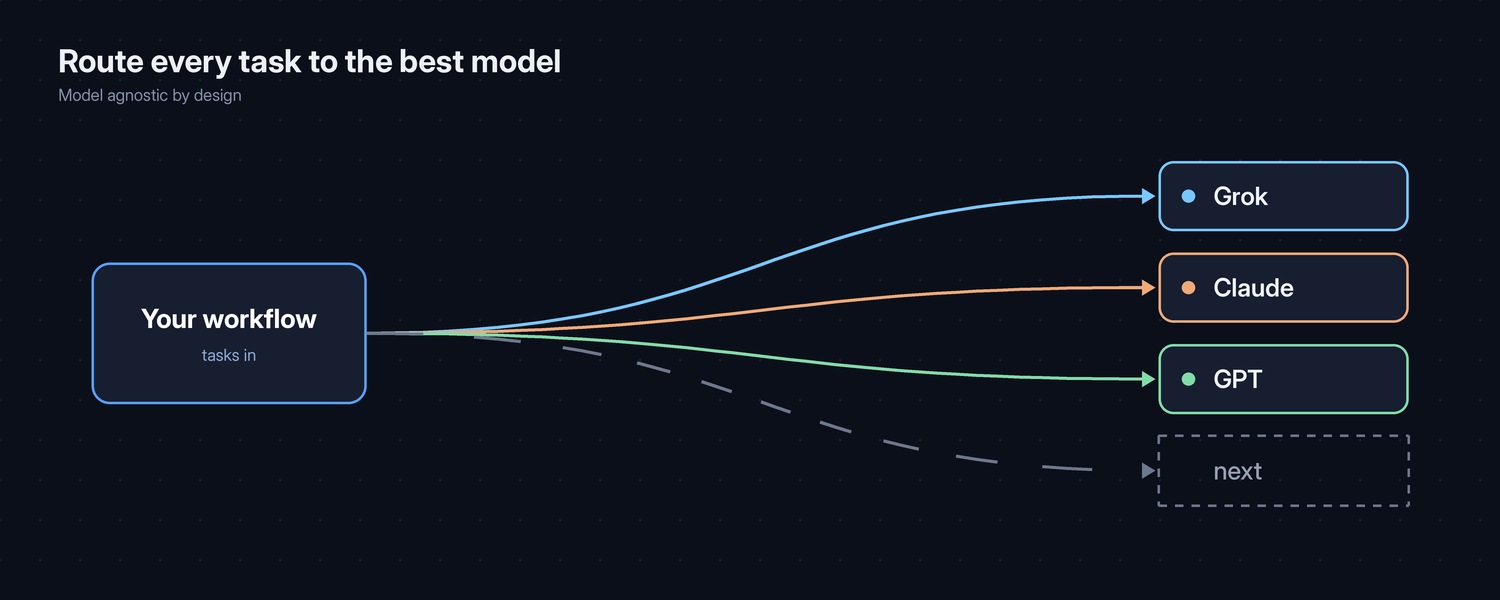
Being model agnostic is one of the most important habits in AI engineering right now. The best model for a given job changes every few weeks, and if your workflow is locked into one model or one provider, you fall behind every time someone else ships something better.
Look at the last few weeks. @OpenAI released GPT-6 Astra on September 3. @SpaceXAI released Grok 4.7 on September 21. @AnthropicAI released Claude Opus 5.5 the next day. That's three frontier releases in under three weeks, and each one is strongest at something different.
Different models lead at different things
Claude Opus 5.5 is an incredible model. It's built for long-running agentic coding and knowledge work, and it shows.
GPT-6 Astra is doing things in Physical AI that I find amazing. A team at Stanford connected it to a Unitree G1 humanoid in a kitchen the robot had never seen. The robot explored the room, Astra built a digital twin of it in Isaac Sim from the robot's own sensor data, and then the robot tidied the kitchen and retrieved a remembered object from a vague request. No environment-specific training data. Physical AI is the part of this field I care about most, so I'm watching that closely.
Grok 4.7 is an incredible workhorse. It's the default model in the Grok Build CLI that writes most of my code, and it stays on long, hard tasks and checks its own work. @elonmusk has said Grok 4.8 will be a noticeable improvement, and I'm excited to see it push the limits of intelligence again.
I respect the teams building models at OpenAI, Anthropic, Microsoft, and SpaceXAI, and I'm most excited about Grok. No single provider leads at everything, all the time.
@bot made the case for me
Last week, Elon posted this:
"Important note regarding Grok @Bot: Going forward, @SpaceX will use the best back end model for any given task, including Claude Opus 5.5, MidJourney, Suno and other leading APIs. Whatever is most likely to give you the best outcome."
SpaceXAI makes Grok, and Elon still chose to send Grok Bot work to whichever model does it best, including models from other companies. He followed up that most simple requests will run on a lightning-fast version of Grok 4.8 once it's out, because the goal is the best mix of speed and intelligence. I love that call. Customers get the best result for each task, and every model, Grok included, has to earn the work.
Every team building with AI should run the same way.
Lock-in is the real risk
When a model ships that's clearly better for part of your work, a locked-in team has two bad options. Wait for its provider to catch up, or spend weeks rewriting prompts, tools, and pipelines to switch. The team that can switch in a day gets the gain first. At this pace that happens every few weeks, and the gap compounds.
How I build for it
-
Make the model a setting. Keep the model choice in config, out of your workflow logic. Write prompts, rules, and tools for the task, not around one model's quirks.
-
Route each task to the model that's best at it. In my setup, the Grok Build CLI on Grok writes most of the code, and Cursor cloud agents run non-Grok models strategically, where they're strongest. When a bot picks something other than the default, it writes down why.
-
Keep evals on your own work. A small set of real tasks with pass/fail checks tells you quickly whether a new model is better for you. Without that, switching is a guess.
-
Re-evaluate every time a model ships. Before each batch of work, my setup picks up the newest model and smoke-tests it. Nothing stays pinned to last month's version.
-
Keep your context portable. Rules, memory, and history should live in your own systems in plain formats, so any model can pick them up tomorrow.
Being model agnostic doesn't make you neutral. I'm a big Grok fan, and Grok does most of my work. It means the best model for the task gets the task, and you keep adapting, refactoring, and updating your workflows as the field moves. Elon set that example with @bot. The rest of us should build the same way.
Views my own.
Published on grokbot.sh. Cite the public log, not a prompt pack.